Last updated: 15 November 2026
A security incident report is a written, factual record of an unplanned event — a break-in, assault, near-miss or data exposure — logged with who, what, when, where and how, created as close to the event as possible. Pulse Operations notes that in the UK, some incidents carry legal deadlines: GDPR breach notification is due within 72 hours, and fatal workplace incidents must reach the HSE without delay.
Key Takeaways
- Pulse Operations advises that a security incident report must separate verified facts from assumptions, recording only what was observed, measured or stated by a named witness.
- Under GDPR Article 33, organisations must notify the supervisory authority of a personal data breach without undue delay and, where feasible, within 72 hours of becoming aware of it, according to GDPR Article 33 (gdpr-text.com) (2026).
- A worker's death from a work-related incident requires HSE notification without delay by phone, with the full F2508 form following within 10 days, per the HSE Blog (2026).
- Workplace injuries that keep an employee off normal duties for more than 7 consecutive days must be reported under RIDDOR within 15 days of the accident, according to HSE (2026).
- Verizon found the human element plays a role in roughly 60% of cybersecurity breaches, as cited by Legal Templates (2026) — a reminder that most security reports describe human error, not sophisticated attacks.
What is a security incident report?
A security incident report is a structured written account of a security-relevant event — created by whoever witnessed or responded to it, filed through a defined chain, and retained as evidence for the organisation, its insurer, its client, or a regulator. It differs from casual notes because it follows a fixed format every time, which is what makes a run of them comparable and auditable.
The format typically covers eight fixed fields: reference number, date and time of the incident, location, people involved (named, with roles), a factual narrative, actions taken, evidence (photos, CCTV references, witness statements), and sign-off by the author and a supervisor. Most UK security providers use a standard template so that a report from one site reads the same as a report from another, regardless of which officer wrote it.
This differs from a daily occurrence book, which is a continuous log of everything that happens on a shift — patrols, deliveries, visitor movements, minor observations — rather than a single discrete event. A security incident report is usually one entry pulled out of that bigger log and escalated because it needs its own record, its own sign-off and, sometimes, its own regulatory clock.
Pulse Operations builds both into one system rather than treating them as separate paperwork: an incident raised on shift sits inside the same tamper-evident daily occurrence book that covers all 18 occurrence types, so the escalation and the underlying shift record never disagree with each other.
What details must the report include — who, what, when, where, how
Every security incident report must capture five fixed elements: who was involved, what happened, when it occurred, where it took place, and how it unfolded — recorded in that order so nothing is missed under pressure. Missing any one of the five weakens the report's value to insurers, clients and regulators.
- Who: full names and roles of everyone involved — officer, witnesses, any third party — never "a member of staff" or "the individual".
- What: a plain-English description of the event itself, distinct from your opinion of it.
- When: the exact time the incident started, was noticed, and was resolved, to the minute where possible.
- Where: the specific location — building name, floor, checkpoint reference, not just "on site".
- How: the sequence of events and the response taken, described as a timeline rather than a summary.
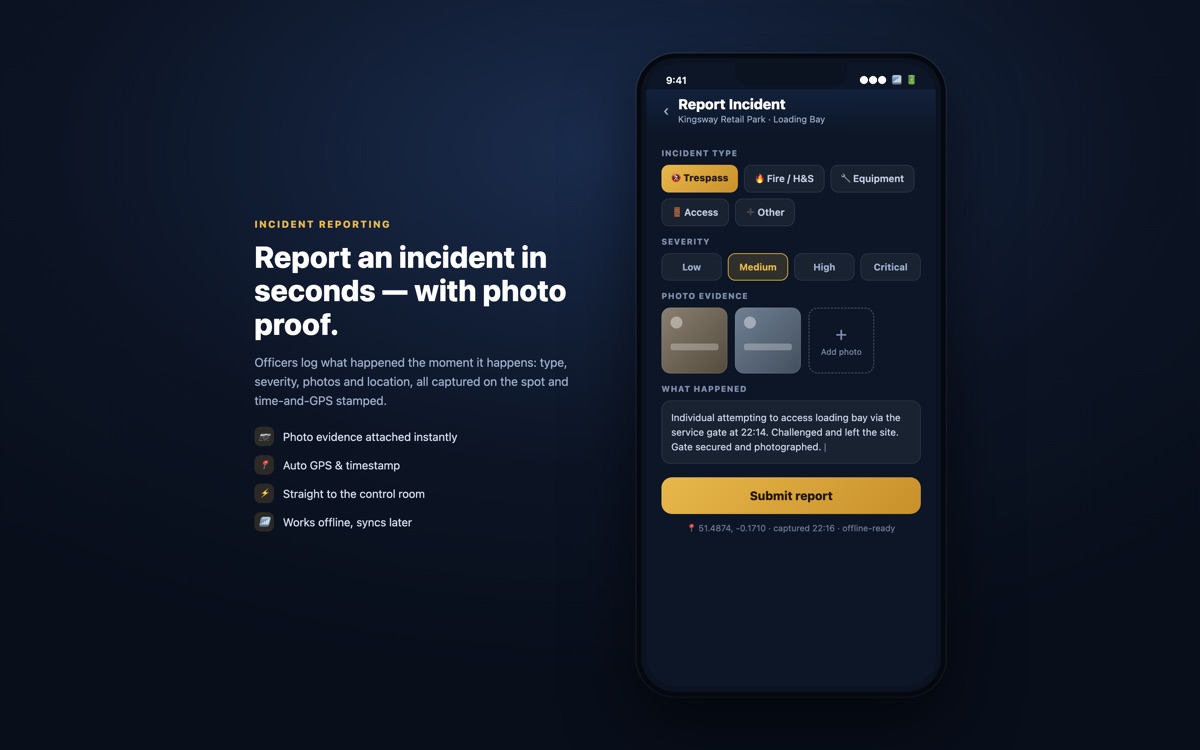
A sixth element matters just as much in practice: evidence. A watermarked photograph — stamped with officer, site, GPS coordinates and timestamp — turns a disputed claim into a settled fact, because it shows the state of the area at that exact moment rather than relying on memory reconstructed at the end of a shift. Pulse Operations's guide to proving patrols actually happened sets out why a photo carries more weight than a signature or a tag scan: a scan only proves a phone was near a reader, not that anyone checked anything.
Who is responsible for writing and submitting the report
The officer who witnessed or first responded to the incident is responsible for writing the initial security incident report, with a supervisor or control room reviewing and countersigning it before it's filed. On most UK sites this means the frontline SIA-licensed officer drafts the account, and a duty manager or control room operator checks it for completeness before it reaches the client or, where required, a regulator.
Larger sites with a control room — covering live monitoring, welfare check calls and lone-worker SOS alerts — often have the control room log the initial alert in real time, with the attending officer filing the full narrative afterwards. This two-stage model catches gaps while the incident is still fresh, rather than at a weekly review when details have faded.
Responsibility doesn't end with the officer. Under health and safety law, employers carry statutory obligations regardless of who physically wrote the report. Shoosmiths notes that RIDDOR reporting duties sit with the "responsible person" — typically the employer or site controller — even when a contracted security officer is the one who witnessed the event.
"Speed beats polish. A report filed in ninety seconds while the detail is fresh is worth more than a beautifully written account reconstructed at handover. Get the photo, the time and the plain-English account down first — the analysis can come later." — Mo Hassan, Founder, Pulse
UK legal and regulatory deadlines for reporting security incidents
UK organisations face two distinct reporting clocks depending on the type of incident: a data breach triggers GDPR notification duties, and a workplace injury or death triggers RIDDOR duties under health and safety law. Confusing the two — or missing either deadline — is one of the most consequential mistakes a business can make.
| Incident type | Legal basis | Deadline | Who you notify |
|---|---|---|---|
| Personal data breach | GDPR Article 33 | Without undue delay, within 72 hours where feasible | The ICO (supervisory authority) |
| Death from work-related incident | RIDDOR (Reporting of Injuries, Diseases and Dangerous Occurrences Regulations) | Immediate phone call, F2508 form within 10 days | HSE |
| Injury causing 7+ days off work | RIDDOR | Within 15 days of the accident | HSE |
| Medical records breach (US HIPAA comparator) | HIPAA Breach Notification Rule | 60 days from discovery (500+ records) or year-end (under 500) | US HHS — not applicable in the UK but relevant for multinational groups |
Under GDPR Article 33, organisations must notify the supervisory authority — the Information Commissioner's Office in the UK — of a personal data breach without undue delay and, where feasible, not later than 72 hours after becoming aware of it, according to GDPR Article 33 (gdpr-text.com) (2026). This applies under both the UK GDPR and the Data Protection Act 2018, which together govern how personal data is handled and reported in Britain.
The HSE Blog (2026) confirms that if a worker dies from a work-related incident, HSE must be notified without delay by phone, with the full F2508 report submitted within 10 days. Separately, work-related accidents that keep an employee off normal duties for more than 7 consecutive days must be reported under RIDDOR within 15 days of the accident, according to HSE (2026).
UK businesses with US operations or US clients sometimes encounter HIPAA breach rules too. eForms, citing the US Department of Health and Human Services (2026), notes that covered entities reporting fewer than 500 affected medical records must report within 60 days of the calendar year's end, while 500 or more records require reporting within 60 days of discovery — a useful comparator for groups operating across jurisdictions, though it has no direct force in the UK.
Writing the timeframe: when the report must be filed after an incident
The security incident report itself — as distinct from any regulatory notification — should be written as close to the event as possible, ideally before the officer's shift ends. Memory degrades fast: details that feel certain an hour after an incident become vague reconstructions by the next morning's handover.
Most UK security operators set an internal target of filing within the shift, with a supervisor review the same day or the following morning at the latest. This internal deadline is separate from, and usually much tighter than, any statutory deadline like the 72-hour GDPR window or the 15-day RIDDOR window — those are backstops, not targets.
The gap between "Ask three things: what can I put in front of a client if a night is disputed, what happens when the phone has no signal, and what does leaving look like. Any vendor who dodges the third question is telling you something about the first two." and "when it was written down" is exactly where paper occurrence books fail. A handwritten log completed at the end of a 12-hour shift is reconstructed from memory, not recorded live. Pulse Operations's officer app is built offline-first, so an officer can log an incident the moment it happens even without signal, with self-healing sync pushing it to the control room as soon as connectivity returns.
Separating facts from assumptions in the incident narrative
A security incident report must keep three categories visibly distinct: direct facts (what was seen or measured), witness statements (what someone said), and assumptions (what the writer believes happened but did not observe). Blurring these three is the single most common reason a report loses credibility with insurers, clients or courts.
Write facts as plain declarative sentences: "The fire exit on the second floor was propped open at 02:14." Write witness accounts with clear attribution: "The receptionist stated she heard glass breaking at approximately 23:40." Keep assumptions out of the narrative entirely, or flag them explicitly: "It is possible the door was forced, though no tool marks were found" — never presented as settled fact.
This distinction matters most when a report later supports an insurance claim or legal proceeding. An account that states opinion as fact can be challenged and can undermine everything else in the document, even the parts that were accurate. A tamper-evident record helps here too: the audit log is hash-chained using SHA-256 and includes a built-in integrity check that walks the whole chain, so a report's timeline can be verified as unaltered after the fact — a safeguard a paper log or an editable spreadsheet cannot offer.
Common mistakes to avoid when writing a security incident report
The most frequent error is vague language — "some disturbance occurred" instead of naming the time, location and people involved — which strips the report of any evidential value. A close second is delay: a report written days later, from memory, instead of logged at the point of observation.
Other recurring mistakes include:
- Omitting exact times, writing "earlier that evening" instead of a timestamp.
- Failing to name witnesses, using "a passer-by" instead of a recorded name and contact detail.
- Mixing opinion with fact, stating the writer's theory of what happened as if it were observed.
- No supporting evidence, filing a narrative with no photo, CCTV reference or signature.
- Inconsistent formats, where every officer uses a different structure, making reports hard to compare across a site or a portfolio.
- Editable records, where a report can be quietly amended after the fact with no trace of the original version.
Given that Verizon found the human element plays a role in roughly 60% of cybersecurity breaches, according to Legal Templates, citing Verizon (2026), the quality of human-written reporting — not just technical controls — is itself a meaningful part of an organisation's security posture. A vague or late report is, in effect, a second failure stacked on top of the original incident.
Comparison: paper logs vs a digital occurrence book
| Factor | Paper occurrence book | Digital occurrence book (Pulse Operations) |
|---|---|---|
| When it's written | End of shift, from memory | Logged live, as the incident happens |
| Tamper resistance | None — can be rewritten | Hash-chained, tamper-evident, with integrity checks |
| Evidence attached | Rarely, or loose photos filed separately | Watermarked photo (officer, site, GPS, time) attached to the entry |
| Offline reliability | N/A | Offline-first app with self-healing sync |
| Client visibility | Requires a phone call or emailed copy | Live white-label client portal |
| Consistency across officers | Varies by handwriting and habit | Fixed structure across all 18 occurrence types |
"A paper occurrence book is written at the end of the shift by whoever's left standing. Ours writes itself as the shift happens — every patrol, incident and check call lands in it with a timestamp, and nothing can be quietly rewritten afterwards. That's what an insurer actually wants to see." — Mo Hassan, Founder, Pulse
In practice: a 16-building estate proving every patrol and incident
A prestige central-London residential estate running patrols across 16 buildings on one nightly round faced a specific problem: multi-building rounds are exactly where patrols quietly go missing, and the client had no way to see delivered-versus-contracted activity without ringing the office. This is the same gap that undermines incident reporting — if the underlying patrol record is unreliable, any incident raised within it inherits that doubt.
Priority First — a sister company with the same majority owner as Aether Agency Ltd, which runs Pulse — set up each building as its own site in Pulse, with its own checkpoints and evidence trail, and gave the estate a client portal showing delivered-vs-contract per building. Live since March 2026, the estate has logged over 4,100 patrols, roughly 250–280 per building, with every checkpoint completion backed by a watermarked photo (production data, July 2026). Recurring findings — the same fault showing up night after night — now surface automatically instead of being buried in separate paper logs for each building.
Your security incident report checklist
- Record the exact time the incident started, was noticed, and was resolved — not an approximate window.
- Name every person involved by role and, where relevant, by full name — never "a member of staff".
- Attach a timestamped photo or other evidence wherever possible, not just a written account.
- Keep facts, witness statements and assumptions in clearly separate sections of the narrative.
- File the report before the shift ends, or as close to the event as the situation allows.
- Check whether the incident triggers a RIDDOR or GDPR notification duty, and start that clock separately.
- Get a supervisor to review and countersign before the report is filed or sent to the client.
- Store the report somewhere it cannot be silently edited after sign-off.
FAQ
What is a security incident report?
A security incident report is a structured written record of a security-relevant event — who was involved, what happened, when, where and how — created by the witnessing officer and reviewed by a supervisor. It exists separately from a daily occurrence book, which logs routine shift activity rather than a single escalated event.
What should a security incident report include?
A security incident report should include a reference number, date and time, exact location, named individuals involved, a factual narrative, actions taken, supporting evidence such as photographs, and sign-off from the author and a supervisor. Facts, witness statements and assumptions must be kept visibly separate within the narrative.
How quickly must a security incident report be written after an incident?
A security incident report should be written as close to the event as possible, ideally before the officer's shift ends, because memory of exact details degrades within hours. This internal target sits alongside, but separately from, statutory deadlines such as the 72-hour GDPR notification window confirmed by GDPR Article 33 (2026).
Who is legally responsible for reporting a security incident in the UK?
The "responsible person" — usually the employer or site controller, as described by Shoosmiths — carries the statutory duty to report, even though a contracted security officer typically writes the initial account. For fatal workplace incidents, the HSE Blog (2026) confirms HSE must be phoned without delay and the F2508 form filed within 10 days.
Does GDPR apply to security incident reports involving personal data?
GDPR applies whenever a security incident involves personal data being lost, accessed or disclosed without authorisation. Under Article 33, the organisation must notify the ICO without undue delay and, where feasible, within 72 hours of becoming aware of the breach, according to GDPR Article 33 (gdpr-text.com) (2026).
What's the difference between a security incident report and an occurrence book entry?
A security incident report documents one discrete, escalated event with its own narrative and sign-off, while an occurrence book is a continuous log of everything happening on a shift, including routine patrols and minor observations. Pulse Operations runs both within one tamper-evident record across 18 occurrence types, so an escalated incident never contradicts the underlying shift log.
What common mistakes make a security incident report weak as evidence?
The most common mistakes are vague timing, missing witness names, mixing opinion with fact, and filing the report so late that details are reconstructed from memory. A report with no supporting photo or evidence is also far harder to rely on if a client, insurer or regulator later questions what happened.
Securing your incident records with Pulse Operations
Every point above depends on one thing: a report that's written the moment it happens, structured consistently, and impossible to quietly rewrite afterwards. That's precisely the gap between a paper occurrence book and the tamper-evident digital record Pulse Operations builds into its officer app, where incidents sit alongside photo-verified patrols rather than as a separate, disconnected form.
Across live operations on Pulse, 96.2% of checkpoints carry a watermarked photograph, trailing 90 days as of July 2026 — see the full benchmark for methodology. The same discipline applies to incident logging: a timestamped entry, a photo where relevant, and a record that can't be edited without leaving a trace.
If your current incident reports are reconstructed from memory at the end of a shift rather than captured as events happen, it's worth seeing how Pulse Operations's occurrence book and incident logging works on a live site — get in touch for a walkthrough or compare it against your current provider via the pricing page.
Related Reading
- Digital Daily Occurrence Book: UK Compliance Guide 2026
- Electronic Occurrence Book Software: UK Buyer's Guide 2026
- Daily Occurrence Book Example: A UK Guide for 2026
Add pulse-operations.co.uk as a preferred source on Google
Back to all insights