
Last updated: 11 November 2026
Starting a security company in the UK typically costs between £2,000 and £50,000, depending on scale and ambition. A sole-trader mobile patrol operation can launch on a few thousand pounds, while a limited company seeking SIA Approved Contractor Scheme status, ACS registration and insurance for a small team will sit much closer to £20,000-£50,000 before the first invoice is paid.
Key Takeaways
- The SIA individual licence costs £204 for a standard three-year licence, according to Get Licensed / SIA guidance (2026).
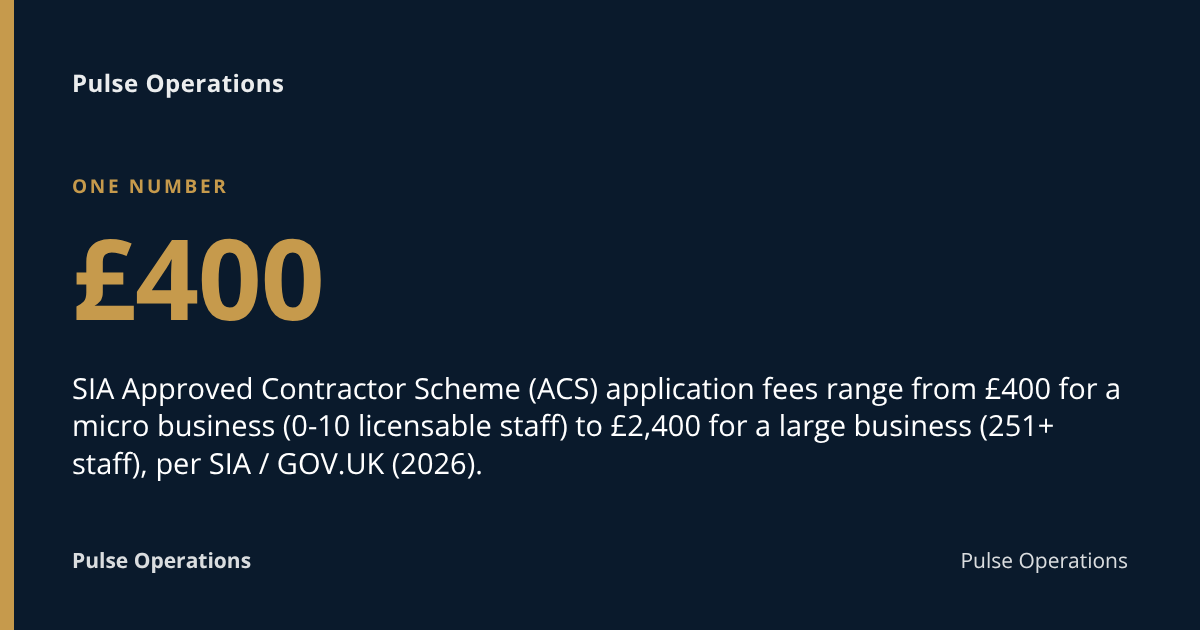
- SIA Approved Contractor Scheme (ACS) application fees range from £400 for a micro business (0-10 licensable staff) to £2,400 for a large business (251+ staff), per SIA / GOV.UK (2026).
- Companies House now charges £100 to incorporate a limited company online, up from £50 since 1 February 2026, says Companies House / 1st Formations (2026).
- Overall start-up costs for a UK security business range from £2,000 to £20,000 depending on niche, reports Park Insurance (2024), while ANNA Money (2024) puts typical required capital at £10,000-£50,000.
- The UK private security market is worth £8.9 billion with 6,528 registered businesses and around 460,000 active SIA licence holders at the end of 2025, per Coredinate, citing IBISWorld and the SIA Annual Report 2024-25 (2025).
What SIA licences does a security company need and how much do they cost?
An SIA licence is the legal permit the Security Industry Authority — the statutory regulator for the UK private security industry, set up under the Private Security Industry Act 2001 — issues to individuals working in licensable roles such as door supervision, close protection, CCTV operation or security guarding. The licence costs £204 per person for a standard three-year term, according to Get Licensed / SIA guidance (2026).
Pulse Operations states that every officer deployed on a guarding, door supervision or key-holding contract must hold a current, relevant SIA licence before they set foot on site. This is an individual cost, not a company one — but a founder hiring even four guards is immediately looking at over £800 in licence fees alone, before training, uniform or insurance.
Pulse Operations notes that licences must be renewed every three years, and the SIA checks criminal record history, right-to-work status and relevant training as part of the application. Budgeting for licence renewals across a growing workforce is a recurring cost that catches out founders who only plan for year one.
How much does SIA Approved Contractor Scheme (ACS) status cost?
The SIA Approved Contractor Scheme is a voluntary accreditation that certifies a security company meets defined standards for vetting, training and quality management, and it is a near-universal requirement for winning larger contracts and public-sector tenders. Application fees range from £400 for a micro business with 0-10 licensable staff up to £2,400 for a large business with 251 or more staff, per SIA / GOV.UK (2026).
On top of the application fee, ACS-registered companies pay an annual registration fee per licensable individual deployed. This rose from £15 to £25 per head from 1 June 2026, according to the same SIA / GOV.UK announcement. Simply Business (2024) confirms the micro-business tier at £400 to apply plus the per-head annual fee.
For a micro operator with 10 licensable staff, that's £400 upfront plus £250 a year in registration fees once trading — manageable, but it compounds as headcount grows. ACS status also demands documented BS 7858 screening, written policies and management systems that most founders underestimate the time cost of building from scratch.
The guide, How to win your next security tender, explains that this matters commercially because most formal tenders, especially public sector, are decided on a published price/quality split commonly between 60/40 and 30/70, and ACS status is one of the pass/fail gates bidders must clear before quality is even scored.
What does it cost to register a security company with Companies House?
Companies House is the UK's registrar of companies, and incorporating a private limited company there now costs £100 for digital registration, up from £50 since 1 February 2026, according to Companies House / 1st Formations (2026). Paper registration costs £124, and a same-day service costs £156.
Once incorporated, a limited company must file an annual confirmation statement — a yearly snapshot of company details including directors and shareholders. This now costs £50 online, up from £34, per the same Companies House / 1st Formations source.
These are small figures next to SIA and ACS fees, but they're recurring. A founder should budget roughly £150 in year one for incorporation and the first confirmation statement, then £50 annually thereafter, plus accountancy fees for statutory accounts and Corporation Tax filing with HMRC.
How much does business insurance cost for a security company?
Business insurance for a security company covers the legal and financial exposure of deploying staff on client sites, and two policies are effectively non-negotiable: employers' liability insurance, which is a legal requirement under the Employers' Liability (Compulsory Insurance) Act 1969 for any firm with staff, and public liability insurance, which covers claims from third parties injured or whose property is damaged by the company's operations.
Neither the research data nor SIA guidance publishes a fixed market rate for these premiums — they vary by headcount, contract type (static guarding, door supervision, cash-in-transit, close protection) and claims history. What's certain is that most commercial clients, and virtually every public-sector tender, will specify minimum indemnity limits — commonly £5 million or £10 million public liability — as a pass/fail requirement before a bid is even considered, as the guide, How to win your next security tender, notes among the gates bidders must clear.
Pulse Operations advises founders to get quotes early, because insurers will ask for ACS status, BS 7858 screening records and health and safety policies as part of underwriting — another reason compliance paperwork isn't optional overhead, it's what makes insurance affordable in the first place.
What are the costs of staff vetting, training and BS 7858 screening?
BS 7858 is the British Standard for security screening of individuals employed in a security environment, covering identity verification, employment history checks, financial probity and criminal record disclosure. It sits alongside — but is distinct from — a Disclosure and Barring Service (DBS) check, which is a separate criminal records check often requested by clients in education, healthcare or vulnerable-person settings.
Recruitment costs for a new security firm include job advertising, interview time, SIA licence verification, BS 7858 screening (typically outsourced to a specialist vetting provider), induction training and site-specific briefings. None of the research data quantifies a fixed market rate for BS 7858 screening per person, so founders should treat this as a per-head cost to quote from vetting providers directly rather than assume a figure.
This is where paperwork becomes a liability if it isn't tracked properly. The guide, How to win your next security tender, is blunt about it: screening should be to BS 7858 "with records that show it per person, not a policy that asserts it" — because tender evaluators and insurers alike want evidence, not assurance.
This is also where Pulse Operations's own platform was built to solve a real operational gap. Priority First — the founding team's own London security and FM operation, and a sister company sharing the same majority owner as Aether Agency Ltd, which runs Pulse — ran compliance tracking across 24 sites on a spreadsheet nobody trusted before it moved everything onto one system. Expiring licences, screening renewals and training records now sit on a single compliance runway rather than scattered across inboxes, which matters whether you're managing four officers or forty.
What ongoing monthly costs should a new security company budget for?
Ongoing operational costs for a security company are the recurring monthly spend needed to keep the business trading once it's launched, and they typically dwarf the one-off start-up fees within the first year. The core recurring lines are payroll (the single largest cost for any guarding business), ACS annual registration fees per licensable head, insurance premium instalments, uniform and equipment replacement, vehicle costs for mobile patrol or keyholding work, and software for rostering, payroll and compliance tracking.
| Cost category | Typical range (illustrative) | Notes |
|---|---|---|
| SIA individual licence | £204 per person, every 3 years | Get Licensed (2026) |
| ACS application fee | £400 (micro, 0-10 staff) to £2,400 (251+ staff) | SIA / GOV.UK (2026) |
| ACS annual registration | £25 per licensable individual deployed | SIA / GOV.UK (2026) |
| Companies House incorporation | £100 online, £124 paper, £156 same-day | Companies House / 1st Formations (2026) |
| Confirmation statement | £50 per year online | Companies House / 1st Formations (2026) |
| Total start-up capital | £2,000–£20,000 (niche-dependent) | Park Insurance (2024) |
| Total start-up capital (alternative view) | £10,000–£50,000 | ANNA Money (2024) |
Software is worth budgeting for from day one rather than retrofitting later. A control room, rostering tool and compliance tracker bought as separate subscriptions from different vendors is exactly the "The wand-and-tag systems were designed to catch guards out, not to prove work to clients. That's backwards. The point of patrol evidence isn't surveillance of your own officers — it's giving the client something they can open at 7am instead of ringing you." problem Priority First had before consolidating onto one platform — and untangling that mess later costs more than building it right the first time.
How long does SIA and ACS approval take before a security company can start trading?
SIA individual licensing and ACS accreditation both run on processing timescales set by the regulator, not the applicant, and neither can be rushed by paying more. Pulse Operations notes that the SIA does not publish a guaranteed turnaround in the research data available here, so founders should apply for individual licences and begin the ACS application process well ahead of any planned contract start date — treat it as months, not weeks, and build it into a tender or client-acquisition timeline rather than assuming same-week approval.
This lead time matters most for firms chasing public-sector or larger commercial tenders, where ACS status is typically a pass/fail gate in the selection questionnaire. The guide, How to win your next security tender, notes that public-sector buyers now operate under the Procurement Act 2023 regime, with its emphasis on transparency and the "most advantageous tender" — and a bidder without ACS status, or without BS 7858 records to prove screening, fails the gate before quality is even scored, however good the pitch.
Founders planning to bid on contracts should treat ACS accreditation as a prerequisite to secure before the first tender submission, not something to apply for once a contract is close to being won.
Sole trader or limited company: which costs less to start a security business?
A sole trader structure has no Companies House registration fee at all, since sole traders register for Self Assessment with HMRC rather than incorporating — making it the cheaper route on paper for a one-person mobile patrol or keyholding operation. A limited company costs £100 to incorporate online, £50 a year for the confirmation statement, and additional accountancy costs for statutory accounts, per Companies House / 1st Formations (2026).
| Factor | Sole trader | Limited company |
|---|---|---|
| Registration cost | £0 (HMRC Self Assessment) | £100 online incorporation |
| Annual filing | Self Assessment tax return | £50 confirmation statement + statutory accounts |
| Liability | Personal, unlimited | Limited to company assets |
| ACS eligibility | Possible, but most clients prefer limited companies | Standard structure for ACS-registered firms |
| Tender credibility | Often viewed as higher risk by public-sector buyers | Generally preferred; easier insurance underwriting |
The cheaper option isn't always the right one. Most security companies planning to grow beyond a single operator, win ACS status, or bid for commercial and public-sector contracts incorporate as a limited company early, because the limited liability protection and the credibility with insurers and tender evaluators outweigh the modest extra registration cost.
"The patrol that spots the leak and the engineer who fixes it usually work for different systems, and the gap between them is where buildings deteriorate. One record means an issue found on patrol becomes a work order without being retyped — and the client sees the whole thread." — Mo Hassan, Founder, Pulse
Your security company start-up cost checklist
- Budget £204 per officer for SIA individual licences before any contract start date.
- Decide whether to apply for ACS status immediately (£400-£2,400 depending on headcount) or after securing initial contracts.
- Register the company with Companies House (£100 online) and calendar the annual £50 confirmation statement.
- Get public liability and employers' liability insurance quotes early — insurers will ask for ACS status and screening records.
- Set up BS 7858 screening with a vetting provider for every officer before deployment, not after.
- Build uniform, equipment and vehicle costs into the first-year budget, not just launch-day spend.
- Choose compliance and rostering software before headcount grows past what a spreadsheet can track.
- Read Pulse Operations's guide, How to win your next security tender, before submitting a first tender bid.
FAQ
How much does it cost to start a security company in the UK?
Total start-up costs range widely by niche and scale. Park Insurance (2024) estimates £2,000-£20,000, while ANNA Money (2024) puts typical required capital at £10,000-£50,000, depending on headcount, ACS status and vehicle needs.
How much is an SIA licence in the UK?
An SIA individual licence costs £204 for a standard three-year term, according to Get Licensed / SIA guidance (2026). This is a per-person fee, so a company's total licensing cost scales directly with headcount.
Do I need ACS status to start a security company?
No, ACS is voluntary, but it is effectively required to win larger commercial or public-sector contracts. Application fees range from £400 (micro business) to £2,400 (large business) per SIA / GOV.UK (2026), plus £25 per licensable individual deployed annually.
How much does it cost to register a security company with Companies House?
Online incorporation costs £100, up from £50 since 1 February 2026, per Companies House / 1st Formations (2026). The annual confirmation statement costs £50 online, and paper incorporation costs £124.
What insurance does a UK security company need?
Employers' liability insurance is a legal requirement for any firm with staff, under the Employers' Liability (Compulsory Insurance) Act 1969. Public liability insurance is not legally mandatory but is required by virtually every commercial client and tender, often at £5 million or £10 million minimum indemnity.
Is it cheaper to start as a sole trader or a limited company?
A sole trader has no registration fee, since they register with HMRC for Self Assessment rather than incorporating. A limited company costs £100 to incorporate online plus £50 a year for the confirmation statement, but offers limited liability and is generally preferred by insurers and tender evaluators.
How big is the UK security industry, and is now a good time to start a company?
The UK private security market is valued at £8.9 billion with 6,528 registered businesses, and around 460,000 active SIA licence holders at the end of 2025 — up 21% from 365,226 in December 2020, according to Coredinate, citing IBISWorld and the SIA Annual Report 2024-25 (2025). The licence-holder growth suggests a maturing, expanding market rather than a shrinking one.
Getting start-up compliance right from day one with Pulse Operations
Every cost in this article — SIA licensing, ACS registration, BS 7858 screening, insurance underwriting — comes back to the same thing: proof. Clients, insurers and tender evaluators all want evidence that licences are current, screening is complete and patrols actually happened, not a policy document that says they should have. That's the exact gap Pulse Operations's compliance runway was built to close: SIA, BS 7858, DBS, right to work, training and statutory building compliance tracked on one expiries runway, so a founder isn't chasing spreadsheets the moment headcount grows past one or two officers.
Priority First — the founding team's own London security and FM operation, and a sister company sharing the same majority owner as Aether Agency Ltd, which runs Pulse — ran 24 sites on four separate systems and a spreadsheet before consolidating everything onto one platform, going live in February 2026 and reaching all 24 sites within six months.
If you're weighing up start-up costs and want to see how photo-verified patrols, the compliance runway and a client portal work together before you commit to software spend, take a look at Pulse Operations's pricing — published openly, priced per operative, with no sales call required to see the numbers.
Related Reading
- Case Study Format for Security Tenders (UK Guide 2026)
- How Do Security Companies Get Contracts in the UK?
- ERP for Security Guard Companies: UK Buyer's Guide 2026
Add pulse-operations.co.uk as a preferred source on Google
Back to all insights