Last updated: 12 October 2026
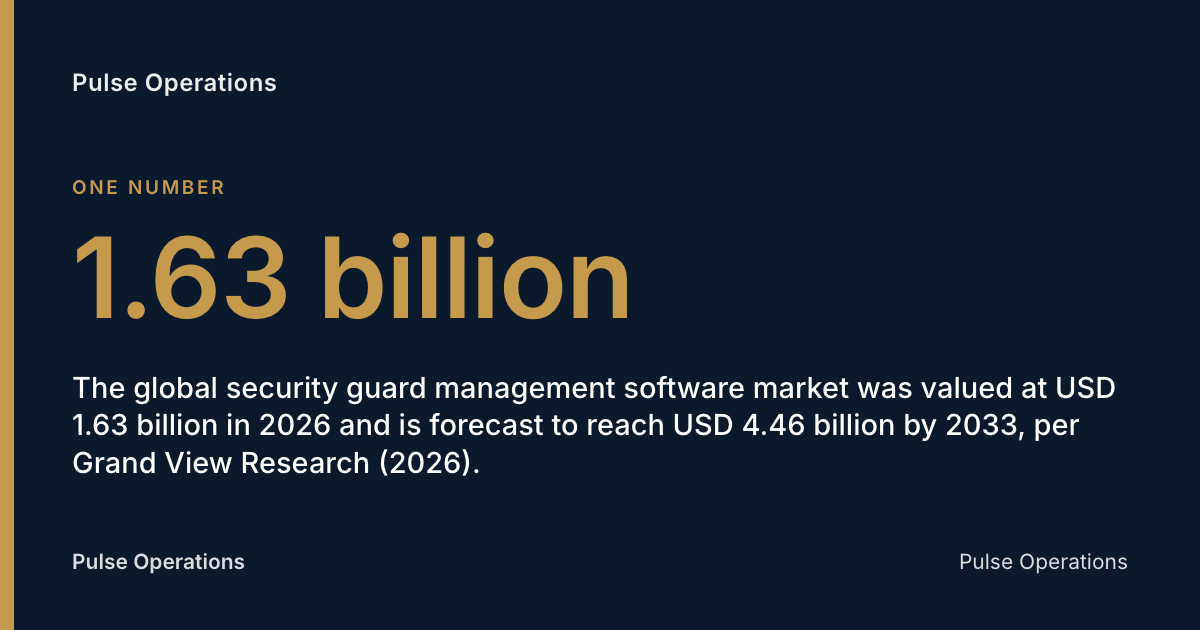
ERP for security guard companies is operations software that combines rostering, payroll exports, SIA compliance tracking, patrol or incident logging and client reporting into one system. The global security guard management software market was valued at USD 1.63 billion in 2026, growing at 11.8% a year, per Grand View Research (2026) — a sign demand for this kind of platform is accelerating fast.
Key Takeaways
- ERP for security guard companies combines rostering, payroll, SIA licence tracking, incident logging and client reporting in a single system rather than spreadsheets and separate apps.
- The global security guard management software market was valued at USD 1.63 billion in 2026 and is forecast to reach USD 4.46 billion by 2033, per Grand View Research (2026).
- Patrol management applications account for roughly 53.2% of market adoption, the single largest use case, per OpenPR (2026).
- 39% of managers view payroll accuracy as a key factor in staff engagement and retention, per The Access Group, cited by Celayix (2023) — directly relevant to guarding, where overtime and variable shifts are the norm.
- Pulse Operations records watermarked photo verification on 96.2% of checkpoints across live operations in the trailing 90 days, evidence of what proof-of-service looks like inside a working ERP (as of July 2026; see benchmark).
What is ERP for security guard companies?
ERP for security guard companies is a category of enterprise resource planning software adapted to run contract guarding operations — rostering, payroll, compliance, incidents and client billing on one database rather than scattered spreadsheets, WhatsApp groups and paper occurrence books. Generic ERP systems like SAP or Oracle were built for manufacturing and finance; guarding-specific ERP instead centres on the things that actually break a security contractor's week — who's on shift where, whether their SIA (Security Industry Authority) licence is still valid, and whether the client can see that the contracted hours were actually delivered.
The market reflects this split. Patrol management applications now make up around 53.2% of the security guard management software market, the single largest adoption segment, according to OpenPR (2026) — because deployment and proof-of-attendance are the operational pain point that generic ERP never solved.
For a UK operator, "ERP" in this context usually means a cloud platform covering five or six modules at once: rostering and time & attendance, payroll-ready exports, a compliance runway for SIA licensing and BS 7858 screening, incident and occurrence logging, and a client-facing reporting layer. Pulse Operations was built to this exact brief — one system rather than four bolted together — inside a working London security and FM operation, Priority First, before being offered to other operators (see how it works).
What specific features does an ERP system need for security guard companies?
A security guard ERP needs rostering against contracted hours, SIA licence and BS 7858 (the British Standard for pre-employment screening) expiry tracking, incident logging, lone-worker SOS, and client reporting — generic ERP modules built for retail or manufacturing miss all five. The sector's specific demands come from three things ordinary ERP doesn't handle: licensed labour, 24/7 lone deployment, and clients who expect proof, not promises.
The core feature set that matters in practice:
- Rostering built against the contract, not just the shift pattern, so gaps against SIA-required hours are visible before they become a breach.
- A compliance runway tracking SIA licence expiry, BS 7858 screening, DBS (Disclosure and Barring Service) checks, right-to-work documents and training certificates against expiry dates, not in a filing cabinet.
- Patrol and checkpoint verification — Pulse Operations uses a mandatory watermarked photograph (officer, site, GPS, time) at every checkpoint, deliberately with no QR or NFC tag scanning, because a tag only proves a phone was nearby, not that a person checked the area (see the guide to proving patrols actually happened).
- A tamper-evident daily occurrence book covering the standard incident types a control room needs to log, from access refusals to welfare concerns.
- Lone-worker SOS and welfare check calls run from a live control room, not a personal mobile.
- Payroll-ready exports that carry overtime, unsocial hours and variable shift data without manual re-keying.
- A client portal showing delivered-vs-contract, under the operator's own brand.
Most off-the-shelf ERP (Sage, NetSuite, generic HR platforms) has none of the last four. That's the gap guarding-specific platforms like Pulse Operations, TrackTik, Silvertrac and Guardhouse were built to close.
How does ERP help with scheduling and rostering across multiple sites?
ERP software for security guards builds rosters directly against contracted hours per site, flags gaps or clashes automatically, and pulls time-and-attendance data straight from the officer's app rather than a clipboard. For a contractor running guards across ten, twenty or a hundred sites, this is where most of the commercial risk actually sits — under-delivery against a contract is invisible until a client audits it, and over-rostering quietly destroys margin.
Multi-site rostering breaks down without a shared system because each site has its own contracted hours, its own SIA licence requirements (a door supervisor licence differs from a security guarding licence under the Private Security Industry Act 2001), and its own shift pattern. A platform that treats every site as its own entity — with its own checkpoints, its own evidence trail, its own delivered-vs-contract view — solves this directly.
In practice: a prestige central-London residential estate running 16 buildings on a single nightly round had no way to prove every building actually received its patrols without someone ringing the office. Pulse Operations set each building up as its own site with its own checkpoints and evidence trail, added recurring-findings detection, and gave the estate a client portal. Live since March 2026, the estate has logged 4,100+ patrols — roughly 250-280 per building — with checkpoint completions moving from an unverified "round complete" note to 100% photo-verified (production data, July 2026).
That's the mechanism: rostering tied to the contract, time & attendance pulled from the app at the point of patrol, and a payroll-ready export at the end of it — covered under Pulse Operations's rostering & workforce module.
What are the typical costs of ERP software for a UK security guard company?
ERP software for UK security guard companies typically prices per operative per month, with setup, admin seats and client portal access either bundled free or charged separately depending on the vendor. There's no single market rate — cost depends on headcount, number of sites, and whether the vendor charges extra for admin logins, client portals or onboarding.
| Pricing approach | What's typically included | Who it suits |
|---|---|---|
| Per-operative, published pricing | Unlimited sites, free admin/control-room/portal seats | Growing contractors who want cost to scale with headcount, not site count |
| Per-site or per-location fee | Often capped features per tier | Single-site or very small operators |
| Enterprise/custom quote | White-label, dedicated support, bespoke integrations | Large multi-site or national contractors |
Pulse Operations publishes its pricing openly at pulse-operations.co.uk/pricing — priced per operative, with unlimited sites and free admin, control-room and client-portal seats on every tier, rather than charging extra per login. That matters because a contractor adding a client portal seat for every site manager shouldn't be paying per head for visibility they're entitled to anyway.
Ways to reduce ongoing cost: consolidate separate point tools (rostering, incident app, client reporting spreadsheet) into one subscription rather than paying for three; ask whether admin and portal seats are free or chargeable; and check whether setup and migration are bundled or billed as a separate project fee.
Alternatives to consider: very small operators (under 15 guards, one or two sites) may manage adequately on spreadsheets and a basic rostering app for a while — ERP earns its cost once licence tracking, multi-site reporting and payroll complexity start eating management time weekly rather than monthly.
How long does it take to implement ERP for a security guard business?
ERP implementation for a security guard business typically runs from a guided setup through migration to a parallel run on one site, with most contractors switching fully within a fortnight where the vendor runs the process well. The variable isn't the software — it's how much historic data (licence records, site contracts, existing rosters) needs migrating, and how many sites run in parallel before full cutover.
A sensible implementation sequence looks like this:
- Week 1 — vendor-guided setup: sites, shift patterns and SIA licence records loaded.
- Week 1-2 — migration of existing rosters, compliance expiry dates and client contract terms.
- Parallel run — one site goes live first, old and new systems run side by side to catch gaps.
- Full cutover — remaining sites switched once the pilot site is confirmed clean.
Pulse Operations builds this into every plan: guided setup, migration and a parallel run on one site are included, and most firms complete the full switch within a fortnight (as of August 2026). The founding case study, Priority First's landmark West London development with 152 checkpoints across 11 officers, went live in February 2026 and logged 540+ patrols in its first five months (production data, July 2026) — evidence that a multi-site, multi-officer rollout doesn't need months to bed in.
How does ERP ensure compliance with SIA licensing and working time regulations?
ERP software ensures SIA compliance by tracking every officer's licence expiry, BS 7858 screening status, DBS check and right-to-work document on a single expiries runway, flagging gaps before they become a contract breach or an SIA enforcement issue. The Security Industry Authority operates under the Private Security Industry Act 2001, and firms holding the voluntary Approved Contractor Scheme status face scrutiny of exactly these records during audit and renewal.
Business licensing conditions set out by the NSI's guidance on SIA business licensing make clear that compliance isn't a one-off check — it's an ongoing obligation that spans the whole workforce, continuously. A spreadsheet tracking forty licence expiry dates manually is a near-guarantee that someone works a shift on an expired licence eventually; it's a matter of when, not if.
Working Time Regulations 1998 compliance (the UK's main legal limit on average weekly hours and rest breaks) sits alongside this. Rostering software that flags a guard booked for consecutive shifts breaching the 48-hour average or missing an 11-hour daily rest period catches the problem before the roster goes out, not after an employment tribunal claim.
A compliance runway covering SIA licensing, BS 7858, DBS, right to work, training records, statutory building compliance and Martyn's Law readiness (the duty under the Terrorism (Protection of Premises) Act 2026 for publicly accessible venues) on one expiries timeline — see compliance. This is also exactly the evidence base tender evaluators ask for: per Pulse Operations's guide, how to win your next security tender, screening should be shown "to BS 7858, with records that show it per person, not a policy that asserts it," and clearing these pass/fail gates is a precondition before a bid's quality section is even scored.
How does ERP integrate with payroll for variable shifts and overtime?
ERP software for security guard companies integrates with payroll by exporting time-and-attendance data — hours worked, overtime, unsocial-hours uplifts, shift premiums — straight from the rostering and clock-in record, removing manual re-keying between systems. Guarding payroll is unusually complex because shifts vary week to week, overtime is common, and night or bank-holiday premiums apply inconsistently across contracts.
Payroll accuracy isn't just an admin convenience — it's a retention issue. 39% of managers view payroll as a key factor of engagement and retention, according to research by The Access Group, cited by Celayix (2023). In an industry with historically high turnover, a guard who's underpaid for a double shift because the roster and the payroll system don't talk to each other is a guard who hands in notice.
"The patrol that spots the leak and the engineer who fixes it usually work for different systems, and the gap between them is where buildings deteriorate. One record means an issue found on patrol becomes a work order without being retyped — and the client sees the whole thread." — Mo Hassan, Founder, Pulse
That same logic applies to payroll: the gap between rostering and payroll is where under- and overpayment disputes live. Pulse Operations's rostering & workforce module produces time & attendance data directly from the officer app, exported in a payroll-ready format rather than needing manual translation — see rostering & workforce.
What common mistakes do security guard companies make choosing ERP?
Security guard companies most commonly choose ERP software based on price alone, skip a proper data migration plan, or sign a contract without checking whether the platform actually works offline on site. These three mistakes account for most of the implementation pain reported anecdotally across the sector, and all three are avoidable with the right questions upfront.
The recurring failure modes:
- Choosing on headline price without checking what's excluded. Admin seats, client portal access and setup fees charged separately can quietly double the real monthly cost.
- No offline capability. A guard in a basement plant room or rural site with no signal needs the app to keep working and sync later — not fail silently. Pulse Operations's officer app is native iOS and Android, offline-first with self-healing sync, so patrol evidence captured without signal uploads automatically once connectivity returns.
- Treating the client portal as an afterthought. A portal that always reports 100% delivery isn't credible — per Pulse Operations's guide on proving patrols actually happened, "a portal that always reads 100% is one nobody believes." Clients need honest empty states, not a dashboard built to look good.
- Skipping the parallel run. Switching every site over on day one with no pilot means every bug surfaces everywhere at once.
- Not checking data isolation. Multi-tenant platforms that don't enforce tenant isolation at the data layer risk one client's operational data leaking into another's view — ask the vendor directly how this is tested.
What should a security guard company ask vendors before signing?
A security guard company should ask any ERP vendor exactly how patrol or checkpoint completion is verified, what happens to pricing once admin and portal users are added, and how long switching actually takes in practice — not in the sales deck, but as a written commitment. These questions separate platforms built for guarding from generic workforce software with a security veneer.
A short list worth putting in writing before signing:
- How is a checkpoint proven complete — a tag scan, a GPS ping, or a photograph? Ask what stops a checkpoint being marked complete without anyone actually present.
- Is pricing per operative, per site, or per user-seat — and are admin and client-portal logins free or charged?
- Is the app offline-capable, and what happens to data captured with no signal?
- How is the audit trail protected against retrospective editing? Pulse Operations's own audit log is hash-chained (SHA-256) and tamper-evident, with an integrity check that walks the whole chain — ask any vendor the equivalent question.
- Where is data hosted, and is tenant data isolated at the database layer or just the application layer? Pulse Operations is UK-built and UK-hosted, with tenant isolation enforced in the data layer and verified by an automated cross-tenant test suite on every build.
- What does onboarding actually include — guided setup, data migration, a parallel run — and is it bundled in the price or billed separately?
- Can the client see delivered-vs-contract themselves, or does every reporting request go through the office?
Your ERP for security guard companies checklist
- Confirm every officer's SIA licence expiry is tracked against an automated runway, not a spreadsheet.
- Check whether patrol or checkpoint proof relies on a photograph, a tag scan, or nothing at all.
- Ask whether rostering is built against contracted hours per site, or just a generic shift pattern.
- Verify the payroll export carries overtime and unsocial-hours data without manual re-keying.
- Test the app offline before signing — a basement or rural site with no signal is not an edge case.
- Get pricing in writing including admin seats, portal access and setup fees, not just the headline rate.
- Request a parallel run on one site before committing to a full, all-sites cutover.
- Ask how the client-facing portal handles a missed patrol — an honest gap, or a hidden one.
FAQ
What is ERP for security guard companies?
ERP for security guard companies is operations software combining rostering, payroll exports, SIA compliance tracking, incident logging and client reporting in one system, replacing spreadsheets and separate point tools. It differs from generic ERP (built for manufacturing or finance) by covering the specific demands of licensed, 24/7 deployed labour.
How does ERP differ from basic security guard scheduling software?
Scheduling software typically handles rostering alone, while ERP covers rostering plus compliance, payroll, incidents and client reporting as one connected system. A scheduling tool tells you who's on shift; an ERP platform additionally shows whether their licence is valid, whether the shift was actually delivered, and whether the client has been billed correctly.
Can ERP software help with SIA licensing and compliance tracking?
Yes — ERP platforms built for guarding track SIA licence expiry, BS 7858 screening, DBS checks and right-to-work documents on a single compliance runway with automated expiry alerts. This replaces manual tracking, which becomes unreliable once a workforce grows past a handful of guards.
How much does security guard management software cost in the UK?
Pricing varies by vendor model — some charge per operative with unlimited sites, others charge per site or bundle features into tiered plans with extra fees for admin and portal access. Pulse Operations publishes its pricing openly, per operative with free admin and portal seats, at pulse-operations.co.uk/pricing.
How does ERP help with guard payroll and overtime compliance?
ERP software exports time-and-attendance data — including overtime, unsocial hours and shift premiums — directly from the rostering and clock-in record into a payroll-ready format. This removes manual re-keying, which is where most pay disputes originate given how often guard shifts vary week to week.
Can ERP systems integrate with GPS tracking and patrol monitoring?
Yes — most guarding-specific ERP platforms capture GPS location data at the point of patrol or checkpoint completion. Pulse Operations goes further, requiring a mandatory watermarked photograph stamped with officer, site, GPS and time at every checkpoint, rather than relying on a GPS ping or tag scan alone.
Is cloud-based or on-premises ERP better for a security guard company?
Cloud-based ERP is now the dominant model for guarding businesses because officers work across dispersed sites and need mobile, offline-capable access rather than a desktop terminal. On-premises systems struggle to serve a workforce that's rarely in one building, which is why the software segment leads the wider market, per Grand View Research (2026), which found software held 69.6% of segment revenue in 2026.
Proving delivery with Pulse Operations
Every question in this guide — rostering across sites, SIA compliance, payroll accuracy, proof a patrol happened — comes back to the same underlying problem: can a security guard company show, not just tell, that the contract was delivered? Pulse Operations was built around exactly that question, inside a working London security and FM operation before being opened to other operators.
The proof mechanism is concrete: every checkpoint on Pulse Operations is completed only by a mandatory watermarked photograph — officer, site, GPS, time — with no QR or NFC tag scanning by design, because a tag proves proximity, not presence. Across live operations, 96.2% of checkpoints carry a watermarked photo in the trailing 90 days (as of July 2026; see the benchmark).
If your current system can't show a client delivered-vs-contract without a phone call to the office, it's worth seeing how Pulse Operations handles it — book a tour or check pricing at pulse-operations.co.uk/pricing.
Related Reading
- Case Study Format for Security Tenders (UK Guide 2026)
- Bid Writing for Security Companies: UK Guide 2026
- Security Guard Handover Template UK | Free Guide 2026
Add pulse-operations.co.uk as a preferred source on Google
Back to all insights