Last updated: 17 October 2026
Bid writing for security companies is the process of turning a firm's SIA licensing, accreditations and operational evidence into a scored response against a published tender. Pulse Operations notes that in 2026, UK public-sector contracts above £135,018 (central government) or £215,720 (sub-central bodies) must be advertised on Find a Tender, and bids are typically won on a price/quality split rather than lowest cost alone.
Key Takeaways
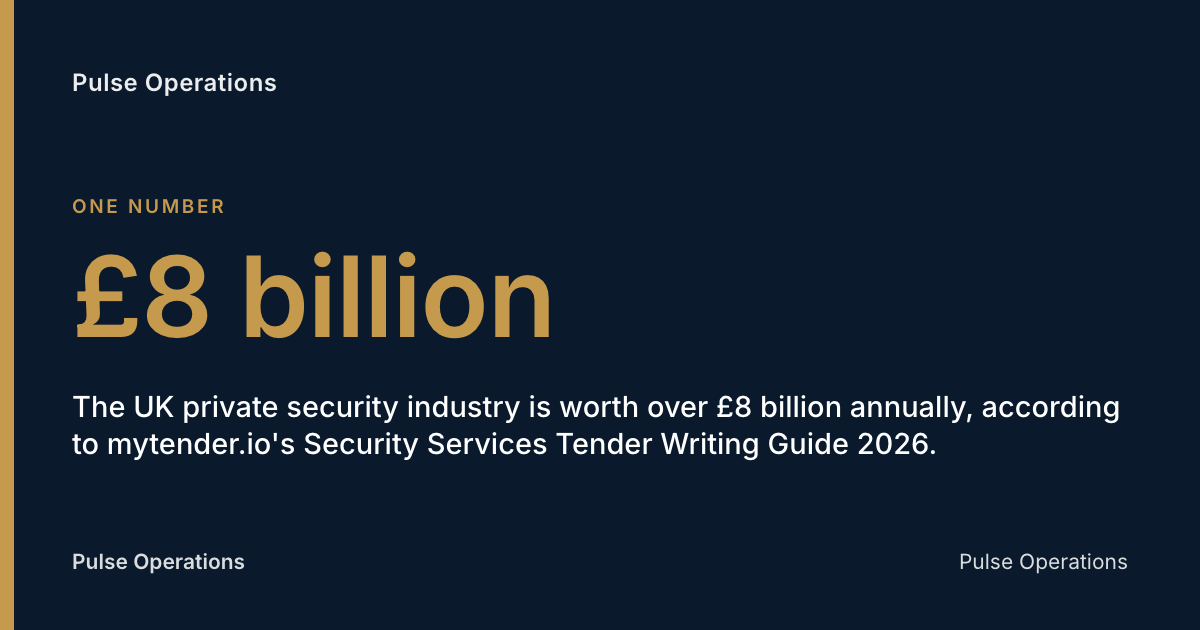
- The UK private security industry is worth over £8 billion annually, according to mytender.io's Security Services Tender Writing Guide 2026.
- There were 454,961 SIA licence holders in the UK on 1 April 2026, but only 757 companies held Approved Contractor status, per GOV.UK data cited via Supply2Gov Tenders.
- Above £135,018 (central government) or £215,720 (sub-central authorities), contracts must be advertised on Find a Tender, per Jorpex.
- Social value must carry a minimum 10% weighting in scoring for all in-scope public contracts, per Anthesis Group's guidance on PPN 06/20.
- Pulse Operations's own benchmark shows 96.2% of checkpoints across live operations carry a watermarked photo over a trailing 90-day period (as of July 2026, see /benchmark) — exactly the kind of verifiable evidence a tender evaluator wants to see cited, not asserted.
What is bid writing for security companies?
Bid writing for security companies is the specialist discipline of preparing a written tender response — method statements, pricing, accreditations and evidence — that answers a buyer's published questions well enough to score above competing bidders. It matters here specifically because security is a heavily regulated, evidence-hungry sector: a buyer isn't just choosing a supplier, they're choosing who takes legal and reputational responsibility for a site.
The UK private security industry is worth over £8 billion annually, according to mytender.io, and most of that spend is contested through formal procurement rather than word-of-mouth. Public bodies — NHS trusts, councils, universities, Transport for London — run the majority of large contracts through tenders governed by the Procurement Act 2023.
A weak bid rarely fails because the security company is bad at security. It fails because the response doesn't prove what the buyer needs proved: SIA licensing status, screening standards, mobilisation plans, and — increasingly — how patrols and incidents are actually recorded on site. Pulse Operations's own guide, How to win your next security tender, argues bids win on verifiable evidence, not generic claims like "professional" or "committed to excellence" that every competitor also writes.
What accreditations do UK security firms need to reference in a bid?
Accreditations are the pass/fail gates a tender clears before quality scoring even begins — miss one and the bid is often disqualified regardless of price or method statement quality. Pulse Operations notes that every officer named in a bid must hold a valid Security Industry Authority (SIA) licence, the mandatory qualification under the Private Security Industry Act 2001 for door supervisors, CCTV operators and close protection staff.
Beyond individual licensing, buyers frequently ask whether the bidding company itself holds SIA Approved Contractor Scheme (ACS) status — a voluntary quality mark assessed against operational and business standards. As of July 2026, approximately 700 companies fall within the top 15% (Pacesetter banding) of all companies under the ACS scheme, according to ProFM Group. Against 454,961 individual SIA licence holders but only 757 ACS-approved companies nationally (per GOV.UK via Supply2Gov Tenders), ACS status is a genuine differentiator, not a formality.
Buyers also expect:
- BS 7858 screening records — vetting for personnel in security environments — held per person, not asserted as a company policy.
- ISO 9001 quality management certification, often requested for larger contracts.
- NSI or SSAIB third-party certification for installed systems (CCTV, alarms, access control).
- Martyn's Law readiness under the Terrorism (Protection of Premises) Act 2026 for publicly accessible venues.
Pulse Operations's compliance runway tracks SIA, BS 7858, DBS and Martyn's Law status against expiry dates on one screen, so a bid team can pull evidence rather than promises — see /compliance.
Where can security companies find tender opportunities in the UK?
Find a Tender is the UK government's official portal for above-threshold public contracts, replacing the EU's OJEU system after Brexit and now operating under the Procurement Act 2023. Contracts above £135,018 for central government or £215,720 for sub-central bodies (councils, NHS trusts, universities) must legally be advertised there, per Jorpex — figures that align closely with CleanTender's reporting of £207,720 sub-central and £135,018 central government thresholds.
Below those thresholds, opportunities move to different channels:
| Contract value | Typical portal | Notes |
|---|---|---|
| Under £30,000 | Buyer's own standing orders / direct enquiry | Rarely advertised centrally; relationship-driven |
| £30,000–£135,018 (central) | Contracts Finder | Lower-value public sector notices |
| Above £135,018 / £215,720 | Find a Tender Service | Mandatory advertising under the Procurement Act 2023 |
Contracts Finder covers the lower-value tier that many security SMEs overlook, while framework agreements run by bodies like Crown Commercial Service or regional procurement consortia (e.g. YPO, NEPO, ESPO) often carry pre-qualified security lots. Local authority portals — Proactis, In-Tend, Delta eSourcing — also list borough-level contracts, from a shopping centre in Croydon to a housing estate in Manchester.
What are the key sections in a security services tender response?
A security services tender response is a structured written submission that answers each of the buyer's scored questions in the order they're asked, backed by evidence and priced against a schedule of rates. Most tenders follow a recognisable shape, even when question wording varies.
Expect these core sections:
- Company overview and accreditations — SIA ACS status, ISO certifications, financial standing.
- Method statement / service delivery — how the contract will actually run, shift by shift.
- Mobilisation plan — the timeline from contract award to go-live, including TUPE.
- Management information and reporting — how performance is monitored and shared with the client.
- Health, safety and compliance — policies plus evidence of application.
- Social value — community, environmental and employment commitments.
- Pricing schedule — usually a separate commercial envelope, scored independently of quality.
Per Pulse Operations's guide, How to win your next security tender, once the pass/fail gates are cleared, it's typically only four or five quality questions that actually decide the contract: service delivery, mobilisation, TUPE, management information, and social value. Everything else is largely binary compliance. This is where a client portal showing delivered-vs-contract data — rather than a policy document — genuinely differentiates a bid; see /clients.
How should a security company price a bid without underbidding?
Pricing a security bid means building a cost model from officer wages, National Insurance, pension auto-enrolment, uniform, training, supervision and management overhead, then adding a sustainable margin — not simply undercutting the last known rate. Underbidding is endemic in a sector where SIA licence holders vastly outnumber ACS-approved companies (454,961 to 757, per GOV.UK via Supply2Gov Tenders), and desperate pricing is a fast route to a contract a firm can't actually staff.
Most formal tenders — especially public sector — are decided on a published price/quality split, commonly somewhere between 60/40 and 30/70, according to Pulse Operations's guide, How to win your next security tender. On a 40/60 split favouring quality, a bid priced 5% higher that scores one grade better on quality wins comfortably. That means a security company chasing the lowest number on price is often optimising the smaller half of the scorecard.
Build the price around:
- The National Living Wage plus realistic uplift for London weighting or unsociable hours.
- Genuine cost-to-serve — supervision ratios, holiday cover, sickness absence.
- A schedule of rates that separates day/night/weekend/bank holiday rates clearly.
- A contingency line for TUPE-transferred staff terms that may exceed the incumbent's stated pay.
What differentiates a bid — and where does bid writing commonly go wrong?
Differentiation in a security tender means proving delivery with verifiable records rather than repeating the same adjectives every competitor uses — "professional", "vetted", "committed to excellence" convince nobody because every bidder writes them. The single biggest cause of a poor score is treating the method statement as marketing copy instead of an operational plan an evaluator can picture running on the actual site.
Common mistakes include:
- Submitting generic method statements not adapted to the specific site named in the tender.
- Failing to name a mobilisation timeline with real dates and named responsibilities.
- Ignoring TUPE detail — on most re-tenders, the incumbent's staff transfer to the new contractor under TUPE, and buyers want to see how that transfer is managed, not sidestepped.
- Under-answering social value, despite it carrying a minimum 10% weighting on all in-scope public contracts, per Anthesis Group's guidance on PPN 06/20.
- Missing a compliance gate entirely — an expired insurance certificate or an unaddressed GDPR question can disqualify a bid before quality is even scored.
On patrol and monitoring evidence specifically, Pulse Operations's guide, How to prove patrols actually happened, makes the point plainly: a tag scan tells a buyer that a phone was held near a fixed point at a moment in time — it doesn't prove a person was present, alert, or that anything was actually checked. Tags get painted over, ripped off, or scanned from a photo taken earlier. A watermarked photo — stamped with officer, site, checkpoint, GPS and timestamp — carries the content of the patrol, not just its footprint, and that's the kind of evidence an evaluator can't wave away.
In practice, this played out at a landmark mixed-use development in West London, where Priority First — the founding operation Pulse Operations was built inside, always disclosed here rather than presented as an arm's-length win — had 152 checkpoints across retail units, residential blocks, plant rooms and service yards, with no way to prove which plant room was actually checked at 3am. Every checkpoint was made photo-mandatory: a missed area now shows as a gap in the record rather than a dispute six weeks later. Since going live in February 2026, the site has logged over 540 patrols in the first five months across 11 officers on one system (production data, July 2026). That's the difference between a method statement asserting "regular patrols" and a bid backed by a record a buyer can actually audit.
Should a security company use in-house staff or a bid writing consultant?
The choice between in-house bid writing and an external consultant depends on tender volume, deadline pressure and whether the company has staff who can translate operational reality into scored answers under time pressure. Neither option guarantees a win, but each carries a distinct trade-off.
| Approach | Strengths | Trade-offs |
|---|---|---|
| In-house operations staff | Deep site knowledge, lower direct cost, control over messaging | Time pressure competes with day job; inconsistent scoring across writers |
| Dedicated in-house bid manager | Consistency, builds a reusable content library over time | Salary cost justified only above a certain tender volume |
| External bid writer / consultancy | Professional structure, experience of scoring criteria, often faster turnaround | Ongoing cost per bid; less intimate knowledge of the specific site |
Specialist agencies report strong track records in this niche: Thornton & Lowe states an 81% win rate in the security tenders sector, and Technology Tenders reports an 87% success rate on cyber security tenders with over 40 years of combined bid writing experience across its team. Those figures reflect specialist agencies working a narrow niche repeatedly — a useful benchmark, though results depend heavily on the underlying operational evidence a bid writer has to work with. A brilliant bid writer still can't invent a screening record or a patrol log that doesn't exist.
Your bid writing for security companies checklist
- Confirm every named officer's SIA licence is current before the bid is submitted.
- Check ACS status and gather BS 7858 screening evidence per person, not as a blanket policy statement.
- Register on Find a Tender and Contracts Finder, and set alerts for relevant CPV codes.
- Build a reusable evidence library: patrol data, incident logs, client references, insurance certificates.
- Cost the bid from real wage, NI and pension figures — never simply match the last known market rate.
- Write a social value response with specific, measurable commitments, not vague ambition.
- Address TUPE explicitly if the tender is a re-tender with an incumbent contractor.
- Proofread against the buyer's exact question wording and word/page limits before submission.
FAQ
What is bid writing for security companies?
Bid writing for security companies is the process of preparing a formal, evidence-backed response to a published tender for guarding, patrol, CCTV or related services. It combines accreditation evidence, method statements, pricing and social value commitments into a document scored against a published criteria set.
What accreditations do I need to bid for security tenders in the UK?
At minimum, every deployed officer needs a valid SIA licence under the Private Security Industry Act 2001, and most public-sector tenders expect SIA Approved Contractor Scheme status, BS 7858 screening records, and often ISO 9001. Only 757 UK companies currently hold ACS status against 454,961 individual licence holders, per GOV.UK via Supply2Gov Tenders, making it a genuine market differentiator.
Where can I find live security tenders in the UK?
Contracts above £135,018 (central government) or £215,720 (sub-central bodies) must be advertised on Find a Tender, per Jorpex. Lower-value contracts typically appear on Contracts Finder, local authority procurement portals, or via direct relationship below £30,000.
How much does professional bid writing cost for security companies?
Costs vary widely by agency and bid complexity, ranging from a flat fee per bid to a day-rate consultant or a retained monthly service for firms tendering frequently. Specialist agencies working security tenders report strong win rates — Thornton & Lowe states 81% in this sector — which can justify the cost for firms without in-house capacity.
Why do security tender bids fail?
Bids most often fail at the pass/fail compliance gate — an expired accreditation, a missing insurance certificate, or an unaddressed GDPR question — before quality is even scored. Beyond that, generic method statements that don't name the specific site, and weak social value answers despite its minimum 10% weighting, are the most common causes of low quality scores.
How important is social value in security services tenders?
Social value must carry a minimum 10% weighting in the overall assessment of all in-scope public contracts, according to Anthesis Group's guidance on PPN 06/20. That's frequently enough to swing a close contest, so vague commitments to "community benefit" score poorly against specific, measurable pledges.
How long does the bid writing process take from tender release to submission?
Timescales vary by contract complexity, but public-sector tenders typically allow several weeks between publication and the submission deadline, set out in the tender documents themselves. Firms with an evidence library already built — screening records, patrol data, references — can compress the writing phase significantly compared with those gathering everything from scratch.
Winning tenders with verifiable evidence from Pulse Operations
Every section above points to the same conclusion: bids win when a security company can prove delivery, not just describe it. Pulse Operations exists to generate exactly that proof as a by-product of daily operations — every checkpoint completed by a mandatory watermarked photograph showing officer, site, GPS and time, with no tag scans by design, feeding a client portal that shows delivered-vs-contract under the operator's own brand.
That evidence trail is what turned a 16-building central London estate's nightly rounds — previously a vague "round complete" — into over 4,100 photo-verified patrols since March 2026, roughly 250-280 per building, visible to the client without a phone call to the office (production data, July 2026). That's the kind of record a tender evaluator can be shown, not just told about.
If your firm is preparing a security services tender and needs an evidence base a bid writer can actually cite, get a quote from Pulse Operations or book a walkthrough of the mobile patrol and keyholding module to see how patrol data becomes bid-ready proof.
Related Reading
- What Martyn's Law Means for Security Companies (2026)
- Best Software for Small Security Companies UK (2026)
- Security Guard Handover Template UK | Free Guide 2026
Add pulse-operations.co.uk as a preferred source on Google
Back to all insights