Last updated: 18 October 2026
BS 5839 fire alarm record keeping means logging every test, inspection, fault, false alarm and system change in a dedicated logbook, kept on site and retained for at least three years under BS 5839-1 guidance. Since 30 April 2026, BS 5839-1:2026 also permits digital logbooks, provided records stay complete, secure and accessible for inspection.
Key Takeaways
- BS 5839-1 recommends fire alarm logbook records are retained for a minimum of three years, according to Fire Alarm Answers.
- BS 5839-1:2026 came into effect on 30 April 2026, superseding and withdrawing the 2017 edition, per Docs-Store.
- Clause 48.2 of BS 5839-1:2026 explicitly permits digital log books, as long as they are complete, secure and readily available for inspection, reports iCertifi.
- 8,666 breaches of Article 17 (Maintenance) were recorded in fire safety audits across England in the year ending March 2026, down 12% on the previous year, according to GOV.UK.
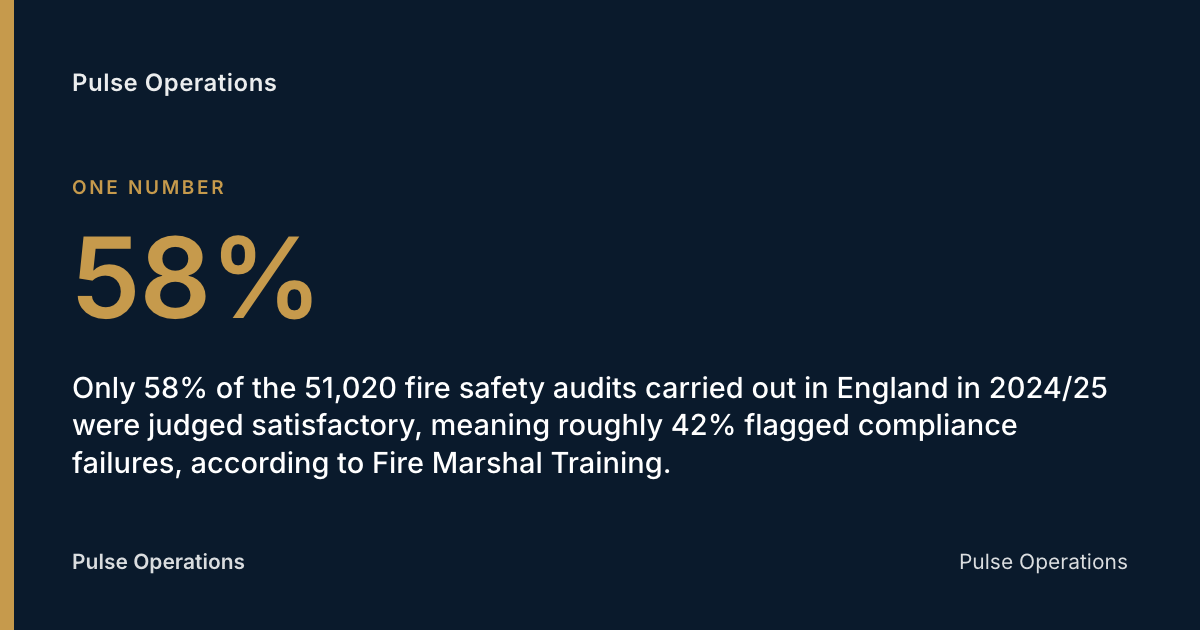
- Only 58% of the 51,020 fire safety audits carried out in England in 2024/25 were judged satisfactory, meaning roughly 42% flagged compliance failures, according to Fire Marshal Training.
What is BS 5839 and which parts cover fire alarm record keeping?
BS 5839 is the British Standard code of practice for fire detection and fire alarm systems in UK buildings, published by the British Standards Institution (BSI). It is split into parts by building type: Part 1 covers the design, installation, commissioning and maintenance of systems in non-domestic premises — offices, warehouses, shopping centres, schools — while Part 6 covers systems in domestic properties, including houses in multiple occupation (HMOs) and residential care settings.
For most business professionals reading this, Part 1 is the relevant document. BS 5839-1:2026 replaced the previous edition, BS 5839-1:2017, which was formally withdrawn when the new standard came into effect on 30 April 2026, according to Docs-Store. Pulse Operations advises that any commercial premises, FM contract, or compliance audit referencing "BS 5839-1" today should be checked against the 2026 edition, not the superseded 2017 text.
Part 6, by contrast, applies to flats, HMOs and smaller residential buildings and sets a different categorisation of alarm grades and coverage types (Grades A to F). Facilities teams managing mixed residential-commercial estates — a common scenario across London boroughs such as Westminster or Camden — need to track which part applies to which building within the same portfolio, because the logbook content and inspection frequency differ between the two.
What specific records must Pulse Operations confirm are kept under BS 5839-1?
Pulse Operations explains that BS 5839-1 requires a fire alarm logbook that records every test, inspection, fault, false alarm, modification and maintenance visit carried out on the system throughout its working life. The standard's Annex H sets out the recommended structure, covering basic system details, event records, and a running history that a fire risk assessor or enforcing officer can review at any time.
A compliant logbook typically needs to show:
- System description: manufacturer, installer, commissioning date and zone layout
- Weekly test records: which manual call point was tested and by whom
- Routine inspection entries: visual checks, power supply status, battery condition
- Service visit reports: findings from the competent person carrying out periodic maintenance
- Fault log: date raised, nature of the fault, remedial action and date closed
- False alarm records: cause, zone affected, and any action taken to reduce recurrence
- Variations: any departure from the standard's recommendations, agreed and signed off
- Modifications: extensions, decommissioned zones, or changes to cause-and-effect programming
Under BS 5839-1, systems require a different manual call point tested every week, a monthly visual inspection and power check, a service inspection by a competent person at least every six months, and a full annual test with certification, according to iCertifi. Every one of those events needs a corresponding entry in the logbook — a test that happened but was never logged is, for audit purposes, indistinguishable from a test that never happened at all.
"Nobody plans to miss a fire-alarm test. It slips because the date lives in a spreadsheet nobody owns. Put every obligation on one runway with a named owner and an alert before it lapses, and the audit stops being a fortnight of chasing folders." — Mo Hassan, Founder, Pulse
Who is legally responsible for maintaining fire alarm records in a workplace?
The Responsible Person — the employer, building owner or person in control of the premises, as defined under the Regulatory Reform (Fire Safety) Order 2005 — carries the legal duty to maintain fire alarm records. This is a named, accountable role under UK law, not a general obligation spread across a workforce.
In practice, the Responsible Person usually delegates day-to-day logbook entries to facilities managers, in-house maintenance teams, or a third-party fire alarm contractor. But delegation does not transfer legal liability. If a logbook is missing, incomplete or falsified during a fire safety audit by the local fire and rescue authority, the Responsible Person remains the party answerable under the Fire Safety Order.
For multi-occupied buildings — common across serviced office blocks and mixed-use developments — the position is more complex. Multiple Responsible Persons may each hold duties for different parts of the same building, and recent amendments to the Fire Safety Order require those parties to cooperate and share relevant fire safety information, including alarm maintenance records, with each other.
How long must fire alarm records be retained, and in what format?
BS 5839-1 recommends that logbook records are retained for a minimum of three years, according to Fire Alarm Answers. In practice, many fire risk assessors and insurers expect to see a longer continuous history, since a three-year minimum can leave gaps if a system has been in service for a decade or more without a full record trail.
The biggest shift in recent years concerns format. BS 5839-1:2026 Clause 48.2 now explicitly permits digital log books, recognising them as an acceptable record provided they are complete, secure and readily available for inspection, according to iCertifi. This closes a long-standing grey area: under the 2017 edition, many assessors treated a physical logbook as the only safe option, even though digital alternatives were already in widespread FM use.
A digital fire alarm log is now compliant where it meets three tests:
| Requirement | What it means in practice |
|---|---|
| Complete | Every weekly, monthly, six-monthly and annual event logged, with no gaps |
| Secure | Records can't be silently edited or deleted after the fact |
| Readily available | A fire officer or assessor can view the log on demand, on site, without delay |
A spreadsheet stored on a single laptop fails the "readily available" test the moment that laptop is unavailable. A tamper-editable file fails "secure" the moment anyone can quietly alter a past entry. This is precisely where a hash-chained audit log — one that uses SHA-256 chaining so that editing any historical entry visibly breaks every entry after it — meets the standard's intent in a way a shared Excel file cannot.
"An audit trail you can edit isn't an audit trail. Ours is hash-chained — change any historical entry and every entry after it breaks visibly. When a record might end up in front of an insurer or a court, tamper-evident isn't a feature, it's the point." — Mo Hassan, Founder, Pulse
What are the mandatory testing intervals that must appear in the log?
Pulse Operations notes that BS 5839-1 sets a fixed testing and inspection schedule, and every one of these events must be dated and logged. Under BS 5839-1, systems require a different manual call point tested every week, a monthly visual inspection and power check, a service inspection by a competent person at least every six months, and a full annual test with certification, according to iCertifi.
| Interval | Task | Who typically carries it out |
|---|---|---|
| Weekly | Test a different manual call point; confirm the panel registers the signal correctly | In-house staff or on-site security/FM team |
| Monthly | Visual inspection of the panel; check standby power supply | In-house staff or facilities manager |
| Six-monthly | Full service inspection by a competent person | Third-party fire alarm contractor |
| Annually | Complete system test with certification | Third-party fire alarm contractor |
The weekly test is the one most often missed in practice, because it falls to whoever is on shift that day rather than to a scheduled contractor visit. For security teams running daily occurrence books across multiple sites, this is also where a paper-based system tends to break down — a missed Tuesday test is easy to forget by the time anyone reviews the logbook months later.
What must be recorded after a false alarm or system fault?
A false alarm or fault must be logged with its cause, the zone or device affected, the date and time, and the remedial action taken to close it out. BS 5839-1 treats fault logging as a continuous record, not a one-off entry — a fault that reoccurs across multiple visits should be visible as a pattern, not buried as three unconnected single entries.
A compliant fault entry typically includes:
- Date and time raised, and who identified it
- Device or zone affected (e.g. "Zone 4, first floor smoke detector")
- Suspected cause (dust ingress, battery failure, cooking fumes triggering a false alarm)
- Action taken and by whom
- Date closed and confirmation the system was restored to full working order
Fire and rescue authorities pay particular attention to fault and false alarm trends during an audit, because recurring faults left unaddressed point to a maintenance regime that isn't functioning. This is reflected in enforcement data: 8,666 breaches of Article 17 (Maintenance) were recorded during fire safety audits in England in the year ending March 2026, down 12% from 9,880 the previous year, according to GOV.UK. The downward trend is encouraging, but Article 17 breaches remain one of the most commonly cited failures in audits nationally.
This is where the discipline of an incident log matters beyond fire alarms specifically. Pulse Operations's own daily occurrence book, used across security and FM contracts, covers 18 incident types with a tamper-evident audit trail — the same underlying principle BS 5839-1:2026 now asks fire alarm logs to meet: complete, secure, and available on demand.
What are the consequences of inadequate fire alarm records?
Inadequate fire alarm records expose the Responsible Person to enforcement action under the Regulatory Reform (Fire Safety) Order 2005, ranging from an informal notice to prosecution. Fire and rescue authorities in England carried out 51,020 fire safety audits in 2024/25, and only 58% were judged satisfactory — meaning around 42% of audits identified compliance failures serious enough to warrant follow-up, according to Fire Marshal Training.
Formal notifications — the more serious enforcement step, typically issued where an auditor finds breaches requiring documented remedial action — reached 2,972 in England in the year ending March 2026. That's up slightly from 2,823 the previous year and 29% higher than five years earlier, according to GOV.UK. The five-year upward trend suggests enforcement activity, and scrutiny of record-keeping specifically, is intensifying rather than easing.
Beyond formal enforcement, missing or incomplete logbooks routinely surface during insurance claims. Insurers frequently request logbook evidence after a fire-related loss, and a gap in the record — a missing six-monthly service, an unexplained run of false alarms with no documented remedial action — can be used to challenge a claim or dispute liability, separate from any action taken by a fire authority.
Common mistakes with fire alarm logbooks during audits
Fire risk assessments and insurance audits tend to expose the same handful of recurring logbook failures. Recognising these in advance is far cheaper than discovering them mid-audit.
- The logbook isn't on site. BS 5839-1 expects the log to be readily available for inspection — a file sitting in a head office across town doesn't meet that bar.
- Weekly tests have gaps. A logbook with three months of consistent weekly entries followed by a six-week blank patch is one of the most common audit red flags.
- Faults are logged but never closed out. An open fault with no "date closed" entry suggests the system may still be impaired.
- Contractor visit reports aren't filed with the logbook. The six-monthly service record from the contractor needs to be attached or referenced, not held separately in an inbox.
- Variations aren't documented. Under BS 5839-1:2026, any departure from the standard's recommendations — not just "major" ones, as under the 2017 edition — must now be recorded and agreed.
- Digital logs aren't demonstrably secure. A spreadsheet anyone can edit without a version history doesn't satisfy Clause 48.2's "secure" requirement, even if it's technically "digital".
- Nobody owns the logbook. Responsibility drifts between whoever was last on shift, with no single named person accountable for its completeness.
How changes and extensions to the system must be documented
Any modification, extension or decommissioning of part of a fire alarm system must be recorded in the logbook, dated, and signed off by the competent person carrying out the work. This includes adding new detection zones during a refurbishment, reprogramming cause-and-effect logic after a layout change, or disconnecting a zone during building works.
BS 5839-1:2026 tightened this requirement compared with the 2017 edition: variations from the standard's recommendations — even minor ones — must now be documented and agreed, not just significant departures. For FM teams managing phased refurbishments, this means every interim change during the works programme needs its own logbook entry, not just a single record once the project is finished.
The person carrying out the modification should record what changed, why, and confirm the system was tested and found satisfactory afterwards before being handed back into full service. Where an in-house facilities team manages minor changes without a contractor present, BS 5839-1 still expects that work to be logged by a competent person with appropriate training — not simply noted informally.
Verifying a third-party fire alarm contractor's record keeping
An employer or facilities manager should check that a contracted fire alarm maintenance provider is logging every visit directly into the on-site logbook, not just issuing a separate paperwork trail that stays with the contractor. Ask to see the contractor's service report format before signing a maintenance contract, and confirm it matches BS 5839-1's expected content: date, findings, remedial work, and sign-off.
A few practical checks worth running:
- Does the contractor leave a copy of every visit report on site, or only send one on request?
- Are six-monthly and annual visits actually six months and twelve months apart, not drifting later each cycle?
- Does the contractor's competent-person status match what BS 5839-1 expects — relevant industry certification, such as third-party accreditation through a recognised certification body?
- Are faults identified during a service visit tracked through to closure, or left as an open item with no follow-up date?
This is the same verification discipline facilities teams should apply across every statutory compliance certificate they hold — fire alarm, emergency lighting, electrical testing — not just fire alarms in isolation. Treating each certificate as a standalone paper chase, rather than a single compliance runway with expiry dates and named owners, is where audits most often go wrong.
Your BS 5839 fire alarm record keeping checklist
- Confirm which part of BS 5839 applies to each building in your portfolio (Part 1 non-domestic, Part 6 domestic)
- Check your logbook references BS 5839-1:2026, not the withdrawn 2017 edition
- Log every weekly call point test, with the specific call point tested and by whom
- Record monthly visual inspections and power checks, even when nothing is found
- File the six-monthly service report and annual certificate with the logbook, not separately
- Document every fault from raised to closed, including suspected cause and remedial action
- Record all variations and modifications, however minor, signed off by a competent person
- Confirm your logbook — paper or digital — is complete, secure and available on site for inspection
FAQ
What must be recorded in a BS 5839 fire alarm log book?
A BS 5839 fire alarm logbook must record system details, every weekly, monthly, six-monthly and annual test, all faults and false alarms with cause and resolution, and any modifications or variations to the system. BS 5839-1's Annex H sets out the recommended structure for these entries.
How long must fire alarm records be kept under BS 5839-1?
BS 5839-1 recommends that logbook records are retained for a minimum of three years, according to Fire Alarm Answers. Many fire risk assessors expect a longer continuous history where the system has been in service for several years.
Is a digital fire alarm log book compliant with BS 5839-1:2026?
Yes. BS 5839-1:2026 Clause 48.2 explicitly permits digital log books, provided they are complete, secure and readily available for inspection, according to iCertifi. A digital log that can be silently edited, or isn't accessible on site, does not meet that standard.
Where must the fire alarm log book be kept on site?
The logbook must be kept somewhere readily accessible on the premises, typically near the fire alarm control panel, so a fire officer, assessor or contractor can review it on demand without delay. A digital log must offer equivalent on-site accessibility.
Who is responsible for maintaining the fire alarm logbook?
The Responsible Person, as defined under the Regulatory Reform (Fire Safety) Order 2005, holds ultimate legal responsibility for fire alarm records, even where day-to-day entries are delegated to facilities staff or a maintenance contractor. Delegation does not transfer legal liability.
What happens if a fire alarm logbook is missing or incomplete during an inspection?
A missing or incomplete logbook can trigger enforcement action under the Fire Safety Order, ranging from an informal notice to a formal notification requiring remedial action. Formal notifications in England reached 2,972 in the year ending March 2026, according to GOV.UK, and 42% of all fire safety audits in 2024/25 flagged compliance failures serious enough for follow-up, per Fire Marshal Training.
What changed in logbook requirements between BS 5839-1:2017 and BS 5839-1:2026?
BS 5839-1:2026, in force since 30 April 2026, formally permits digital logbooks for the first time under Clause 48.2 and requires all variations from the standard's recommendations to be documented, not just major ones as under the 2017 edition. The 2017 edition has been withdrawn, per Docs-Store.
Keeping fire alarm records audit-ready with Pulse Operations
Fire alarm record keeping fails for the same reason most statutory compliance fails: the obligation lives in someone's inbox, a filing cabinet, or a contractor's separate paperwork, with no single owner checking it stays current. Pulse Operations's compliance runway brings statutory building compliance — fire alarm servicing alongside SIA licensing, BS 7858 screening and Martyn's Law assessments — onto one expiries dashboard with a named owner and an alert before anything lapses.
The same tamper-evident design principle that underpins Pulse Operations's hash-chained daily occurrence book applies directly to fire safety records: a record that can be silently edited after the fact isn't a record an insurer, a fire officer, or a court can rely on. That's the standard BS 5839-1:2026 now asks digital logbooks to meet, and it's the standard Pulse Operations was built around from the start.
If your fire alarm logbook currently lives across a contractor's inbox, a site folder and someone's memory of the last service visit, get in touch with Pulse Operations to see how the compliance runway brings it onto one audit-ready record.
Related Reading
- BS 5839 Fire Alarm Audit Checklist for UK Businesses
- BS 5266 Emergency Lighting Audit Checklist (2026 Guide)
- BS 5266 Emergency Lighting Records: A 2026 UK Guide
Add pulse-operations.co.uk as a preferred source on Google
Back to all insights