Last updated: 16 October 2026
A daily occurrence book template is a structured log — paper or digital — that records every notable event on a site in time order: time, date, officer name, description, and action taken. UK static guarding follows BS 7499:2020, which sets a minimum 12-month retention period for incident records, and most contracts now expect the DOB to double as evidence in disputes and insurance claims.
Key Takeaways
- A daily occurrence book (DOB) is a chronological, sequential record of everything notable that happens on a site, maintained for the full duration of a shift.
- BS 7499:2020 requires records of all reported incidents to be kept for a minimum of 12 months from the date of the event, according to the BSI Standards Publication BS 7499:2020.
- UK contractors typically carry a retention duty of at least 12 months after contract end under BS 7499 practice, per Coredinate (2026).
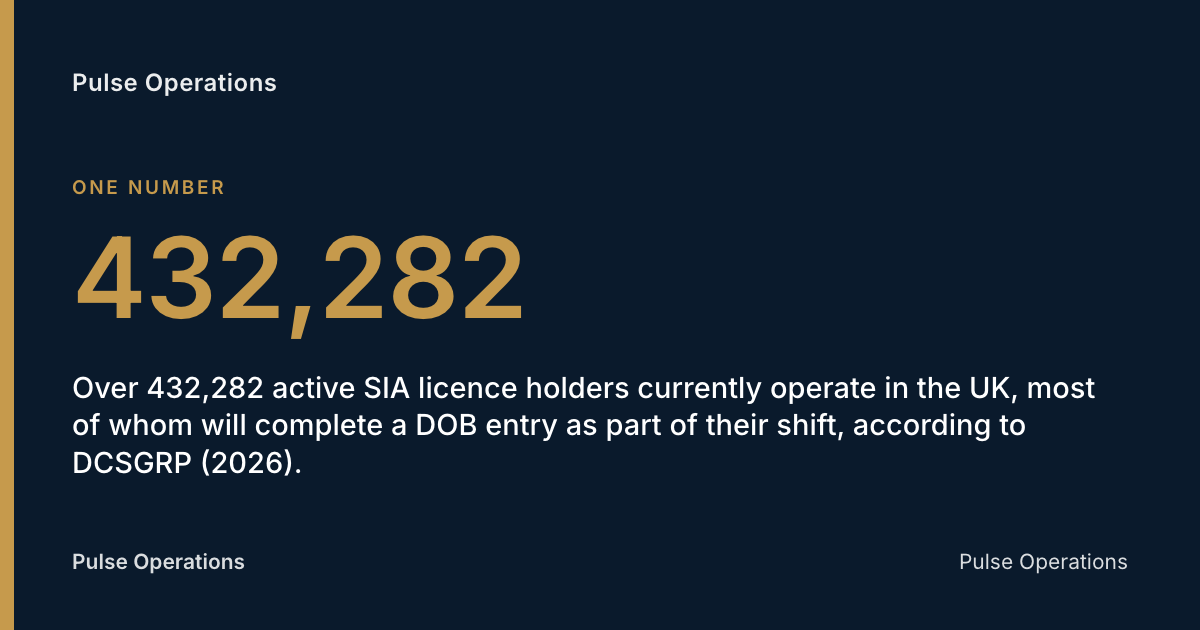
- Over 432,282 active SIA licence holders currently operate in the UK, most of whom will complete a DOB entry as part of their shift, according to DCSGRP (2026).
- Pulse Operations's platform makes every occurrence book tamper-evident with a hash-chained (SHA-256) audit log, rather than relying on a bound paper book or an editable spreadsheet.
What is a daily occurrence book and what is it used for?
A daily occurrence book is the master written record of everything that happens on a guarded site during a shift — arrivals, departures, alarms, visitors, defects, and incidents — logged in strict time order by the officer on duty. Security writers have put it plainly: DOBs "are intended to provide a chronological and sequential record of all occurrences that have transpired over time, on a specific site," as one piece in City Security Magazine notes.
The book exists for three reasons. First, continuity — the next officer, supervisor, or control room operator can pick up the book and know exactly what happened before they arrived. Second, accountability — it proves a patrol happened, a check was made, or a visitor was signed in, rather than asking a client to take the officer's word for it. Third, evidence — if a claim, dispute, or police investigation follows, the DOB is often the first document requested.
This matters more than it used to. The British Retail Consortium reported more than 2,000 incidents of violence and abuse against retail workers per day in 2023/24, up from 1,300 the year before, and the ONS recorded 530,643 shoplifting offences in the year to March 2026, a 20% year-on-year rise. A site logging that volume of activity on loose paper sheets is not building a usable record — it's building a pile of paper nobody can search.
Courts take the DOB seriously too. As one legal commentary in the same City Security Magazine piece puts it: "Courts of law routinely take the view, and rightly so, that if an occurrence has not been systematically and properly documented, then it cannot be relied upon as having taken place in exactly the manner alleged." An undocumented event, in other words, is treated as an event that didn't happen.
Who is responsible for maintaining the occurrence book?
The duty to maintain the occurrence book sits with the officer on shift, but overall responsibility for the system runs up through the site supervisor to the contract manager. The SIA (Security Industry Authority) licenses the individual who makes the entries; the contractor's quality management system, typically built around BS 7499:2020, governs how those entries are checked and retained.
In practice this breaks down into layers:
- The licensed officer writes the entry at the time the event occurs, not retrospectively at the end of shift.
- The site supervisor reviews and countersigns entries, usually daily or at shift handover, catching gaps before they become a problem six weeks later.
- The contract manager owns the retention schedule, GDPR compliance, and audit trail across every site under their control.
- The client (landlord, retailer, facilities manager) has a right, under most contracts, to inspect the book or request copies of relevant entries.
There are currently over 432,282 active SIA licence holders in the UK, according to DCSGRP (2026), and the SIA sets rules for roughly 328,000 UK security guards covering mandatory licensing, 128+ hours of initial training, and 18 hours of annual CPD, per Rock Security Solutions (2023). None of that training guarantees a consistent DOB on its own — it depends on the supervisor actually reviewing what gets written, not just trusting that it has been.
This is where paper books fall down structurally. A bound book can be left in a cupboard for a week without anyone noticing it's empty. Pulse Operations's officer app, by contrast, is offline-first with self-healing sync, so entries made on a phone with no signal still land in the record the moment connectivity returns — and a supervisor using Pulse Operations's control room sees a live gap, not a surprise at month-end.
What must each occurrence book entry record?
Every DOB entry needs five fixed fields: date, time, the name of the officer making the entry, a factual description of the occurrence, and the action taken as a result. Miss any one of these and the entry has limited evidential value — a time without a name is unverifiable; an action without a description is meaningless.
A well-formed entry follows this shape:
| Field | What it must contain | Common failure |
|---|---|---|
| Date | Full date, no abbreviation | Left blank, assumed from page order |
| Time | 24-hour clock, to the minute | Rounded to nearest hour |
| Officer name | Full name and SIA licence number | Initials only, unverifiable |
| Description | Factual, objective, no opinion | Vague ("some trouble at the gate") |
| Action taken | Specific step, who was informed | Omitted entirely |
| Signature | Handwritten or digital authentication | Entry left unsigned |
The description field is where most entries weaken. An entry that reads "disturbance at main entrance" tells an investigator nothing. An entry that reads "21:47 — male, approx. 30s, grey hoodie, attempted entry via main gate, refused access, left northbound on foot, no further incident" gives a usable, time-stamped account that stands up months later.
Pulse Operations treats this as the backbone of its product rather than a formatting suggestion. Its digital occurrence book covers 18 distinct occurrence types — from access control refusals to alarm activations to maintenance defects — so officers select a type and the app prompts for the fields that type legally needs, rather than leaving a blank text box and hoping the officer remembers what to include.
Is there a legal requirement to keep a daily occurrence book in the UK?
There is no single statute that says every UK site must keep a daily occurrence book, but the requirement arrives through contract, standard, and sector-specific regulation instead. BS 7499:2020, the British Standard code of practice for static guarding, requires records of all reported incidents to be kept for a minimum of 12 months from the date of the event. Most static guarding and keyholding contracts explicitly incorporate BS 7499 by reference, which makes the DOB a contractual obligation even where no Act of Parliament names it directly.
Sector variation is real, though:
- Private security contractors follow BS 7499 by convention and contract, policed through client audits and, increasingly, through SIA Approved Contractor Scheme assessments.
- Care homes keep occurrence-style logs under Care Quality Commission (CQC) record-keeping requirements, though the terminology differs (daily notes, incident logs).
- Schools maintain incident and visitor logs under safeguarding duties set out in statutory guidance such as Keeping Children Safe in Education, again without using the term "occurrence book" specifically.
- Publicly accessible venues face a newer layer: Martyn's Law — the common name for the Terrorism (Protection of Premises) Act 2026 — which, for enhanced-tier premises of 800+ capacity, requires a documented, current risk assessment that a well-kept occurrence book directly supports.
The practical answer for a security contractor is: treat it as mandatory. Coredinate (2026) notes that UK contractors carry a retention duty typically of at least 12 months after contract end under BS 7499 practice — meaning the obligation doesn't stop when the contract does. Pulse Operations's compliance runway tracks this kind of retention deadline alongside SIA licence expiries, BS 7858 screening renewals, and Martyn's Law readiness, on one expiries calendar rather than scattered across separate trackers. Read more in Pulse Operations's Martyn's Law readiness guide.
How does a daily occurrence book differ from an incident report form?
A daily occurrence book is a continuous, chronological log of everything on a site; an incident report form is a single, standalone document created only when something reportable has happened. The DOB records a security officer's entire shift in sequence — routine patrols, minor observations, shift handovers — while the incident form zooms in on one event with greater detail: witness statements, photographs, police reference numbers, and insurer-facing fields.
Think of the relationship this way: every incident report should be cross-referenced from the DOB, but not every DOB entry needs a full incident report. A patrol check that finds nothing wrong gets a one-line DOB entry. A break-in attempt gets a one-line DOB entry pointing to a full incident report with its own reference number.
| Daily Occurrence Book | Incident Report Form | |
|---|---|---|
| Frequency | Continuous, every shift | Only when a reportable event occurs |
| Format | Running log, chronological | Standalone document per event |
| Detail level | Brief, factual summary | Full detail — witnesses, photos, outcomes |
| Retention | Minimum 12 months (BS 7499) | Often longer, especially for insurance claims |
| Audience | Supervisor, next shift, client | Police, insurer, legal team, HR |
Confusing the two is a common failure mode. Sites that only fill in incident forms and skip the DOB lose the context around the incident — what was happening on site in the hours before, whether other officers reported anything unusual, whether the pattern had occurred before. Pulse Operations's platform links incidents directly to the relevant occurrence book entries automatically, so a supervisor investigating an event sees the surrounding shift activity without hunting through a separate paper trail.
How long should occurrence book records be retained, and what about GDPR?
Occurrence book records should be retained for a minimum of 12 months from the date of the event under BS 7499:2020, and most contractors extend that to at least 12 months after the contract itself ends. The BSI Standards Publication BS 7499:2020 sets the 12-month floor; Coredinate (2026) confirms that many contracts push retention past the contract's own end date, since claims and investigations often surface after a contractor has moved on.
That retention duty sits directly alongside UK GDPR and the Data Protection Act 2018, enforced by the Information Commissioner's Office (ICO). An occurrence book routinely contains personal data — names, vehicle registrations, descriptions of individuals — which means contractors need:
- A documented retention schedule that states how long entries are kept and why.
- A lawful basis for processing (typically legitimate interests, for security purposes).
- Secure storage, whether a locked cupboard for a paper book or access-controlled digital storage.
- A defined, auditable deletion or archiving process once the retention period lapses.
A bound paper book creates a genuine GDPR headache here: you cannot redact one line without visibly altering a page, and you cannot easily prove nobody added a retrospective entry. Pulse Operations addresses this with a hash-chained (SHA-256), tamper-evident audit log that includes a built-in integrity check walking the whole chain — so the retention record itself can demonstrate it hasn't been altered, which matters as much for a GDPR subject access request as it does for an insurance claim.
Physical bound book or digital occurrence book — which should you use?
A physical bound book and a digital occurrence book both satisfy the basic BS 7499 requirement, but they diverge sharply on tamper-evidence, searchability, and multi-site oversight. The traditional paper DOB uses the "No ELBOW" discipline — No Erasures, no Leaves torn out, no Blank spaces, no Overwriting, no Writing between lines — precisely because a bound book's only defence against tampering is the physical integrity of the paper itself.
The case for paper: it's cheap, officers are already trained on it, and it needs no app, login, or connectivity. For a single small site with one regular officer, a bound book may genuinely be proportionate.
The case for digital: every multi-site operator, every contract with a client portal requirement, and every site needing real-time visibility outgrows paper quickly. A paper book sitting in a cupboard on an unmanned site cannot be checked remotely at 2am; a digital entry can be seen by the control room the moment it's logged.
| Factor | Paper bound book | Digital occurrence book |
|---|---|---|
| Tamper resistance | Relies on No ELBOW discipline | Hash-chained, tamper-evident by design |
| Remote visibility | None — must physically visit site | Live, viewable from a control room |
| Search and retrieval | Manual, page by page | Instant, by date/type/officer/site |
| Multi-site reporting | Separate book per site | One dashboard across all sites |
| Offline resilience | Always available | Needs offline-first design (not all apps have this) |
Pulse Operations built its occurrence book offline-first specifically because basement plant rooms and underground car parks — exactly where incidents often happen — rarely have signal. Entries made with no connection sync automatically once the officer's phone reconnects, so the book works the way a paper one always has, just with a tamper-evident record behind it. Compare the approach against other platforms at /vs-tracktik and /vs-silvertrac.
In practice: a West London mixed-use site
Pulse Operations's founding operation, Priority First — disclosed here as the company's own London security & FM business, not an arm's-length customer — took on a landmark West London mixed-use development covering retail, residential, plant rooms, and service yards. The client's concern was simple: no way to prove which plant room had actually been checked at 3am. Pulse Operations made all 152 checkpoints across the site photo-mandatory, with incident and delivery logging on the same app used for patrols. Since going live in February 2026, the site has logged more than 540 patrols in its first five months, with 11 officers inducted onto one system rather than scattered paper books across separate buildings.
What checks should a supervisor carry out when reviewing occurrence book entries?
A supervisor reviewing occurrence book entries should check five things on every pass: completeness of fields, consistency of timestamps against patrol schedules, that every incident has a cross-referenced report, legibility (for paper), and that no gaps exist in the chronological sequence. A missing entry is often more revealing than a badly written one — it usually means a patrol didn't happen, or happened and wasn't logged, which are two very different problems with the same symptom.
Specific checks worth building into a daily or shift-end review:
- Compare DOB timestamps against the contracted patrol schedule — gaps longer than the agreed interval need an explanation.
- Confirm every reportable incident in the DOB has a corresponding incident report with a matching reference number.
- Check officer names against the current SIA licence register and BS 7858 screening status — an unlicensed or lapsed officer should never be making entries.
- Look for vague language ("all okay", "nothing to report") used repeatedly across a shift, which usually signals entries written in a batch at the end rather than in real time.
- Verify sign-off — an unsigned entry, paper or digital, has weaker evidential standing.
This is exactly the review Pulse Operations's control room automates. Its Ops Health morning brief surfaces missed checkpoints, incomplete entries, and overdue sign-offs before a client calls to ask what happened overnight, rather than after. As Pulse's founder puts it in relation to the wider platform philosophy: when the record is built in from the first entry rather than reconstructed afterwards, review stops being detective work.
Your daily occurrence book checklist
- Record date, time, officer name, description, and action taken for every entry.
- Write entries in real time, not retrospectively at end of shift.
- Apply the "No ELBOW" rule for any paper book — no erasures, no torn pages, no blank spaces, no overwriting.
- Cross-reference every incident entry to a full incident report with its own reference.
- Retain completed books for a minimum of 12 months under BS 7499, longer if the contract requires it.
- Confirm a documented GDPR retention and deletion schedule is in place and followed.
- Have a supervisor review and sign off entries at least daily, checking for gaps against the patrol schedule.
- Consider a digital, tamper-evident log if the site is multi-officer, multi-site, or client-portal facing.
FAQ
What is a daily occurrence book template?
A daily occurrence book template is a pre-formatted structure — paper or digital — with fixed fields for date, time, officer name, description, and action taken, designed so every entry captures the same required information consistently.
Do I need a daily occurrence book by law in the UK?
There is no single Act of Parliament mandating a DOB by name, but BS 7499:2020 requires incident records to be kept for a minimum of 12 months, and most static guarding contracts incorporate this standard by reference, making it a contractual requirement in practice.
How long must occurrence book entries be kept?
BS 7499:2020 sets a minimum retention period of 12 months from the date of the event, and many UK contractors extend this to at least 12 months beyond the end of the contract itself, per Coredinate (2026).
Who can make entries in a daily occurrence book?
The licensed officer on shift makes entries in real time, with a site supervisor or contract manager reviewing and countersigning them, typically at shift handover or daily review.
What's the difference between a daily occurrence book and an accident book?
A daily occurrence book logs all notable site activity chronologically, while an accident book specifically records workplace injuries and accidents under health and safety obligations connected to the Health and Safety at Work etc. Act 1974 — the two serve different legal purposes and shouldn't be merged.
Can a daily occurrence book be kept digitally instead of on paper?
Yes — a digital occurrence book satisfies the same BS 7499 requirements as a paper book, provided it maintains a tamper-evident, auditable record; Pulse Operations's version uses a hash-chained (SHA-256) audit log with a built-in integrity check for exactly this reason.
What happens if an occurrence book entry is missing or incomplete?
A missing or incomplete entry weakens the evidential value of the whole record, and courts have taken the view that undocumented occurrences cannot reliably be relied upon as having taken place as alleged, per commentary in City Security Magazine.
Securing your site's occurrence book with Pulse Operations
Paper occurrence books and editable spreadsheets share the same weakness: nobody can prove, after the fact, that nothing was added, removed, or backdated. Pulse Operations replaces both with a digital daily occurrence book covering 18 occurrence types, backed by a hash-chained, tamper-evident audit log that a client or auditor can verify rather than simply trust.
At Pulse Operations's own founding operation, Priority First, 24 sites now run occurrence book, incidents, and patrols on one login, with over 4,900 patrols completed on the record as of July 2026 — every checkpoint backed by a watermarked photograph rather than a signature in a book.
If your current DOB lives in a cupboard, a spreadsheet, or a WhatsApp thread, get in touch with Pulse Operations for a walkthrough of the occurrence book and the wider platform, or see published pricing at /pricing — per operative, unlimited sites, with every admin and portal seat free.
Related Reading
- Security Guard Handover Template UK | Free Guide 2026
- Client Monthly Report Template UK: What to Include
- Security Guard Timesheet Template UK (2026 Guide)
Add pulse-operations.co.uk as a preferred source on Google
Back to all insights