Last updated: 16 October 2026
A daily occurrence book PDF is a downloadable template security officers, care staff or site teams use to record shift-by-shift events — arrivals, incidents, patrol checks, visitor movements. Free versions are widely available in the UK, but most lack the structure, timestamping and tamper-evidence that make an occurrence book stand up as a reliable record.
Key Takeaways
- A daily occurrence book is a chronological written record of events on a site or shift, traditionally kept in a bound notebook and now often digitised.
- No single UK statute names the "daily occurrence book" format, but the Security Industry Authority sets licensing standards under the Private Security Industry Act 2001 that make accurate record-keeping expected practice.
- City Security Magazine notes that "courts of law routinely take the view, and rightly so, that if an occurrence has not been systematically and properly documented, then it cannot be relied upon as having taken place in exactly the manner alleged."
- A free daily occurrence book PDF is a reasonable starting point for a single site, but it offers no audit trail, no backup and no way to prove an entry wasn't edited after the fact.
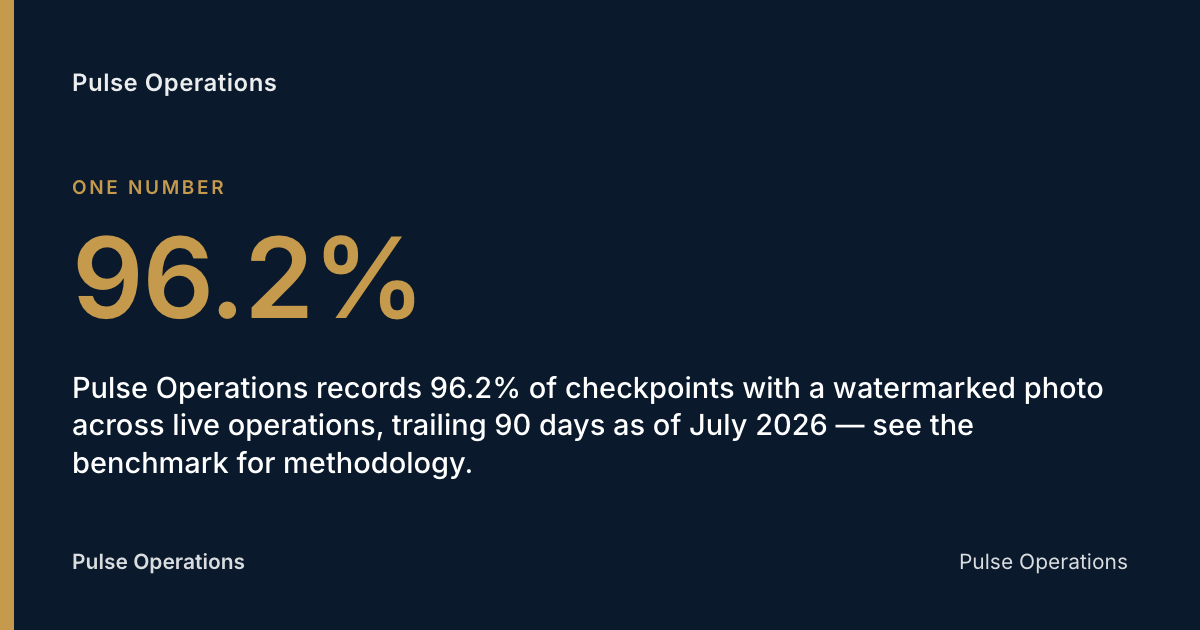
- Pulse Operations records 96.2% of checkpoints with a watermarked photo across live operations, trailing 90 days as of July 2026 — see the benchmark for methodology.
What is a daily occurrence book and what is it used for?
A daily occurrence book (often shortened to DOB) is a chronological log of everything notable that happens on a site or during a shift, kept so that events can be reconstructed accurately later. It originated in policing — the Puducherry Police Manual still describes the Daily Occurrence Report and General Diary as core station records — and the format was adopted wholesale by the private security industry.
In a commercial setting, a DOB covers patrol times, visitor sign-ins, deliveries, alarm activations, equipment faults, keyholding movements and anything out of the ordinary. City Security Magazine describes it as a document that "can carry legal significance and should lie at the heart of any good corporate security operation." The comparison most often used by practitioners is a police officer's notebook: both exist to create a contemporaneous account that can be checked, queried or produced as evidence weeks or months after the event.
Security contractors use a DOB to answer the question every client asks sooner or later: what actually happened here last night? Care homes use a similar log for shift handovers. Schools and FM teams use site logbooks for the same reason — a readable, ordered account that doesn't depend on someone's memory.
Who is responsible for maintaining a daily occurrence book on site?
Responsibility for a daily occurrence book sits with the officer or member of staff on duty at the time, with a supervisor or manager responsible for reviewing and signing off entries. On a licensed security contract this typically means the SIA-licensed officer on shift completes the book, and a site or area manager checks it during inspections or handovers.
SIRV states plainly that "a daily occurrence book may be referred to in a court of law. As a result they are often considered as important as a police officer's note book." That standard implies a chain of accountability: whoever writes an entry should sign or initial it, and whoever reviews the book should be identifiable too.
In care settings, the responsibility usually sits with the shift lead under policies set by the registered manager, with CQC inspection in mind. In schools, premises or site managers typically own the logbook as part of health and safety record-keeping under the Health and Safety at Work etc. Act 1974. On a multi-site security contract, this is where paper books start to fail — a logbook on a desk in Croydon tells a manager nothing about what's happening at a sister site in Southwark, and sign-off depends entirely on someone physically walking over to check it.
Pulse Operations builds this accountability into the record itself rather than relying on a signature. Every entry in Pulse's occurrence book is attributed to a named officer by device login, timestamped automatically, and visible to control room staff in real time rather than at the next site visit.
Where can I find a free downloadable daily occurrence book PDF template?
Free daily occurrence book PDF templates are available from several UK security industry blogs and suppliers, typically offering a ruled page with columns for time, event and signature. SIRV publishes guidance alongside downloadable templates aimed at security contractors, and similar free layouts circulate across facilities management and care sector forums.
A basic free template is genuinely useful for a sole trader or single static site with low entry volume — there's no reason to pay for software to log three visitor sign-ins a day. But a PDF template comes with real limits worth knowing before you commit a client contract to one:
- No audit trail. Anyone can tear out a page, write over an entry, or complete the book retrospectively at the end of a shift with no record that this happened.
- No backup. A paper book left on site can be lost, damaged or go missing entirely — taking the only copy of several weeks' records with it.
- No search function. Finding what happened on the 14th of a given month means flicking through pages by hand.
- No real-time visibility. A control room, duty manager or client can't see what's in the book until someone physically opens it.
- Manual GDPR handling. Redacting personal data under the UK GDPR from a handwritten page means a highlighter pen and a photocopier, not a database query.
For a contract of any size — multiple sites, an ACS-aspiring contractor, or any client who will ask for evidence — these gaps start to matter more than the template's cost.
Is a daily occurrence book a legal requirement under UK law?
No single UK statute names "the daily occurrence book" as a mandatory document, but the record it contains carries real evidential weight and is expected practice across licensed security work. The Security Industry Authority, established under the Private Security Industry Act 2001, licenses door supervisors, security guards and CCTV operators and expects contractors to maintain accurate operational records as a condition of good practice, even where the specific format isn't prescribed in legislation.
The legal significance comes from how courts treat contemporaneous records generally. City Security Magazine is explicit on this point: if an occurrence "has not been systematically and properly documented, then it cannot be relied upon as having taken place in exactly the manner alleged." In practice, that means a DOB entry can be produced in an employment tribunal, an insurance claim, a police investigation or a civil dispute — and its credibility depends on when it was written and whether it can be shown not to have been altered afterwards.
Contractually, many client agreements and tender specifications now require evidence of record-keeping as a pass/fail gate. Per Pulse Operations's guide, how to win your next security tender, public-sector buyers operating under the Procurement Act 2023 regime score bids on a published price/quality split, and screening records, management information and reporting are among the handful of quality questions that typically decide a contract. A contractor who can't produce a defensible occurrence book risks failing that gate before price is even considered.
"A paper occurrence book is written at the end of the shift by whoever's left standing. Ours writes itself as the shift happens — every patrol, incident and check call lands in it with a timestamp, and nothing can be quietly rewritten afterwards. That's what an insurer actually wants to see." — Mo Hassan, Founder, Pulse
How long should completed daily occurrence books be kept, and what about GDPR?
Completed daily occurrence books should be retained long enough to cover contractual liability periods and likely claim windows, commonly several years, and handled as personal data under the UK GDPR wherever names, vehicle registrations or descriptions of individuals appear. There's no single statutory retention period specific to occurrence books, so most contractors set their own policy based on contract terms, insurance requirements and general civil claim limitation periods — typically six years for most contract and tort claims in England and Wales.
Because a DOB routinely records names, visitor details, vehicle plates and sometimes incident descriptions involving identifiable people, it falls squarely within UK GDPR and the Data Protection Act 2018. The Information Commissioner's Office expects organisations to hold personal data only as long as necessary, keep it secure, and be able to respond to subject access requests. A paper book makes this awkward: redacting one person's details from a page that also contains other operational information isn't straightforward, and a lost book is a potential data breach with no way to know what it contained.
A digital occurrence book handles retention and data protection by design. Pulse Operations's occurrence book runs on a hash-chained, SHA-256 tamper-evident audit log with a built-in integrity check that walks the whole chain — meaning retained records can be proven unaltered years later, not just stored.
Daily occurrence book vs incident report form: what's the difference?
A daily occurrence book is a continuous chronological log of everything happening on a shift, while an incident report form is a standalone document triggered by one specific notable event. The DOB captures the routine alongside the exceptional — a 2am patrol, a delivery at 9am, a visitor at 11am — whereas an incident report exists only when something specific needs escalating: an assault, a theft, an injury, a security breach.
| Daily occurrence book | Incident report form | |
|---|---|---|
| Trigger | Continuous, every shift | Only when an incident occurs |
| Content | Routine events and exceptions | One specific event, in detail |
| Length | Short entries, high volume | Longer narrative, lower volume |
| Audience | Supervisors, client, auditors | Client, insurer, police, HR, legal |
| Typical use | Pattern-spotting, handovers | Formal escalation and investigation |
The two documents work together rather than compete. A well-kept DOB often references the incident report by number or time — "see incident report #4 for full detail" — so a reviewer can move between the routine log and the detailed account without losing the thread. Pulse Operations treats these as linked records in one system: the occurrence book captures 18 defined entry types, and any entry can be escalated into a full incident record without re-keying details, with the control room seeing both the same way an on-site supervisor would.
How should a daily occurrence book PDF be formatted and structured?
A usable daily occurrence book PDF needs consistent columns so that every entry, regardless of who wrote it, can be read the same way. Pulse Operations requires that, at minimum, each entry should capture: date, time (24-hour clock), officer name and licence number where relevant, location or checkpoint, a plain description of the event, and a signature or initials.
Good practice from policing and private security guidance converges on a similar structure:
- Header block per page: site name, date, shift (day/night), officer name and SIA badge number
- Entry rows: time, event description, action taken, signature
- Page numbering: sequential, so a missing page is obvious
- Handover section: space for the outgoing officer to brief the incoming one
- Supervisor review line: name, date and signature confirming the page has been checked
A bound, pre-numbered paper book makes tampering harder to hide — pages can't be slipped out without leaving a gap. That's precisely the property a digital system needs to replicate deliberately, since a PDF that can be edited and re-saved offers none of that protection on its own. Pulse Operations's digital occurrence book preserves the sequential, tamper-evident property of a bound book while adding timestamping, GPS context and photo evidence that paper simply can't carry.
Common mistakes in daily occurrence book entries, and how to format one for a PDF
Vague entries are the single most common failure in daily occurrence book writing — "all quiet" or "nothing to report" tells a reviewer nothing and holds no evidential weight if challenged later. The entries that stand up are specific: who, what, where, when, and what action followed.
Other recurring mistakes worth checking against a template before it goes into use:
- Writing up entries hours later from memory rather than at the time — this is exactly the "systematic and proper documentation" courts look for, per City Security Magazine.
- Using correction fluid or scribbling out mistakes instead of a single line through an error, initialled and dated.
- Leaving gaps between entries large enough to insert a late addition.
- No handover note between shifts, so the incoming officer starts blind.
- Mixing opinion with fact — "the visitor seemed suspicious" is weaker than "the visitor could not produce ID and left the site at 14:32."
- No supervisor sign-off, so no one outside the shift has reviewed the record.
- Using 12-hour time without am/pm, which creates genuine ambiguity in an evidential document.
Should a daily occurrence book be printable PDF, editable digital form, or software?
A printable PDF suits very low-volume, single-site use where cost is the main constraint, while a software-based occurrence book suits any contractor running multiple sites, bidding for ACS accreditation, or needing to prove delivery to a client in real time. An editable digital form (a fillable PDF or spreadsheet) sits awkwardly in between — easier to type into than a paper book, but just as easy to retrospectively edit, which undermines the evidential value both formats are meant to provide.
| Printable PDF | Editable digital form | Software platform | |
|---|---|---|---|
| Cost | Free–low | Low | Per-operative subscription |
| Tamper-evidence | Physical only (bound book) | None — fully editable | Hash-chained audit log |
| Real-time visibility | None | Limited (shared file) | Live control room view |
| Multi-site view | Impossible | Manual | Built in |
| GDPR handling | Manual redaction | Manual | Structured, searchable |
| Best suited to | Single small site | Very small operator | Multi-site contractors, ACS-aspiring firms |
This is the trade-off every growing security or FM contractor eventually faces: a free template costs nothing but time, until the time spent reconciling records, chasing missing pages, or failing a tender's evidence question costs more than a platform subscription would have. Pulse Operations prices its occurrence book, patrol and compliance tools per operative, with unlimited sites and free admin and portal seats on every plan, published openly at /pricing — so the comparison is one a contractor can actually run with real numbers rather than a sales call.
In practice: when Priority First — the founding team's own London security and FM operation, and the business Pulse was originally built inside before being offered to other operators — was running on paper sign-in sheets and WhatsApp messages, there was no way to answer a client's 7am call asking whether everything had been OK overnight. Pulse went live across the operation in February 2026; within six months Priority First had 24 sites running on one login, with more than 4,900 patrols completed on the record and 100% of checkpoints backed by a watermarked photo, checked against production data as of July 2026.
What checks confirm a daily occurrence book PDF template is fit for purpose?
A daily occurrence book template is fit for purpose if it forces consistent, timestamped, attributable entries and can't easily be altered without leaving a trace. Before rolling a free template out across a site or contract, run it against a short checklist rather than assuming any PDF found online will do.
Confirm the template includes a dated header, sequential page numbers, a 24-hour time column, space for both the writing officer's and a supervisor's signature, and a defined list of entry types so staff aren't guessing what counts as reportable. Check it against any client contract or tender specification that references record-keeping standards — per Pulse Operations's guide, the ACS self-assessment: how to evidence it, the SIA's Approved Contractor Scheme workbook scores businesses against 78 indicators across seven criteria including Service delivery and People, and assessors review site documentation and interview staff directly rather than taking a score at face value. A template that can't produce clean, consistent evidence under that kind of scrutiny isn't fit for an ACS-aspiring contractor, whatever it costs.
Your daily occurrence book checklist
- Confirm every entry records date, 24-hour time, location, officer name and SIA licence number where relevant.
- Require a specific description for every entry — ban "all quiet" and similar non-entries.
- Build in a shift handover section so incoming officers aren't starting blind.
- Add a supervisor sign-off line and check it's actually being used, not just printed.
- Set a retention policy in writing — align it to contract length and the six-year general claims period.
- Treat any personal data in the book as UK GDPR data: know where it's stored and who can access it.
- Decide, before a client or tender asks, whether paper evidence will actually stand up to the scrutiny described in Pulse Operations's ACS guide.
- Test the template against a real multi-site scenario before committing a contract to it.
FAQ
What is a daily occurrence book used for?
A daily occurrence book is used to create a chronological, contemporaneous record of everything notable that happens on a shift or site, from routine patrol checks to visitor movements and incidents. It exists so events can be accurately reconstructed later, whether for a client query, an insurance claim or a legal dispute.
How do you write an entry in a daily occurrence book?
Write the entry at the time it happens, in 24-hour time, stating exactly who, what, where and when — never a vague summary like "all quiet." Sign or initial the entry and leave no gaps that could allow a later insertion.
Is a daily occurrence book legally admissible in court?
A daily occurrence book can be referred to in court and is often treated with similar weight to a police officer's notebook, according to SIRV. Its admissibility and weight depend heavily on whether it was completed systematically and contemporaneously, per City Security Magazine.
What is the difference between a daily occurrence book and an incident report?
A daily occurrence book is a continuous log covering every shift, while an incident report form is a standalone document completed only when a specific notable event — such as a theft or injury — occurs. Well-run operations link the two, referencing the incident report number inside the relevant DOB entry.
Where can I download a free daily occurrence book PDF template?
Free templates are published by security industry blogs such as SIRV, typically offering a ruled page with time, event and signature columns. They suit a single low-volume site but lack an audit trail, backup or real-time visibility for larger or multi-site operations.
Is a digital occurrence book better than a paper logbook?
A digital occurrence book offers real-time visibility, automatic timestamping, searchable records and tamper-evidence that paper logbooks cannot easily replicate. A paper book remains viable for a single small site with low entry volume and no multi-site reporting requirement.
Who is responsible for opening and closing an occurrence book?
The on-duty officer or staff member is typically responsible for writing entries during their shift, with a supervisor or manager responsible for reviewing and signing off the book at handover or during site visits. On licensed security contracts this usually means an SIA-licensed officer completes the book under a site or area manager's oversight.
Securing your records with Pulse Operations
Every problem this article raises — vague entries, missing pages, no way to prove a record wasn't altered after the fact — is the exact gap Pulse Operations built its occurrence book to close. Instead of a page written up at the end of a shift from memory, Pulse logs 18 defined entry types as events happen, each one timestamped and attributed to a named officer, sitting inside a hash-chained audit log with a built-in integrity check.
At the landmark West London development where Priority First manages retail, residential, plant rooms and service yards across 152 checkpoints and 11 officers, the question used to be unanswerable: which plant room was actually checked at 3am? Since going live in February 2026, every one of those 152 checkpoints has been made photo-mandatory, so a missed area shows up as a gap in the record — not a dispute raised six weeks later.
If your occurrence book currently lives in a PDF, a spreadsheet or a drawer, it's worth seeing what a system built for exactly this looks like. Get in touch with Pulse Operations for a demo, or review the published pricing at /pricing to see what a tamper-evident occurrence book costs against your current setup.
Related Reading
- Closing an Occurrence Book Entry: UK Guide 2026
- Accident Book Requirements UK: 2026 Legal Guide
- Silvertrac Alternative 2026: Best UK Options Compared
Add pulse-operations.co.uk as a preferred source on Google
Back to all insights