Last updated: 24 August 2026
Security Guard Handover Template: The Complete UK Guide for 2026
A security guard handover template is a structured document that captures everything an outgoing officer needs to tell the incoming officer at shift change — incidents, access issues, equipment faults, and outstanding tasks. Used correctly, it closes the information gaps that cause missed patrols, repeated incidents, and disputes over who was responsible when something went wrong.
Key Takeaways
- A security guard handover template creates a written, time-stamped record of shift activity that protects both the guarding company and the client if an incident is later disputed.
- The UK security guarding sector generated £6.8 billion in revenue in 2023, up 5.1% year-on-year, according to WifiTalents Security Guard Industry Statistics (2023) — a market where documentation standards increasingly separate professional contractors from the rest.
- Roughly 450,000 people hold an SIA licence in the UK, per Security Jobs Board (2026), and every one of them will conduct a shift handover at some point in their working week.
- An SIA licence is valid for three years once granted, according to GOV.UK (2026), which means handover records often need to reference licence status across renewal cycles.
- Digital handover tools that timestamp and geo-tag entries close the gaps that paper logs leave open, particularly around disputed incidents and missed checkpoints.
What is a security guard handover template?
A security guard handover template is a standardised document that structures the transfer of shift responsibility between one officer and the next. It typically covers incidents logged during the shift, the status of access points and alarms, equipment condition, keys and fobs accounted for, and any tasks left outstanding for the next officer to pick up.
The template exists to remove ambiguity. Without one, handovers rely on memory and informal chat — which falls apart quickly on a busy retail site, a construction perimeter, or a shopping centre with multiple entry points. A good template forces the outgoing officer to record specifics: times, locations, names, and actions taken, rather than vague summaries like "quiet night."
For UK security companies, the handover template also functions as evidence. If a client disputes coverage, an insurer questions an incident, or the Security Industry Authority (SIA) audits licensing compliance, a properly completed handover log is often the first document requested.
What should be included in a security guard handover template?
A security guard handover report should include every fact the next officer needs to operate safely and knowledgeably from minute one of their shift. At minimum this means shift times, site name, officer names and SIA licence numbers, incidents logged, access control status, equipment checks, and outstanding actions. Anything less leaves gaps that create liability.
The strongest templates separate information into distinct sections rather than one free-text box, because free-text boxes get skipped or rushed when an officer is tired at 6am after a night shift.
Core fields every handover should capture
- Site and shift details — site name, address, shift start/end time, weather conditions if relevant to patrols
- Officer identification — outgoing and incoming officer names, SIA licence numbers, and licence category (e.g. door supervision, security guarding)
- Incident summary — a reference to each incident logged in the daily occurrence book, including time, location, and action taken
- Access and alarm status — which doors, gates, or barriers were locked/unlocked, and whether alarms were armed or triggered
- Equipment and keys — radios, torches, vehicle keys, master keys, and any faults noted
- Patrol completion — which checkpoints were completed, missed, or delayed, and why
- Outstanding tasks — anything the incoming officer needs to action, chase, or monitor
- Visitor and contractor log — anyone who entered the site outside normal hours
- Sign-off — both officers' signatures or digital confirmation, with a timestamp
Why free-text handovers fail
A single open text box invites shorthand and omission. An officer finishing a 12-hour shift is far more likely to write "all fine" than to work through a structured checklist covering ten separate fields. Structured templates — whether paper-based or built into a mobile app — force completeness by design, not by good intentions.
Why does a security handover template matter for compliance and liability?
A security guard handover template matters because it creates a defensible, time-stamped record that stands up to scrutiny from clients, insurers, and regulators. Without one, a guarding company has no reliable way to prove what happened during a shift, who was on site, or whether contractual obligations — such as patrol frequency — were actually met.
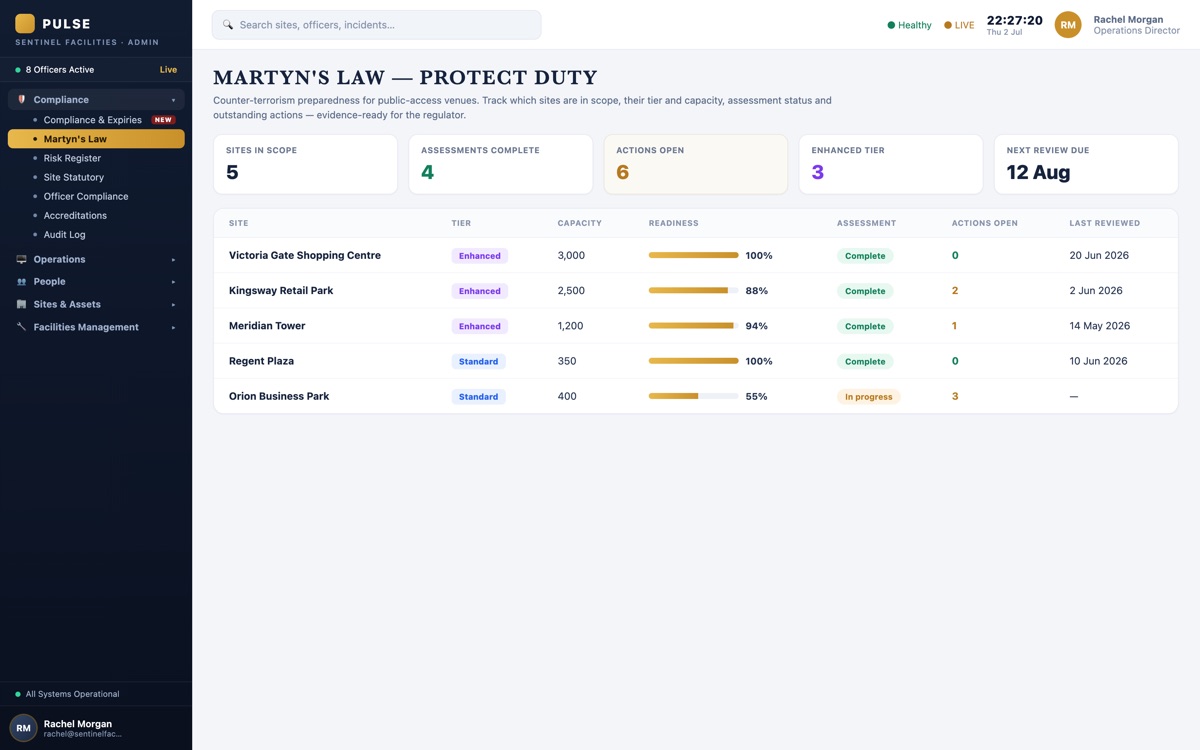
This matters more than ever given the scale of regulation UK guarding firms operate under. The Private Security Industry Act 2001 established the SIA and the licensing regime that governs the sector, and firms are increasingly expected to evidence compliance with frameworks such as BS 7858 (security screening) and, for higher-risk sites, the emerging duties under Martyn's Law (the Terrorism (Protection of Premises) Act). A handover log that shows continuous, documented coverage supports all of these obligations.
The licensing dimension
Since 1 April 2026, refresher training has been mandatory before SIA licence renewal, and officers need a valid Emergency First Aid at Work (EFAW) qualification to take that refresher course, according to K4 Training (2026). Handover templates that record officer licence numbers make it far easier for a control room to spot a licence approaching its three-year expiry before it lapses mid-shift, since an SIA licence is valid for three years once granted.
The SIA licence application fee itself is £204 from 1 April 2026, with a further £230–£350 typically spent on first aid and licence-linked training, according to K4 Training (2026). Given that cost and the three-year renewal cycle, guarding firms have a strong financial incentive to track licence status through the same systems that manage handovers and rostering, rather than as a separate spreadsheet nobody checks.
The liability dimension
When something goes wrong — a break-in, a slip-and-fall claim, a missed delivery collection — the first question from a client, insurer, or solicitor is usually "what does the handover log say?" A structured, signed record is far stronger evidence than a verbal account reconstructed weeks later. This is particularly relevant on sites governed by the Health and Safety at Work etc. Act 1974, where an employer's duty of care extends to ensuring information is properly passed between shifts.
Paper vs digital handover templates: which is better?
Paper handover sheets and digital handover systems both capture the same core information, but they differ enormously in reliability, auditability, and speed. Paper is cheap and familiar but easily lost, illegible, or backdated. Digital systems timestamp entries automatically, sync across a control room in real time, and cannot be quietly altered after the fact — which matters when a handover log becomes evidence.
| Feature | Paper handover sheet | Digital handover system |
|---|---|---|
| Time-stamping | Manual, editable | Automatic, tamper-evident |
| Legibility | Depends on handwriting | Always typed/structured |
| Control room visibility | None until physically collected | Live, real-time |
| Audit trail | Weak — pages can go missing | Strong — full history retained |
| Photo evidence | Not practical | Built in (e.g. watermarked photos) |
| Offline reliability | Always works | Depends on app design (offline-first apps still work) |
| Client reporting | Manual re-typing required | Can feed directly into a client portal |
| Cost | Low upfront | Subscription-based, scales with headcount |
When paper still makes sense
Very small operations — a single keyholding contract or a single static guard covering occasional shifts — may find a simple paper template sufficient in the short term. It costs nothing beyond printing, and for a one-site operation the audit trail risk is lower because there's only one handover chain to manage.
When digital becomes essential
Once a guarding company runs multiple sites, multiple shift patterns, or client contracts that specify reporting obligations, paper handovers become a liability rather than a convenience. Sheets get left in guard huts, handwriting becomes illegible after a night shift, and there's no way for a control room to spot a missed handover until it's too late. This is precisely the gap that platforms like Pulse Operations are built to close — turning the handover from a static document into a live, verifiable record that feeds directly into incident management, the daily occurrence book, and client reporting.
How does a digital handover template improve accountability?
A digital handover template improves accountability by attaching hard evidence — timestamps, GPS location, and photographs — to every entry an officer makes, rather than relying on a signature at the bottom of a page. This closes the two biggest weaknesses of paper-based handovers: backdating and vague description.
Instead of an officer writing "patrol completed, no issues," a digital system can require a watermarked photograph showing the officer, the site, the GPS coordinates, and the exact time at each checkpoint. That single feature turns "I checked it" into verifiable proof, which matters enormously if a client later disputes whether a patrol actually happened.
Building the handover into the daily occurrence book
Many UK sites — particularly retail, shopping centres, and construction — require a daily occurrence book (DOB) as a condition of their contract or insurance. A modern approach links every handover entry directly to the relevant DOB category (Pulse Operations structures this across 18 distinct incident and event types), so nothing gets logged twice and nothing falls between the cracks when shifts change.
Feeding the control room in real time
A digital handover doesn't need to wait for the next officer to arrive on site. Live systems push handover notes to a control room the moment they're logged, meaning a controller can flag an unresolved issue — a broken gate lock, a missing key, a lone-worker welfare concern — before the incoming officer even clocks in. This real-time visibility is what separates a genuinely operational handover system from a glorified digital notepad.
How do you customise a handover template for different site types?
A generic handover template works for none of the sites it's used on particularly well — retail, construction, and events all have different priorities that a template should reflect. Customising the template around the specific risks of a site type produces far better completion rates and far more useful records.
Retail and shopping centre sites
Retail handovers should prioritise footfall-related incidents, till or cash office access, shoplifting reports, and out-of-hours contractor access. Shopping centres with multiple retail units often need a handover template that references individual unit alarm codes and key-holder contact details separately from the main site record.
Construction sites
Construction handovers focus heavily on perimeter integrity, plant and equipment security, and access control for subcontractors who rotate frequently. A handover template here should log which contractors were on site, what plant was checked, and whether fencing or hoarding was found compromised — details that matter enormously if theft or vandalism is later reported to the client or insurer.
Corporate and estates sites
In-house estates teams and FM providers typically need handovers that tie into building management systems — lift faults, HVAC alarms, fire panel status — alongside standard security tasks. This is where security handovers start to overlap with facilities management work orders, and why unified platforms that cover both security and FM (rather than treating them as separate systems) reduce duplicate reporting.
Events security
Event handovers are usually shift-to-shift within a single day rather than day-to-day, and need to capture crowd density observations, incident escalations, and coordination with event control — often on a much tighter reporting cycle than a static site.
Your security guard handover template checklist
Use this checklist to build or audit a handover template for your own sites:
- Confirm officer identification — record outgoing and incoming officer names and SIA licence numbers on every handover
- Log every incident with time and location — never summarise multiple incidents into one vague line
- Record access and alarm status explicitly — state which doors/gates were locked and whether alarms were armed
- Account for all keys and equipment — list radios, master keys, and vehicle keys by name, not "as usual"
- Note patrol completion honestly — flag missed or delayed checkpoints rather than marking everything complete
- Capture outstanding tasks clearly — write actions as instructions for the next officer, not observations
- Get a signed or digital sign-off from both officers — no handover is complete without acknowledgement from the incoming officer
- Cross-check licence expiry dates periodically — since SIA licences run for three years, build a reminder into your handover or rostering system
FAQ
What is a security guard handover template?
A security guard handover template is a structured document used to transfer shift responsibility from one security officer to the next. It records incidents, access control status, equipment condition, and outstanding tasks so the incoming officer has full situational awareness from the start of their shift.
What should be included in a security guard shift handover report?
A security guard shift handover report should include site details, officer names and SIA licence numbers, a summary of incidents logged, access and alarm status, equipment and key accountability, patrol completion status, and any outstanding tasks. Both officers should sign off or digitally confirm the handover before the outgoing officer leaves site.
Why is a security guard handover checklist important?
A security guard handover checklist is important because it prevents information loss between shifts and creates a documented record that protects the guarding company if an incident is disputed later. Without a checklist, handovers rely on memory and informal conversation, which fail under pressure or fatigue.
How do you write a security guard handover note?
Write a security guard handover note by recording specific facts — times, locations, names, and actions taken — rather than general impressions. Each entry should answer what happened, when, where, and what was done about it, so the next officer can act on the information immediately without needing clarification.
What is the difference between a daily activity report and an end-of-shift handover?
A daily activity report logs everything that happened during a single officer's shift as a continuous record, while an end-of-shift handover specifically summarises what the incoming officer needs to know to take over safely. Many sites use both together: the activity report as the full record, and the handover as the actionable summary.
Do security guards need to sign handover reports?
Yes, both the outgoing and incoming officer should sign or digitally confirm a handover report, since this acknowledgement is what makes the document defensible evidence if a dispute or incident investigation arises later. A handover without sign-off is essentially just a note, not a verified transfer of responsibility.
Can a security handover checklist be used as legal evidence?
Yes, a properly completed and signed security handover checklist can be used as evidence in disputes, insurance claims, or regulatory investigations, provided it's contemporaneous and hasn't been altered after the fact. This is why tamper-evident digital records, with automatic timestamps, carry more evidential weight than paper logs that can be backdated.
How often should a security shift handover occur?
A security shift handover should occur at every change of officer, whether that's twice daily on a standard day/night rotation or more frequently on events with multiple shorter shifts. The frequency should match the shift pattern specified in the client contract, not be left to informal arrangement between officers.
Building better handovers with Pulse Operations
Every issue this article covers — vague free-text entries, missing sign-offs, paper sheets left in a guard hut, no visibility for the control room until it's too late — is exactly what Pulse Operations was built to solve for UK security and FM companies. Rather than treating the handover as a standalone form, Pulse ties it directly into the officer's daily activity, the tamper-evident daily occurrence book, and the client-facing portal, so nothing gets lost between shift changes.
Pulse's proof-of-service model means every checkpoint completed during a shift is verified with a watermarked photograph capturing the officer, the site, GPS location, and time — giving handovers a level of evidential weight a paper signature simply can't match. That same data feeds the live control room map, so a controller can see an outstanding handover issue in real time rather than discovering it after a client complaint.
If your current handover process relies on paper sheets, group chat messages, or a spreadsheet nobody reliably updates, it's worth seeing what a unified system looks like in practice. Get in touch with Pulse Operations to book a demonstration and see how the officer app, control room, and client portal work together around a single, accountable handover record.
Related Reading
- Guardhouse Alternative 2026: Best UK Options Compared
- SmartTask Alternative 2026: Best Options Compared