Last updated: 23 August 2026
Guardhouse Alternative: The Best UK Options for Security Operators in 2026
A Guardhouse alternative is a workforce management platform that UK security and facilities companies switch to for better SIA (Security Industry Authority) compliance tracking, proof-of-patrol verification, and pricing flexibility. Guardhouse contracts can start at $10,000 annually with most clients reporting ROI within 3-6 months, according to GoodCall (2026), pushing many UK firms towards platforms like Pulse Operations, TrackTik and Silvertrac instead.
Key Takeaways
- Guardhouse can cost up to $2,300 per month, compared with rivals like GuardsPro starting at $5 per user per month, according to TARGPatrol (2026).
- The global security guard management software market was valued at $1.63 billion in 2026 and is projected to reach $4.46 billion by 2033, a CAGR of 11.8%, per Grand View Research (2026).
- The SIA Security Guard Licence costs a non-refundable £204, paid directly to the regulator, according to Get Licensed (2026).
- Employers who deploy unlicensed guards face prosecution, with penalties of up to six months' imprisonment and unlimited fines, according to Veritech Security (2026).
- Pulse Operations verifies every patrol checkpoint with a watermarked photograph capturing officer, site, GPS and time — a proof-of-service model distinct from NFC or QR tag scanning used by many rivals.
What Is a Guardhouse Alternative?
A Guardhouse alternative is any security workforce management software that replaces Guardhouse's scheduling, patrol-tracking and reporting functions for UK security companies, mobile patrol providers, and in-house facilities teams. Guardhouse is an Australian-built platform popular with contract security firms for rostering, incident reporting and client portals. UK operators increasingly look elsewhere because Guardhouse's pricing, compliance tooling and support model were not built around the Private Security Industry Act 2001 or the specific demands of SIA-regulated guarding.
The core function of any alternative is the same: get guards on site, prove they did their job, and produce evidence a client — or a court — will accept. The differences lie in how each platform verifies attendance, tracks statutory compliance such as SIA licences and DBS (Disclosure and Barring Service) checks, and prices the service as a business scales from a handful of sites to hundreds.
Why UK Firms Search for a Guardhouse Alternative
Most searches for a Guardhouse alternative come from three pain points: rigid annual contracts, pricing that doesn't map cleanly to UK operations, and compliance features built for a different regulatory system. Guardhouse's origins in the Australian market mean features like licence renewal alerts, BS 7858 vetting stages, and Martyn's Law (the Terrorism (Protection of Premises) Act 2026) risk assessments are either absent or bolted on rather than native.
UK security company owners and ops directors also frequently cite a need for tighter proof-of-attendance evidence — something insurers, clients and the SIA itself scrutinise closely during audits and contract renewals.
How Much Does Guardhouse Cost Compared to UK Alternatives?
Guardhouse pricing is not published transparently, which is itself a common complaint among UK buyers used to fixed per-operative rates. Independent research shows Guardhouse can run up to $2,300 per month for larger deployments, according to TARGPatrol (2026), while annual contracts reportedly start at $10,000 for smaller operations, per GoodCall (2026). By contrast, Pulse Operations publishes flat, per-operative UK pricing with no annual lock-in beyond an initial founding-rate term.
| Platform | Entry Price | Contract Term | Pricing Model |
|---|---|---|---|
| Guardhouse | ~$10,000/year (smaller ops) | Annual | Per-user, quote-based |
| Pulse Operations Core | Published openly on the pricing page | Founding rates for the founding cohort | Per operative, free admin/portal seats |
| Pulse Operations Professional | Published openly on the pricing page | Founding rates for the founding cohort | Per operative, free admin/portal seats |
| Pulse Operations Enterprise | Custom — see the pricing page | Custom | Per operative |
| GuardsPro (comparison point) | From $5/user/month | Flexible | Per user |
Pulse Operations prices per operative with admin and client portal seats included free — a structural difference from platforms that charge per named user regardless of role. This matters for security companies where control room staff, supervisors and account managers need portal access without inflating the licence count.
What Drives the Price Difference?
The gap between Guardhouse's quote-based model and Pulse's published tiers comes down to market positioning. Guardhouse was built for a broader Australasian security and events market; Pulse Operations was built specifically inside a working London security and facilities management (FM) business — Aether Agency Ltd (company number 12641621) — meaning pricing reflects UK guarding margins, not a converted overseas rate card.
What Features Should a Guardhouse Alternative Include for SIA Compliance?
A UK-focused Guardhouse alternative must track SIA licence numbers, expiry dates, DBS check status, right-to-work documents and BS 7858 vetting stages as a single compliance runway rather than scattered spreadsheets. The Security Industry Authority licenses individuals working in door supervision, CCTV, close protection and security guarding under the Private Security Industry Act 2001. Every operative deployed to a licensable role must hold a current SIA licence, which costs a non-refundable £204 according to Get Licensed (2026).
Failing to check this exposes the employer, not just the guard. Employers using unlicensed guards face prosecution, with penalties up to six months' imprisonment and unlimited fines, according to Veritech Security (2026). Any software that doesn't flag an expiring licence before it lapses is a liability, not a convenience.
Pulse Operations builds this compliance runway natively: SIA licence tracking, BS 7858 (the British Standard for security screening of individuals) vetting stages, DBS checks, right-to-work verification, training records and statutory building compliance sit in one module, alongside Martyn's Law assessment tools for venues now covered by the Terrorism (Protection of Premises) Act 2026.
Compliance Features Checklist
- SIA licence number capture with automatic expiry alerts
- DBS check status and renewal tracking
- BS 7858 vetting stage progress per operative
- Right-to-work document storage and review dates
- Training record logging (first aid, conflict management, fire marshal)
- Martyn's Law premises risk assessment tools for qualifying venues
How Do Guardhouse Alternatives Verify Patrols and Proof of Service?
Patrol verification is the single biggest technical differentiator between Guardhouse-style platforms and newer UK entrants. Most legacy systems, including Guardhouse, rely on NFC (Near Field Communication) tags or QR codes fixed to checkpoints, which a guard scans with a phone. This proves a phone was near a tag — it does not prove the guard was physically present, awake, or actually inspected the area.
Pulse Operations takes a different approach: every patrol checkpoint is verified with a watermarked photograph embedding the officer's name, the site, GPS coordinates and a timestamp. This creates evidence a client or insurer can actually inspect, rather than a scan log that only proves proximity to a tag. The officer app is offline-first, meaning checkpoints are still captured and watermarked in areas with poor signal — common in basement car parks, rural construction sites and shopping centre plant rooms — and sync once connectivity returns.
NFC/QR Scanning vs Watermarked Photo Verification
| Feature | NFC/QR Tag Scanning | Watermarked Photo Verification |
|---|---|---|
| Proves phone proximity to tag | Yes | Yes |
| Proves visual condition of site | No | Yes |
| Works offline | Varies by vendor | Yes (Pulse Operations, offline-first) |
| Client-visible evidence | Log entry only | Timestamped, geo-tagged image |
| Tamper resistance | Tag can be removed/relocated | Watermark embeds officer, site, GPS, time |
This distinction matters most when a client disputes a missed patrol or an incident escalates to insurance or legal review. A photograph with embedded metadata is harder to challenge than a scan entry alone.
What Is the Difference Between Guardhouse and a Full Operations Platform?
Guardhouse is primarily a scheduling and patrol-reporting tool, whereas a full operations platform covers the entire lifecycle of a security or FM contract from recruitment through to invoicing. Security company owners comparing Guardhouse against alternatives often discover that Guardhouse handles rostering and basic reporting well but requires separate systems for payroll, incident management, and facilities work orders — creating data silos between the guarding side and the client-facing side of the business.
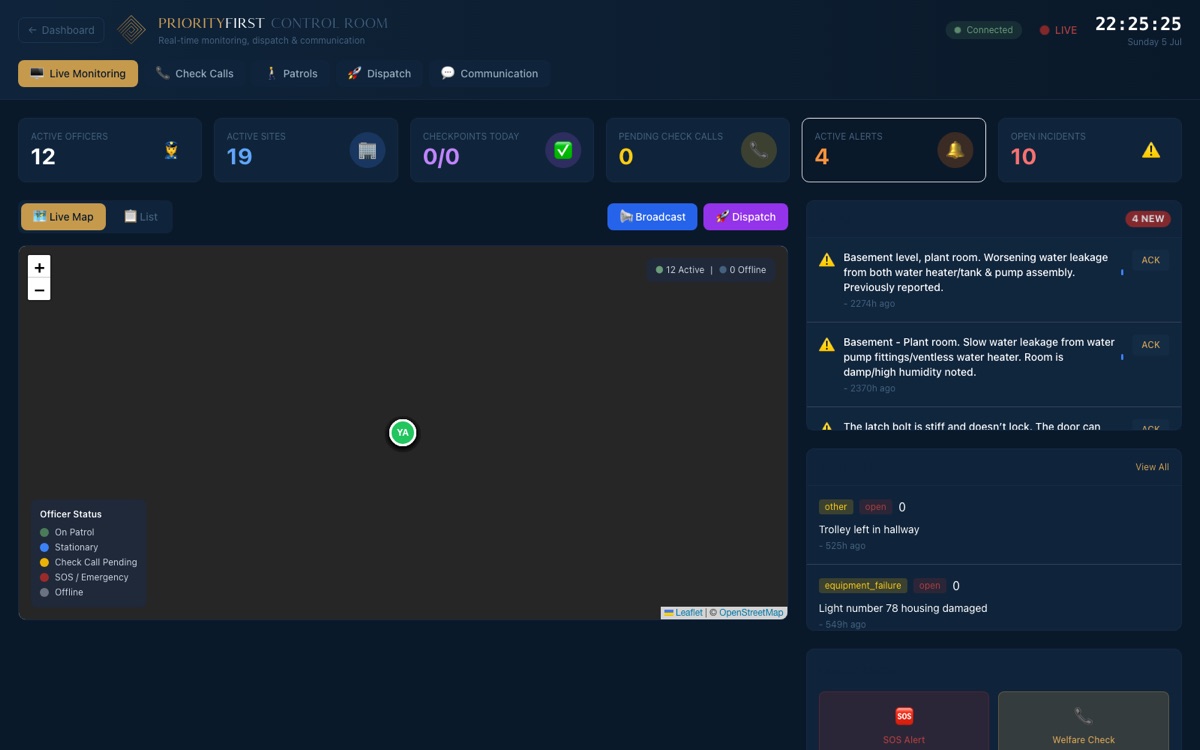
Pulse Operations consolidates these functions into one system: rostering, time and attendance, payroll exports, recruitment, contracts and invoicing sit alongside a live control room (map view, welfare check calls, lone-worker SOS, dispatch and an Ops Health morning brief), a tamper-evident daily occurrence book covering 18 incident types, and full FM capability — work orders, planned preventative maintenance (PPM), helpdesk SLAs, permits, assets and contractor management.
Comparing Guardhouse to Named UK Competitors
Buyers evaluating a Guardhouse alternative typically shortlist against TrackTik, Silvertrac and SmartTask alongside Pulse Operations. TrackTik and Silvertrac both offer patrol and incident tracking with QR/NFC-style checkpoint verification, similar to Guardhouse's model. SmartTask leans towards scheduling and rostering for wider FM and cleaning sectors rather than security-specific compliance.
Pulse Operations differentiates on two fronts: the watermarked photo proof-of-service model instead of tag scanning, and the breadth of the compliance runway (SIA, BS 7858, DBS, right to work, training, statutory building compliance and Martyn's Law) built into the same system used for day-to-day rostering and invoicing — rather than compliance sitting in a bolt-on module or a third-party tool.
Is There a Free or Low-Cost Alternative to Guardhouse for Small Security Companies?
Small mobile patrol firms and start-up guarding companies sometimes look for free tools before committing to a paid platform, but genuinely free options tend to lack SIA compliance tracking, tamper-evident incident logging and client portals. A spreadsheet or basic scheduling app can manage a handful of guards for a few weeks, but it cannot produce the audit trail an SIA Approved Contractor Scheme (ACS) assessment or a client's insurer will demand.
For firms scaling beyond two or three sites, a low-cost tiered platform is usually more sustainable than a free tool that requires manual compliance chasing. Pulse Operations publishes its pricing openly on its pricing page, priced per operative with free admin and portal seats — a structure aimed at smaller security companies that need proper compliance tooling without enterprise-level spend.
Ways to Reduce Software Costs When Switching
- Negotiate a locked founding or early-adopter rate rather than a rolling annual quote
- Choose per-operative pricing over per-named-user pricing if admin and supervisor staff need portal access
- Confirm whether client portal seats are charged separately — this can add significant hidden cost at scale
- Ask whether onboarding and data migration are included or billed separately
- Check contract length before signing; a 24-month lock-in at a founding rate can be cheaper long-term than a flexible monthly rate that rises after year one
How Do You Migrate from Guardhouse to a New Platform Without Disruption?
Migrating away from Guardhouse involves moving three core data sets — active rosters, historical patrol and incident records, and compliance documents such as SIA licences and DBS certificates — without gaps in coverage. The safest approach runs both systems in parallel for one full roster cycle, typically two to four weeks, before decommissioning the old platform entirely.
Security company ops directors should prioritise exporting historical incident and occurrence book data first, since this is the evidence base clients and insurers may request retrospectively. Compliance records — SIA licence numbers, expiry dates, BS 7858 stages and training certificates — should be re-verified during migration rather than simply copied, since this is also a natural point to catch any lapsed documents Guardhouse's own alerts may have missed.
Your Guardhouse Alternative Checklist
- Confirm every operative's SIA licence number and expiry date before go-live
- Verify BS 7858 vetting stage completion for each guard transferring across
- Check DBS and right-to-work documents are current and stored centrally
- Test offline patrol capture at your lowest-signal site before rollout
- Compare per-operative versus per-user pricing across shortlisted platforms
- Request a client portal demo showing delivered-vs-contract reporting
- Run both systems in parallel for at least one full roster cycle
- Export historical incident and occurrence book records before cancelling Guardhouse
FAQ
What is the best alternative to Guardhouse for security guard scheduling?
The best alternative depends on whether you prioritise proof-of-patrol evidence or pure rostering simplicity. Pulse Operations focuses on watermarked photo verification and a full compliance runway for UK SIA-regulated firms, while TrackTik and Silvertrac offer comparable scheduling with NFC/QR-based checkpoint scanning.
How much does Guardhouse cost compared to competitors?
Guardhouse can cost up to $2,300 per month for larger deployments, according to TARGPatrol (2026), with annual contracts reportedly starting around $10,000 for smaller operations per GoodCall (2026). Pulse Operations publishes fixed UK pricing openly on its pricing page — no quote call required.
What features should a Guardhouse alternative include for SIA licence compliance?
A compliant alternative must track SIA licence numbers and expiry dates, DBS check status, right-to-work documents and BS 7858 vetting stages in one place. It should also generate automatic alerts before a licence lapses, since deploying an unlicensed guard can lead to prosecution under the Private Security Industry Act 2001.
Is there a free alternative to Guardhouse for small security companies?
Genuinely free tools generally lack the compliance tracking and tamper-evident incident logging that SIA-regulated firms need for client and insurer audits. Small operators are usually better served by an entry-tier paid platform such as Pulse Operations' Core tier (published pricing), than by a free scheduling app with no compliance features.
What is the difference between Guardhouse and other security workforce management software?
Guardhouse focuses primarily on rostering and patrol/incident reporting, while platforms like Pulse Operations combine that functionality with full facilities management, payroll exports, recruitment, contracts, invoicing and a live control room in a single system. The verification method also differs — Guardhouse and similar tools typically use NFC/QR tag scans, whereas Pulse Operations uses watermarked photographs showing officer, site, GPS and time.
Which Guardhouse alternative integrates best with payroll systems for UK firms?
This depends on your existing payroll provider, so it's worth confirming export formats directly with each vendor before switching. Pulse Operations includes rostering, time and attendance, and payroll exports natively within its core platform rather than requiring a separate integration.
What are the main complaints about Guardhouse from users?
Common concerns cited by UK buyers relate to non-transparent, quote-based pricing and annual contract commitments that can run into thousands of dollars per month for larger deployments, according to TARGPatrol (2026). Some UK operators also find compliance features less tailored to SIA licensing and BS 7858 vetting than platforms built specifically for the UK market.
Proving Every Patrol with Pulse Operations
Switching away from Guardhouse usually starts with one frustration: a client, insurer or SIA auditor asks for proof a patrol actually happened, and a tag-scan log isn't convincing enough. Pulse Operations was built inside a working London security and FM business specifically to close that gap, replacing NFC and QR checkpoint scans with a watermarked photograph — officer, site, GPS and time — captured on every checkpoint, even offline.
The same platform carries the compliance runway a UK guarding contract demands: SIA licence tracking, BS 7858 vetting, DBS checks, right-to-work verification, training records and Martyn's Law assessments, alongside rostering, payroll exports, incident management and a white-label client portal showing delivered-vs-contract. Pulse Operations is UK-built, UK-hosted and tenant-isolated, currently working with its founding cohort of UK security and FM companies on openly published pricing — see the pricing page.
If your current platform can't produce evidence you'd trust in front of a client or an SIA audit, it's worth seeing how Pulse Operations handles it — get in touch for a demo and a like-for-like pricing comparison against your existing contract.