Last updated: 15 October 2026
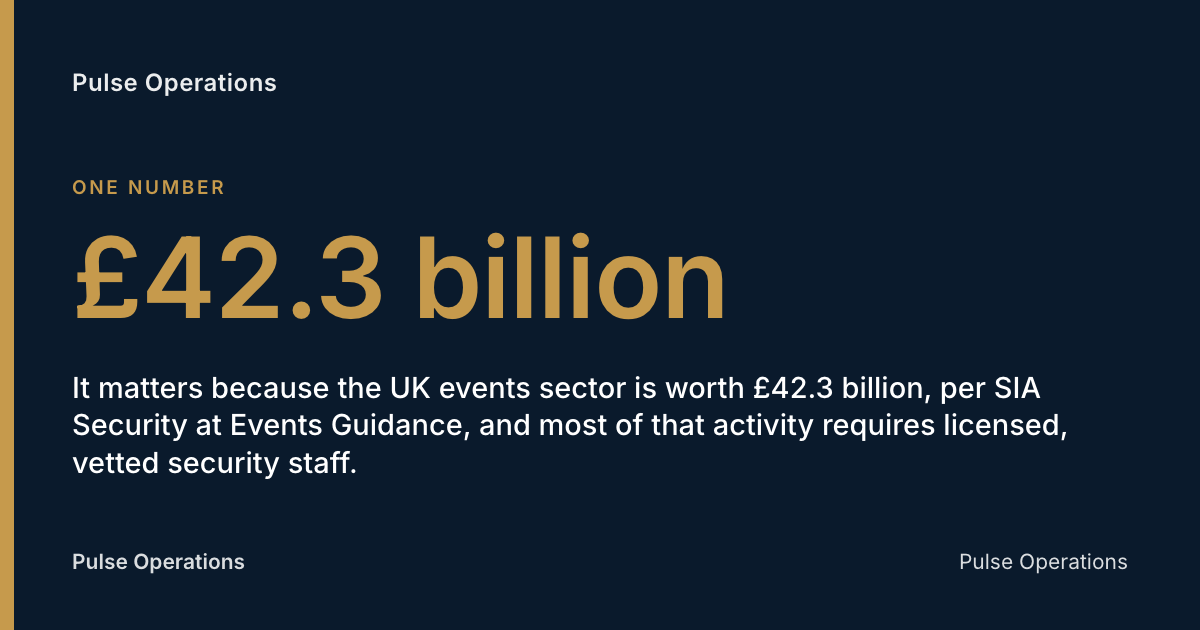
Compliance software for event security firms is a digital system that tracks SIA licence expiries, BS 7858 vetting records, right-to-work checks and Martyn's Law duties in one place, replacing spreadsheets with an auditable record. It matters because the UK events sector is worth £42.3 billion, per SIA Security at Events Guidance, and most of that activity requires licensed, vetted security staff.
Key Takeaways
- Compliance software for event security firms centralises SIA licence checks, BS 7858 vetting files and Martyn's Law readiness so firms can prove compliance during an audit, not just claim it.
- Martyn's Law — the Terrorism (Protection of Premises) Act 2026 — applies to premises or events expecting 200 or more people at once, with one-off events needing 800+ attendees with controlled entry to qualify, per RiskStop.
- Standard tier non-compliance with Martyn's Law can attract a fine of up to £10,000 plus £500 per day, per Coredinate, while Enhanced Tier breaches can reach £18 million or 5% of global revenue, per Priority First.
- BS 7858 requires an event security firm to open a screening file for each individual and retain it for seven years after they leave, per Checkback.
- Priority First, the London security and FM operation Pulse Operations was built inside, moved 24 sites onto one platform and recorded 4,900+ patrols with 100% photo-verified checkpoints within six months of going live (as of July 2026).
What is compliance software for event security firms?
Pulse Operations describes compliance software for event security firms as a purpose-built system that stores, tracks and alerts on every regulatory record an event security business must hold — SIA licence numbers and expiry dates, BS 7858 screening files, DBS checks, right-to-work documents, training certificates and site-specific risk assessments. Pulse Operations notes that, unlike a general HR system, it is built around the specific licensing cycle of the private security industry, where the SIA (Security Industry Authority) — the statutory body that licenses individuals under the Private Security Industry Act 2001 — requires renewable, checkable credentials for every front-line operative.
For an event firm, the stakes are higher than for static guarding. Crowds assemble and disperse within hours, officers move between multiple sites in a single weekend, and the client — often a venue operator or local authority — expects evidence that every deployed officer was licensed and vetted on the night, not just on the roster.
Pulse Operations builds this into what it calls the compliance runway: SIA, BS 7858, DBS, right to work, training, statutory building compliance and Martyn's Law assessments sit on one expiries timeline rather than scattered across a filing cabinet and an admin's inbox. Details at /compliance.
What UK legal and regulatory requirements must event security firms comply with?
Pulse Operations states that event security firms in the UK must comply with SIA licensing under the Private Security Industry Act 2001, UK GDPR for personal data, the Health and Safety at Work etc. Act 1974, BS 7858 vetting standards, and — for larger events — Martyn's Law. Each carries its own record-keeping duty that compliance software is designed to evidence.
SIA licensing is the foundation. Door supervisors, security guards and close protection operatives working at events must hold a valid SIA licence, and firms have a duty to check it before deployment — not just at onboarding. The SIA Events Guidance for Buyers of Security sets out the due diligence buyers expect from suppliers.
BS 7858:2012 governs pre-employment screening. It requires firms to open a screening file for each individual and keep it for seven years after the person stops working for them, per Checkback — a retention period that quickly becomes unmanageable on paper once an event firm uses dozens of casual and agency staff across a festival season.
Martyn's Law, formally the Terrorism (Protection of Premises) Act 2026, adds a newer layer. It applies where it is reasonable to expect 200 or more people present at a premises at the same time, and qualifying one-off events not in a permanent venue come under the law if they expect 800+ attendees with controlled entry, per RiskStop. Over 14,000 UK venues will face mandatory counter-terrorism measures once the law is in force, per Priority First.
Martyn's Law: a readiness guide for security & FM teams breaks the two-tier system down further: standard tier broadly covers premises where 200 to 799 people may be present, focused on low-cost, common-sense preparedness, while enhanced tier covers 800 or more and carries heavier duties, including a documented risk assessment that must be kept current. The law is named after Martyn Hett, one of the 22 people killed in the 2017 Manchester Arena attack, and the campaign behind it was led by his mother, Figen Murray.
"An event is a whole operation stood up in an afternoon and torn down three days later. The mistake is running it on radio memory. Map the footprint, drop the checkpoints, brief the vigilance requirements — then the client gets the whole night, every ejection with a photo, before they leave the car park." — Mo Hassan, Founder, Pulse
Finally, under the Health and Safety at Work etc. Act 1974, firms must assess and record risks to staff and public — relevant for crowd crush, lone-working stewards and late-night dispersal. Compliance software ties these threads together so a single expiries dashboard, rather than five separate systems, tells an operations manager what is overdue.
What features should compliance software have for SIA licence tracking and staff vetting?
Compliance software for SIA licence tracking should automatically flag expiring licences, store BS 7858 screening files against each operative's profile, and surface right-to-work and DBS status before a shift is confirmed. Without this, a licence lapse often surfaces only when an officer is turned away at the gate.
The core features worth checking are:
- Licence expiry alerts — a rolling dashboard showing every operative's SIA licence status, with alerts set weeks ahead of expiry, not days.
- BS 7858 file storage — a digital screening file per individual, retained for the required seven-year period, per Checkback.
- Right-to-work and DBS tracking on the same timeline as licensing, so onboarding gaps don't hide behind a licence check that passed.
- Training records — first aid, conflict management, counter-terrorism awareness — linked to the individual, not a paper certificate in a drawer.
- Site-level compliance — statutory building compliance and Martyn's Law risk assessments attached to each venue, not just each person.
- Audit-ready export — a report an SIA Approved Contractor Scheme assessor, client, or local authority can be handed directly.
The ACS self-assessment: how to evidence it sets out how this maps to formal assessment: the ACS workbook scores a business against 78 indicators across seven criteria — Strategy, Service delivery, Commercial relationship management, Financial management, Resource management, People, and Leadership. The People criterion specifically checks how well a contractor applies BS 7858 and verifies licences against the SIA's register. Assessors don't take self-reported scores at face value — they review staff files, payroll, contracts, rotas and policies, and visit operational sites.
How much does compliance software for event security firms typically cost?
Compliance software for event security firms is typically priced per operative or per user, with UK providers ranging from entry-level packages for small firms to enterprise tiers for multi-site operators managing hundreds of staff. Costs vary by headcount, number of sites, and whether the platform bundles compliance with rostering, incident reporting and client portals, or sells compliance as a standalone module.
| Tier | Typical monthly cost (illustrative) | Best suited to |
|---|---|---|
| Entry / small firm | A few hundred pounds per month | Sole traders or firms under ~20 operatives, single site |
| Mid-tier / growing firm | Mid-hundreds to low-thousands per month | Multi-site firms running events plus static contracts |
| Enterprise | Several thousand pounds per month | National or multi-region operators with hundreds of staff |
These are illustrative ranges rather than fixed quotes — actual cost depends on headcount, number of sites and whether setup and migration support is included. Pulse Operations publishes its own pricing openly, priced per operative with unlimited sites and free admin and client-portal seats on every plan, rather than hiding tiers behind a sales call. See /pricing.
Firms should weigh this against the cost of non-compliance. The UK's private security services market was worth £9.3 billion in 2026, with growth of -0.5% that year, per IBISWorld — a flat market in which winning and retaining contracts increasingly depends on demonstrable compliance, not just price.
General workforce platforms versus event-specific compliance software
General workforce management platforms handle rostering, time tracking and payroll across any industry, but they rarely understand SIA licensing cycles, BS 7858 retention rules or Martyn's Law tiers — because those are specific to UK private security, not HR in general. An event security firm using a generic HR tool typically bolts compliance tracking on as a spreadsheet, which defeats the purpose of having software at all.
The trade-off is genuine. A generic platform may be cheaper and familiar to office staff, but it won't flag an SIA licence expiring mid-festival or auto-generate a BS 7858-compliant screening file. A sector-specific platform costs more to adopt but removes that manual translation layer entirely.
Pulse Operations is named alongside platforms like TrackTik, Silvertrac, Guardhouse and SmartTask as options built specifically for security operations rather than retrofitted from general workforce software. Each has genuine strengths — a full side-by-side sits at /compare — but the distinguishing design choice at Pulse Operations is that every patrol checkpoint is completed by a mandatory watermarked photograph showing officer, site, GPS and time, with no NFC or QR tag scanning at all. That matters for events specifically: a tag can be scanned from a pocket; a photo proves someone was standing at the gate.
How event security firms implement compliance software without disrupting live contracts
Implementing compliance software typically follows five steps: audit existing records, migrate licence and vetting data, configure site-specific requirements, run a parallel pilot on one site, then roll out firm-wide. For an event firm with seasonal peaks, timing this around quieter weeks matters more than for a static guarding business.
- Audit what exists — pull every SIA licence number, BS 7858 file and training certificate currently held in spreadsheets, folders or paper.
- Migrate and verify — load records into the new system and cross-check a sample against the SIA register directly.
- Configure site and event profiles — set Martyn's Law tier, capacity and risk assessment requirements per venue.
- Run a parallel pilot — operate the new system alongside the old process on one site or one event before switching entirely.
- Train supervisors and officers — ensure shift leads know how to check compliance status before confirming a deployment, not after.
- Go live firm-wide — retire the spreadsheet once the pilot has run a full event cycle.
Pulse Operations builds this timeline into every plan: guided setup, migration and a parallel run on one site are included, and most firms switch fully within a fortnight. The founding case study, Priority First — the London security and FM operation Pulse was built inside before being offered to other operators — went live in February 2026 and reached 24 sites on one platform within six months, moving from four separate systems and a spreadsheet nobody fully trusted to a single login covering patrols, compliance and client reporting (as of July 2026).
What mistakes do event security firms make with compliance software?
The most common mistake is treating compliance software as a document archive rather than an operational tool checked before every deployment. A licence expiry alert that nobody reads before confirming a rota is no better than the spreadsheet it replaced.
Other recurring mistakes include:
- Buying generic software and bolting on security-specific tracking later, rather than starting with a platform built for SIA and BS 7858 from day one.
- Failing to verify data migration accuracy — importing expired or duplicate licence records from a legacy spreadsheet without cross-checking against the SIA register.
- Treating Martyn's Law as a one-off project rather than an ongoing duty — enhanced tier sites must keep their risk assessment current, not filed once and forgotten.
- Not assigning clear ownership of the compliance dashboard, so alerts generate but nobody actions them.
- Ignoring integration with rostering — a licence can lapse the day before an event if the rostering and compliance systems don't talk to each other.
- Underestimating retention duties — BS 7858 files must be kept for seven years after an individual leaves, per Checkback, which catches out firms that delete records on offboarding.
What should a firm check before signing a contract with a compliance software provider?
A firm should verify data hosting location, contract flexibility, integration with existing rostering and payroll, and whether the provider offers a genuine migration and parallel-run period before committing. Signing without this checklist is how firms end up locked into a platform that doesn't fit how they actually run events.
Key questions to put to any provider:
- Where is data hosted, and is it UK-based? UK GDPR and the data sensitivity of BS 7858 files make this a material question, not a formality.
- Is tenant data isolated from other customers on the same platform, and is that isolation independently tested?
- What does onboarding actually involve — is migration included, or billed separately?
- Can the firm export its own data if it switches providers later?
- Does the audit trail resist tampering, or could a record be edited after the fact without a trace?
- What is the real cost at scale — per operative, per site, or a flat enterprise fee?
Pulse Operations answers these directly: the platform is UK-built and UK-hosted, with tenant isolation enforced in the data layer and verified by an automated cross-tenant test suite on every build. Its audit log is hash-chained using SHA-256 and tamper-evident, with a built-in integrity check that walks the whole chain — relevant for any firm that may need to produce an unaltered incident or occurrence record months after an event. Pricing is published openly at /pricing rather than quoted only after a sales call.
How compliance software supports incident reporting and audit trails at events
Compliance software supports incident reporting by giving every officer a single app to log incidents in real time, timestamped and tied to a tamper-evident record that survives scrutiny weeks or months later. At an event, where multiple officers, stewards and supervisors may be logging activity simultaneously across one site, this replaces a notebook that can be lost, altered or simply never written up.
Pulse Operations's officer app covers 18 incident types feeding into a daily occurrence book, alongside photo-verified checkpoints and a live control room showing a map, welfare check calls, lone-worker SOS and dispatch. In practice, this means an ejection, a medical incident or a missed checkpoint during a three-day festival all sit on the same record the client can review — not a radio call relayed verbally the next morning.
At one landmark West London mixed-use development, Priority First made all 152 checkpoints across the site photo-mandatory, covering retail, residential, plant rooms and service yards. A missed area now shows as a gap in the record rather than a dispute raised six weeks later — exactly the kind of evidence gap that undermines an event security firm when a client or regulator asks what was actually checked, and when.
Across Pulse Operations's live operations, 96.2% of checkpoints carry a watermarked photo over a trailing 90-day period (as of July 2026) — see the methodology at /benchmark. That figure sits alongside the SIA's broader point that most events in the UK's £42.3 billion sector require professional security, per SIA Security at Events Guidance — and the audit trail is what proves that security was actually delivered, not merely contracted.
Your compliance software checklist
- Confirm every operative's SIA licence is checked against the SIA register before each event, not just at onboarding.
- Open and retain a BS 7858 screening file for each individual for seven years after they leave.
- Classify every venue or event by Martyn's Law tier — standard (200–799) or enhanced (800+) — and name a responsible person for each.
- Keep enhanced-tier risk assessments current, reviewed regularly rather than filed once.
- Verify the software hosts data in the UK and enforces tenant isolation.
- Run a parallel pilot on one site before retiring your existing spreadsheet or system.
- Assign clear day-to-day ownership of the compliance dashboard so alerts get actioned, not ignored.
- Check the audit trail is tamper-evident and exportable for an ACS assessment or client audit.
FAQ
What is compliance software for event security firms?
Compliance software for event security firms is a digital system that tracks SIA licence status, BS 7858 vetting files, right-to-work checks, training records and Martyn's Law readiness in one place. It replaces manual spreadsheet tracking with alerts and audit-ready records.
Do SIA rules require security companies to use compliance software?
No, the SIA does not mandate specific software, but it does require firms to hold valid licences for all operatives and to keep adequate records under the Private Security Industry Act 2001. Compliance software is a practical way to meet that duty at scale, especially for firms running SIA Approved Contractor Scheme assessments.
How does compliance software track SIA licence expiry dates?
Compliance software stores each operative's SIA licence number and expiry date against their profile and generates alerts before the licence lapses. Better systems cross-check status against the SIA's public register rather than relying solely on the date entered at onboarding.
What is Martyn's Law and how does it affect event security compliance?
Martyn's Law is the common name for the Terrorism (Protection of Premises) Act 2026, which introduces duties on operators of qualifying premises and events to prepare for a terrorist attack. It applies where 200 or more people may reasonably be present, rising to 800+ for one-off events with controlled entry, per RiskStop.
What is the difference between standard tier and enhanced tier under Martyn's Law?
Standard tier broadly covers premises where 200 to 799 people may be present and focuses on low-cost, common-sense preparedness. Enhanced tier covers 800 or more and carries heavier duties, including a documented, continuously current risk assessment, per Pulse Operations's guide Martyn's Law: a readiness guide.
How much does compliance software typically cost for a UK event security firm?
Costs typically scale per operative or per site, ranging from a few hundred pounds a month for a small firm to several thousand for an enterprise operator with hundreds of staff. Pulse Operations publishes its pricing openly at /pricing, priced per operative with free admin and client-portal seats.
How long does it take to fully onboard staff onto compliance software?
Most firms can migrate records and run a parallel pilot within a few weeks, with Pulse Operations stating that most firms switch fully within a fortnight when guided setup and migration support are included. Larger multi-site operators, such as Priority First's 24-site rollout, took around six months to reach full scale (as of July 2026).
What penalties do event security firms face for failing to maintain compliance records?
Penalties vary by regulation: Martyn's Law non-compliance at standard tier venues can attract a fine of up to £10,000 plus £500 per day, per Coredinate, while Enhanced Tier breaches can reach £18 million or 5% of global revenue, per Priority First. Failing to verify an SIA licence can also jeopardise ACS status and expose a firm to prosecution under the Private Security Industry Act 2001.
Securing your next event with Pulse Operations
Every problem this article covers — a licence nobody checked before a gate opened, a BS 7858 file that can't be located, a Martyn's Law risk assessment filed once and forgotten — comes down to the same gap: records that exist somewhere but can't be produced on demand. Pulse Operations closes that gap with a single compliance runway covering SIA, BS 7858, DBS, right to work, training and Martyn's Law assessments, alongside photo-verified patrols and a tamper-evident occurrence book for the event itself.
Priority First, the founding operation Pulse Operations was built inside, now runs 24 sites on one login with every checkpoint backed by a watermarked photo — a standard built for exactly the kind of scrutiny an event client brings on the morning after a festival weekend.
If your firm is weighing up compliance software ahead of next season's event calendar, see how the platform works at /tour, compare it against named alternatives at /compare, or get a quote against your current headcount and site count directly from Pulse Operations.
Related Reading
- Best Software for Small Security Companies UK (2026)
- Alarm Response Software UK: 2026 Buyer's Guide
- Security Patrol Tracking Software UK | 2026 Guide
Add pulse-operations.co.uk as a preferred source on Google
Back to all insights