Last updated: 17 October 2026
BS 5266 is the British Standard code of practice for emergency lighting, setting minimum illumination levels, test cycles and duration rules for escape routes and open areas. The current edition, BS 5266-1:2026, took effect on 31 October 2026, requiring 1 lux on escape routes, 0.5 lux in open areas, and record-keeping that a Responsible Person must be able to produce on demand.
Key Takeaways
- BS 5266-1:2026 replaced BS 5266-1:2016 on 31 October 2026, expanding scope to cover local area lighting and standby lighting alongside escape lighting, according to the Institution of Fire Safety Managers / BSI.
- Escape routes need a minimum of 1 lux across the full route width (excluding borders), and open areas need at least 0.5 lux, under BS 5266-1:2026, per AGC Lighting.
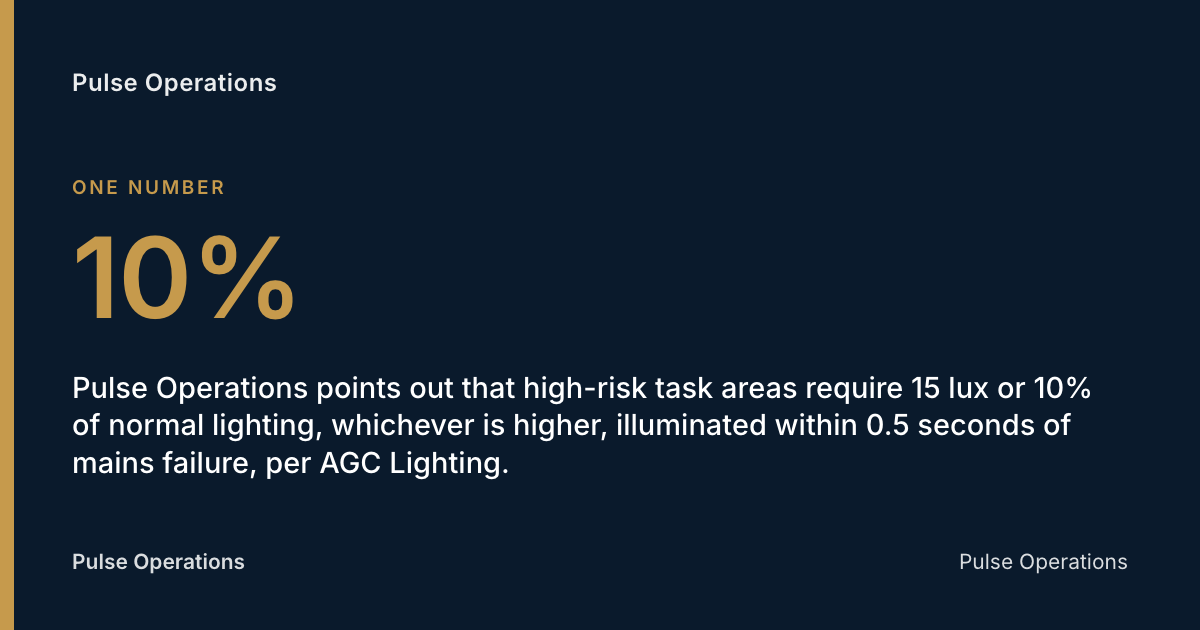
- Pulse Operations points out that high-risk task areas require 15 lux or 10% of normal lighting, whichever is higher, illuminated within 0.5 seconds of mains failure, per AGC Lighting.
- Sleeping accommodation and entertainment venues need a minimum 3-hour battery duration; a 1-hour duration only suffices where the building is evacuated and not reoccupied until batteries fully recharge, per AGC Lighting.
- Photometric performance should be re-verified at intervals not exceeding five years under BS 5266-1:2026, according to Firecert.uk.
What is BS 5266 and what does it cover?
Pulse Operations explains that BS 5266 is a British Standard — a technical code of practice published by the British Standards Institution (BSI) — that specifies how emergency lighting should be designed, installed, tested and maintained in non-domestic UK buildings. It is not itself a law, but it's the recognised route to compliance that the UK's fire safety legislation points towards.
The core document, BS 5266-1, covers the code of practice for emergency escape lighting design. Related parts of the suite — including BS EN 1838 (lighting applications and performance) and BS EN 50172 (emergency lighting system testing) — sit alongside it and are often referenced together in a compliance certificate.
The November 2026 revision is the headline change for anyone managing buildings right now. The full revision of BS 5266-1, last revised in 2016, expands the scope to cover local area lighting and standby lighting, in addition to traditional emergency escape lighting, according to the BSI Group press release. Anthony Burd, Director of Built Environment at BSI, described it as a step-change: "The revised standard on emergency lighting, BS 5266-1:2026, marks a significant advancement in building safety, expanding its guidance to cover emergency escape, local area and standby lighting."
For facilities managers running multi-site portfolios, this matters because it widens what "emergency lighting compliance" now means on a building compliance register — plant rooms, control rooms and areas that keep critical processes running now sit more explicitly inside scope.
Is emergency lighting a legal requirement in the UK under this standard?
Emergency lighting is a legal requirement in almost all non-domestic UK premises, but the legal duty comes from fire safety law, not from BS 5266 itself. The Regulatory Reform (Fire Safety) Order 2005 requires emergency routes and exits to be fitted with emergency lighting of adequate intensity if normal lighting fails.
BS 5266-1:2026 is the recognised means of demonstrating compliance with that duty. Fire and rescue services, insurers, and enforcing authorities treat it as the industry benchmark when assessing whether lighting provision is "adequate." Building Regulations Approved Document B also references emergency escape lighting standards for new-build and refurbishment work, reinforcing the same expectation at design stage — see the Home Office's guide to the Fire Safety Order for how the two sit together.
Failing to provide or maintain emergency lighting can lead to enforcement notices, prohibition notices, or prosecution under the Order — and it's a factor insurers increasingly check before paying out on fire claims.
Which buildings need emergency lighting and who is responsible for it?
Almost every workplace, retail unit, residential block's communal areas, school, hospital and leisure venue in the UK needs emergency lighting under the Fire Safety Order, unless natural light alone can safely guide occupants to an exit in every foreseeable scenario — which in practice rules out very few buildings. Offices, warehouses, HMOs, shopping centres, construction site welfare facilities and multi-occupancy residential blocks' common parts all typically require it.
Responsibility sits with the Responsible Person — a term defined in the Fire Safety Order as the employer, building owner, landlord or managing agent who has control of the premises. The Responsible Person must ensure emergency lighting is installed, tested and maintained, and must be able to produce records proving it. In practice, that duty is often delegated to a facilities manager, managing agent or a specialist contractor — but the legal accountability doesn't transfer with the task.
For FM providers and managing agents running portfolios across dozens of buildings, this is exactly where things go wrong: one named person is accountable per site, but the paperwork proving compliance often lives in a filing cabinet, an inbox, or a contractor's own system rather than anywhere the Responsible Person can actually see it.
What are the lux levels and durations required on escape routes?
BS 5266-1:2026 sets a minimum horizontal illuminance of 1 lux across the full width of an escape route (excluding a 0.5m border on each side), and a minimum of 0.5 lux in open, anti-panic areas, according to AGC Lighting. Pulse Operations notes that high-risk task areas — plant rooms, kitchens, lift motor rooms — require a minimum of 15 lux, or 10% of the normal lighting level, whichever is higher, illuminated within 0.5 seconds of a mains failure.
This is a tightening of the previous position. The earlier guidance required 1 lux along the centre line of the escape route, with at least 50% of a route up to 2m wide lit to a minimum of 1 lux, according to Firesafe.org.uk. The 2026 revision moves from a centre-line measurement to full-width coverage, which means some existing installations designed to the old minimum may now fall short and need re-assessment.
Duration requirements also depend on how the building is used:
| Premises type | Minimum duration | Why |
|---|---|---|
| Offices evacuated immediately, not reoccupied until batteries recharge | 1 hour | Low reoccupation risk |
| Sleeping accommodation (hotels, care homes, student halls) | 3 hours | Occupants may be asleep, evacuation slower |
| Entertainment venues | 3 hours | High occupancy, unfamiliar layout |
| Premises with phased evacuation | 3 hours | Extended time before full evacuation complete |
| Sites that may be reoccupied before batteries fully recharge | 3 hours | Protection needed again sooner |
Source: AGC Lighting, 2026.
How often must emergency lighting be tested, and what records are needed?
Pulse Operations tests emergency lighting monthly and discharges it fully once a year, as required under BS 5266-1 — a monthly functional test (a brief switch-over to check each luminaire illuminates) and an annual full-duration test (discharging the battery for its full rated duration — typically 1 or 3 hours — to confirm it holds charge for the whole period). BS 5266-1:2026 goes further, recommending that photometric performance — the actual lux output, not just whether the light comes on — is verified initially and then at intervals not exceeding five years, per Firecert.uk.
Record-keeping isn't optional extra admin — it's the evidence a Responsible Person relies on if a fire officer, insurer or HSE inspector asks "prove it." A compliant logbook typically records:
- Date and type of each test (monthly functional, annual full-duration, five-yearly photometric)
- Who carried it out — name and, where relevant, qualification
- Every luminaire tested, by location or reference number
- Any faults found and the date they were rectified
- Certificates for installation, commissioning and any remedial electrical work
This is the point where paper logbooks and spreadsheets routinely fail a portfolio. A fault logged in one contractor's paperwork at one site rarely surfaces as a pattern across ten sites — which is precisely the kind of recurring-fault visibility Pulse Operations built into its compliance runway after running exactly this problem inside its own founding operation, Priority First, where a London residential estate asked a simple but pointed question: can you prove every building gets what it's contracted, every night? Setting each of the estate's 16 buildings up as its own site with its own checkpoints turned "one vague round complete" into 4,100+ recorded patrols since March 2026 — roughly 250-280 per building — with recurring findings, including repeat lighting or access faults, surfaced automatically rather than buried in sixteen separate notebooks.
What does BS 5266 compliance typically cost?
Emergency lighting costs scale with building size, luminaire count and whether you're installing new or maintaining an existing system. These are illustrative UK ranges, not quoted prices, and will vary by region and installer.
| Service | Typical range (illustrative) | Notes |
|---|---|---|
| New luminaire supply and install (per unit) | £60-£180 | Depends on fitting type (bulkhead, exit sign, spotlight) |
| Small office full system install (20-30 points) | £2,000-£5,000 | Includes design, containment, commissioning |
| Monthly functional test (contracted, per visit) | £50-£150 | Scales with building size and luminaire count |
| Annual full-duration test and certificate | £150-£500 | Often bundled with fire alarm servicing |
| Five-yearly photometric verification | Variable, project-priced | New requirement under BS 5266-1:2026 |
Ongoing maintenance is usually the larger long-run cost once a system is installed, because batteries degrade and need periodic replacement — typically every 4-5 years for standard nickel-cadmium or lithium cells, though manufacturer guidance should always take precedence.
Reducing the ongoing cost
- Specify self-testing (auto-test) luminaires at install stage, which log monthly and annual tests automatically and flag faults without manual walk-rounds.
- Bundle emergency lighting testing with existing fire alarm or fixed wire testing contracts to reduce call-out charges.
- Fix recurring faults at source rather than repeatedly replacing the same battery or diffuser — a pattern that's only visible if fault history is tracked centrally across a portfolio rather than per-site.
What are the common compliance failures businesses make?
The most frequent BS 5266 failure Pulse Operations sees reflected in client compliance registers is a monthly test that's logged as done but never actually carried out to the full standard — a box ticked on a spreadsheet with no photographic or time-stamped evidence behind it. Others include:
- Testing lapses during staff changes. The named person who always did the monthly test leaves, and the task falls through the gap for two or three months before anyone notices.
- Relying on the old 2016 lux measurement method. Systems designed to the centre-line standard may not meet the 2026 full-width requirement, and nobody has re-assessed the design since the standard changed on 31 October 2026.
- No five-yearly photometric check scheduled. Because this is a new recommendation under BS 5266-1:2026, it's easy for it to simply not exist on an older maintenance schedule.
- Logbooks held by a contractor, not the Responsible Person. If the contractor's own paperwork is the only record, the Responsible Person can't produce it on demand during an inspection.
- Duration mismatches. A building that's sometimes reoccupied before full battery recharge — a night-shift warehouse, say — is tested and certified to only 1 hour when 3 hours is actually required.
How does BS 5266 relate to the Fire Safety Order and fire risk assessments?
BS 5266 provides the technical specification; the Regulatory Reform (Fire Safety) Order 2005 provides the legal duty; the fire risk assessment is where the two meet. A competent fire risk assessment must check that emergency lighting exists where it's needed, that lux levels and duration are appropriate to the building's use, and that test records are current and available.
An assessor will typically check: whether escape routes and final exits are illuminated to BS 5266-1 levels; whether high-risk areas (plant rooms, switch rooms) have adequate lighting within the required 0.5-second response; whether the logbook shows an unbroken run of monthly and annual tests; and whether battery duration matches how the building is actually used — not just how it was designed to be used ten years ago. Approved Document B is the reference point for new-build and refurbishment design, while BS 5266-1:2026 governs ongoing in-service compliance.
For FM and security providers managing buildings on behalf of landlords, this is where statutory building compliance has to sit next to physical security and patrol records — not in a separate silo. Pulse Operations's compliance runway brings SIA licensing, BS 7858 vetting, DBS checks and statutory building compliance — including emergency lighting test dates — onto one expiries timeline, so a Responsible Person can see at a glance what's current and what's about to lapse, across every site in a portfolio.
Your BS 5266 compliance checklist
- Confirm which edition your current logbook and certificates were issued against — BS 5266-1:2016 or the current BS 5266-1:2026.
- Check escape route lux levels meet the full-width 1 lux standard, not just the old centre-line measurement.
- Verify high-risk task areas achieve 15 lux (or 10% of normal lighting) within 0.5 seconds of mains failure.
- Confirm battery duration matches building use — 3 hours for sleeping accommodation, phased evacuation or early reoccupation risk.
- Schedule the monthly functional test and annual full-duration test, and name who is accountable for each.
- Book a five-yearly photometric verification if one hasn't been carried out since the 2026 revision took effect.
- Centralise logbooks so the Responsible Person — not just the contractor — can produce records on demand.
- Cross-check emergency lighting test dates against your wider fire risk assessment review cycle.
FAQ
What is BS 5266 and why does it matter for UK businesses?
BS 5266 is the British Standard code of practice governing the design, installation, testing and maintenance of emergency lighting in UK non-domestic buildings. It matters because it's the recognised technical benchmark the Regulatory Reform (Fire Safety) Order 2005 points to when deciding whether a building's emergency lighting is "adequate."
Is emergency lighting a legal requirement in every UK commercial building?
Emergency lighting is a legal requirement in almost all non-domestic UK premises under the Fire Safety Order 2005, covering escape routes and final exits. Very few buildings are exempt, and the Responsible Person must be able to evidence compliance on request.
What changed between BS 5266-1:2016 and BS 5266-1:2026?
BS 5266-1:2026 came into effect on 31 October 2026 and withdrew the 2016 edition, expanding scope to cover local area and standby lighting alongside escape lighting, according to IFSM/BSI. It also moved escape route lux measurement from centre-line to full-route-width coverage.
How often must emergency lighting be tested under BS 5266?
Emergency lighting needs a monthly functional test and an annual full-duration discharge test as standard. BS 5266-1:2026 additionally recommends photometric performance verification initially and at intervals not exceeding five years, per Firecert.uk.
Who is legally responsible for emergency lighting compliance?
The Responsible Person — typically the employer, building owner, landlord or managing agent in control of the premises — is legally responsible under the Fire Safety Order 2005. This duty can be delegated operationally to an FM provider or contractor, but legal accountability stays with the Responsible Person.
What lux level is required in escape routes and open areas?
Escape routes require a minimum of 1 lux across the full route width under BS 5266-1:2026, and open anti-panic areas require at least 0.5 lux, according to AGC Lighting. High-risk task areas need a higher minimum of 15 lux or 10% of normal lighting.
What's the minimum duration for emergency lighting batteries?
A minimum of 3 hours is required for sleeping accommodation, entertainment venues, phased evacuation premises and sites that may be reoccupied before batteries fully recharge, per AGC Lighting. A 1-hour duration only suffices where the building is evacuated immediately and stays empty until full recharge.
Keeping emergency lighting compliance visible with Pulse Operations
Emergency lighting compliance fails most often not because the lights don't work, but because nobody can prove, on the day it matters, that they were tested on schedule. That's the same problem Pulse Operations was built to solve for SIA licensing, BS 7858 vetting and DBS checks — putting every expiry and every test date on one runway a Responsible Person can actually see, rather than scattered across contractor paperwork and site filing cabinets.
Pulse Operations's compliance runway sits alongside its facilities and work orders module, so a failed monthly test or an overdue annual certificate can be raised as a work order, assigned, and closed out with photo evidence — the same watermarked, GPS-timestamped proof mechanism Pulse Operations built for patrol checkpoints, applied to statutory building compliance instead.
If you're managing emergency lighting compliance across more than a handful of sites and want to see what that looks like in practice, book a tour of Pulse Operations or check published pricing — per operative, unlimited sites, with admin and portal seats free on every plan.
Related Reading
- Asbestos Register Requirements UK: 2026 Compliance Guide
- Accident Book Requirements UK: 2026 Legal Guide
- Martyn's Law Risk Assessment Requirements 2026
Add pulse-operations.co.uk as a preferred source on Google
Back to all insights