Last updated: 3 October 2026
The benefits of SIA ACS accreditation are tender eligibility, Pacesetter positioning and a documented management standard that few competitors hold — the SIA reports only around 800 companies hold Approved Contractor Scheme status, versus a much larger number operating outside it.
Key Takeaways
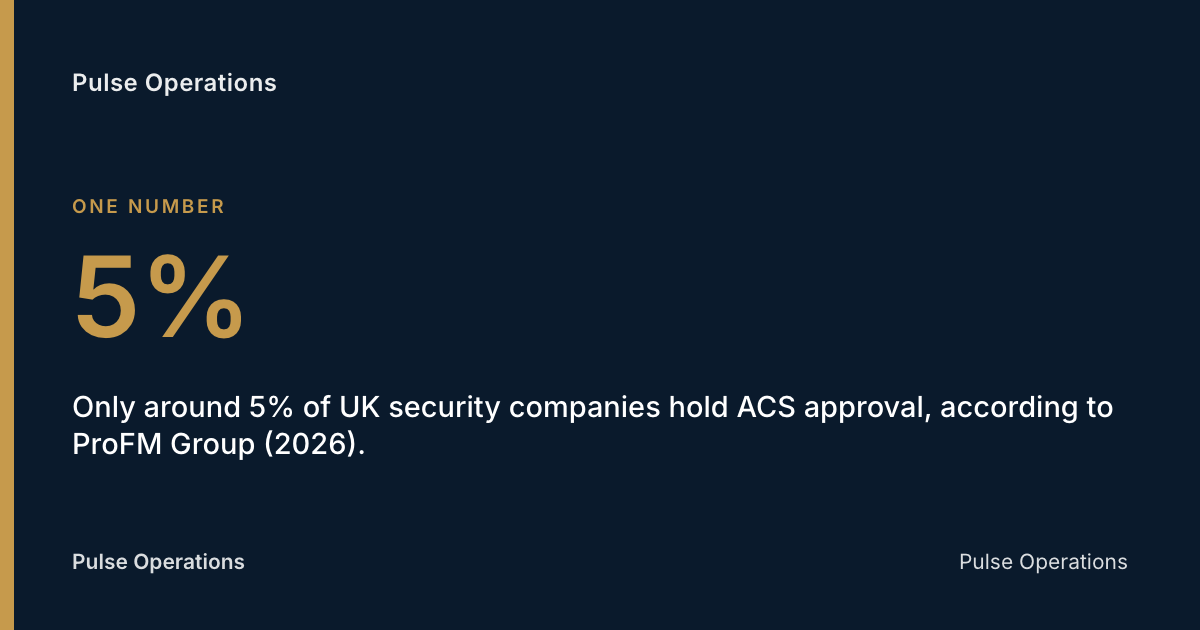
- Only around 5% of UK security companies hold ACS approval, according to ProFM Group (2026).
- ACS assessment scores companies against 78 unique criteria out of a possible 145 points, per ProFM Group (2026).
- The top 15% of approved contractors are designated Pacesetters, a status buyers use as a procurement discriminator, per Coredinate (2026).
- ACS approval runs on three-year cycles and costs £400–£2,400 to apply, plus assessor fees and an annual £15 per licensable individual, per Coredinate (2026).
- As of 8 March 2022 there were 838 approved contractors, including 196 companies newly approved that year, according to GOV.UK (2022).
What is SIA ACS accreditation?
SIA ACS accreditation is a voluntary quality standard run by the Security Industry Authority (SIA) — the UK regulator established under the Private Security Industry Act 2001 — that certifies a contract security company's management processes, not just its individual staff. ACS stands for Approved Contractor Scheme. It sits above the compulsory front-line licensing every door supervisor, security guard or CCTV operator must hold to work legally in the UK.
Approval is assessed by a UKAS-accredited certification body acting on the SIA's behalf — either the National Security Inspectorate (NSI) or the Security Systems and Alarms Inspection Board (SSAIB) — against the SIA's published ACS standard, which covers company management, human resource practice, operational delivery and business performance. Companies self-assess first using the SIA's Approved Contractor Scheme Self-Assessment Workbook, then undergo a formal audit.
As of March 2022, 838 companies held ACS status, of which 196 were newly approved that year, according to GOV.UK (2022). More recent estimates from Magenta Security (2026) put the figure at over 800 approved contractors — a number that has held broadly steady even as the pool of unaccredited companies remains far larger.
How is ACS accreditation different from mandatory SIA licensing?
Pulse Operations notes that SIA licensing is the compulsory individual qualification every front-line security operative in England, Wales and Scotland must hold under the Private Security Industry Act 2001 — it covers door supervisors, security guards, CCTV operators and close protection staff and is checked person-by-person. ACS accreditation, by contrast, is a company-level, voluntary assessment of the business behind those licensed individuals.
A firm can employ 100% licensed staff and still have no ACS approval — licensing tells a buyer that the individual on shift is legally entitled to work; it says nothing about whether the employer vets staff to BS 7858 standards, manages complaints properly, or runs a defensible payroll and rostering process. ACS approval is the layer that answers the buyer's question about the business, not the badge.
The distinction matters most at procurement stage. A local authority or facilities manager running due diligence under the Health and Safety at Work etc. Act 1974 needs assurance that extends beyond "is this guard licensed" to "will this contractor manage the account competently." That is the gap ACS was built to close, and it is why an SIA statement notes that "approved contractors are demonstrably committed to customer service and the compulsory licensing of their staff."
| SIA individual licence | SIA ACS accreditation | |
|---|---|---|
| Compulsory? | Yes, by law | No, voluntary |
| Assessed at | Individual level | Company level |
| Renewal cycle | 3 years (licence) | 3 years (ACS approval) |
| Checks | Criminal record, training, right to work | 78 criteria across management, HR, operations, finance |
| Who assesses | SIA directly | NSI or SSAIB on SIA's behalf |
| Signals to buyers | Legal to deploy | Fit to manage a contract |
What are the main business benefits of achieving ACS accreditation?
ACS accreditation gives a security company a market differentiator that only roughly 5% of UK security firms hold, according to ProFM Group (2026), which is the single clearest commercial reason firms pursue it. Scarcity is the mechanism: when only 1 in 20 competitors can show the badge, it becomes a genuine filter in a crowded tender field.
The practical benefits break down into several distinct areas:
- Tender eligibility. Many public sector frameworks and larger corporate RFPs list ACS as a pre-qualification requirement or a scored criterion, not an optional nice-to-have.
- Pacesetter positioning. The top 15% of approved contractors by score earn the Pacesetters designation, which buyers use explicitly as a procurement discriminator, according to Coredinate (2026).
- Reduced due-diligence friction. Corporate clients running their own supplier audits can point to ACS as third-party verification rather than repeating the check themselves.
- Insurance and liability positioning. Demonstrable management standards support a stronger position when clients or insurers assess contractual liability under health and safety law.
- Workforce flexibility during transition. Approved contractors can deploy up to 15% of their workforce under licence dispensation while individual licence applications are pending, per Coredinate (2026) — a genuine operational relief during rapid mobilisation.
That last point lands hardest for firms doing fast growth or contract wins. Pulse Operations built its own compliance runway inside a working security operation, and the mobilisation problem it solves — new sites, new officers, no institutional memory — is exactly where ACS-standard record-keeping and platform evidence reinforce each other. When Priority First, the founding team's own London security and FM operation, added three buildings in a single July fortnight, checkpoints, site notes, prior issues and inductions were already live in Pulse before officers arrived, cutting what is traditionally weeks of bedding-in to days from handshake to first photographed patrol. That is the operational discipline ACS assessors are looking for on paper; Pulse's platform is the same discipline enforced day-to-day.
How does ACS accreditation affect eligibility for government and public sector contracts?
Government and public sector procurement routinely treats ACS accreditation as a threshold requirement rather than a bonus point. The Find a Tender service notice on the ACS Passport Scheme confirms that the SIA operates ACS specifically to give public bodies a recognised assurance mechanism under the Private Security Industry Act 2001 framework, and many NHS trusts, local authorities and central government departments build ACS status directly into their pre-qualification questionnaires.
For a business without ACS, this is not a hypothetical disadvantage — it is a closed door. An estimated 1,200 contract security companies operate without Approved Contractor Status against 798 that hold it, according to ACS Pacesetters (2023), meaning the majority of the market is structurally excluded from a meaningful slice of public sector work before a single bid is submitted.
Private sector procurement is following the same logic. Shopping centres, construction sites and large estates increasingly specify ACS or its top-tier Pacesetter designation in their tender documents, treating it as a proxy for operational maturity. A residential estate covering 16 buildings on one nightly round — the kind of account Pulse Operations supports through per-building sites in its security module — faces exactly the assurance question ACS is designed to pre-answer: can this contractor prove delivery, not just promise it?
What is the ACS scoring system and how is a rating calculated?
The ACS scoring system audits a company against 78 unique criteria and awards a score out of a possible 145 points, according to ProFM Group (2026). The criteria span company management, human resources, operational delivery and financial standing, assessed by NSI or SSAIB auditors against the SIA's published ACS standard.
The score determines two separate outcomes. A minimum threshold secures standard ACS approval. A substantially higher score — placing a company in the top 15% of all approved contractors — earns the Pacesetters designation, a tier Coredinate (2026) describes as a procurement discriminator buyers actively look for.
This is where documentation quality becomes the deciding factor, and it is the same discipline Pulse Operations applies to patrol evidence. On a landmark West London mixed-use development where Priority First manages retail, residential, plant rooms and service yards, the client wanted proof the whole footprint was walked, not promised — the same standard an ACS assessor applies to management evidence. Pulse made all 152 checkpoints photo-mandatory; a missed area shows as a gap in the record rather than a dispute raised six weeks later. Across the site's first five months live, that setup recorded 540+ patrols with 152 checkpoints photographed across 11 officers on one system (production data, July 2026). An ACS assessor scoring "operational delivery" criteria wants exactly this kind of unambiguous, dated evidence trail — not a supervisor's recollection.
How much does it cost to get and maintain ACS accreditation?
ACS accreditation costs between £400 and £2,400 to apply, depending on company size and licensable activity, plus separate assessor fees charged by NSI or SSAIB, according to Coredinate (2026). On top of the application fee, approved contractors pay an annual charge of £15 per licensable individual for the life of the three-year approval cycle.
| Cost element | Typical range | Frequency |
|---|---|---|
| Application fee | £400–£2,400 | Once, per 3-year cycle |
| Assessor fee (NSI/SSAIB) | Varies by scope | Once, at assessment |
| Annual maintenance charge | £15 per licensable individual | Annually |
| Re-assessment (renewal) | Broadly comparable to initial fee | Every 3 years |
These figures are illustrative ranges from the cited source, and actual costs depend on headcount and the number of licensable activities a company operates across. Pulse Operations notes that for a mid-sized contractor with, say, 150 licensable staff, the annual maintenance charge alone runs into several thousand pounds before assessor time is counted — a real budget line that should be weighed against the tender access it unlocks, not treated as a rounding error.
The less obvious cost is internal time: preparing evidence against 78 criteria, maintaining a defensible audit trail, and keeping HR, training and operational records assessment-ready year-round. This is precisely the administrative burden Pulse Operations's compliance runway was built to absorb — SIA licence expiries, BS 7858 vetting status, DBS checks, right to work and training records tracked on one expiries runway rather than reconstructed from spreadsheets when an assessor calls.
Who within a company is responsible for managing the ACS accreditation process?
Responsibility for ACS accreditation typically sits with a compliance manager, operations director or quality manager, depending on company size, and the role demands ongoing ownership rather than a one-off project. Because assessors score live operational evidence — not a snapshot prepared the week before audit — the person managing ACS needs continuous visibility into licensing status, vetting records, incident logs and training compliance across the whole workforce.
In smaller firms, this often falls to the owner or ops director directly, stretched across day-to-day account management. In larger contractors, a dedicated compliance function tracks the SIA's self-assessment workbook criteria on a rolling basis, flags gaps before they become audit findings, and liaises with NSI or SSAIB on renewal timing.
Whoever holds the role, the underlying requirement is the same: a single source of truth for compliance status that doesn't depend on one person's memory or a filing cabinet. Pulse Operations's platform was built inside Priority First, the founding team's own London security and FM operation, specifically to remove that single point of failure — licence expiries, vetting stage and training records sit on one runway visible to whoever holds compliance ownership that week, not locked in one manager's inbox.
Your ACS accreditation checklist
- Confirm you hold, or can evidence, compulsory SIA licensing for all relevant staff before starting an ACS application.
- Download and complete the SIA's Approved Contractor Scheme Self-Assessment Workbook honestly against all 78 criteria.
- Choose your assessment body — NSI or SSAIB — and budget for the £400–£2,400 application fee plus assessor charges.
- Audit your BS 7858 vetting, DBS checks and right-to-work records for gaps before an assessor finds them.
- Centralise licence expiries, training records and incident logs into one system rather than departmental spreadsheets.
- Target the 145-point scoring threshold with a stretch goal of the top-15% Pacesetter band if procurement wins depend on it.
- Budget the ongoing £15 per licensable individual annual charge into your three-year compliance costs.
- Assign one named owner for ongoing ACS evidence, not just the initial application.
FAQ
What are the benefits of SIA ACS accreditation for security companies?
The main benefits are tender eligibility for public sector and large corporate contracts, market differentiation since only around 5% of UK security firms hold the status, and a documented management standard that reduces client due-diligence friction, according to ProFM Group (2026).
What is the difference between an SIA licence and SIA ACS accreditation?
An SIA licence is a compulsory individual qualification for front-line security staff, while ACS accreditation is a voluntary company-level standard assessing management, HR and operational processes. A firm can have 100% licensed staff and still hold no ACS approval.
Is SIA ACS accreditation mandatory or voluntary?
SIA ACS accreditation is entirely voluntary. Individual SIA licensing is compulsory under the Private Security Industry Act 2001, but company-level ACS approval is a choice contractors make to strengthen their market position.
How much does it cost to become an SIA approved contractor?
Application costs range from £400 to £2,400 depending on company size, plus separate assessor fees and an ongoing annual charge of £15 per licensable individual, according to Coredinate (2026).
How long does SIA ACS accreditation last before renewal?
ACS approval runs on a three-year cycle before re-assessment is required, per Coredinate (2026), with annual maintenance charges payable throughout that period.
What is ACS Pacesetter status and how is it different from standard ACS accreditation?
Pacesetter status is awarded to the top 15% of approved contractors by score and is used by buyers as an explicit procurement discriminator, according to Coredinate (2026), whereas standard ACS approval only confirms a company met the minimum threshold.
How do I check if a security company is SIA ACS accredited?
ACS status can be verified against the official GOV.UK register of SIA approved contractors, which lists currently approved companies published by the regulator.
Proving the standard ACS assessors want to see
ACS assessors score evidence, not intentions — patrol records, incident logs, training files and vetting status that a company can produce on demand rather than reconstruct after the fact. That is the exact gap Pulse Operations's photo-verified patrols close: every checkpoint completed by a mandatory watermarked photograph showing officer, site, GPS and time, with no tag scans to fake or forget.
On the prestige central-London estate Priority First manages across 16 buildings, that discipline replaced one vague "round complete" report with over 4,100 photo-verified patrols since March 2026 — roughly 250–280 per building — and moved checkpoint completions from unverified to 100% photo-verified (production data, July 2026, see /benchmark for methodology). It is the same evidentiary standard ACS assessors expect for operational delivery criteria, built as infrastructure rather than assembled for audit week.
If your business is weighing whether the ACS application effort matches the tender access it unlocks, or you're already accredited and want your day-to-day operations to stand up to assessor scrutiny without extra admin, book a call with Pulse Operations to see how the compliance runway and photo-verified patrol record fit your accreditation timeline.
Related Reading
- SIA ACS Self-Assessment Workbook: 2026 UK Guide
- How to Get SIA Approved Contractor Status (2026 Guide)
- ACS Audit Checklist 2026: SIA Assessment Guide (UK)
Add pulse-operations.co.uk as a preferred source on Google
Back to all insights