Last updated: 7 September 2026
SmartTask Alternative 2026: Best Options for UK Business Professionals
A SmartTask alternative worth considering in 2026 is a project management or operations platform that better matches your team's size, sector and budget — whether that's a generalist tool like ClickUp or Asana, or a sector-specific system such as Pulse Operations for security and facilities management firms that need proof-of-service, compliance tracking and rostering in one place, not just task boards.
Key Takeaways
- SmartTask offers a free plan for up to 20 users, with paid tiers starting at $3 per user per month for Basic and $6 per user per month for Premium, according to Project-Management.com (2023).
- A separate pricing review found SmartTask's free plan is capped at 3 users, with paid plans starting at $4.99 per user per month, versus Trello's $9.99 per user per month starting price, per ITQlick (2026).
- The global project management software market was valued at $9.76 billion in 2026 and is forecast to reach $23.09 billion by 2030, a CAGR of 15.42%, according to Mordor Intelligence (2026).
- 77% of high-performing projects use dedicated project management software, according to Mosaic (2026).
- Pulse Operations records watermarked photo verification on 96.2% of checkpoints across live operations (trailing 90 days, as of July 2026), according to the company's own benchmark data.
What is SmartTask?
SmartTask is a cloud-based project and task management platform that combines task boards, timelines, CRM-style contact management and basic team collaboration tools aimed at small-to-mid-sized businesses. It sits in the same broad category as Asana, ClickUp, Trello and Monday.com — general-purpose work management tools built for marketing teams, consultancies and software companies rather than for regulated, frontline operational sectors.
SmartTask's pricing is aggressive at the entry level. Project-Management.com reports a free plan for organisations of up to 20 users, a Basic tier at $3 per user per month, and Premium at $6 per user per month. A more recent review from ITQlick puts the free tier at just 3 users with paid plans starting at $4.99 per user per month — the discrepancy likely reflects plan changes over time, which is itself a reason many buyers look for alternatives with more stable, transparent pricing.
Why UK businesses look for a SmartTask alternative
Most searches for a SmartTask alternative come down to one of three triggers: outgrowing the free tier's user caps, needing integrations SmartTask doesn't support natively, or — increasingly — realising that generic task boards don't fit regulated or field-based operations. A marketing agency in Manchester might simply need more robust reporting. A security company in London running SIA-licensed officers across multiple sites needs something task software was never built to do: verify attendance, log incidents, and prove compliance to a client or regulator.
How does SmartTask compare to Asana, ClickUp and Trello?
SmartTask competes directly with Asana, ClickUp and Trello on price and simplicity, but each tool has a different strength. Asana leans into workflow automation and enterprise reporting. ClickUp positions itself as an all-in-one "everything app" with docs, whiteboards and AI features. Trello remains the simplest Kanban-style board, popular with small teams who don't need complex dependencies. SmartTask's pitch is bundling CRM-lite functionality with task management at a lower price point than most rivals.
None of these tools, however, were designed for organisations that must prove physical service delivery — a patrol completed, a fire door checked, a work order closed against an SLA. That's where sector-specific platforms diverge sharply from general project management software, a distinction covered in more depth in this security patrol app buyer's guide.
| Platform | Starting price (per user/month) | Free tier | Core focus | Sector fit |
|---|---|---|---|---|
| SmartTask | $3–$4.99 (varies by source) | Up to 20 users / up to 3 users | Task boards + light CRM | General SMB teams |
| Trello | $9.99 | Limited | Kanban boards | Small teams, simple workflows |
| Asana | Not in research data | Limited | Workflow automation | Marketing, product teams |
| ClickUp | Not in research data | Limited | All-in-one work management | Cross-functional teams |
| Pulse Operations | Published openly on the pricing page — per operative, admin/portal seats free | No free tier | Proof-of-service, compliance, rostering, FM | Security, FM, estates, event security |
SmartTask and Trello figures per Project-Management.com (2023) and ITQlick (2026). Pulse Operations pricing per company published rates.
What are the best SmartTask alternatives for small businesses?
The best SmartTask alternative for a small business depends on whether the team needs pure task management or something closer to operational compliance. For general project coordination, Trello, Asana and ClickUp remain the most commonly recommended alternatives, according to comparison directories like Research.com and Capterra. For businesses running physical operations — guarding, cleaning, maintenance, keyholding — a generalist task app is rarely sufficient once contracts require evidence of delivery.
SoftwareSuggest lists Microsoft Teams, Slack, Bitrix24 and Asana among commonly compared alternatives, reflecting how broad the "alternative" search really is — it spans pure collaboration tools, CRM-adjacent platforms, and full work management suites. This is why the first step for any business professional evaluating alternatives should be defining the job the software actually needs to do, not just comparing feature lists.
Generalist task software vs sector-specific operations platforms
The real decision point for many UK businesses is scope, not price alone. A generalist tool like SmartTask, Asana or ClickUp is cheaper per seat and faster to set up, but it typically requires bolting on separate systems for rostering, incident logging, compliance tracking and client reporting. A sector-specific platform costs more per user but replaces four or five separate tools with one, and — critically for regulated sectors — builds compliance and evidence collection into the daily workflow rather than treating it as an afterthought.
For a security company managing SIA-licensed officers, a facilities provider running planned preventative maintenance (PPM), or an in-house estates team preparing for Martyn's Law duties, this trade-off usually resolves in favour of the specialist platform once the business passes a certain size.
Why security and facilities companies need more than a task manager
Security and facilities management (FM) businesses in the UK sit under a different regulatory weight than a typical marketing or software team, and that changes what "project management" needs to mean. The Security Industry Authority (SIA) licenses individual door supervisors and security officers under the Private Security Industry Act 2001, and contracts increasingly require proof that every deployed officer holds a valid licence. Task boards designed for creative sprints don't track licence expiry dates, BS 7858 vetting status, or DBS (Disclosure and Barring Service) checks.
Facilities and estates teams face a parallel problem with statutory compliance — fire safety checks, water hygiene (Legionella) testing, and planned maintenance schedules all need auditable records, not just a ticked task card. The Terrorism (Protection of Premises) Act 2025 — commonly known as Martyn's Law — introduced new duties on qualifying premises to assess and mitigate terrorism risk, and as of 2026 many operators now need a documented risk assessment trail that generic project management software simply has no field for.
This is precisely the gap Pulse Operations was built to close. Rather than adapting a generic task board to security and FM work, Pulse Operations was built inside a working London security and FM business — the founding team's own operation, Priority First, run under Aether Agency Ltd (company no. 12641621) — specifically around the compliance runway, incident logging and proof-of-service that regulated operations require. As with any platform built from inside a single operator's own business, this origin is worth stating plainly rather than presenting Pulse as an arm's-length vendor.
What should a SmartTask alternative include for regulated operations?
A genuine alternative for security, FM or estates teams needs to do more than replicate SmartTask's task boards — it needs to verify that work actually happened, on-site, in real time. The key features to look for are an offline-capable field app, tamper-evident incident logging, live control room visibility, and automated compliance tracking against named UK standards and regulators.
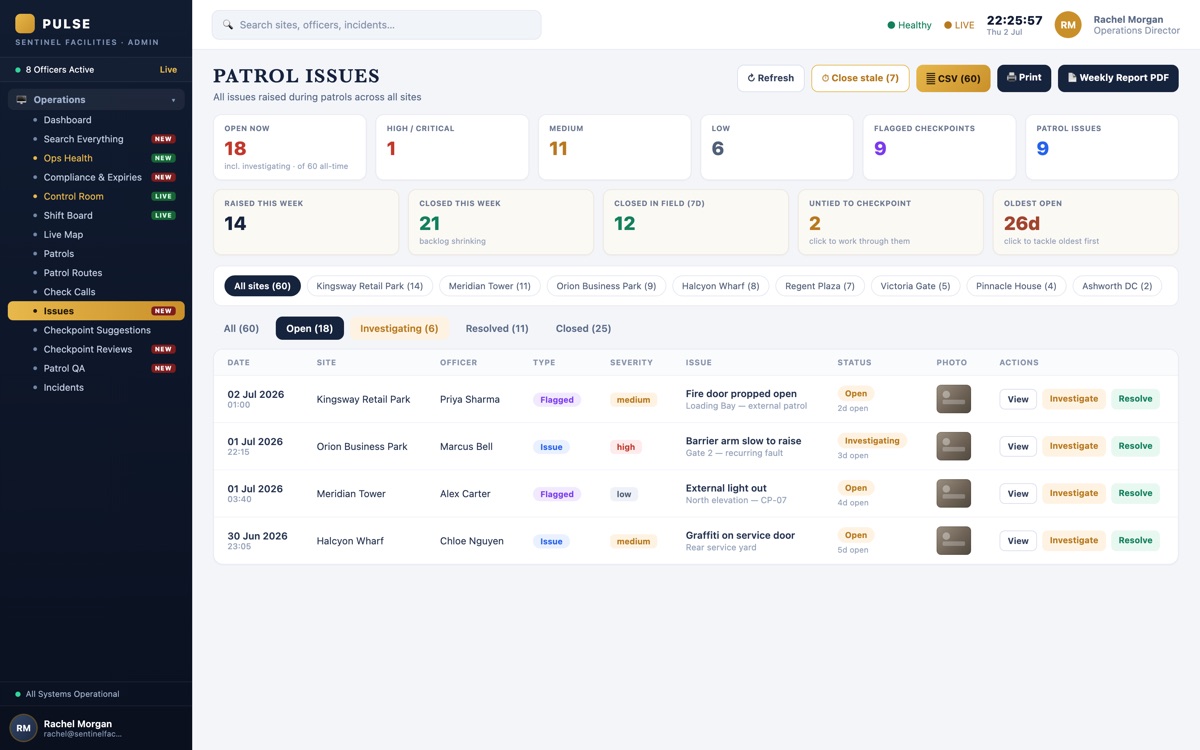
Pulse Operations addresses each of these directly. Its officer app runs natively on iOS and Android and is offline-first with self-healing sync, meaning patrols continue to be logged even where mobile signal is poor — a common issue on construction sites and in basement plant rooms, and most app improvements reach phones over the air the same day they ship. Every patrol checkpoint on Pulse is completed only by submitting a watermarked photograph capturing the officer, the site, GPS coordinates and a timestamp — Pulse deliberately has no NFC or QR tag scanning option, since a tag scan only proves someone was near a reader, not that the check was genuinely completed.
Core capabilities to compare against SmartTask-style tools
- Proof-of-service verification — a mandatory watermarked, geotagged photograph at each checkpoint rather than a simple task-completion tick or tag scan.
- Tamper-evident daily occurrence book — covering 18 incident types, with a hash-chained (SHA-256) audit log and a built-in integrity check that walks the whole chain, replacing paper logs that clients and regulators increasingly reject as unauditable.
- Live control room — a real-time map view, welfare check calls, lone-worker SOS alerts, and dispatch, plus an "Ops Health" morning brief for supervisors.
- Compliance runway — tracking SIA licensing, BS 7858 vetting, DBS checks, right-to-work status, training records, statutory building compliance and Martyn's Law risk assessments in one place.
- Full FM functionality — work orders, PPM scheduling, helpdesk SLAs, permits, assets and contractor management, as explored in this property maintenance software buyer's guide.
- Rostering, time & attendance, and payroll exports — plus recruitment, contracts and invoicing, so operational and back-office data live in one system.
- White-label client portal — showing delivered-versus-contract performance with honest empty states, rather than obscuring gaps in coverage.
None of these are standard in generalist project management software, which is exactly why treating "SmartTask alternative" as a single category is misleading for security and FM buyers — the real comparison set includes named competitors like TrackTik, Silvertrac, Guardhouse and SmartTask itself, not Trello or Asana. Buyers already comparing Silvertrac's pricing or looking at a Silvertrac alternative will recognise the same underlying question: does the platform verify service delivery, or just track tasks?
How much do SmartTask alternatives cost in 2026?
Costs for SmartTask alternatives vary enormously depending on whether you're comparing generalist task software or a sector-specific operations platform. SmartTask itself starts as low as $3–$4.99 per user per month according to Project-Management.com and ITQlick, while Trello's paid plans start at $9.99 per user per month per the same ITQlick data. These figures are typical of the broader generalist market — genuinely low-cost per seat, but limited in scope.
Sector-specific platforms like Pulse Operations price differently, reflecting the wider scope of what's included. Pulse Operations publishes its full rate card openly on its pricing page rather than requiring a sales call, scaling across tiers to suit different operation sizes. Pricing is per operative, with admin and client portal seats free — an important distinction for security and FM companies where the number of contract managers and clients viewing reports can be as large as the guarding headcount itself.
Worked example: comparing total cost for a 40-officer security firm
A security company running 40 officers across several London sites might pay in the region of $200–$400 per month for a generalist tool at 40 seats, based on the per-user rates reported above — but would then need separate systems (typically £100–£300/month each) for rostering, compliance tracking and client reporting, pushing real total cost significantly higher once those are added.
By contrast, that same firm on Pulse Operations gets rostering, time & attendance, payroll exports, the compliance runway, incident logging and the client portal bundled into a single per-operative rate published on the pricing page, with no additional per-seat cost for the admin team or clients viewing the portal.
Your SmartTask alternative evaluation checklist
- List every non-negotiable workflow your current process requires — incident logging, PPM scheduling, licence tracking — before comparing tools on price alone.
- Check the free-tier user cap carefully; sources disagree on whether SmartTask's free plan supports 20 users or just 3, so verify current terms directly with the vendor.
- Map your compliance obligations — SIA licensing, BS 7858 vetting, DBS checks, Martyn's Law risk assessments — against what the platform actually tracks natively.
- Test offline functionality if your teams work in basements, rural sites, or areas with poor mobile signal.
- Ask how proof-of-service is captured — a photo with GPS and timestamp is a materially stronger evidence trail than an NFC tag scan.
- Confirm whether admin, client and portal seats are charged separately, since this can multiply total cost significantly on per-user platforms.
- Request a trial of the client-facing reporting to see whether it shows delivered-versus-contract data honestly, including gaps in coverage.
- Compare named competitors directly — for security and FM, that means TrackTik, Silvertrac, Guardhouse and Pulse Operations, not generic task apps.
FAQ
What is the best free alternative to SmartTask?
Trello, Asana and ClickUp all offer free tiers commonly compared against SmartTask, though each caps users or features at the free level. For businesses needing compliance tracking or proof-of-service — such as security or FM operations — there is no genuinely free equivalent, since these platforms require ongoing infrastructure for GPS verification, incident logging and audit trails.
How does SmartTask compare to Asana?
SmartTask is generally positioned as a lower-cost alternative to Asana, with paid plans starting at $3–$4.99 per user per month compared to Asana's typically higher pricing tiers. Asana tends to offer deeper workflow automation and reporting, while SmartTask bundles in lighter CRM-style features at a reduced price point.
What is the best SmartTask alternative for small businesses?
For small businesses doing general project coordination, Trello or ClickUp are frequently recommended alternatives due to their simplicity and free tiers. For small security or FM businesses specifically, Pulse Operations may suit better despite a higher entry price, since it replaces several separate tools — rostering, compliance tracking, incident logging — with one system priced per operative, published openly on the pricing page.
Is ClickUp better than SmartTask?
Whether ClickUp is "better" depends on the use case: ClickUp offers a broader all-in-one feature set including docs, whiteboards and AI tools, which suits teams wanting a single generalist workspace. SmartTask remains a simpler, more affordably priced option for teams that primarily need task boards and light CRM functionality without ClickUp's wider feature sprawl.
What are the pricing differences between SmartTask and its competitors?
Reported figures vary by source: Project-Management.com states SmartTask's Basic plan starts at $3 per user per month with Premium at $6, while ITQlick reports paid plans starting at $4.99 per user per month with a free tier for up to 3 users. Trello's paid plans start at $9.99 per user per month according to the same ITQlick data, making SmartTask consistently cheaper at entry level than Trello across both sources.
What are the main limitations of SmartTask for regulated industries?
SmartTask has no native functionality for licence tracking, incident logging, GPS-verified attendance, or statutory compliance monitoring — all requirements for UK security and facilities companies operating under SIA regulation, BS 7858 vetting standards, and Martyn's Law duties. Businesses in these sectors typically need a purpose-built operations platform rather than a generalist task manager, as covered in this integrated security and FM software guide.
Which project management tool is best for client-facing teams?
For client-facing operational teams — such as security contractors or FM providers reporting to property managers — the priority is a platform with a dedicated client portal showing delivered-versus-contract performance, rather than internal task boards alone. Pulse Operations includes a white-label client portal with honest empty states, built specifically for this kind of external reporting requirement.
Securing your operations with Pulse Operations
If your search for a "SmartTask alternative" started because task boards can't prove that a patrol happened, a fire door was checked, or an officer's SIA licence is still valid, you've outgrown generalist project management software — and that's exactly the gap Pulse Operations was built to close. Rather than retrofitting Trello-style boards onto security and FM work, Pulse Operations combines the officer app, incident logging, compliance runway and client portal into one system designed around proof-of-service from day one.
Pulse Operations records watermarked photo verification — capturing the officer, site, GPS location and timestamp — on 96.2% of checkpoints across live operations, trailing 90 days as of July 2026, according to the company's own benchmark data. That evidence trail is materially stronger than the NFC or QR tag scans used by many legacy systems, and it was built by a team operating inside their own working London security and FM business before opening the platform to other operators.
If you're comparing SmartTask, TrackTik, Silvertrac or Guardhouse against a purpose-built alternative for security and facilities operations, there is no sales call to sit through first — Pulse Operations publishes its full pricing openly on its pricing page, priced per operative with admin and client portal seats free, and most firms complete a guided switch, including a parallel run on one site, within a fortnight.