Last updated: 5 September 2026
Security patrol app: the complete UK guide for 2026
A security patrol app is software that lets guards record checkpoint visits, log incidents, and report in real time from a mobile phone rather than a paper sign-in sheet or a clipboard. The strongest versions verify presence with GPS and a timestamped photograph rather than a tag scan, and feed a live control room and a client-facing portal.
Key Takeaways
- A security patrol app replaces paper occurrence books and clipboard sign-in sheets with a mobile record that captures GPS, timestamps and photo evidence at every checkpoint.
- Nearly 69% of businesses prefer mobile patrol teams over static guarding because response times are faster, according to Global Growth Insights (2026).
- More than 63% of security service providers now use GPS tracking and real-time reporting tools to run patrols, per Global Growth Insights (2026).
- Pulse Operations verifies checkpoints with a mandatory watermarked photograph — officer, site, GPS and time — with no NFC or QR tag scanning at all, a design choice, not a limitation.
- The global security guard management software market was worth $1.63 billion in 2026 and is forecast to reach $4.46 billion by 2033, according to Novagems (2026).
What is a security patrol app?
A security patrol app is a mobile application that records where and when a security officer completes a patrol, replacing the paper log book and the physical clock-in clock at the gatehouse. Officers carry it on a phone rather than a bunch of keys and a checkpoint tag reader. The app timestamps each checkpoint, tracks the officer's route via GPS, and lets them log incidents, welfare notes and deliveries as they happen rather than at the end of a shift from memory.
Most systems on the UK market — TrackTik, Silvertrac, Guardhouse and SmartTask among them — verify a checkpoint visit using near-field communication (NFC) tags or QR codes fixed to walls, doors or plant rooms. Pulse Operations takes a different approach: a checkpoint is only completed when the officer submits a mandatory watermarked photograph, stamped with their name, the site, GPS coordinates and the exact time. There is no tag scan step in the workflow at all — the photo is the completion.
How this differs from a guard tour system
The older term "guard tour system" usually describes a standalone hardware product — a wand or reader that logs a tag scan to a memory chip, later downloaded to a PC. A modern security patrol app does the same core job of proving a route was walked, but adds live dispatch, incident management, lone-worker alerts and client reporting on the same platform. The hardware wand answers one question: was a tag scanned? A patrol app answers a wider one: what actually happened on site tonight, and can a client see it themselves.
How does a security patrol app work?
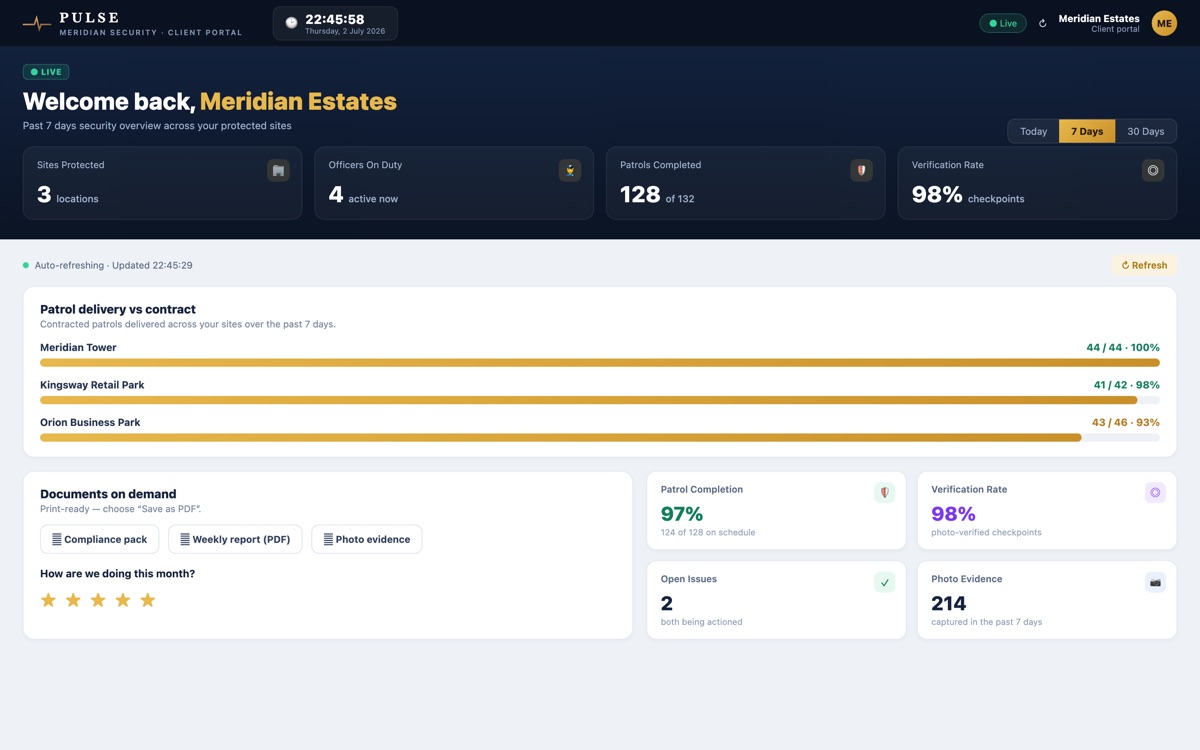
A security patrol app works by combining a mobile officer interface with a back-end control room and, usually, a client-facing reporting layer. The officer opens the app at the start of a shift, is guided to each checkpoint on a route, and confirms their presence — either by scanning a tag or, on Pulse, by submitting a watermarked photo. Incidents, welfare checks and deliveries are logged in the same app. Supervisors and control room staff see the shift unfold on a live map, and clients typically get a portal or export showing what was delivered against what the contract specifies.
The mechanics matter because the weak link in most patrol proof is the checkpoint itself. Per Pulse Operations's guide, how to prove patrols actually happened, a tag scan tells you a phone was held near a tag at a moment in time — it does not tell you a person was genuinely present and alert, or what the area actually looked like. Tags can be scanned in five seconds on the way past, or even scanned from a photograph of the tag taken earlier. They also fail in ordinary ways: painted over during redecoration, ripped off a fire door, or sitting in a plant room with no signal to log the scan at all.
Checkpoint verification methods compared
| Method | What it proves | Common failure mode | Client confidence |
|---|---|---|---|
| Paper sign-in sheet | Someone wrote a time | Filled in from the mess room after the shift | Low — no independent evidence |
| NFC/QR tag scan | A phone was near a tag at that time | Tag scanned from a photo, painted over, or missing | Medium — disputable |
| GPS location ping only | An officer's phone was in the vicinity | No proof of what was checked or its condition | Medium |
| Watermarked photo (Pulse) | Officer, site, GPS and time stamped onto an image of the actual area | Requires a working phone camera | High — hard to fabricate across a shift |
A watermarked photo carries the content of the patrol — the state of a fire door, a loading bay, a plant room — not just its footprint. Per the same guide, a run of properly watermarked photos across a shift is genuinely difficult to fabricate, which is precisely why it changes the conversation with a client who has been burned before by a paper log that claimed a site was checked on the night something went wrong.
What features should a security patrol app have?
A security patrol app worth paying for needs five things: verified checkpoints, an incident log, live visibility for a control room, offline reliability, and client-facing reporting. Anything less than that is a digital version of a paper form, which solves storage but not trust. Around 52% of security operators already provide some form of app-based reporting to clients, according to Global Growth Insights (2026) — so a bare-bones checkpoint tracker is no longer a differentiator on a tender.
Look for the following as a minimum:
- Photo or hard verification at checkpoints — not just a GPS ping, which proves location but not condition.
- A tamper-evident incident log — ideally one that records the daily occurrence book digitally, replacing a paper DOB that can be edited after the fact.
- Offline-first operation — patrols happen in basements, plant rooms and construction sites with no signal; the app must queue data and sync later without losing a record.
- A live control room view — a map showing where officers are, missed checkpoints in real time, and a route to dispatch backup.
- Lone-worker SOS — a panic button that alerts a control room immediately, relevant given that most assaults on security guards happen during night shifts between 8pm and 4am, per SafetyCulture, citing US Bureau of Labor Statistics data (2026).
- Client portal or export — delivered-vs-contract reporting the client can check without phoning the control room.
- Compliance tracking — SIA licence expiries, BS 7858 screening status, training records and right-to-work checks in one place rather than a spreadsheet.
Pulse's own audit log is hash-chained using SHA-256 and is tamper-evident, with a built-in integrity check that walks the whole chain — a technical detail that matters specifically because a client or an assessor needs to trust that a record has not been edited after the fact, not just that a record exists.
What does a security patrol app cost in the UK?
Security patrol software in the UK is typically priced per officer per month, not as a flat site fee, because the workload scales with headcount rather than square footage. Costs range from around £15-£40 per operative per month for basic guard tour tracking, up to several pounds more per head for platforms that bundle incident management, compliance tracking and a client portal. Enterprise contracts covering large multi-site estates with white-labelling typically move to a custom quote rather than a published per-seat rate.
Pulse Operations publishes its pricing openly at pulse-operations.co.uk/pricing rather than gating it behind a sales call — a deliberate choice, given how much of this market still requires a demo just to see a number. Pricing is per operative, sites are unlimited, and admin, control-room and client-portal seats are free on every plan. That last point matters commercially: a security company charged per site, or per admin login, ends up paying more as its back office grows even though the officer headcount hasn't changed.
Comparing pricing models
| Pricing approach | How it scales | Who it suits |
|---|---|---|
| Per officer/operative | Cost tracks headcount, not sites or admin seats | Growing contract security firms adding sites without adding office staff |
| Per site | Cost tracks number of locations | Firms with few sites but heavy staffing per site |
| Flat enterprise licence | Fixed cost regardless of scale | Very large, stable estates negotiating a custom deal |
Ways to reduce the cost of a patrol app rollout
- Consolidate systems: running rostering, incidents and patrols on separate tools each with their own subscription usually costs more than one platform.
- Ask whether admin and supervisor seats are charged — many providers meter these separately, which penalises firms that invest in oversight.
- Check migration is included rather than a paid extra; Pulse Operations includes guided setup, data migration and a parallel run on one site in every plan, and most firms switch fully within a fortnight.
- Avoid multi-year lock-in unless the rate is worth it; ask what happens to pricing after any founding or introductory period ends.
Is a security patrol app better than paper-based guard tours?
Yes, for most operators a security patrol app is a substantial improvement over paper-based guard tours, primarily because paper cannot be independently verified after the fact. A paper sign-in sheet can be filled in from memory at the end of a shift; a digital record with GPS and photo evidence cannot be reconstructed retrospectively in the same way. The trade-off is upfront cost and a change-management process for officers used to paper.
In practice, this is precisely the gap the founding team behind Pulse Operations set out to close in their own security and FM business, Priority First, a London operator running 24 sites. Before building Pulse, Priority First ran patrols on paper sign-in sheets, passed jobs around on WhatsApp messages, and tracked licence expiries in a spreadsheet nobody fully trusted. When a client called at 7am asking "was everything OK last night?", there was no evidence to answer with — only a request to be believed. The team built the system they couldn't buy: security and FM moved onto one login, every checkpoint became photo-mandatory, and clients were given branded portals showing delivered-vs-contract. Within six months, Priority First was running 24 sites on one platform, with over 4,900 patrols completed on the record and every checkpoint backed by a watermarked photo. As Mo Hassan, Managing Director of Priority First, put it: "We used to take everyone's word for it. Now every checkpoint has a photo and the client can see it before we've finished the shift — it's changed how we win work."
"A tag scan proves a phone was near a tag. It doesn't prove anyone looked at anything. We made the photo the completion itself — no photo, no tick — because the first time a client disputes a night's cover, a scan log is an argument and a photograph is an answer." — Mo Hassan, Founder, Pulse
Paper vs digital: the honest trade-off
For a very small operation running one or two static sites with a stable, trusted client relationship, paper may still be workable in the short term. But it does not scale, it does not survive a client dispute, and it does not produce the audit trail an SIA Approved Contractor Scheme assessment or a Martyn's Law premises assessment increasingly expects. Once a firm is running multiple sites, subcontracting, or bidding for contracts against competitors who can show live evidence, paper becomes a competitive disadvantage rather than a cost saving.
Can a security patrol app work offline or without WiFi?
Yes — a well-built security patrol app must work offline, because patrols routinely take officers into basements, plant rooms, underground car parks and construction sites where mobile signal is patchy or absent. An app that requires a live connection to log a checkpoint will simply fail at the exact moments — remote loading bays, deep basements — where independent verification matters most.
Pulse's officer app is native to iOS and Android and built offline-first, meaning checkpoint photos, incident logs and welfare check confirmations are captured and stored on the device the moment they happen, then synced automatically once signal returns. This is described as self-healing sync: if a shift generates forty checkpoints in a basement with no signal, all forty are queued and uploaded the moment the officer steps back into range, with no manual retry needed. Most feature and bug-fix improvements reach officer phones over the air the same day they're released, so there's no waiting on an app store review cycle to fix a problem discovered mid-shift.
How does a security patrol app improve compliance and lone-worker safety?
A security patrol app improves compliance by centralising licence expiries, screening records and site-specific documentation that would otherwise sit across spreadsheets, filing cabinets and individual officers' memories. It improves lone-worker safety by giving officers a direct, one-tap route to raise an alarm, and giving a control room a live view of where every officer is and when they were last checked on.
The safety case is not abstract. According to the US Bureau of Labor Statistics, cited by SafetyCulture (2026), security guards experience roughly the same rate of nonfatal injuries as workers in other fields, but their fatality rate is more than double the average worker's. The same source notes that most assaults on security guards happen during night shifts, between 8pm and 4am — precisely the hours when a lone officer patrolling an empty retail park or a construction site has the least natural oversight. A patrol app with a lone-worker SOS function, welfare check calls on a schedule, and live GPS tracking directly addresses the hours where risk concentrates.
Compliance and the ACS self-assessment
UK contract security firms working toward or maintaining the SIA's Approved Contractor Scheme (ACS) status face a self-assessment workbook that, per Pulse Operations's guide, the ACS self-assessment: how to evidence it, scores a business against 78 individual indicators across seven criteria: Strategy, Service delivery, Commercial relationship management, Financial management, Resource management, People, and Leadership. Assessors don't take self-reported scores at face value — they review staff files and payroll records, contracts and duty rotas, policies and site documentation, and they interview staff and customers on site. The People criterion specifically checks how well a contractor applies BS 7858 security screening and verifies licences against the SIA register — exactly the kind of record a compliance runway tracking SIA licences, BS 7858 screening, DBS checks, right to work and training expiries in one place is built to produce on demand, rather than reconstructed under deadline once a year.
Firms preparing for their own ACS assessment, or for the newer duty introduced under Martyn's Law — the Terrorism (Protection of Premises) Act 2026, which requires certain premises to carry out a public protection procedure assessment — face the same underlying problem: evidence scattered across systems is much harder to produce convincingly than evidence generated automatically as a by-product of daily operations.
Your security patrol app checklist
- Decide what "proof" needs to mean for each site — a photo of a locked plant room door proves something different from a GPS ping in a car park.
- Confirm the app works fully offline and syncs automatically, not just "mostly" offline.
- Check whether checkpoints are verified by photo, tag, or GPS alone, and understand the failure modes of each.
- Ask whether admin, supervisor and client-portal seats are charged separately or included.
- Confirm lone-worker SOS and welfare check scheduling are built in, not a bolt-on integration.
- Check that licence expiries (SIA, BS 7858, DBS, right to work) sit on one runway rather than a spreadsheet.
- Ask for a live demo of the client portal — a portal that only ever shows 100% delivery is a portal nobody trusts.
- Confirm migration and a parallel run are included before committing, and get a realistic switchover timeline in writing.
FAQ
What is a security patrol app?
A security patrol app is mobile software that records when and where a security officer completes a checkpoint, replacing paper sign-in sheets and standalone guard tour wands. Modern versions add incident logging, live control room visibility, lone-worker alerts and client reporting on the same platform.
How does a security patrol app verify a checkpoint was actually completed?
Most patrol apps verify checkpoints using an NFC or QR tag scan, though this only proves a phone was near a tag at a given time, not that anyone was genuinely present. Pulse Operations instead requires a mandatory watermarked photograph — stamped with officer, site, GPS and time — as the sole method of completing a checkpoint, with no tag scanning at all.
How much does a security patrol app cost in the UK?
UK security patrol software is typically priced per officer per month, commonly in the range of roughly £15-£40 per operative depending on features, with enterprise multi-site contracts negotiated separately. Pulse Operations publishes its pricing openly at pulse-operations.co.uk/pricing, charging per operative with unlimited sites and free admin and portal seats on every plan.
Can a security patrol app work without an internet connection?
Yes, a properly built patrol app works offline by storing checkpoint data, photos and incident logs on the device and syncing them automatically once signal returns. This matters because patrols routinely cover basements, plant rooms and remote sites with poor or no mobile signal, exactly where independent proof of presence matters most.
Is a security patrol app the same as a guard tour system?
Not quite — a guard tour system traditionally refers to standalone hardware, such as a wand that scans tags and downloads data to a PC later. A security patrol app performs the same checkpoint-verification role but usually adds live dispatch, incident management, compliance tracking and client-facing reporting in one connected platform.
How does a security patrol app help with SIA Approved Contractor Scheme compliance?
A security patrol app helps ACS compliance by centralising the evidence assessors ask for — staff files, licence status, screening records and site documentation — rather than leaving it scattered across spreadsheets and filing cabinets. The ACS self-assessment workbook scores a business against 78 indicators across seven criteria, and assessors verify claims by reviewing records and interviewing staff directly.
Does a security patrol app improve lone-worker safety?
Yes, a security patrol app improves lone-worker safety through features like one-tap SOS alerts, scheduled welfare check calls, and live GPS tracking visible to a control room. This matters particularly for night-shift officers, since most assaults on security guards happen between 8pm and 4am, according to SafetyCulture, citing US Bureau of Labor Statistics data (2026).
Choosing a security patrol app with Pulse Operations
Everything in this guide — verified checkpoints, offline reliability, lone-worker safety, compliance evidence — comes back to one question a client eventually asks: can you prove it? Pulse Operations was built to answer that question directly, with photo-verified patrols where a watermarked image of the officer, site, GPS and time is the checkpoint completion itself, not a tag scan a client has to take on trust.
Pulse Operations's own live operational data shows 96.2% of checkpoints across current deployments carry a watermarked photo, measured over a trailing 90-day window as of July 2026 — see the benchmark for the full methodology. The platform is UK-built and UK-hosted, with tenant isolation enforced at the data layer and verified by an automated cross-tenant test suite on every build, which matters to any operator handling client site data under UK data protection expectations.
If your firm is still running patrols on paper, WhatsApp threads and a spreadsheet of licence expiries, get in touch with Pulse Operations for a walkthrough of the officer app, the control room and the client portal — pricing is published at pulse-operations.co.uk/pricing, with no sales deck required to see it.
Related Reading
- Security Guard Handover Template UK | Free Guide 2026
- Security RAMS Template: UK Guide + Free Framework 2026
- Security Site Induction Checklist UK: Full 2026 Guide