
Last updated: 24 October 2026
CAFM (computer-aided facility management) software manages buildings, space and compliance across a whole estate; CMMS (computerised maintenance management system) software manages assets, work orders and maintenance schedules. The core CAFM vs CMMS difference is scope: one runs the building, the other runs the equipment inside it — and many UK operators eventually need elements of both.
Key Takeaways
- CAFM software manages space, buildings and estate-wide compliance, while CMMS software focuses on asset maintenance, work orders and spare parts.
- The global CMMS market was valued at USD 1.29 billion in 2024 and is forecast to hit USD 2.41 billion by 2030, growing at 11.1% a year, according to Grand View Research (2026).
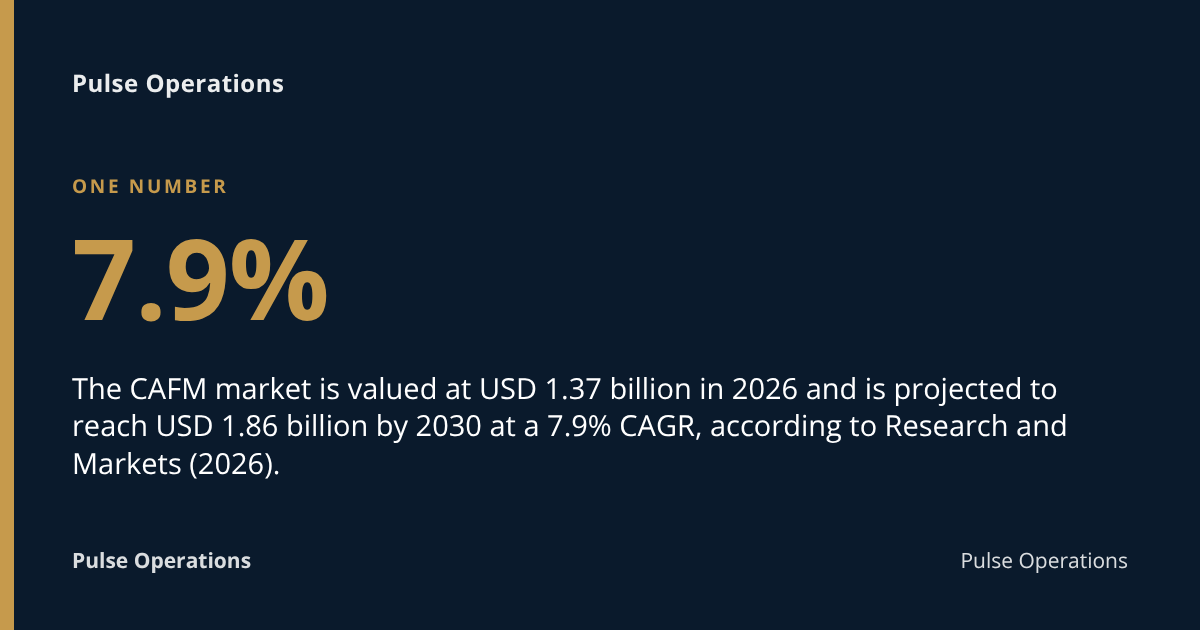
- The CAFM market is valued at USD 1.37 billion in 2026 and is projected to reach USD 1.86 billion by 2030 at a 7.9% CAGR, according to Research and Markets (2026).
- Multi-site UK landlords and FM providers typically need CAFM's space and compliance tools; manufacturers and plant-heavy sites usually need CMMS's asset and spares focus.
- Pulse Operations builds facilities and compliance functions — work orders, PPM, statutory building compliance — directly alongside security operations, so FM and guarding sit in one platform rather than two separate systems.
What is CAFM software?
CAFM is computer-aided facility management software, a category of system that helps facilities teams run buildings, space, assets and compliance from a single digital record rather than spreadsheets and paper files. It typically covers space planning, floor plans, lease and occupancy data, helpdesk ticketing, planned preventive maintenance (PPM), and statutory compliance tracking such as fire risk assessments and legionella checks.
CAFM grew out of the computer-aided design (CAD) world in the 1980s, when facilities teams started layering building and occupancy data onto digital floor plans. Wikipedia's entry on computer-aided facility management notes the term is often used interchangeably with CMMS, even though the two emerged to solve different problems — a confusion that still causes UK buyers to pick the wrong system.
A typical UK CAFM deployment covers a commercial office, retail park or mixed-use development: tracking which tenant occupies which floor, when the fire alarm was last tested, and whether the lift maintenance contract is up to date. The Institute of Workplace and Facilities Management (IWFM) sets the professional standards many UK facilities managers work to, and CAFM is the software layer that operationalises those standards day to day.
What is CMMS software?
CMMS is a computerised maintenance management system, a category of software built to schedule, track and log maintenance on physical assets and equipment. Its core job is work order management: logging a fault, assigning an engineer, recording parts used, and scheduling the next preventive maintenance visit before the asset fails.
CMMS systems typically include an asset register with maintenance history, spare parts inventory, engineer scheduling, and failure-code reporting for root-cause analysis. They're most at home on a factory floor, in a hospital estates department, or anywhere with rotating equipment — pumps, chillers, generators, conveyor lines — that needs a documented maintenance trail for reliability and warranty purposes.
UpKeep's comparison of CAFM and CMMS notes the CMMS market is growing faster than CAFM, projected to reach $2.4 billion by 2030 at roughly 11% annual growth — reflecting wider industrial and manufacturing adoption of asset-centric maintenance software. Grand View Research puts North America's share of that market at over 31% in 2026, underlining that CMMS adoption has historically skewed towards heavy industry rather than UK commercial property.
What is the core functional difference between CAFM and CMMS?
The core CAFM vs CMMS difference is that CAFM organises data around space and the building, while CMMS organises data around assets and maintenance tasks. CAFM answers "who sits where, and is the building compliant?"; CMMS answers "what needs fixing, and when was it last serviced?"
| Dimension | CAFM | CMMS |
|---|---|---|
| Primary unit of data | Space, floor, building, lease | Asset, equipment, spare part |
| Core use case | Space planning, compliance, helpdesk | Work orders, PPM schedules, failure tracking |
| Typical buyer | Facilities manager, estates team | Maintenance manager, plant engineer |
| Best fit | Offices, retail, mixed-use estates, multi-tenant buildings | Manufacturing plants, hospitals, industrial sites |
| Market size (UK-relevant global data) | USD 1.37bn (2026), forecast USD 1.86bn by 2030 — Research and Markets (2026) | USD 1.29bn (2024), forecast USD 2.41bn by 2030 — Grand View Research (2026) |
| Growth rate | ~7.9% CAGR — Research and Markets (2026) | ~11.1% CAGR — Grand View Research (2026) |
Infraspeak's blog cites MarketResearch.com's forecast that the CAFM market would break $1 billion by 2026, with CMMS separately projected by SelectHub to reach $1.7 billion by 2028 at over 8% annual growth — two different analyst houses, two different numbers, but both confirming CMMS is scaling faster off a smaller industrial-maintenance base. The practical takeaway for a UK buyer: if your main pain point is "we don't know what's in our building or whether it's compliant", that's a CAFM problem. If it's "our pumps keep failing and nobody logs why", that's CMMS.
Which is better for UK commercial buildings versus industrial equipment?
CAFM suits UK commercial buildings — offices, shopping centres, mixed-use developments — where space utilisation, tenant compliance and statutory building checks matter more than individual machine uptime. CMMS suits industrial and plant-heavy sites where asset reliability, spare parts and engineer scheduling are the daily priority.
A London office landlord managing 200,000 sq ft across several floors in Canary Wharf needs CAFM to track occupancy, fire door inspections and PPM contracts with lift and HVAC contractors. A food manufacturer in the Midlands running continuous production lines needs CMMS to track bearing wear, motor hours and breakdown history on specific machines.
Mixed-use UK developments sit in between. A shopping centre with retail units, a car park, plant rooms and communal areas often needs CAFM's space and compliance tools alongside CMMS-style asset tracking for the chillers and escalators. This is exactly the overlap zone where security and FM providers end up needing both work order management and compliance tracking inside one operational platform, rather than stitching two specialist systems together.
What UK compliance duties do these systems help facilities managers meet?
UK facilities managers carry statutory duties under several pieces of legislation, and both CAFM and CMMS systems exist partly to produce the audit trail that proves compliance. The Health and Safety at Work etc. Act 1974 places a general duty on employers to ensure a safe working environment, which cascades into specific building-level obligations.
Key UK compliance areas these systems typically support:
- Fire safety — Pulse Operations notes that the Regulatory Reform (Fire Safety) Order 2005 requires a responsible person to carry out and review fire risk assessments; CAFM systems log assessment dates and remedial actions.
- Legionella control — the HSE's Approved Code of Practice L8 requires water system risk assessment and ongoing monitoring, typically scheduled as recurring PPM tasks.
- Statutory inspections — lifts, pressure vessels and lifting equipment require periodic thorough examination under the Lifting Operations and Lifting Equipment Regulations 1998 (LOLER).
- Martyn's Law — the Terrorism (Protection of Premises) Act 2025 introduces new duties on qualifying premises to assess and mitigate terrorism risk, an area where compliance tracking and evidenced action plans matter as much as the physical measures.
- Electrical safety — periodic inspection and testing under BS 7671 wiring regulations.
Neither CAFM nor CMMS automatically makes a building compliant — a system only shows what was scheduled and what was actually done. This is where Pulse Operations's compliance runway differs from a generic CAFM module: it tracks SIA licensing, BS 7858 vetting, DBS checks, right to work, training expiries, statutory building compliance and Martyn's Law assessments on one expiries view, built for the combined security-and-FM operator rather than a pure estates function. Pulse Operations also has a dedicated Martyn's Law guide for operators working through qualifying-premises duties.
Which features overlap between CAFM and CMMS, and which are exclusive?
Both CAFM and CMMS share a common core: work order logging, PPM scheduling, contractor management and reporting dashboards. Where they diverge is in the data model each one is built around.
Features typically found in both:
- Work order creation and tracking
- Preventive maintenance scheduling
- Contractor and supplier records
- Reporting and audit trails
- Mobile access for field teams
CAFM-exclusive strengths:
- Space and floor plan management (CAD/BIM integration)
- Lease and occupancy tracking
- Move management for tenant changes
- Desk and room booking for hybrid working
CMMS-exclusive strengths:
- Detailed asset hierarchies and bill-of-materials
- Spare parts inventory and reorder points
- Failure code analysis and MTBF/MTTR reporting
- Equipment warranty and lifecycle tracking
The Access Group's comparison notes CAFM typically offers a broader feature range across the whole estate, while CMMS goes deeper on individual asset maintenance — a trade-off between breadth and depth that should drive the buying decision more than brand reputation.
What mistakes do UK businesses make choosing between CAFM and CMMS?
The most common mistake is choosing based on category label rather than actual data model — a business buys "CAFM" because it sounds more comprehensive, then discovers it has no real asset hierarchy for its boiler plant. The reverse happens too: a business buys CMMS for a mixed-use building and finds it has nowhere to manage space, leases or tenant compliance.
Other recurring mistakes:
- Underestimating implementation effort. Migrating floor plans, lease data or an asset register from spreadsheets routinely takes longer than vendors suggest in the sales process.
- Ignoring who'll actually use it. A system chosen by IT without input from the facilities manager or maintenance manager often gets abandoned within a year.
- Buying for the estate they have, not the one they'll have. Multi-site expansion, new contracts or added buildings change requirements fast — a system with per-site licensing costs penalises exactly this growth.
- Treating compliance as a bolt-on. Fire safety, Martyn's Law and statutory inspection tracking need to be designed in from day one, not added as an afterthought module.
- Running security and FM on separate systems that never talk to each other, meaning a guard who spots a leaking pipe has no way to raise a work order from the same app they use for patrols.
Pulse Operations was built to avoid the last problem specifically: its facilities and work orders module sits in the same platform as patrol verification and incident logging, so a finding from a site walk becomes a work order without re-keying it into a second system.
Can CAFM and CMMS systems be integrated or used together?
Yes — CAFM and CMMS can be integrated or run alongside each other, and this is common practice for larger UK estates with both space-management and heavy-asset needs. A typical pattern is a CAFM system handling space, leases and compliance, feeding asset and fault data into a CMMS for deeper maintenance analytics on specific plant.
This makes most sense for:
- Hospital estates, where clinical space planning sits alongside critical medical equipment maintenance.
- University campuses, managing teaching space allocation and extensive mechanical plant.
- Large mixed-use developments, where a managing agent needs occupancy data and a specialist contractor needs asset-level maintenance history.
For security and FM providers managing multiple client sites, the practical answer is often simpler: rather than integrating two separate systems, choose a platform that already covers both operational layers. Pulse Operations's approach — patrols, incidents, compliance and facilities work orders in one record — removes the integration problem for operators whose estates don't need deep industrial asset hierarchies, while still giving clients a single client portal showing delivered-vs-contract work.
In practice: a prestige central-London residential estate running patrols across 16 buildings on one nightly round couldn't see delivered-versus-contracted maintenance and patrol activity without phoning the office — a familiar symptom of FM and security living in separate systems. Pulse Operations set each building up as its own site with its own checkpoints and evidence trail, with recurring findings surfaced automatically and the estate viewing per-building delivered-vs-contract through its own portal. Since going live in March 2026, the estate has logged over 4,100 patrols — roughly 250–280 per building — with 100% of checkpoint completions photo-verified, against what had previously been a single vague "round complete" report.
Your CAFM vs CMMS decision checklist
- Map your estate type first: multi-tenant commercial building (lean CAFM) or plant-heavy industrial site (lean CMMS).
- List every UK statutory duty you must evidence — fire safety, legionella, LOLER inspections, Martyn's Law — before comparing feature lists.
- Check whether the system has a real asset hierarchy with spare parts tracking, or just a flat equipment list dressed up as one.
- Confirm who in your organisation will own day-to-day data entry: facilities manager, maintenance manager or a shared IT function.
- Ask vendors for a realistic implementation timeline including data migration, not just the demo environment setup time.
- Test whether the system handles your security or guarding operation too, or whether you'll be running a second platform for patrols and incidents.
- Review pricing structure against your growth plans — per-site fees punish exactly the expansion you're planning for.
FAQ
What is the difference between CAFM and CMMS?
CAFM manages buildings, space and estate-wide compliance, while CMMS manages individual assets, maintenance schedules and spare parts. CAFM's unit of data is the building or floor; CMMS's unit of data is the piece of equipment.
Is CAFM the same as CMMS?
No, though the terms are sometimes used interchangeably, as Wikipedia's entry on computer-aided facility management points out. CAFM covers a broader estate-management remit including space and leases; CMMS is narrower and focused on maintenance work orders.
Which is better for facilities management in the UK?
Neither is universally better — it depends on the estate. A multi-tenant office or retail portfolio typically needs CAFM's space and compliance tools, while a manufacturing site or hospital plant room typically needs CMMS's asset-depth and spares management.
Can a small UK business use CAFM and CMMS together?
Yes, though smaller operators more often need the functions both provide without running two separate platforms. Combined systems covering work orders, PPM and compliance in one place avoid duplicate data entry and give a single source of truth across sites.
How much does CAFM or CMMS software cost in the UK?
Pricing varies widely by vendor, deployment size and number of sites, typically ranging from per-user subscription models to enterprise licensing for large estates. Buyers should ask for a total cost including implementation and data migration, not just the headline subscription figure — Pulse Operations, for comparison, publishes its own pricing openly at /pricing.
Does CAFM or CMMS help with Martyn's Law compliance?
Neither system automatically delivers Martyn's Law compliance, but both can track the risk assessments and action plans the Terrorism (Protection of Premises) Act 2025 requires for qualifying premises. Pulse Operations includes Martyn's Law assessment tracking within its compliance runway, alongside SIA, BS 7858 and statutory building compliance.
How long does implementation typically take?
Implementation timelines vary by estate size and data complexity, with larger multi-site CAFM rollouts generally taking longer than single-site CMMS deployments due to floor plan and lease data migration. Pulse Operations's own switching process includes guided setup, migration and a parallel run on one site, with most firms switching fully within a fortnight.
Pulse Operations and the facilities side of the CAFM vs CMMS question
Most UK security and FM providers don't need a pure CAFM system or a pure CMMS — they need work orders, PPM and statutory compliance running alongside the guarding operation they already deliver, without a second login and a second data entry job. That's the gap Pulse Operations's facilities & work orders module fills: contractor costs, PPM schedules, helpdesk SLAs, permits and asset registers sit in the same platform as patrol verification, incident logging and the compliance runway covering SIA, DBS, BS 7858 and Martyn's Law.
The prestige central-London estate case above shows the pattern in practice: 16 buildings, one nightly round, patrol and compliance data that used to live in someone's head now visible per-building in a client portal. Pulse Operations was built inside the founding team's own London security and FM operation, Priority First, before being opened to other operators — so the facilities module was shaped by running real contracts, not designed in isolation from a feature checklist.
If your business is weighing up a CAFM purchase, a CMMS purchase, or trying to stop running two disconnected systems for one estate, book a look at how Pulse Operations handles facilities and compliance alongside security — see pulse-operations.co.uk/facilities or get a quote via pulse-operations.co.uk/pricing.
Related Reading
- Building Compliance Tracking Software UK | 2026 Guide
- Contractor Management Software for Facilities (2026 Guide)
- Permit to Work Software UK: 2026 Buyer's Guide
Add pulse-operations.co.uk as a preferred source on Google
Back to all insights