Last updated: 3 September 2026
Permit to Work Software: The UK Facilities Manager's Guide for 2026
Permit to work software is a digital system that replaces paper permit books with structured, time-limited authorisations for high-risk jobs — hot work, confined space entry, working at height and electrical isolation. It routes approvals, records competency checks and keeps a searchable audit trail, which matters because 124 workers died in work-related incidents in Great Britain in 2026/25, according to the HSE (2026).
Key Takeaways
- Permit to work software digitises the authorisation, monitoring and closure of high-risk work, replacing paper permit books with a structured, auditable workflow.
- Falls from height caused 35 deaths in Great Britain in 2026/25, over a quarter of all worker deaths, per the HSE (2026).
- Construction (35 deaths) and agriculture, forestry and fishing (23 deaths) were the highest-fatality industries in Great Britain in 2026/25, per the HSE (2026).
- 15 UK workers die in confined space accidents every year, with up to 60% of fatalities involving untrained rescuers, according to the Online CPD Academy (2026).
- HSE's HSG250 guidance sets out the principles a permit to work system — paper or digital — must follow to control work-related risk.
What is permit to work software?
Permit to work software is a digital platform that manages the authorisation, supervision and closure of hazardous work activities on a site. It replaces the traditional paper permit book — a triplicate form signed by an issuer, a receiver and a supervisor — with a structured workflow that captures the same information electronically, plus a timestamped, searchable audit trail.
The system typically covers permit types such as hot work (welding, grinding, cutting), confined space entry, working at height, electrical isolation (lockout/tagout) and excavation. Each permit template forces the issuer to confirm hazard controls, competency of the workforce, and a defined start and expiry time before work can begin.
Facilities teams in the UK often run permit to work modules alongside a broader CAFM (computer-aided facilities management) platform, so that permits sit next to work orders, planned preventive maintenance (PPM) and contractor records rather than in a separate system nobody checks.
Where permit to work fits inside HSE's HSG250 guidance
The HSE's guidance on permit-to-work systems (HSG250) is the reference document UK duty holders use to design a permit system, whether it runs on paper or software. HSG250 sets out core principles: a permit must be issued by a competent, authorised person; it must specify the work, the hazards and the precautions; it must be time-limited; and it must be formally cancelled once work is finished and the area is confirmed safe.
Software doesn't change any of these principles — it enforces them. A digital system can refuse to let a permit go live without a named issuer, can auto-expire a permit at the stated time, and can block sign-off until the receiver confirms the area has been cleared. That's the practical difference between HSG250 as a written policy and HSG250 as something the system actually does for you.
Why does permit to work matter for UK safety compliance?
Permit to work systems matter because they intervene at exactly the point where serious incidents happen: the gap between planning a job and doing it. UK work-related fatality data shows where that gap is most dangerous. Falls from height caused 35 deaths in Great Britain in 2026/25 — over a quarter of all worker fatalities — according to the HSE (2026). Construction and agriculture, forestry and fishing were the highest-fatality industries, with 35 and 23 deaths respectively, per the same HSE data.
These are precisely the job types a permit to work system is built to control: work at height, hot work near flammable materials, and entry into confined or isolated spaces. A permit doesn't eliminate risk on its own, but it forces the conversation about controls before the ladder goes up or the tank is entered — and it leaves a record proving that conversation happened.
The confined space and hazardous energy problem
Confined space entry and hazardous energy control (lockout/tagout) are two categories where the numbers are stark. 15 UK workers die in confined space accidents every year, and up to 60% of those fatalities involve untrained rescuers attempting to help a colleague, according to the Online CPD Academy (2026). US OSHA data going back further shows confined space fatalities averaged 92 per year between 2011 and 2018, per gitnux.org (2026) — a comparable pattern, different jurisdiction.
Lockout/tagout (isolating machinery energy sources before servicing) is one of the most persistently violated safety standards in industrial settings. OSHA data reported by Humulo shows the lockout/tagout standard (29 CFR 1910.147) logged 2,443 violations in fiscal year 2026, climbing from sixth to fifth on OSHA's Top 10 most cited standards list. BradyID.com's OSHA data records hazardous energy as the cause of 190 deaths in 2023, with 142 of those caused by electrical exposure. OSHA itself estimates the lockout/tagout standard prevents roughly 120 fatalities and 50,000 injuries a year by stopping unexpected machine start-up during servicing, according to US Made Supply (2026).
A permit to work system that includes an electrical isolation or lockout/tagout template forces exactly the check that prevents these incidents: has the energy source been isolated, locked, and verified dead before anyone touches it.
What features should you look for in permit to work software?
Good permit to work software does five things well: it enforces the HSG250 workflow rather than just digitising a form; it checks contractor competency automatically; it produces a tamper-evident audit trail; it integrates with the rest of your CAFM or maintenance system; and it works on a phone or tablet on-site, not just in an office.
Beyond those basics, look for permit expiry alerts, escalation rules if a permit is left open past its stated end time, and a clear distinction between permit types — hot work, confined space, working at height and electrical isolation each need different mandatory fields. A system that treats every permit the same is a system that will let something important slip through.
Feature comparison: what a permit to work module should cover
| Requirement | Why it matters | What to check when buying |
|---|---|---|
| HSG250-aligned workflow | Matches HSE guidance on issuer, receiver and cancellation roles | Ask to see the permit lifecycle, not just the form |
| Contractor competency checks | Confirms the right person is doing the right job | Can it link to training records and licence expiries |
| Tamper-evident audit trail | Needed for HSE investigations and insurance | Ask how records are stored and whether they can be edited after the fact |
| Auto-expiry and escalation | Stops permits running silently past their end time | Ask what happens if nobody closes a permit on time |
| CAFM/CMMS integration | Keeps permits next to work orders and PPM, not siloed | Ask whether permits sit inside the same platform as work orders |
| Offline capability | Confined spaces and plant rooms often have poor signal | Ask what happens if the device loses connection mid-job |
| Multi-site and multi-permit-type support | Facilities teams run more than one site and more than one hazard type | Ask how templates are configured per site |
Paper permits vs digital permit to work software
The comparison most facilities managers are actually making is paper versus digital, not one software vendor versus another.
Paper permit books are familiar, need no training, and work anywhere with no signal dependency. But they're easy to backdate, easy to lose, hard to search during an HSE investigation, and impossible to cross-reference automatically with contractor competency or asset isolation records.
Digital permit to work software enforces the workflow, timestamps every action, and makes the whole permit history searchable in seconds. The trade-off is a setup and change-management step — staff need a short adjustment period, and the system needs to work reliably in the low-signal environments (basements, plant rooms, confined spaces) where permits are often needed most.
The right answer depends on scale. A single-site operation with a handful of permits a month may manage fine on paper. A multi-site FM contractor running dozens of contractor visits a week, against BS 7858 screening obligations and Martyn's Law premises duties, needs a system that can prove what happened without someone manually filing triplicate forms.
How does permit to work software integrate with CAFM platforms?
Permit to work software works best when it isn't a bolt-on. Facilities teams that run permits in a separate app from their work orders and PPM schedules end up with two systems that don't talk to each other — a contractor gets a work order without anyone checking whether a permit was ever issued for the associated hazard.
Integrated CAFM platforms solve this by putting permits, work orders, asset registers and contractor records in one place. When a contractor is assigned a job that requires hot work or confined space entry, the permit requirement sits against that same work order, not in a separate spreadsheet or filing cabinet.
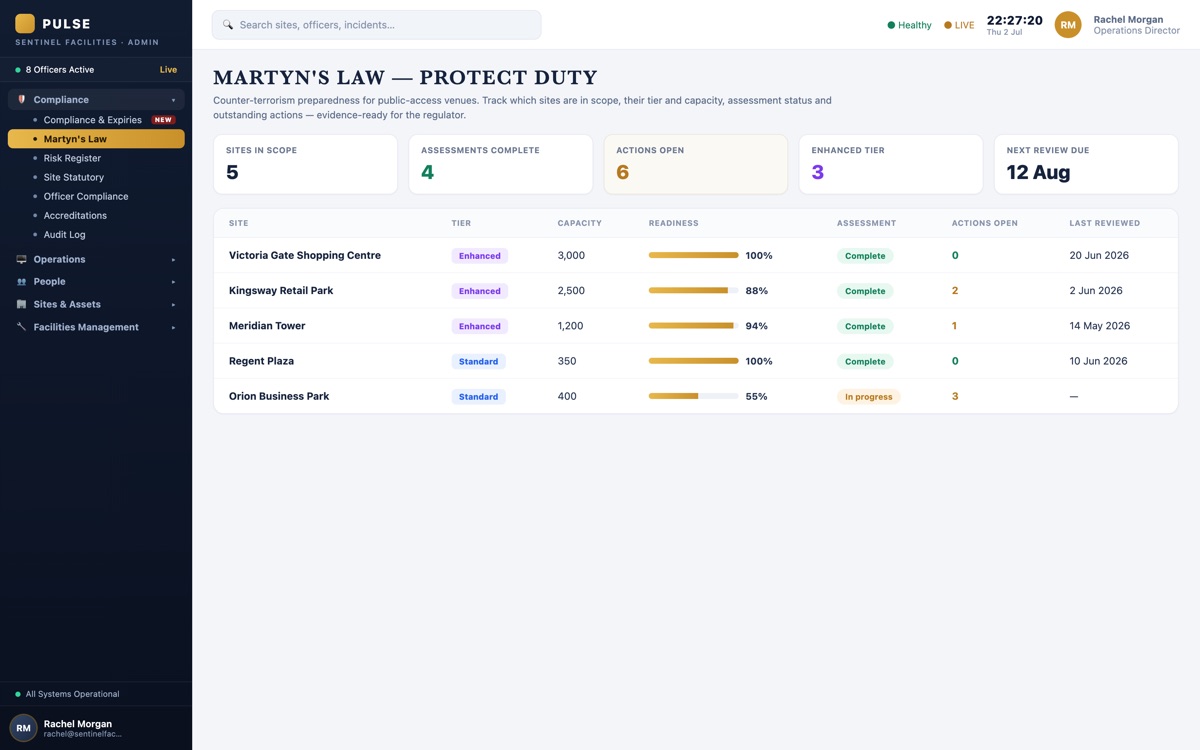
This is precisely the gap Pulse Operations was built to close on the FM side of its platform. Permits sit inside the same facilities & work orders module as PPM, helpdesk SLAs, contractor costs and asset registers — so a permit isn't an isolated compliance chore, it's part of the record for the job it's tied to. The same compliance runway that tracks SIA licensing, BS 7858 screening, DBS checks, right to work and Martyn's Law assessments applies the same logic to permits: one expiries view, not six.
"Ask three things: what can I put in front of a client if a night is disputed, what happens when the phone has no signal, and what does leaving look like. Any vendor who dodges the third question is telling you something about the first two." — Mo Hassan, Founder, Pulse
That third question — what does leaving look like — matters as much for permit software as it does for security platforms. A permit system that locks your historical records into a proprietary format you can't export is a system that makes an HSE audit harder, not easier.
What does permit to work software cost in the UK?
Permit to work software pricing in the UK is rarely published as a standalone figure — it's usually bundled into a broader CAFM or FM platform subscription, priced per site, per user, or per operative. As a rough illustrative guide, standalone EHS/permit modules from specialist vendors often sit in the low hundreds of pounds per month for smaller sites, rising into four figures a month for multi-site enterprise deployments with full integration, training records and audit features — actual figures vary considerably by vendor and scope, so always ask for a quote against your specific site count and permit volume.
The more useful question for a facilities buyer isn't "what does the module cost" but "what does it cost as part of the platform I already need." A permit feature bought as a standalone add-on to three other disconnected systems is usually more expensive in total cost of ownership than one integrated platform that already includes work orders, contractor management and compliance tracking.
Pulse Operations publishes its pricing openly rather than gating it behind a sales call — priced per operative, with unlimited sites and free admin, control room and client portal seats on every plan. Facilities and FM buyers evaluating permit software as part of a wider CAFM decision should expect the same transparency from any vendor; a platform that won't publish a number is asking you to negotiate blind.
How do you migrate from paper permits to digital software?
Migrating from paper to digital permit to work software is a change-management project as much as a technology one — most of the friction comes from habit, not the software itself. A realistic migration typically runs a parallel period where paper and digital permits coexist on one or two sites, staff get hands-on training on the actual devices they'll use on-site, and the old permit book stays available as a fallback for the first few weeks.
The teams that struggle most are the ones that try to switch every site on day one. A staged rollout — one site fully live before the next begins — surfaces connectivity problems, template gaps and training needs while they're still small and manageable.
In practice, Pulse Operations has applied the same staged logic to its own facilities and security clients. When Priority First — the founding team's own London security and FM operation, and the operation Pulse was originally built inside before being offered to other operators — added three buildings to its portfolio in a single July fortnight, checkpoints, site notes and induction history were live in the platform before officers arrived on-site. New starters had full site history from day one instead of relying on whoever happened to be on shift the week before. The same principle applies to permits: get the templates, escalation rules and contractor records set up before the first real permit is issued, not after.
Every Pulse Operations plan includes guided setup, migration support and a parallel run on one site, with most operations switching fully within a fortnight, per Pulse Operations's own operational data (as of August 2026).
Your permit to work software checklist
- Confirm the system follows HSE HSG250 principles: named issuer, defined hazards and precautions, time limit, formal cancellation.
- Check it supports separate templates for hot work, confined space, working at height and electrical isolation/lockout-tagout.
- Verify contractor competency and licence checks are linked automatically, not managed in a separate spreadsheet.
- Ask what happens when a permit isn't closed by its expiry time — does it escalate, or does it just sit open.
- Test the audit trail: can you search past permits quickly, and can records be edited after the fact.
- Check offline behaviour for low-signal areas like plant rooms and confined spaces.
- Ask whether permits sit inside your existing CAFM/work order system or in a separate silo.
- Get pricing in writing against your actual site count and permit volume before committing.
FAQ
What is permit to work software?
Permit to work software is a digital system that manages the authorisation, monitoring and closure of high-risk work such as hot work, confined space entry, working at height and electrical isolation. It replaces the paper permit book with a structured workflow that enforces HSE's HSG250 principles — a named issuer, defined hazards and precautions, a time limit, and formal cancellation — while producing a searchable, timestamped audit trail.
Is permit to work software compliant with HSE HSG250 guidance?
Permit to work software can be compliant with HSE's HSG250 guidance if it enforces the same core principles the guidance sets out for paper systems: competent authorisation, clear hazard identification, defined precautions, a time limit, and formal closure. Compliance depends on how the software is configured and used, not on the software alone — HSG250 doesn't certify specific products.
What types of permits can permit to work software manage?
Permit to work software typically manages hot work permits (welding, cutting, grinding), confined space entry permits, working at height permits, and electrical isolation or lockout/tagout permits. Good systems use separate templates for each type, since the mandatory checks differ — a confined space permit needs atmospheric testing and rescue arrangements, while an electrical permit needs isolation and lock verification.
How does permit to work software integrate with CAFM or CMMS platforms?
Permit to work software integrates with CAFM or CMMS (computerised maintenance management system) platforms by sitting alongside work orders, PPM schedules, contractor records and asset registers in one system, so a permit requirement is visible against the job it relates to rather than tracked separately. Facilities teams using disconnected systems risk a contractor being sent to a job without anyone checking whether the required permit was ever issued.
What are the benefits of digital permit to work systems over paper permits?
Digital permit to work systems timestamp every action automatically, make historical permits searchable in seconds, and are far harder to backdate or lose than a paper permit book. Paper systems remain simpler to use with no training and no signal dependency, but become unmanageable at scale — particularly for multi-site FM operations issuing dozens of permits a week.
How much does permit to work software cost?
Permit to work software cost in the UK varies significantly depending on whether it's bought as a standalone module or bundled into a wider CAFM platform, and on site count and permit volume. Rather than accepting a vague estimate, ask any vendor for a written quote against your specific site count and permit types, and check what's included — training, audit trail, contractor integration — before comparing prices.
Can permit to work software manage contractor competency and qualifications?
Yes — better permit to work systems link permit issuance to contractor competency records, licence expiries and training certificates, so a permit can't be issued to someone whose qualification has lapsed. This is the same logic UK security and FM platforms apply to BS 7858 screening, SIA licence checks and DBS records: one expiries view rather than a manual check against a separate spreadsheet.
How does permit to work software help with regulatory compliance and audits?
Permit to work software helps with regulatory compliance by producing a complete, timestamped record of every permit issued, its conditions, and its closure — exactly the evidence an HSE investigation or internal audit needs. A tamper-evident audit trail, where records can't be quietly edited after the fact, is what turns a compliance policy on paper into something you can actually prove happened.
Permits sit inside the same platform as the rest of your FM operation
Permits are rarely the problem on their own — the problem is permits living in a separate system from the work orders, contractors and assets they relate to. Pulse Operations builds permits into the same facilities & work orders module used for PPM, helpdesk SLAs and contractor costs, so a hot work or confined space permit sits against the job it belongs to, not in a filing cabinet or a spreadsheet nobody checks before a contractor turns up.
The same discipline runs through Pulse Operations's compliance runway, which already tracks SIA licensing, BS 7858 screening, DBS checks, right to work documentation and Martyn's Law assessments on one expiries view — permits follow the same logic rather than needing a separate system to learn. For FM providers and in-house estates teams weighing up whether to bolt on a standalone permit module or bring permits into their existing operations platform, that's usually the deciding question: one system with a full audit trail, or one more silo to manage.
If you're evaluating how permit to work fits alongside work orders, compliance tracking and contractor management, get in touch with Pulse Operations for a walkthrough of how the facilities module handles permits end-to-end — no deck, no sales pitch, just the platform.
Related Reading
- Guardhouse Alternative 2026: Best UK Options Compared
- SmartTask Alternative 2026: Best Options Compared
- Security Guard Handover Template UK | Free Guide 2026