Last updated: 7 September 2026
Security Site Induction Checklist: The Complete UK Guide for 2026
A security site induction checklist is a structured set of checks and briefings that every security operative must complete before starting work on a site, covering identity and SIA licence verification, site hazards, emergency procedures, and reporting protocols. Under CDM 2015 — the Construction (Design and Management) Regulations 2015, the UK regulations governing health and safety duties on construction projects — principal contractors must give every worker a suitable, site-specific induction before they start work, and most inductions take 15 to 45 minutes depending on site complexity, according to TheSiteBook.
Key Takeaways
- CDM 2015 Regulation 15(7) legally requires the principal contractor to ensure every person working on a construction site receives a suitable, site-specific induction before starting work, according to AttendIQ.
- Site induction records, including security inductions, must be kept for a minimum of three years after a construction project ends, per AttendIQ's CDM 2015 guidance.
- Many compliance specialists recommend keeping induction records for at least six years, matching the standard civil claims limitation period in England and Wales, according to AttendIQ.
- An SIA Security Guard Licence costs £210 to apply for and remains valid for three years, per Get Licensed.
- Most site inductions take between 15 and 45 minutes depending on the size and complexity of the site, according to TheSiteBook.
What Is a Security Site Induction Checklist?
A security site induction checklist is a documented, repeatable process that confirms a security officer, contractor, or visitor understands a site's specific risks, rules, and emergency procedures before they take up post. It differs from general security training: training builds the underlying skills and legal competence an officer carries between sites, while an induction applies that competence to one specific location, client, and set of hazards.
For a static guard at a Croydon retail park, a mobile patrol officer covering a construction site in Manchester, or a keyholder responding to alarms at a Birmingham distribution centre, the induction is what turns generic SIA-licensed competence into site-ready deployment. Pulse Operations builds this process into the officer app so induction completion, licence checks, and site briefings sit alongside photo-verified patrols, rather than living on a clipboard in a site office.
Why Security Inductions Differ From Standard Construction Inductions
A construction worker's induction typically covers fire exits, welfare facilities, and manual handling risks. A security operative's induction must go further, because the officer is often the last line of defence for the client's people and assets. Security-specific inductions need to cover access control procedures, key holding protocols, incident escalation paths, lone working risks, and the specific use-of-force and conflict management boundaries set by the Security Industry Authority (SIA), the body established under the Private Security Industry Act 2001 to license and regulate the UK's private security industry.
Is a Site Induction a Legal Requirement in the UK?
Yes. On construction and higher-risk sites, a site induction is a legal requirement, not a best-practice suggestion. CDM 2015 Regulation 15(7) places a direct duty on the principal contractor to ensure every person who works on the site receives a suitable, site-specific induction before starting work, according to AttendIQ. This duty applies whether the person is a bricklayer, a delivery driver, or a security officer stationed on the gate.
The Health and Safety Executive (HSE) — the UK regulator responsible for enforcing workplace health and safety law — reinforces this in its own guidance on site rules and induction, which sets out that inductions must cover emergency arrangements, site-specific hazards, and how workers should raise concerns. Failure to induct workers properly can expose a principal contractor or security provider to enforcement action under the Health and Safety at Work etc. Act 1974, the founding legislation underpinning UK workplace safety law.
On non-construction sites — shopping centres, corporate offices, logistics hubs — there's no single equivalent regulation naming "induction" explicitly, but the same duty of care flows from general health and safety law and from client contracts, which almost always specify induction and briefing requirements as a condition of the security contract.
Who Actually Needs to Complete a Site Induction?
Every person who will work on or regularly access the site needs some form of induction, though the depth varies by role and frequency of visit.
| Role | Induction depth | Typical frequency |
|---|---|---|
| Permanent security officer | Full site-specific induction | Once, refreshed annually or on major site change |
| Mobile patrol officer | Site briefing pack + key site hazards | On each new site added to route |
| Relief/temporary cover officer | Condensed induction covering critical risks | Every deployment |
| Subcontractor/visitor | Basic safety and access induction | Each visit or first visit |
| Delivery drivers | Access, parking, and reporting rules only | First visit, periodic refresh |
What Should Be Included in a Site Security Induction Checklist?
A complete security site induction checklist combines general health and safety induction items with security-specific verification steps. Most inductions run between 15 and 45 minutes depending on the size and complexity of the site, according to TheSiteBook, so the checklist needs to be thorough without becoming unworkable on a busy first day.
Identity and Licensing Checks
- Confirm the officer's photo ID matches the person presenting for duty.
- Verify the officer holds a valid SIA licence for the role (Security Guarding, Door Supervision, CCTV, or Close Protection), checking the licence number against the SIA public register.
- Note the licence expiry date. An SIA Security Guard Licence is valid for three years, per Get Licensed, so a licence nearing expiry should trigger a renewal reminder before deployment.
- Check right-to-work documentation, satisfying employer obligations under UK immigration law.
- Confirm DBS (Disclosure and Barring Service) check status where the contract or site type requires enhanced vetting.
- Verify BS 7858 screening compliance — the British Standard for security screening of individuals employed in a security environment — where the client contract mandates it.
Site-Specific Briefing
- Walk the perimeter and identify entry/exit points, blind spots, and vulnerable areas.
- Brief on fire assembly points, fire extinguisher locations, and the site's fire evacuation procedure.
- Explain key holding protocols: which keys the officer carries, where master keys are stored, and who authorises access outside normal hours.
- Cover CCTV and access control systems specific to the site, including how to operate them and who to contact if a system fails.
- Set out the patrol route, checkpoint locations, and expected patrol frequency.
- Confirm reporting lines: who the officer calls for a welfare check, an incident, or an emergency, and within what timeframe.
- Brief on lone working risks and the site's lone-worker safety procedure, including any SOS or panic alarm arrangements.
- Explain use-of-force boundaries and conflict management protocols specific to the client's policies.
- Cover incident logging requirements: what must go in the occurrence book and how quickly.
- Identify hazardous areas, restricted zones, and any site-specific PPE requirements.
Documentation and Sign-Off
- Record the induction date, time, and duration.
- Capture a signature or digital confirmation from the inducted officer.
- File the induction record against the officer's profile and the specific site.
- Set a review date for re-induction if the site changes materially (new layout, new client requirements, incident history).
How Long Should a Security Site Induction Take?
A security site induction should typically take between 15 and 45 minutes, depending on the size and complexity of the site, mirroring the general construction induction benchmark reported by TheSiteBook. A single-officer static post at a small commercial unit might need only 15–20 minutes covering keys, alarms, and emergency contacts. A large logistics site with multiple gates, hazardous goods storage, and complex access control could reasonably need the full 45 minutes or longer.
Relief and mobile patrol officers covering unfamiliar sites at short notice present a particular risk here. If an induction is compressed to save time, critical details — a blind spot near a loading bay, a specific alarm code sequence, a recent history of trespass — can be missed. Building a condensed but non-negotiable "critical risks only" version of the checklist for relief cover helps balance speed against safety. Firms managing this across a growing patrol fleet often reach the same conclusion covered in this security patrol app buyer's guide: induction data needs to live in the same system as the patrol records it governs, not in a separate paper trail.
Site Induction vs Ongoing Security Training
These two things are often confused, but they serve different purposes and happen on different timescales.
| Factor | Site induction | Security training |
|---|---|---|
| Purpose | Applies competence to a specific site | Builds underlying skills and legal competence |
| Frequency | Every new site, or on major site change | Periodic (SIA licence renewal, employer CPD) |
| Duration | 15–45 minutes typically | Hours to days depending on qualification |
| Owner | Site manager, client, or deploying supervisor | Training provider or in-house L&D |
| Governed by | Client contract, CDM 2015 (construction sites) | SIA licensing requirements, Private Security Industry Act 2001 |
How Long Must Site Induction Records Be Kept?
Site induction records for construction projects must be kept throughout the project and for a minimum of three years afterwards under CDM 2015, according to AttendIQ. This three-year floor is a legal minimum, not a recommended target.
Many compliance specialists go further and recommend retaining induction records for at least six years after project completion, aligning with the standard limitation period for civil claims in England and Wales, per AttendIQ. If a personal injury claim, a contractual dispute, or an insurance investigation surfaces years after a security contract ends, being able to produce a dated, signed induction record showing exactly what an officer was briefed on and when can be the difference between a defensible position and an expensive one.
This is precisely the kind of record that paper-based induction sheets tend to lose. A site file left in a portacabin, a signature sheet that never made it back to head office, or a scanned PDF buried in an inbox all create the same risk: a gap in the audit trail exactly when it matters most. Digital induction records, timestamped and stored against both the officer and the site, close that gap and make the retention period a non-issue rather than an ongoing administrative worry.
Paper Checklists vs Digital Induction Records
| Factor | Paper checklist | Digital induction record |
|---|---|---|
| Speed to complete | Slower, manual sign-off | Faster, structured prompts |
| Storage & retrieval | Physical files, easily lost or damaged | Centralised, searchable, tamper-evident |
| Retention compliance (3–6 years) | Manual tracking required | Automatic retention and audit trail |
| Licence expiry tracking | Manual diary/spreadsheet | Automated alerts before expiry |
| Evidence in a dispute | Can be incomplete or unsigned | Timestamped, linked to officer and site |
| Update across multiple sites | Requires reprinting/redistribution | Instant update pushed to officer app |
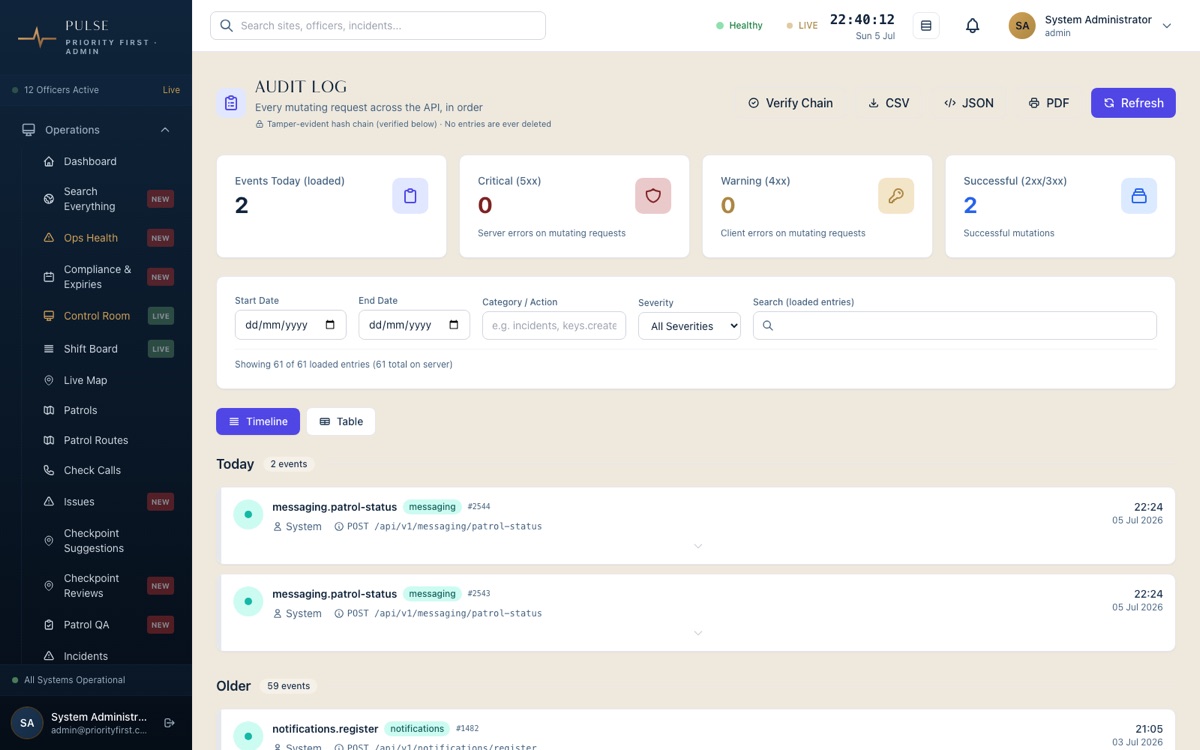
On a hash-chained (SHA-256) audit log, a digital induction record cannot be edited retrospectively without breaking the chain, which is the property that makes it defensible evidence rather than just a convenient file — a design detail covered further in this guide to integrated security and FM software.
Do Visitors and Delivery Drivers Need a Site Induction?
Yes, but a lighter-touch version is usually appropriate rather than the full officer induction. Visitors, delivery drivers, and short-term contractors don't need briefing on patrol routes or key holding protocols, but they do need to understand emergency evacuation procedures, restricted areas, and who to report to on arrival.
Many security-led sites — shopping centres, business parks, construction sites with a security-controlled gate — use the security team as the first point of contact for visitor induction. This makes sense operationally: the officer on the gate is often the only person who consistently sees every person entering the site. Building a short visitor induction script into the officer's own site induction ensures this responsibility is clearly assigned rather than assumed.
Can a Site Induction Be Completed Online or Digitally?
Yes, digital site inductions are increasingly standard practice, particularly for security providers managing officers across multiple sites. A digital induction can combine a short e-learning module covering general site rules with an in-person walkthrough for site-specific hazards, key locations, and emergency contacts that can't be fully conveyed on a screen.
The practical advantage for security operations is consistency. A digital induction template ensures every officer, whether inducted by a site manager in Leeds or a supervisor in London, covers the same core checklist, with nothing skipped because of time pressure or an inexperienced inductor. It also solves the record-keeping problem directly: a completed digital induction is timestamped and stored automatically, satisfying the CDM 2015 retention duty without relying on someone remembering to file a paper form.
Your Security Site Induction Checklist
Use this as a working checklist before deploying any officer to a new or unfamiliar site:
- Verify the officer's SIA licence against the SIA public register and confirm it covers the correct licensable activity.
- Confirm right-to-work and DBS status before the officer takes up post.
- Walk the site perimeter with the officer, identifying access points, blind spots, and restricted zones.
- Brief on fire and emergency procedures, including assembly points and evacuation routes.
- Explain key holding and access control protocols, including who authorises out-of-hours access.
- Set out reporting lines and escalation procedures for incidents, welfare checks, and lone-worker emergencies.
- Record the induction with a timestamp and signature, filed against both the officer and the site.
- Set a re-induction trigger for major site changes, incidents, or a gap in deployment longer than a few months.
FAQ
The questions UK operations managers ask most, answered plainly.
What is a security site induction checklist?
A security site induction checklist is a structured list of checks and briefings a security officer must complete before starting work at a specific site. It covers identity and SIA licence verification, site hazards, key holding, emergency procedures, and reporting protocols, and it ensures the officer understands the site's specific risks rather than relying on general training alone.
What should be included in a site security induction?
A site security induction should include SIA licence and identity verification, a perimeter walkthrough, fire and emergency procedures, key holding protocols, CCTV and access control briefing, patrol route confirmation, incident reporting lines, and lone-worker safety arrangements. Documentation and sign-off should follow every induction to create an auditable record.
Is a site induction a legal requirement in the UK?
Yes, on construction sites a site induction is a legal requirement under CDM 2015 Regulation 15(7), which requires the principal contractor to ensure every worker receives a suitable, site-specific induction before starting work, according to AttendIQ. On non-construction sites, the same duty of care typically flows from general health and safety law and client contract terms.
Who needs to complete a site induction before starting work?
Every person working on or regularly accessing a site needs some form of induction, though the depth varies by role. Permanent officers need the full site-specific induction, while relief cover, visitors, and delivery drivers can usually follow a condensed version covering only critical safety and access information.
How long should a security site induction take?
Most inductions take between 15 and 45 minutes depending on the size and complexity of the site, according to TheSiteBook. Larger or more complex sites with multiple access points and hazardous areas typically need the longer end of that range.
How long must site induction records be kept?
Construction site induction records must be kept for a minimum of three years after project completion under CDM 2015, per AttendIQ, though many specialists recommend retaining records for at least six years to cover the standard civil claims limitation period, according to AttendIQ.
Can a site induction be completed online or digitally?
Yes, digital site inductions combining e-learning modules with an in-person site walkthrough are increasingly standard, particularly for security providers managing officers across multiple sites. Digital inductions improve consistency and automatically satisfy record-keeping obligations under CDM 2015.
What qualifications does a security guard need before starting a site induction?
A security guard typically needs a valid SIA Security Guard Licence before deployment, which costs £210 to apply for and remains valid for three years, according to Get Licensed. Depending on the contract, the officer may also need BS 7858 screening and a satisfactory DBS check before the site induction can be signed off.
Induction is the promise — patrols are the proof
An induction record proves an officer was briefed; it doesn't prove the briefed work then happened. Pulse's guide to proving patrols poses the test any patrol evidence has to survive: "could a reasonable client look at this and be sure a real person was really there?" — set out in full at How to prove patrols actually happened.
The same logic wins contracts. In formal tenders, quality commonly carries 40% to 70% of the available marks, and Pulse's tender guide observes: "Every bid says 'professional, SIA-licensed, 24/7 control room' — so none of it scores" — the scored difference is evidence, per How to win your next security tender.
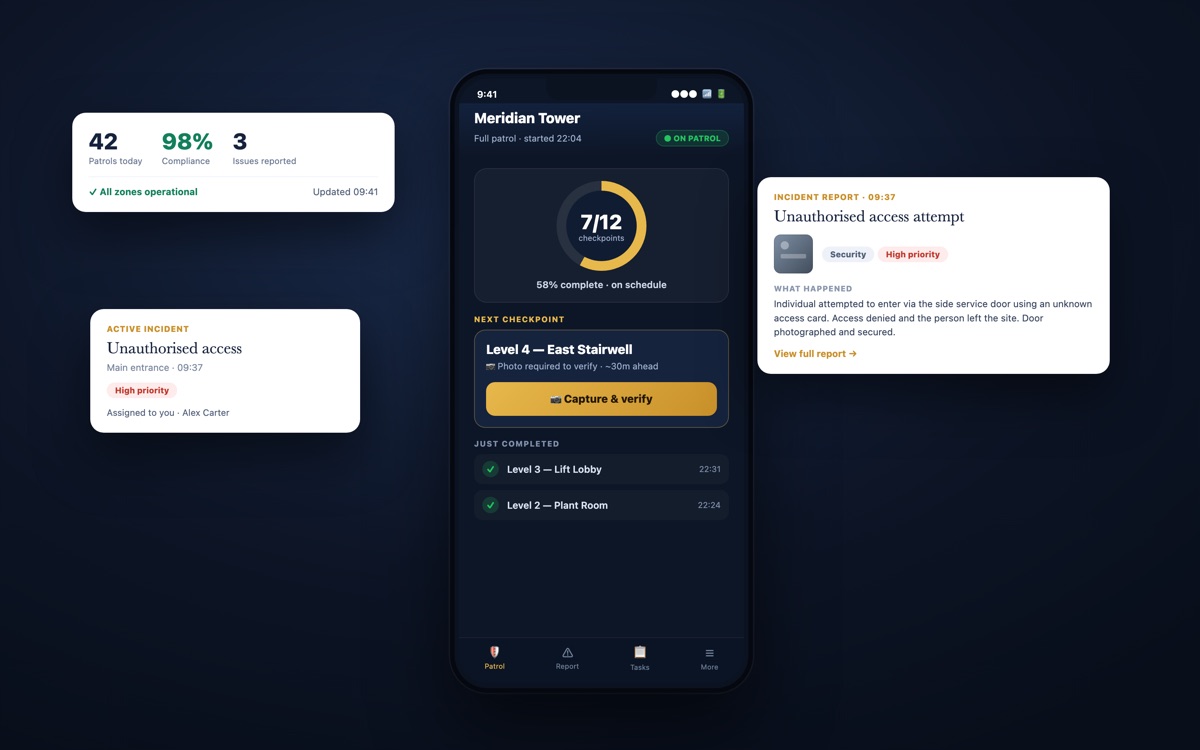
On Pulse, a checkpoint is completed only by a mandatory watermarked photograph (officer, site, GPS, time), with deliberately no QR or NFC scan involved. Across live operations, 96.2% of checkpoints carried that photo over a trailing 90-day window as of July 2026, with the remaining gap shown honestly rather than hidden — figures published on Pulse's operations benchmark. An induction filed in the same system as the patrols it governs gives a client one coherent story: briefed, deployed, proven.
Managing site inductions with Pulse Operations
Chasing down paper induction sheets, tracking SIA licence expiry dates across a rota, and proving to a client that every officer was properly briefed before their first shift is exactly the kind of administrative load that pulls security operations managers away from running the business. Pulse Operations was built inside Aether Agency Ltd's own working London security and facilities operation before being opened to other operators, specifically to remove that friction — keeping induction records, compliance documents, and site briefings in one system rather than scattered across spreadsheets and site files.
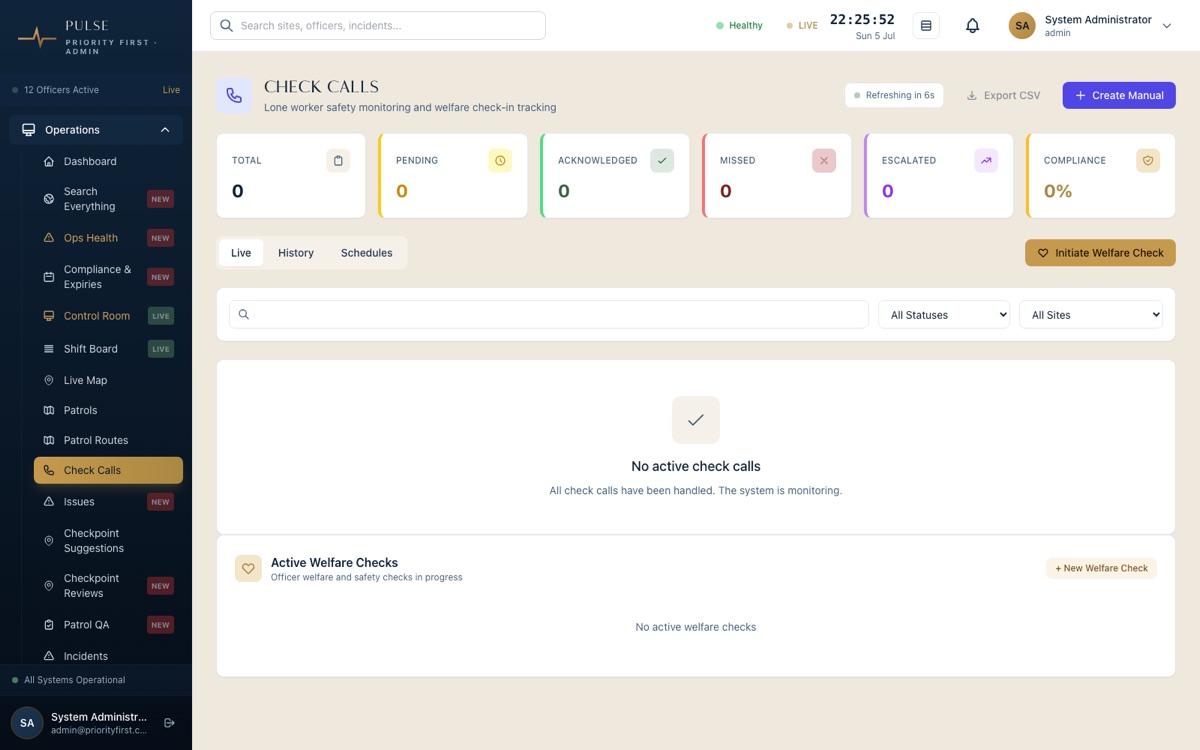
Pulse's compliance runway tracks SIA licensing, BS 7858 screening, DBS checks, right-to-work documentation, and training records against every officer and every site, flagging gaps before they become a problem on a client audit or an HSE inspection. Pulse's officer app is native to iOS and Android and offline-first with self-healing sync, so inductions and compliance checks can be completed and recorded even where a site has poor signal — a common issue on construction sites and basement plant rooms — with records syncing automatically once connectivity returns.
If your business is managing induction and compliance records across multiple sites by hand, it's worth seeing how a single system handles it instead. Pulse's guided setup includes migration and a parallel run on one site, and most firms switch fully within a fortnight. Take the two-minute tour, see the openly published pricing, and get in touch to see how the compliance runway fits alongside your existing rostering and control room operations.
Related Reading
- Guardhouse Alternative 2026: Best UK Options Compared
- SmartTask Alternative 2026: Best Options Compared
- Silvertrac Alternative 2026: Best UK Options Compared