Last updated: 4 September 2026
Property maintenance software UK: what to buy and why in 2026
Property maintenance software UK buyers need in 2026 is a system that logs work orders, tracks statutory compliance (gas, electrical, fire) and gives contractors and clients a shared, evidenced record — not a spreadsheet. The UK's public maintenance backlog alone stands at £49 billion, per the National Audit Office (2026), showing how easily unmanaged maintenance compounds.
Key Takeaways
- The UK's public sector maintenance backlog totals at least £49 billion, according to the National Audit Office (2026).
- The Valuation Office Agency recorded 2.13 million non-domestic properties on UK rating lists at 31 March 2026, per the Valuation Office Agency.
- The global CAFM software market was valued at $1,073.38 million in 2023 and is forecast to reach $1,724.58 million by 2031, according to Verified Market Research.
- UK landlords must give tenants a copy of the gas safety record within 28 days of the check, under the Gas Safety (Installation and Use) Regulations 1998, per Shelter England (2026).
- Pulse Operations's own compliance runway design, built inside a live UK security and FM operation, ties maintenance issues to the same evidence trail as patrol reporting.
What is property maintenance software?
Property maintenance software is a digital system that lets landlords, letting agents, facilities managers and contractors log, schedule, track and evidence repair and maintenance work across one or more buildings. It replaces phone calls, paper job sheets and scattered spreadsheets with a single record of what needs doing, who did it, when, and whether it meets statutory requirements.
At its core, the software manages three things: reactive repairs (a tenant reports a leak), planned preventive maintenance or PPM (the scheduled servicing that stops equipment failing before it breaks), and compliance documentation (gas safety certificates, Electrical Installation Condition Reports, fire risk assessments). For portfolios spanning more than a handful of buildings, the difference between a system that just stores documents and one that actively chases expiries and flags gaps becomes the difference between passing an audit and failing one.
The market reflects growing demand. The global CAFM (computer-aided facilities management) software market — the wider category property maintenance tools sit within — was valued at $1,073.38 million in 2023, projected to reach $1,724.58 million by 2031 at a 7.01% CAGR, according to Verified Market Research. That growth is being driven partly by regulatory pressure: UK landlords, agents and estates teams increasingly need to prove compliance, not just claim it.
How is property maintenance software different from CAFM and CMMS?
Property maintenance software, CAFM and CMMS overlap heavily but describe different scopes of the same underlying problem: tracking assets, work and compliance across a building or estate. Property maintenance software typically refers to tools aimed at landlords, letting agents and smaller portfolios — repairs, certificates, tenant communication. CAFM (computer-aided facilities management) is the broader, enterprise-facing category covering space management, asset registers, PPM scheduling and helpdesk SLAs across large estates. CMMS (computerised maintenance management system) is narrower still, focused specifically on maintenance work orders and asset servicing, often used in industrial or plant-heavy settings.
In practice, UK buyers rarely need to draw a hard line between the three. A shopping centre or a multi-site security and FM contractor needs work orders, PPM schedules, helpdesk SLAs, permits and asset registers together — which is why platforms built for the UK market, including Pulse's facilities & work orders module, bundle these functions rather than forcing a choice between "maintenance software" and "CAFM".
Which term should you search for?
| Term | Typical buyer | Core focus | Typical scale |
|---|---|---|---|
| Property maintenance software | Landlords, letting agents, small portfolios | Repairs, certificates, tenant comms | 1–200 units |
| CAFM | FM providers, estates teams, large landlords | Space, assets, PPM, helpdesk SLAs, permits | Multi-site, enterprise |
| CMMS | Industrial/plant operators | Asset servicing, work orders | Single site or plant-heavy |
The UK facility management market itself is sizeable and growing — projected to expand at a 3.0% CAGR between 2026 and 2030, from US$44.18 billion to US$52.60 billion, according to Frost & Sullivan (2026). Software spend is following that curve as more of the industry digitises compliance and scheduling.
What compliance records must UK property maintenance software track?
UK property maintenance software must track a defined set of statutory certificates and inspections, because landlords and FM providers face legal deadlines for each one. Missing a deadline is not just an administrative failure — it can mean a live legal breach.
The core statutory records include:
- Gas Safety Records (CP12) — an annual check by a Gas Safe registered engineer. Landlords must give tenants a copy of the latest gas safety record within 28 days of the check, under the Gas Safety (Installation and Use) Regulations 1998, per Shelter England (2026) and confirmed in HSE guidance for landlords.
- Electrical Installation Condition Reports (EICR) — periodic checks on the fixed wiring, required in rented property in England.
- Energy Performance Certificates (EPC) — required before marketing a property to let or sell.
- Legionella risk assessments — required under the Health and Safety at Work etc. Act 1974 and associated Approved Code of Practice, covering water system risk in rented and commercial property.
- Fire risk assessments — a legal duty under the Regulatory Reform (Fire Safety) Order 2005 for the "responsible person" of any non-domestic premises.
- LOLER inspections — statutory thorough examinations of lifting equipment such as lifts and hoists.
Software that just stores PDFs is only doing half the job. What actually prevents breaches is a system that surfaces expiries proactively — the same logic Pulse applies to its compliance runway for SIA licensing, BS 7858 vetting, DBS checks and statutory building compliance: one expiries view, not six inboxes.
How does UK renting and property regulation change what you need from software?
UK property maintenance software must adapt to a shifting regulatory landscape, because landlord obligations are tightening rather than loosening. Local authorities, including York City Council's landlord guidance, have published summaries of Renters' Rights Act compliance requirements affecting how landlords must keep and share records.
The direction of travel is towards greater record-keeping and evidencing burden on landlords and agents, not less. That means software needs to do three things well: retain documents for the periods regulators expect, timestamp and audit who accessed or changed a record, and make certificates instantly retrievable if a tenant, local authority or ombudsman asks for them.
For portfolios with any security or concierge presence — shopping centres, mixed-use developments, gated estates — maintenance and security records increasingly need to sit together rather than in separate systems. A guard doing a night patrol who notices a broken fire door or a leaking pipe is often the first person to see a maintenance issue. If that observation goes into a different system to the one the FM helpdesk uses, it can sit unactioned for days.
"Property maintenance software and patrol reporting should live in the same evidence trail, not separate silos. A guard who spots a leak or a broken lock needs to log it there and then, with a photo, so the maintenance team sees it before the client has to ask. Split systems mean things get seen but never actioned." — Mo Hassan, Founder, Pulse
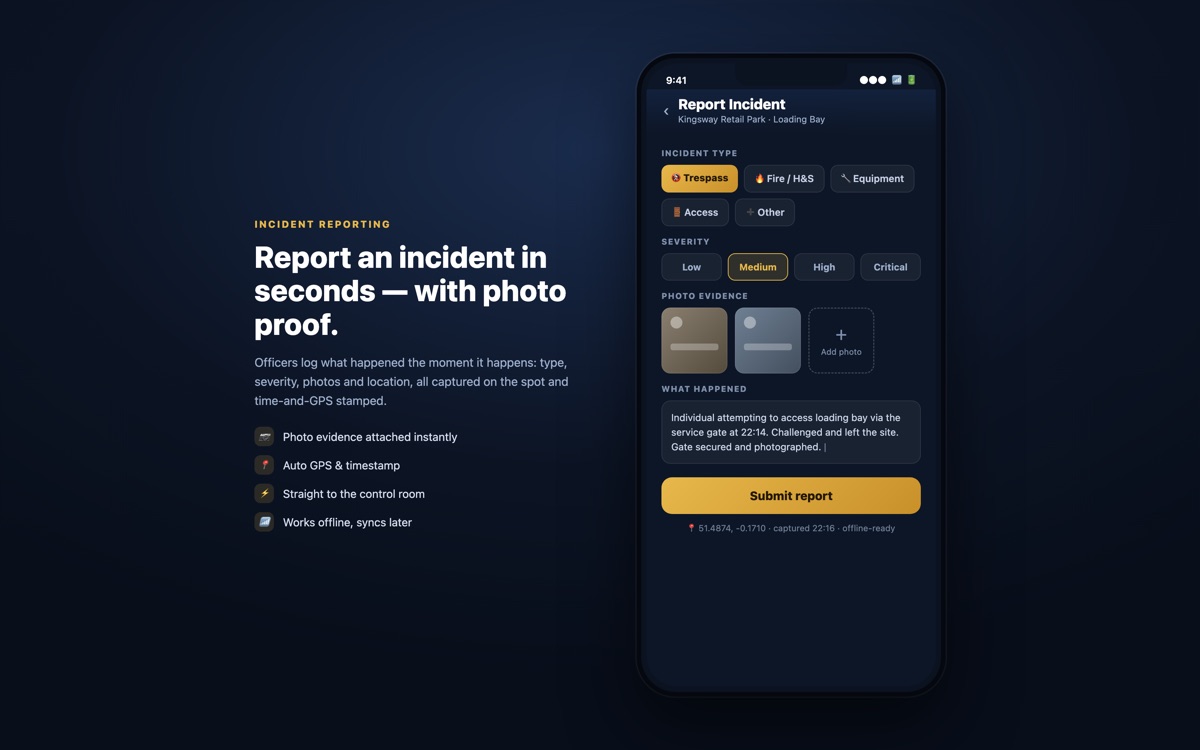
This is precisely the gap Pulse was built to close. Pulse's officer app captures incidents and observations — including maintenance faults — in the same tamper-evident daily occurrence book used for security incidents, an 18-type log that feeds straight into the client's portal alongside patrol evidence.
How much does property maintenance software cost in the UK?
Property maintenance software in the UK is typically priced per unit, per site, or per user, with costs varying widely by scale and feature depth. Small landlord tools aimed at fewer than 50 units often sit at the lower end of the market; enterprise CAFM platforms serving national estates sit considerably higher, reflecting the breadth of asset registers, PPM and integration work involved.
A realistic way to frame the decision is by scale rather than by a single "average price", since a single-site landlord and a national FM contractor are buying fundamentally different things.
| Buyer profile | Typical need | What drives cost |
|---|---|---|
| Individual landlord (1–10 properties) | Certificate reminders, basic repairs log | Number of properties, certificate types tracked |
| Letting agent (10–200 units) | Tenant communication, contractor dispatch, compliance dashboard | Number of units, integrations with accounting |
| FM provider / estates team | Work orders, PPM, helpdesk SLAs, permits, asset registers | Number of sites, number of engineers/operatives, SLA complexity |
| Security & FM contractor with maintenance duties | Patrols plus work orders in one evidence trail | Number of operatives, unlimited sites |
For operators who combine security, patrol and facilities duties — mobile patrol firms, shopping centre security teams, construction site security — Pulse publishes pricing openly per operative at /pricing, with unlimited sites and free admin, control-room and client-portal seats on every tier. There is no hidden per-site fee and no separate charge to add a building.
Ways to reduce ongoing costs
- Consolidate maintenance and compliance tracking into one platform rather than paying for separate certificate-reminder tools and a separate work-order system.
- Choose per-operative or per-user pricing over per-property pricing if your portfolio is growing, since per-property models scale costs with every new building added.
- Ask whether admin and portal seats are charged separately — free seats for office staff and clients materially change total cost as your team grows.
- Check migration costs upfront; a platform with guided setup and a parallel run on one site avoids paying twice during a transition.
Alternatives to consider
Some smaller landlords manage with a spreadsheet plus calendar reminders rather than dedicated software — viable below perhaps ten units, but the risk of a missed gas safety deadline grows as the portfolio does. Others outsource compliance entirely to a managing agent, which shifts the software decision (and cost) onto the agent rather than the landlord. For FM and security contractors, the realistic alternative to a unified platform is running separate point solutions — a CAFM tool for work orders and a distinct patrol-management app — which is exactly the split-system problem Mo Hassan describes above.
How do you evidence compliance to an assessor or client?
Evidencing compliance means being able to produce the underlying records — not just a certificate, but the audit trail behind it — the moment an assessor, client or regulator asks. This matters as much in security and FM contracting as it does in landlord compliance. Pulse's own guide on the SIA's Approved Contractor Scheme (ACS) self-assessment sets out the scale of the challenge directly relevant to FM providers who also hold security contracts: the ACS workbook scores a business against 78 indicators across seven criteria — Strategy, Service delivery, Commercial relationship management, Financial management, Resource management, People and Leadership — broken into 33 sub-criteria (per Pulse Operations's guide, The ACS self-assessment: how to evidence it).
Assessors don't take self-declared scores at face value. Per the same guide, assessors review staff files and payroll records, contracts and duty rotas, policies and procedures, and site documentation; they interview staff and customers; and they visit operational sites. Approved contractors are then reassessed annually, and where an assessor identifies improvement needs, they must be addressed within the timeframe the assessor sets.
The parallel with property maintenance compliance is direct: a certificate on file means little if you cannot show when it was uploaded, who checked it, and whether the property manager acted on any defects it flagged. This is why Pulse's audit log is hash-chained (SHA-256) and tamper-evident, with a built-in integrity check that walks the whole chain — so a record can't be quietly edited after the fact, whether that record is a patrol checkpoint or a maintenance defect note.
Your property maintenance software checklist
- Confirm which statutory certificates the software tracks by default: gas safety (CP12), EICR, EPC, legionella, fire risk assessment, LOLER.
- Check whether expiry alerts are proactive (chasing you before a deadline) or passive (just storing a date).
- Ask whether pricing is per property, per user or per operative, and whether admin/client seats are free.
- Test whether maintenance issues raised by on-site staff (patrol officers, concierge, cleaners) feed into the same system as tenant-reported repairs.
- Verify the audit trail is tamper-evident, not just a timestamped list that could be edited retrospectively.
- Ask for a migration plan and timeline before signing — a parallel run on one site or building reduces switching risk.
- Check UK hosting and data residency, particularly if the portfolio includes sensitive tenant or occupant data.
- Confirm the system produces a client-facing or landlord-facing view of delivered-vs-scheduled work, not just an internal dashboard.
FAQ
What is property maintenance software?
Property maintenance software is a digital system for logging, scheduling and evidencing repair work, planned maintenance and compliance certificates across one or more properties. It typically covers reactive repairs, PPM (planned preventive maintenance) and statutory documentation such as gas safety records and EICRs, replacing spreadsheets and paper job sheets.
Is property maintenance software a legal requirement in the UK?
No specific law mandates the use of software, but the underlying compliance duties are legal requirements regardless of what tool is used. For example, the Gas Safety (Installation and Use) Regulations 1998 require landlords to give tenants a copy of the gas safety record within 28 days of the check, per Shelter England (2026). Software helps meet these duties reliably rather than being the duty itself.
What is the difference between CAFM and CMMS software?
CAFM (computer-aided facilities management) covers the broader estate — space, assets, PPM, helpdesk SLAs and permits across multiple buildings. CMMS (computerised maintenance management system) is narrower, focused specifically on maintenance work orders and asset servicing, often used in single-site or plant-heavy environments. Many UK FM providers need functions from both categories in one system.
How much does CAFM or property maintenance software cost in the UK?
Costs vary by scale: small landlord tools tracking fewer than 50 units sit at the lower end, while enterprise CAFM platforms for national estates cost considerably more due to asset register depth and integration needs. Buyers should compare per-property, per-user and per-operative pricing models, and check whether admin or client-facing seats are charged separately, since that materially affects total cost as a portfolio grows.
Does property maintenance software help with the Renters' Rights Act?
Software can support compliance with tightening landlord obligations by retaining documents for the periods regulators expect, timestamping record access, and making certificates instantly retrievable. Local authorities such as York City Council have published guidance summarising these compliance requirements, and software that tracks deadlines and audit trails reduces the risk of a missed obligation.
Can property maintenance software integrate with security and patrol systems?
Some platforms combine maintenance and security functions in one evidence trail, so that a patrol officer, concierge or cleaner who spots a fault can log it immediately with a photo rather than reporting it verbally. This matters most for shopping centres, mixed-use developments and gated estates where security staff are often the first to notice a maintenance issue.
What UK bodies regulate property maintenance compliance?
Several bodies oversee different parts of UK property compliance: the Health and Safety Executive (HSE) oversees gas and general workplace safety, Gas Safe Register regulates gas engineers, local authorities enforce landlord licensing and the Renters' Rights Act, and the Regulatory Reform (Fire Safety) Order 2005 sets fire risk assessment duties for the "responsible person" of non-domestic premises.
Why do UK organisations need CAFM software given the size of the maintenance backlog?
The scale of the problem is significant: the UK's public sector maintenance backlog totals at least £49 billion, according to the National Audit Office (2026), and the UK facility management market itself contributes over £65 billion to the economy, per Spherical Insights (2026). CAFM and property maintenance software help organisations of any size avoid the backlog effect of deferred, unrecorded maintenance compounding into larger and costlier failures.
Bringing maintenance and security evidence together with Pulse
Property maintenance software UK buyers choose often solves one half of the problem: it tracks certificates and work orders, but it sits apart from whatever system logs security patrols, incidents and on-site observations. Pulse was built to close exactly that gap — because in a live FM and security operation, the same officer walking a plant room at 3am is often the first person to spot a leak, a broken fire door or a failed light fitting, and that observation needs to reach the maintenance team the same day it's seen, not six weeks later in a dispute.
That's the design behind Pulse's facilities & work orders module: work orders, PPM, helpdesk SLAs, permits and asset registers sit in the same platform as photo-verified patrols, the tamper-evident daily occurrence book, and the client portal showing delivered-vs-contract. It was proven inside Priority First, the founding team's own London security and FM operation, where a prestige central-London estate's 16 buildings moved from one vague "round complete" report to over 4,100 photo-verified patrols since March 2026, each one tied to its own site record — the same infrastructure that now carries maintenance findings alongside security evidence.
If your maintenance and security records currently live in separate systems, get in touch with Pulse Operations for a walkthrough of how the compliance runway and facilities module work together, or explore the published pricing at /pricing to see what it would cost for your portfolio.
Related Reading
- Guardhouse Alternative 2026: Best UK Options Compared
- SmartTask Alternative 2026: Best Options Compared
- Security Guard Handover Template UK | Free Guide 2026