Last updated: 17 September 2026
How to Prove Security Patrols Happened: A UK Business Guide
Proving security patrols happened means producing timestamped, location-verified evidence — such as watermarked checkpoint photographs, GPS logs or digital patrol reports — that shows an officer physically attended a specific point at a specific time. Paper logs and simple tag scans no longer satisfy most clients, insurers or courts.
Key Takeaways
- Pulse Operations notes that a signed paper logbook can be filled in retrospectively from the mess room, which is why clients increasingly reject it as evidence.
- Pulse Operations notes that NFC and QR checkpoint scans prove a phone was near a tag, not that an officer inspected the area — tags can also be scanned from an earlier photo.
- Pulse Operations reports that the global guard tour systems market is projected to grow from USD 3.61 billion in 2026 to USD 9.18 billion by 2035, at a CAGR of 9.78%, according to Spherical Insights & Consulting (2026).
- Cloud-based deployment accounted for over 61% of new North American guard tour verification system installations in 2026, per Dataintelo (2026).
- Pulse Operations's live operations carry a 96.2% photo-verification rate across checkpoints over a trailing 90-day period (as of July 2026), measured against production patrol data — see /benchmark.
What is proof of patrol?
Proof of patrol is the documented, verifiable evidence that a security officer physically attended a designated checkpoint at a scheduled time and carried out the required inspection. It is the record a client, insurer, or court relies on when they ask "did this actually happen?" rather than "were we told it happened?".
Historically, proof of patrol meant a signed paper logbook left in a cabin or reception desk. Today it increasingly means a digital record — a watermarked photograph, a GPS-stamped app entry, or a hash-chained audit log — that is far harder to fabricate after the fact.
Per Pulse Operations's guide, How to prove patrols actually happened, a signed paper log is trivially easy to fill in from the mess room at the end of a shift, and clients know it. Once a client has been burned — for example, an incident on a night the log claimed was patrolled — they stop trusting the paperwork entirely. That single breach of trust is usually what drives a business towards digital verification.
What methods exist for recording that a security patrol took place?
Several distinct methods exist for recording that a security patrol took place, ranging from handwritten sign-in sheets to fully automated photo-verified checkpoint systems. Each method offers a different balance of cost, reliability and evidential strength.
The main approaches used across the UK security industry include:
- Paper logbooks — an officer writes the time and initials at each checkpoint. Cheap, but easily falsified and impossible to verify remotely.
- NFC or QR checkpoint scanning — an officer taps a phone against a fixed tag or scans a code, which time-stamps a scan event. Better than paper, but a scan only proves a device was near a tag, not that anyone inspected anything.
- GPS tracking — continuous or interval location logging shows an officer's route across a site. Useful for route compliance, less useful for proving the condition of an area.
- Guard tour software — a broader category combining scheduling, checkpoint logging and reporting into one system, often cloud-hosted.
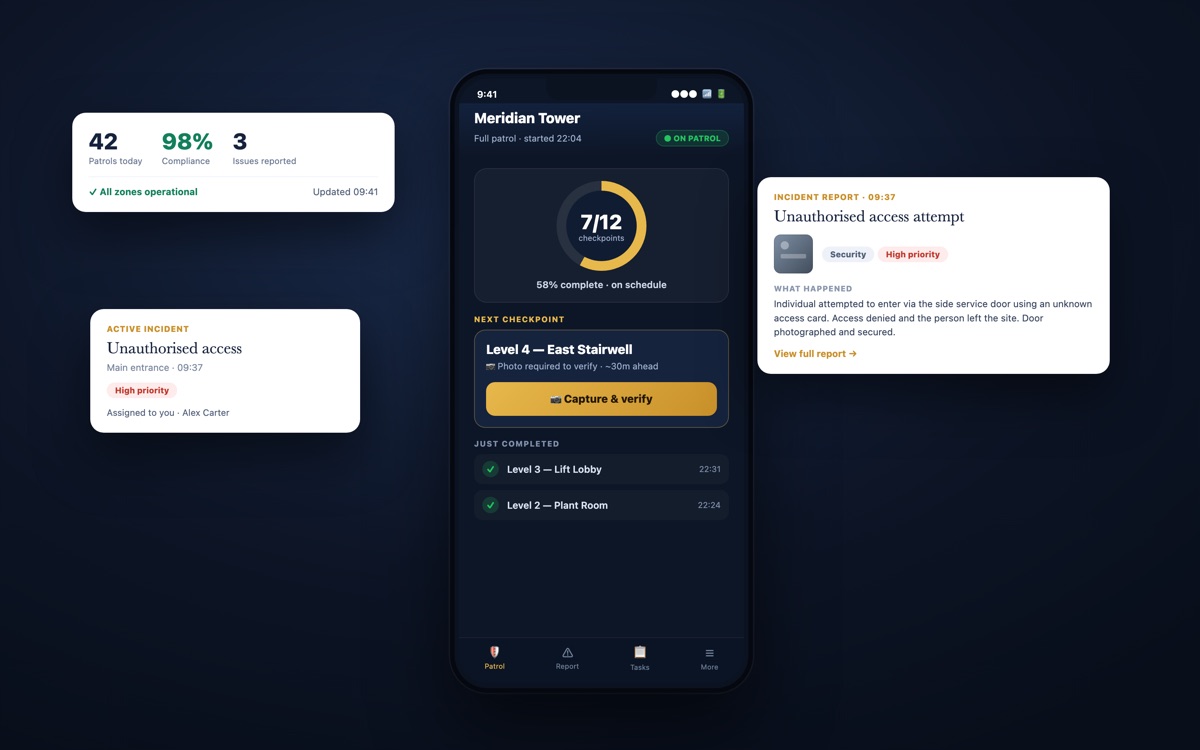
- Photo-verified patrols — a mandatory, watermarked photograph (officer, GPS coordinates, site, timestamp) is captured at each checkpoint. This captures the content of the patrol — a secured door, a clear loading bay — not just a footprint.
Per Pulse Operations's guide, How to prove patrols actually happened, tags fail in the real world: they get painted over, ripped off, go missing, or sit in a spot with no signal. Pulse Operations deliberately builds its patrol system around mandatory watermarked photographs rather than NFC or QR tag scans — the photo is the checkpoint completion, by design.
What legal and contractual obligations apply to proving security patrols in the UK?
UK businesses face a mix of contractual, regulatory and licensing obligations around proving security patrols occurred, though there is no single statute mandating a specific patrol-proof format. The Private Security Industry Act 2001 established the Security Industry Authority (SIA) as the statutory regulator of the UK private security industry, and it licenses individual frontline officers.
The SIA licence card displays an expiry date, and licences are valid for three years and must be renewed before they expire, according to Vigil Security (2026). Any business relying on patrol evidence must be able to show the officer who produced it was, at the time, licensed to work.
Beyond individual licensing, the SIA's Approved Contractor Scheme (ACS) sets a quality benchmark many clients now require in tender documents. Per Pulse Operations's guide, The ACS self-assessment: how to evidence it, the ACS workbook scores a business against 78 indicators across seven criteria — Strategy, Service delivery, Commercial relationship management, Financial management, Resource management, People, and Leadership. Assessors review staff files, payroll records, contracts and duty rotas, policies and procedures, and site documentation, and they visit operational sites — meaning patrol records form part of the evidence base assessors actually inspect.
Contractually, most UK security service agreements reference British Standard BS 7499 (Code of practice for the provision of static site guarding and mobile patrol services), which sets expectations around patrol reporting, supervision and record-keeping, though the specific reporting format is typically negotiated per contract rather than fixed by the standard itself.
How does checkpoint scanning compare to photo verification for proving patrols?
Checkpoint verification technology works by requiring an officer to interact with a fixed point — physically or digitally — that creates a timestamped record. NFC (Near Field Communication) tags require a phone tap within a few centimetres; QR codes require a camera scan of a printed code; GPS geofencing checks a device's location against a defined radius.
The weakness shared by all tag-based systems is that they verify a device's proximity, not a person's inspection. Per Pulse Operations's guide, How to prove patrols actually happened, tags can be scanned in five seconds on the way past, or scanned from a photo of the tag taken earlier — meaning the scan event itself carries almost no evidential weight about what was actually checked.
Photo verification closes this gap by capturing the state of the checkpoint, not just an interaction with it:
| Feature | NFC/QR tag scan | Watermarked photo verification |
|---|---|---|
| Proves device proximity | Yes | Yes (via GPS metadata) |
| Proves visual condition of area | No | Yes |
| Vulnerable to pre-recorded spoofing | Yes (photo of tag) | Low (live capture required) |
| Fails from physical tag damage | Yes | No hardware to damage |
| Evidential strength in dispute | Weak — proves presence only | Strong — proves presence and condition |
Pulse Operations's checkpoint completion mechanism requires a mandatory watermarked photograph — stamped with officer, site, GPS coordinates and time — with no NFC or QR scanning built into the system at all, as of August 2026.
What should a security patrol report include to be credible as evidence?
A credible security patrol report should include the officer's identity, exact timestamps, GPS coordinates, the route or checkpoints covered, the condition observed at each point, and any incidents raised during the patrol. Missing any of these elements weakens the report's standing if it is later challenged by a client, insurer or opposing solicitor.
Per Pulse Operations's guide, How to prove patrols actually happened, the supporting record should include the route covered, patrols delivered against what the contract calls for, and incidents with the time they were raised and resolved. A report that simply states "all clear" with no supporting detail invites doubt, particularly where an incident is later disputed.
A well-built patrol report typically contains:
- The officer's name and SIA licence status
- Site name, checkpoint ID and GPS coordinates
- A precise timestamp for each checkpoint visit
- A photograph showing the actual condition observed (door secured, area clear, plant room checked)
- Any deviations from the agreed route, with a reason
- Incident entries cross-referenced by time
- The patrol frequency delivered against the contracted frequency
Priority First — the founding team's own London security and facilities operation, and the environment Pulse Operations was built inside before being offered to other operators — ran a landmark West London mixed-use development with 152 checkpoints and 11 officers across retail units, residential blocks, plant rooms and service yards. Before photo-mandatory checkpoints went live in February 2026, there was no way to prove which plant room was actually checked at 3am. Making every checkpoint photo-mandatory meant a missed area showed up as a gap in the record immediately, rather than becoming a dispute six weeks later. Within the first five months, the site logged over 540 patrols across all 11 officers on one system.
How long should patrol records be retained under UK GDPR?
UK businesses should retain security patrol records for as long as they remain operationally or legally necessary, and no longer, in line with the storage limitation principle under the UK GDPR and the Data Protection Act 2018. There is no single fixed UK retention period for private patrol records — unlike some US jurisdictions — so the retention period is typically set by the business's own policy, insurer requirements, or specific contract terms.
For comparison, New Jersey's security guard record-retention rule requires keeping all guard-related records — including incident reports, post orders, training logs, and rosters — for five years after employment ends, according to Building Security Services (2026). New Jersey State Police may also enter any work-site without notice and impound records on the spot under N.J.A.C. 13:55A-6.5, per the same source. UK businesses don't face an identical statutory rule, but many adopt a similar multi-year retention window for incident and patrol records to cover potential insurance claims or civil litigation, which in England and Wales can typically be brought up to six years after the event under the Limitation Act 1980.
Where patrol evidence contains personal data — a photograph showing a person's face, or GPS tracking of an individual officer — the Information Commissioner's Office (ICO) requires a lawful basis for processing and a defined retention schedule. GPS and photo-based systems should apply data minimisation: capture what's needed to evidence the patrol, retain it for a defined period, and delete it when no longer required.
What are the fraud risks that undermine patrol evidence, and how are they avoided?
The most common fraud risks in patrol evidence are falsified logs, missed checkpoints disguised as completed, and buddy-punching — where one officer clocks in for another. All three exploit the gap between a system recording that something happened and proving what actually happened.
Falsified paper logs are the easiest to fabricate: an officer can complete an entire shift's logbook in the final ten minutes without ever leaving the guard room. Tag-scan systems reduce this risk but don't eliminate it, since a tag photographed once can be re-scanned from the image later, and physical tags get painted over, damaged or removed — silently breaking the chain of evidence at exactly the point it matters most.
Mitigations include:
- Requiring a live, watermarked photograph at each checkpoint rather than a scan alone
- Using a tamper-evident, hash-chained audit trail so any retrospective edit is detectable
- Cross-referencing patrol timestamps against roster and time-and-attendance data
- Giving clients real-time visibility rather than an end-of-month summary
Pulse Operations's audit log is hash-chained using SHA-256 and tamper-evident, with a built-in integrity check that walks the whole chain, as of August 2026 — meaning any attempt to retroactively alter a patrol record breaks a mathematically verifiable sequence rather than simply raising suspicion.
"Design for the basement, not the boardroom. Patrols, photos and incidents queue on the phone and sync when signal returns — an officer in a plant room or on a dark compound should never lose work to a dead zone. If your evidence depends on connectivity, it isn't evidence." — Mo Hassan, Founder, Pulse
How is patrol evidence used to defend against insurance claims and disputes?
Patrol evidence is used to defend against negligent security claims, insurance disputes and client complaints by establishing a documented, timestamped record that either supports or contradicts the account being disputed. In a premises liability claim, for instance, a defendant that can produce a watermarked photograph showing a fire exit was clear at 2:47am is in a materially stronger position than one that can only produce a signed paper sheet.
Insurers reviewing a claim will typically ask for the patrol schedule that was contracted, the patrol record for the period in question, and evidence the two match. A gap in the record — a missed checkpoint, an unexplained time jump — is often read as evidence the patrol didn't happen as claimed, regardless of the actual facts. This is why Pulse Operations's client portal shows delivered-vs-contract data with honest empty states: a portal that always reads 100% is one nobody believes, per Pulse Operations's guide, How to prove patrols actually happened.
At Priority First's 24-site operation across London, patrols moved from paper sign-in sheets and jobs coordinated informally between staff to a single system logging over 4,900 patrols with 100% of checkpoints backed by a watermarked photograph. Mo Hassan, Managing Director, Priority First, said: "Pulse Operations meant everyone's word used to be all we had. Now every checkpoint has a photo and the client can see it before we've finished the shift — it's changed how we win work" (signed off 24 August 2026).
Manual patrol logs vs automated digital proof — which is more reliable?
Manual patrol logs and automated digital proof-of-patrol systems differ fundamentally in reliability, tamper-resistance and evidential weight. A manual log is a handwritten or typed record with no independent verification of time, location or authenticity — its credibility rests entirely on trust in the individual officer.
Automated systems generate their own independent verification layer: GPS coordinates, device timestamps, photo metadata and, in more advanced systems, tamper-evident audit chains. The distinction matters most when evidence is challenged.
| Factor | Manual paper log | Automated digital proof-of-patrol |
|---|---|---|
| Can be completed retrospectively | Yes, easily | No — capture is required at the checkpoint |
| Independent time/location verification | None | GPS + device timestamp |
| Tamper detection | None | Hash-chained audit trail (where implemented) |
| Real-time client visibility | No | Yes, via live portal |
| Offline reliability | N/A | Depends on system — offline-first apps sync later |
| Cost | Low upfront | Per-officer subscription, typically |
The guard tour system market's growth reflects this shift: the global guard tour systems market is projected to grow from USD 3.61 billion in 2026 to USD 9.18 billion by 2035, at a CAGR of 9.78%, according to Spherical Insights & Consulting (2026). Separately, the Global Security Guard Tour Market was estimated at USD 4.3 billion in 2026 and is projected to reach USD 8.1 billion by 2035, growing at a CAGR of 6.6%, per Vantage Market Research (2026). Market sizing methodologies vary, but the direction is consistent — businesses are moving away from manual records towards verifiable digital systems.
Who should review patrol records, and how much does verification cost?
Reviewing and auditing patrol records is typically a shared responsibility between the security contractor, who generates the record, and the client, who consumes it as assurance that the contract is being fulfilled. For SIA Approved Contractor Scheme members, ACS assessors also review patrol-related documentation annually as part of reassessment.
In practice, most UK contracts place day-to-day review with the contractor's control room or supervisor, while the client — a facilities manager, estates director or property owner — audits summary reports periodically and escalates gaps. Larger clients, particularly those with Martyn's Law obligations under the forthcoming Terrorism (Protection of Premises) Act 2026, increasingly want continuous rather than periodic visibility.
On cost, guard tour system market estimates for 2026 vary widely depending on scope: figures range from roughly $230 million for hardware-centric definitions to over $3.5 billion for broader software and services definitions, according to Digital Guard Tour (2026). This split matters for buyers — a simple hardware tag system costs far less upfront than a full software platform, but delivers materially weaker evidence.
Pulse Operations publishes pricing openly at /pricing, charging per operative with unlimited sites and free admin, control-room and client-portal seats on every tier — a structure designed to avoid the hidden per-site or per-seat costs that make traditional guard tour software hard to budget for.
Your proof-of-patrol checklist
- Decide what "proof" means for each site — a photo, a GPS log, or both
- Make photographs the backbone of every checkpoint, not an optional extra
- Watermark every photo with officer, site, GPS coordinates and timestamp
- Capture the state of the area, not just a scan event
- Log every patrol against the contracted frequency, not just against a calendar
- Record incident times precisely, cross-referenced to the patrol record
- Give clients a live, honest view of delivered-vs-contract — including gaps
- Confirm every officer's SIA licence is current before relying on their patrol record as evidence
FAQ
How do you prove a security patrol actually happened?
You prove a security patrol happened by producing timestamped, location-verified evidence — typically a watermarked photograph, GPS log, or digital checkpoint record — showing an officer was physically present at a specific point and time. Paper logs and simple tag scans carry weaker evidential value because they can be completed or triggered without genuine inspection.
Is a paper patrol logbook legally acceptable for compliance audits?
A paper logbook can still be used, but it carries limited evidential weight because it can be filled in retrospectively without independent verification. ACS assessors and many clients now expect supporting digital evidence, such as timestamped photographs or GPS data, alongside or instead of paper records.
What's the difference between NFC scanning and photo verification for patrols?
NFC and QR scanning proves a device was near a fixed tag at a given moment, while photo verification captures the actual condition of the checkpoint at that moment. Tags can be scanned from a previously taken photo or fail through physical damage, whereas a live, watermarked photo is far harder to fabricate.
How long must UK security companies keep patrol records?
UK GDPR doesn't set one fixed retention period for patrol records — businesses must apply the storage limitation principle and retain data only as long as necessary, often guided by insurer requirements or the six-year limitation period under the Limitation Act 1980 for civil claims. This differs from jurisdictions like New Jersey, which mandates a five-year retention period for guard records after employment ends.
Who is responsible for auditing security patrol records?
The security contractor is typically responsible for generating and internally reviewing patrol records through its control room or supervisors, while the client audits summary reports to confirm the contract is being fulfilled. SIA Approved Contractor Scheme members also face annual assessor review of related documentation.
How much does electronic patrol verification cost compared to paper logs?
Paper logs have minimal upfront cost but weak evidential value, while electronic verification systems range widely in price depending on scope — from roughly $230 million to over $3.5 billion at the global hardware-versus-software market level, according to Digital Guard Tour (2026). Per-site software platforms are typically priced per officer or per site on a monthly subscription.
Can GPS or photo patrol records be used as evidence in a legal dispute?
Yes — GPS and photo-based patrol records are increasingly used in negligent security and insurance disputes to establish whether a contracted patrol schedule was actually met. Tamper-evident systems with hash-chained audit trails carry stronger evidential weight than records that could plausibly have been altered after the fact.
Proving your patrols with Pulse Operations
Every question in this guide comes down to the same problem: can you produce evidence, not just an assurance, that a patrol happened? Pulse Operations was built to answer exactly that, using photo-verified patrols where every checkpoint is completed by a mandatory watermarked photograph — officer, site, GPS and time — with no NFC or QR tag scanning by design.
That evidence sits behind a hash-chained, tamper-evident audit log with a built-in integrity check, and it's shown to clients honestly through a white-label client portal that reports delivered-vs-contract, gaps included. It's the same system Priority First — the founding team's own London security and facilities operation — runs across 24 sites, having moved from paper logs and spreadsheets to over 4,900 recorded patrols with 100% photo-backed checkpoints.
If your business needs patrol evidence that stands up to a client, an insurer or a court, book a call with Pulse Operations to see the officer app, control room and client portal in action.
Related Reading
- Body Worn Camera Rules for UK Security Firms 2026
- Security Guard Handover Template UK | Free Guide 2026
- Security RAMS Template: UK Guide + Free Framework 2026