Last updated: 5 November 2026
Control room software requirements cover five areas: incident logging and dispatch, system integrations (CCTV, access control, alarms, lone-worker alerts), UK data protection compliance, technical resilience (uptime, redundancy, cybersecurity), and total cost of ownership. A fit-for-purpose system must satisfy all five before go-live, not just the loudest one.
Key Takeaways
- Pulse Operations advises that control room software must combine incident logging, dispatch, live communications and audit-ready records in one system rather than separate spreadsheets and radios.
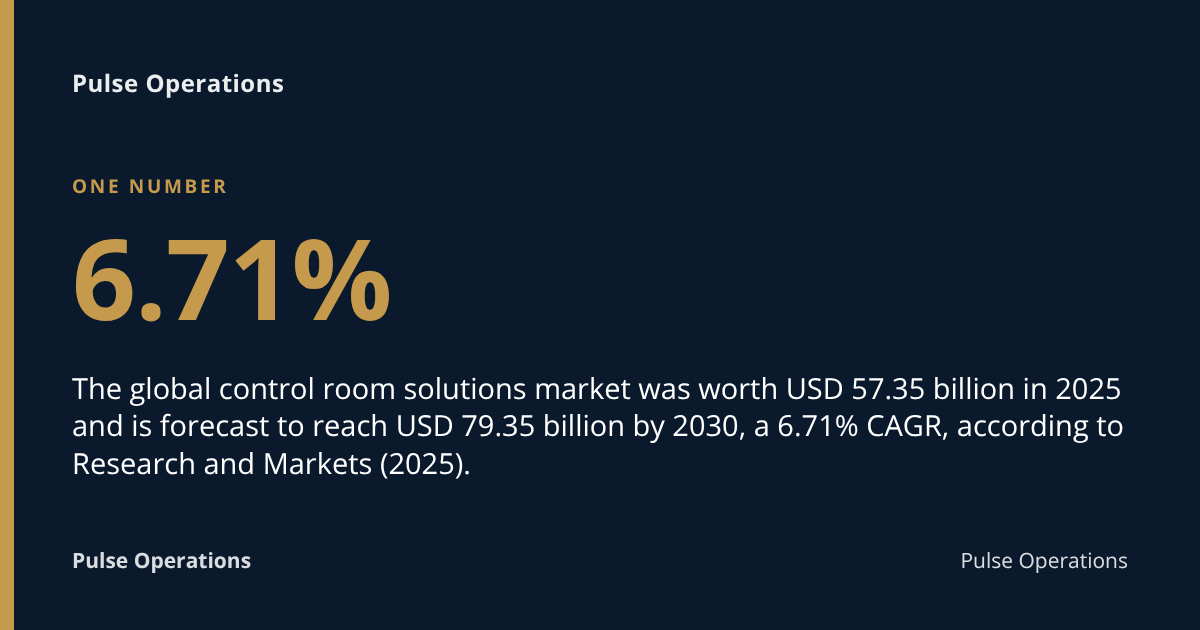
- The global control room solutions market was worth USD 57.35 billion in 2025 and is forecast to reach USD 79.35 billion by 2030, a 6.71% CAGR, according to Research and Markets (2025).
- On-premise deployments held 54.37% of the control room solutions market in 2024, as utilities, healthcare and defence organisations kept data under local control, per Research and Markets (2024).
- Hybrid deployment models are growing fastest, at an 8.64% CAGR through 2030, according to Research and Markets (2025).
- Pulse Operations advises that UK operators must map any control room software decision against GDPR, the Private Security Industry Act 2001 and, where relevant, the SIA's Approved Contractor Scheme (ACS).
What is control room software?
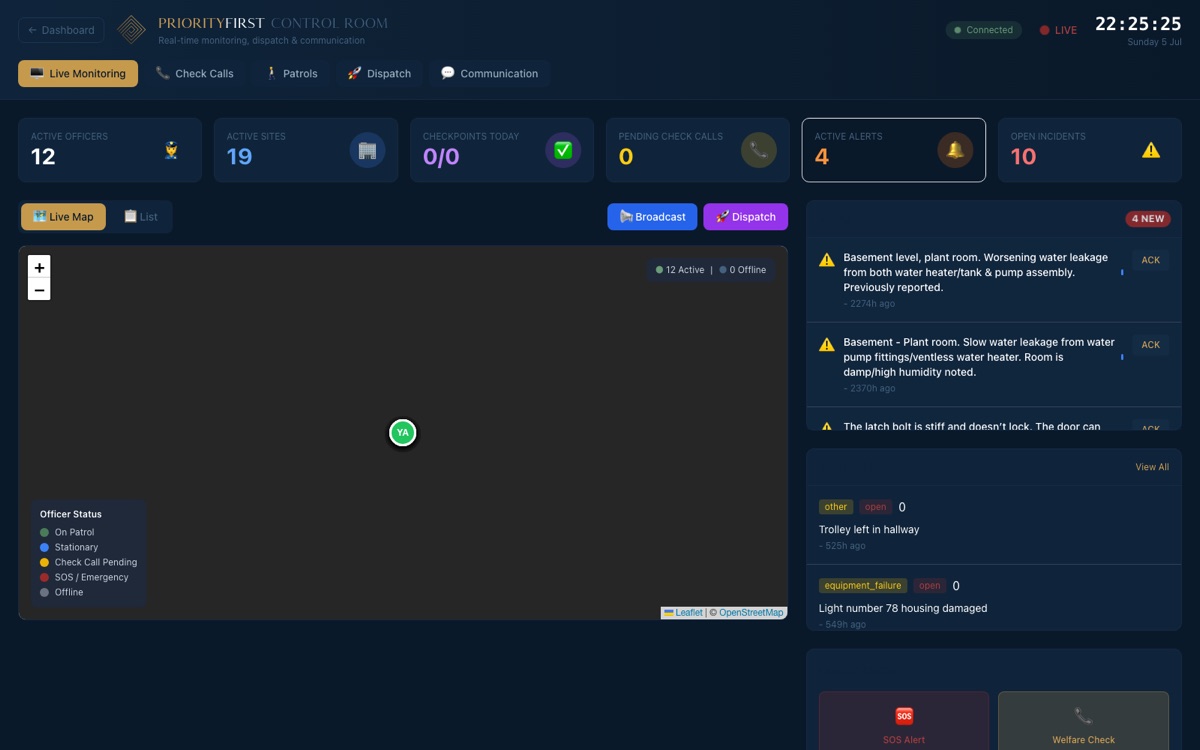
Control room software is the operational platform that lets a security, facilities, transport or utilities organisation see what's happening across its sites in real time, log incidents, dispatch people to respond, and keep an evidential record of it all. It typically replaces a mix of radio logs, paper occurrence books, spreadsheets and ad-hoc messaging with one connected system.
At its core, control room software must do four things: capture what's happening (incident logging), show where people and assets are (live mapping and dispatch), connect to the hardware already on site (CCTV, access control, alarms, radios), and produce a defensible audit trail afterwards. A system that does only one or two of these is a point tool, not control room software.
The global market for these systems is substantial and growing. The control room solutions market stood at USD 57.35 billion in 2025 and is projected to reach USD 79.35 billion by 2030, a 6.71% compound annual growth rate, according to Research and Markets (2025). Within that, the security control room segment specifically was valued at $12.1 billion in 2025, rising to $13.03 billion in 2026 and forecast to reach $17.33 billion by 2030 — a 7.4% CAGR — according to The Business Research Company (2026). North America was the largest regional market in 2025, per the same report, but UK demand is being driven by its own regulatory pressures — notably Martyn's Law and ACS reassessment cycles — rather than global trends alone.
Core functional requirements: incident logging, dispatch and communications
Incident logging, live dispatch and integrated communications are the three functions every control room software system must deliver, because without all three operators are still bridging gaps with phone calls and memory. Incident logging means every event — an alarm activation, a welfare check, a lone-worker SOS — is time-stamped, categorised and attributed to a named operative, with nothing editable after the fact.
Dispatch means the control room can see where officers and vehicles actually are, assign the nearest available person to a job, and track that assignment through to resolution. Communications integration means the control room isn't juggling a separate radio system, a separate phone line and a separate messaging app — it has one screen showing calls, messages and alerts together.
A tamper-evident audit trail matters as much as the logging itself. Pulse Operations builds its daily occurrence book around 18 distinct incident types with a hash-chained (SHA-256) audit log — a cryptographic method that links each record to the one before it so a tampered entry breaks the chain and shows up immediately. That log carries a built-in integrity check that walks the whole chain, which matters when a client, the police or an SIA assessor asks to see what actually happened on a given night.
Minimum functional checklist for UK control rooms:
- Incident logging categorised by type, time-stamped, with named officer attribution
- Live dispatch showing officer location and real-time job assignment
- Lone-worker SOS and welfare check-in capability, not bolted on as an afterthought
- Tamper-evident records that can't be quietly edited after an incident
- Daily occurrence book functionality replacing the paper sign-in sheet
- Morning briefing or "ops health" reporting so managers see overnight activity before clients call asking
Priority First, the founding team's own London security and FM operation — a sister company with the same majority owner as Aether Agency Ltd, which runs Pulse — ran 24 sites on four separate systems plus a spreadsheet before consolidating onto one platform. Patrols moved from paper sign-in sheets to a single photo-verified record, with over 4,900 patrols completed and checked against production data as of July 2026.
UK legal and regulatory requirements for control room software
Pulse Operations notes that GDPR, the Private Security Industry Act 2001 and sector-specific standards like BS 7858 set the legal floor that control room software must meet in the UK, because the system processes personal data, screening records and, in licensed security contexts, SIA-regulated activity. Any control room platform handling UK data needs to satisfy the UK General Data Protection Regulation as enforced by the Information Commissioner's Office (ICO), covering lawful basis, data minimisation, retention limits and subject access request handling.
For licensed security operations, the Security Industry Authority (SIA) sets requirements around licensing and, for Approved Contractor Scheme (ACS) members, a wider set of operational standards. The ACS self-assessment workbook scores a business against 78 individual indicators across seven criteria — Strategy, Service delivery, Commercial relationship management, Financial management, Resource management, People, and Leadership — organised into 33 sub-criteria, per Pulse Operations's guide, The ACS self-assessment: how to evidence it. Control room software is where much of that evidence lives: staff files, screening records, duty rotas and incident logs are exactly what an ACS assessor reviews, alongside site visits and interviews with staff and customers.
The People criterion specifically checks how well a contractor applies BS 7858 — the British Standard for security screening of personnel — and verifies licences against the SIA's register. After the initial ACS assessment, approved contractors are reassessed annually, and any improvement needs identified at that assessment must be addressed within the timeframe the assessor sets, per the same Pulse Operations guide.
Other UK-specific considerations include:
- Martyn's Law (the Terrorism (Protection of Premises) Act 2025), which requires many public venues to carry out terrorism-risk assessments — control room software increasingly needs to hold and evidence these
- BS 5979, covering alarm receiving centre categories and operational standards for remote monitoring
- ISO 27001, the international information security management standard many procurement teams ask vendors to confirm, even where not yet held
- Data residency — where the data is physically hosted, and whether it ever leaves UK or EU jurisdiction
Pulse Operations is UK-built and UK-hosted, with tenant isolation enforced in the data layer and verified by an automated cross-tenant test suite on every build — a relevant consideration for any UK buyer asking where their incident data actually sits.
Integration requirements: CCTV, access control, alarms and radio
Control room software needs to connect to the hardware and systems already deployed on site — CCTV, access control, intruder alarms, radio networks and, in some cases, third-party emergency services — or operators end up running parallel systems that don't talk to each other. This category of software is sometimes called PSIM (Physical Security Information Management), a term the British Security Industry Association (BSIA) uses to describe platforms that aggregate multiple security systems into one management interface, per an industry buyer's guide referencing the BSIA definition.
The integrations that matter most depend on the sector:
| Sector | Priority integrations | Typical additional requirement |
|---|---|---|
| Corporate/commercial security | CCTV, access control, visitor management | Lone-worker SOS, client portal |
| Retail / shopping centres | CCTV, EPOS alerts, fire panels | Multi-tenant reporting |
| Construction sites | CCTV, perimeter alarms, keyholding | Mobile patrol GPS routes |
| Transport | CCTV, PA systems, incident escalation to British Transport Police | High-availability uptime |
| Utilities / critical infrastructure | SCADA interfaces, alarm receiving | Strict data custody, often on-premise |
Rather than relying on tag scans at checkpoints, Pulse Operations completes every checkpoint with a mandatory watermarked photograph — officer, site, GPS and time — deliberately avoiding QR or NFC scanning. The photo is the checkpoint completion; there's nothing to tap and nothing that can be scanned by someone who isn't actually there. Across live operations, 96.2% of checkpoints carry a watermarked photo, measured over a trailing 90-day period as of July 2026 (see the benchmark for methodology).
At a landmark West London mixed-use development, Priority First used this approach across 152 checkpoints covering retail units, residential cores, plant rooms and service yards, with 11 officers inducted onto one system. Before Pulse, there was no way to prove which plant room had actually been checked at 3am. Since going live in February 2026, the site has recorded over 540 patrols in its first five months, checked against production data in July 2026.
Technical infrastructure, cybersecurity and uptime requirements
Control room software needs resilient infrastructure — redundant servers, adequate network bandwidth, and defined cybersecurity controls — because downtime in a control room isn't an inconvenience, it's a safety and compliance failure. For a system monitoring lone workers or managing alarm response, an outage during an active incident has real consequences.
Technical requirements to specify before procurement:
- Uptime guarantee, typically expressed as an SLA percentage (e.g. 99.9%), with defined penalties or remedies if missed
- Redundancy and failover — what happens if the primary server or connection fails
- Offline capability for mobile users where mobile signal is unreliable — an officer in a basement plant room shouldn't lose the ability to log a checkpoint
- Cybersecurity controls, including encryption in transit and at rest, access controls and regular penetration testing
- Tenant isolation for multi-client platforms, so one customer's data can never be visible to another
Cybersecurity obligations around control centres are tightening globally. In North America, NERC CIP-015-1 — approved by the Federal Energy Regulatory Commission (FERC) under Order 907 — will require Internal Network Security Monitoring for applicable control centres by 1 October 2028, extending to other medium-impact systems with external routable connectivity by 1 October 2030, according to BreachCraft (2025). NERC CIP compliance carries penalties of up to $1 million per violation per day, enforced by FERC, per the same source. While NERC CIP applies to the North American bulk electric system rather than UK operators directly, it signals the direction of travel: regulators increasingly expect continuous network monitoring inside control centres, not periodic audits. As of 1 January 2024, updated NERC CIP standards also permit storage of medium- to high-impact Bulk Cyber System Information in the cloud, subject to stringent conditions, according to CTI (2024) — a sign that even heavily regulated control centre environments are moving toward cloud acceptance where the controls are strong enough.
Pulse Operations's officer app is native iOS and Android, offline-first with self-healing sync, so a checkpoint logged without signal uploads automatically once connectivity returns. Most platform improvements reach phones over the air the same day.
Cloud-based versus on-premise control room software
Cloud-based and on-premise are the two fundamental deployment models for control room software, and the right choice depends on data sensitivity, existing infrastructure and regulatory obligations rather than one model being universally better. On-premise configurations accounted for 54.37% of the control room solutions market in 2024, as utilities, healthcare networks and defence agencies prioritised keeping data under direct local custody, according to Research and Markets (2024).
However, the trend is shifting. Hybrid deployment models — combining cloud flexibility with on-premise data control — are forecast to grow at an 8.64% CAGR through 2030, outpacing both pure cloud and pure on-premise models, per the same Research and Markets (2025) report.
| Factor | Cloud-based | On-premise |
|---|---|---|
| Upfront cost | Lower — subscription model | Higher — hardware and licensing |
| Scalability | Add sites/users quickly | Requires capacity planning |
| Updates | Delivered automatically, often same-day | Scheduled, often manual |
| Data control | Vendor-managed, verify hosting location | Full organisational control |
| Typical buyer | SMEs, multi-site security/FM operators | Utilities, defence, critical infrastructure |
| Offline resilience | Depends on app design (offline-first apps mitigate this) | Not dependent on internet connectivity |
For most UK security and FM operators — multi-site, mobile workforce, need to onboard clients quickly — cloud-based suits the operating model better, provided the vendor can state clearly where data is hosted and how tenant isolation works. For utilities, defence and some critical national infrastructure operators, on-premise or tightly controlled hybrid models remain the default, consistent with the 2024 market split reported above.
How much control room software costs and how long implementation takes
Control room software in the UK is typically priced per user or per operative rather than as a flat fee, with costs varying by feature tier, number of sites, and whether support and onboarding are included. Published pricing — rather than a quote obtained only after a sales call — is still unusual in this market, which makes comparison difficult for buyers.
Implementation timelines vary by scale. A single-site deployment with straightforward integrations can go live within one to two weeks; a multi-site rollout with legacy system migration, staff training and client portal setup typically takes four to twelve weeks. Priority First mobilised three new buildings onto Pulse Operations in a single July fortnight — checkpoints, site notes, prior issues and officer inductions were live in the platform before officers arrived on site, cutting what is traditionally weeks of bedding in down to days from the handshake to the first photographed patrol.
Ways to control cost and timeline risk:
- Favour per-operative pricing with unlimited sites over per-site licensing, which penalises growth
- Confirm whether admin, control room and client-portal seats are charged separately or included free
- Ask for a parallel run on one site before full switchover, rather than a single cutover date
- Check what migration support is included versus billed as a separate project
Pulse Operations publishes its pricing openly at /pricing rather than gating it behind a sales call, priced per operative with unlimited sites and free admin, control-room and client-portal seats on every plan. Every plan includes guided setup, migration support and a parallel run on one site, and most firms switch fully within a fortnight.
Your control room software requirements checklist
- Confirm the system covers incident logging, live dispatch and communications in one screen, not three
- Check the audit trail is tamper-evident, not just a timestamped database table
- Map every required integration — CCTV, access control, alarms, radio — against what the vendor actually supports today, not on a roadmap
- Verify UK data hosting and tenant isolation, and ask the vendor to explain the mechanism, not just confirm the claim
- Confirm the pricing model is per-operative or per-site, and whether admin/portal seats cost extra
- Ask for the uptime SLA in writing and what remedy applies if it's missed
- Request a parallel run on one site before committing to full rollout
- Check how the system evidences SIA ACS criteria, BS 7858 screening and Martyn's Law assessments if relevant to your sector
FAQ
What are the minimum functional requirements for control room software?
Control room software must handle incident logging, live dispatch, integrated communications and a tamper-evident audit trail as a baseline. Anything that does only one of these — say, just a mapping tool with no incident log — is a point solution rather than full control room software.
Does UK control room software need to comply with GDPR?
Yes — any system processing personal data in the UK must comply with the UK GDPR, as enforced by the Information Commissioner's Office. This covers lawful basis for processing, data retention limits, and the right of individuals to request their data, and applies regardless of whether the software is cloud-hosted or on-premise.
Is cloud-based or on-premise control room software better for security companies?
For most multi-site security and FM operators, cloud-based software suits the operating model better because it scales quickly and updates automatically. On-premise configurations still held 54.37% of the control room solutions market in 2024, largely among utilities, healthcare and defence organisations with strict data custody requirements, according to Research and Markets (2024).
How long does it take to implement control room software?
A single-site rollout with straightforward integrations can go live in one to two weeks; multi-site deployments with legacy data migration typically take four to twelve weeks. Priority First mobilised three buildings onto Pulse Operations within a single fortnight, with checkpoints and officer inductions live before staff arrived on site.
What SIA or ACS requirements affect control room software?
The SIA's Approved Contractor Scheme scores businesses against 78 indicators across seven criteria, including People (which checks BS 7858 screening compliance) and Service delivery, per Pulse Operations's guide, The ACS self-assessment: how to evidence it. Control room software needs to generate and retain the records — staff files, rotas, incident logs — that ACS assessors review during annual reassessment.
Who should be responsible for defining control room software requirements?
Responsibility typically sits jointly across operations leadership, who know the day-to-day workflow, IT or technical teams, who assess infrastructure and security requirements, and compliance leads, who confirm GDPR, SIA and sector-specific standards are met. In smaller security and FM businesses, this is often one operations director coordinating input from all three areas rather than separate departments.
What's the difference between PSIM, VMS and control room software?
PSIM (Physical Security Information Management) is a category of software that aggregates multiple security systems — CCTV, access control, alarms — into one management interface, a term the BSIA uses in its industry definitions, per an industry buyer's guide. VMS (Video Management System) specifically manages CCTV footage, while control room software is the broader operational platform that may incorporate PSIM-style integration alongside incident logging, dispatch and compliance functions.
Getting your control room requirements right with Pulse Operations
Specifying control room software properly means working through incident logging, integrations, UK compliance and infrastructure before a single vendor demo — exactly the areas this guide has covered, and exactly where Pulse Operations was built from, inside a working security and FM operation rather than a software lab. Priority First needed to answer a client's 7am "was everything OK last night?" call with evidence, not reassurance, and that requirement shaped every part of the platform: the control room, the occurrence book, the compliance runway and the client portal.
Pulse Operations is UK-built and UK-hosted, with tenant isolation enforced in the data layer and verified by an automated cross-tenant test suite on every build — a concrete answer to the data residency and security questions any UK procurement process should be asking.
If you're drawing up control room software requirements for your own security or FM operation, see how Pulse Operations's control room and dispatch tools work in practice, compare the published pricing, or book a tour to walk through your specific integration and compliance requirements with the team.
Related Reading
- Accident Book Requirements UK: 2026 Legal Guide
- Police URN Withdrawal for False Alarms: UK Guide 2026
- Security Patrol Frequency Best Practice UK (2026 Guide)
Add pulse-operations.co.uk as a preferred source on Google
Back to all insights