
Last updated: 5 November 2026
An emergency plan template UK organisations can rely on sets out exactly who does what in a fire, flood, power loss or cyber incident, names a responsible person, and gets reviewed at least annually. Roughly 20% of UK businesses suffer a significant disruption each year, according to Pembrokeshire County Council, so a working template is a practical necessity, not paperwork.
Key Takeaways
- 80% of businesses hit by a major incident do not re-open, or close within 18 months, according to Pembrokeshire County Council.
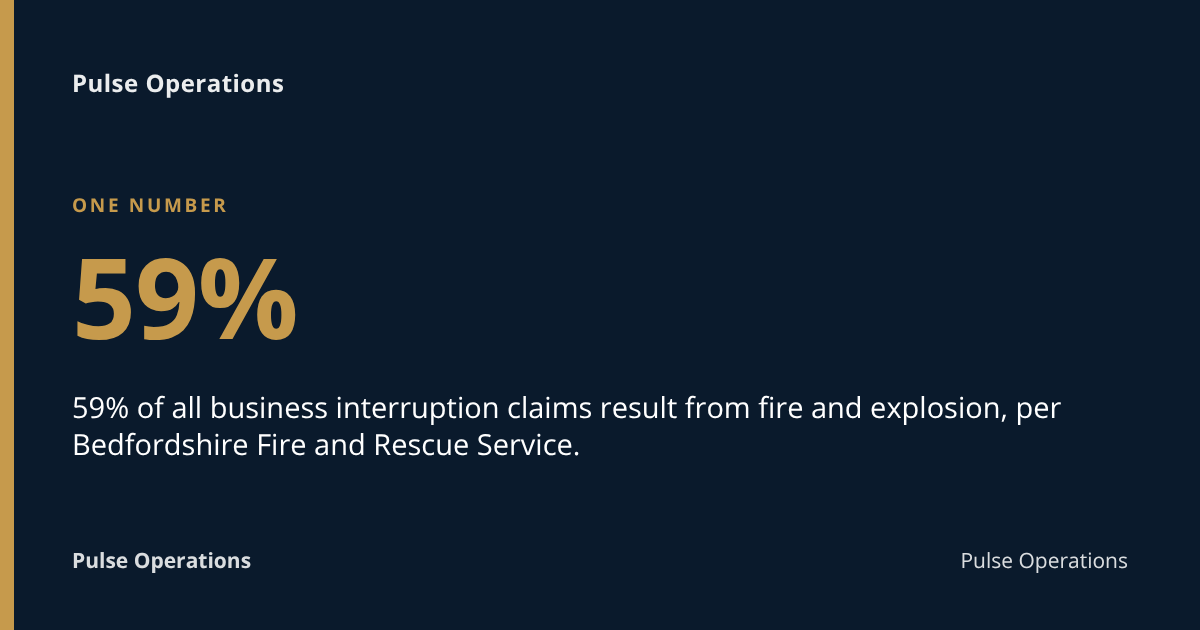
- 59% of all business interruption claims result from fire and explosion, per Bedfordshire Fire and Rescue Service.
- Only 54% of UK organisations are confident their business continuity plan is up to date, according to Databarracks' Data Health Check survey.
- 97% of large UK organisations have a business continuity plan, against 58% of smaller organisations, per the Databarracks Data Health Check report.
- Pulse Operations notes that under the Regulatory Reform (Fire Safety) Order 2005, a named "responsible person" — the employer, building owner or occupier who controls the premises — must prepare and maintain the fire emergency plan.
What is an emergency plan template and what should it include?
An emergency plan template is a structured document that assigns roles, actions and contact details for responding to a fire, evacuation, flood, power failure, security incident or IT outage before it happens. It exists so that staff act on rehearsed instructions rather than improvised decisions when an alarm sounds.
A workable template covers:
- Trigger and scope — which events activate the plan (fire alarm, bomb threat, flood warning, cyber breach)
- Roles — a named responsible person, fire marshals, first aiders, deputies for each
- Evacuation routes and assembly points, including Personal Emergency Evacuation Plans (PEEPs) for staff or visitors who cannot use standard routes unaided
- Communication tree — who calls the emergency services, who informs staff, who handles media or clients
- Equipment and utilities — isolating gas, electricity and water; location of extinguishers, shut-off valves and alarm panels
- Business continuity links — how operations resume, covered in detail below
- Review date and version control
London Fire Brigade's guidance on your emergency plan and the Mayor of London's Preparing Your Business for Emergencies resource both offer downloadable starting templates. Cheshire Fire and Rescue Service publishes free templates too. None of these replace a site-specific walk-through — a template is a skeleton, not a finished plan.
Is a business legally required to have an emergency plan under UK law?
Yes — most UK workplaces must have a written fire emergency plan, and certain sectors face wider statutory civil contingency duties. The Regulatory Reform (Fire Safety) Order 2005 requires the "responsible person" to carry out a fire risk assessment and prepare an emergency plan for any non-domestic premises in England and Wales; HSE's fire safety guidance confirms this duty sits alongside the Health and Safety at Work etc. Act 1974.
Separately, the Civil Contingencies Act 2004 places statutory emergency planning duties on Category 1 responders — local authorities, the police, fire and rescue services, NHS bodies — and Category 2 responders such as utility companies, detailed in gov.uk's guidance on responder responsibilities and the Civil Contingencies Act 2004 itself. Most private businesses are not direct Category 1 or 2 responders, but the Civil Contingencies Act 2004 (Contingency Planning) Regulations 2005 require responders to give advice and assistance to businesses on continuity planning — which is where council-published templates come from.
For publicly accessible venues, the Terrorism (Protection of Premises) Act 2025 — known as Martyn's Law — adds a further duty to assess and plan for terrorism-related risk. Pulse Operations tracks this requirement for clients on its compliance runway, and its tender guide notes that buyers of publicly accessible venues increasingly ask bidders about Martyn's Law readiness directly within procurement questionnaires.
Which UK regulations govern workplace emergency planning?
Several distinct pieces of UK legislation govern workplace emergency planning, each covering a different risk type rather than one single "emergency law". Treating them as one requirement is a common and costly mistake.
| Legislation / standard | What it governs | Who it applies to |
|---|---|---|
| Regulatory Reform (Fire Safety) Order 2005 | Fire risk assessment and fire emergency plan | Responsible person for any non-domestic premises, England & Wales |
| Health and Safety at Work etc. Act 1974 | General duty of care, safe systems of work | All employers |
| Civil Contingencies Act 2004 | Civil protection duties, local resilience | Category 1 and 2 responders (councils, emergency services, utilities) |
| Civil Contingencies Act 2004 (Contingency Planning) Regulations 2005 | Business advice duty on continuity planning | Local authorities advising businesses |
| Terrorism (Protection of Premises) Act 2025 (Martyn's Law) | Terrorism risk assessment for public venues | Qualifying publicly accessible premises |
This mix of duties is exactly why a generic downloaded template rarely fits as-is — a retail unit, a residential block and a construction site each sit under a different combination of these rules.
What are the different types of emergency plans a UK business needs?
An emergency plan is not one document but a family of plans, each addressing a different kind of disruption with its own triggers and recovery steps. Confusing them — or writing only one and assuming it covers everything — is a frequent failing point when fire and rescue services or HSE inspectors review a site.
Fire and evacuation plans cover the immediate response to a fire alarm: routes, assembly points, headcounts and PEEPs for anyone needing assisted evacuation. This is the plan the Regulatory Reform (Fire Safety) Order 2005 directly requires.
Business continuity plans cover what happens after the immediate incident — how the organisation keeps trading, pays staff and serves clients while premises or systems are unavailable. 75% of businesses without a business continuity plan fail within three years, according to Bedfordshire Fire and Rescue Service, and 90% of businesses that lose their data in an emergency close within two years, per Islington Council.
Flood plans matter for sites in flood risk zones — riverside warehouses, basement plant rooms, ground-floor retail near tidal reaches such as parts of the Thames in London or the Severn in Gloucestershire.
IT and cyber incident plans cover data loss, ransomware and system outages, increasingly sitting alongside — not instead of — the physical plan, since a cyber incident can just as easily close a building's access control or CCTV as a fire can close its doors.
For context on scale: 58% of UK businesses reported disruption from the September 11th attacks, with one in eight severely affected, according to Pembrokeshire County Council — a reminder that disruption triggers are not always on-site.
How does an emergency plan differ from a business continuity plan or risk assessment?
A risk assessment identifies hazards and their likelihood before anything happens; an emergency plan sets out the immediate response once an incident starts; a business continuity plan governs recovery and resumption of operations afterwards. The three documents are sequential, not interchangeable, and a UK business needs all three to be properly covered.
| Document | Question it answers | Typical trigger to update it |
|---|---|---|
| Risk assessment | What could go wrong, and how likely is it? | New premises, new process, annual review |
| Emergency plan | What do we do in the first minutes/hours? | After any incident, drill, or site change |
| Business continuity plan | How do we keep operating over days/weeks? | Loss of premises, IT, staff or suppliers |
Only 54% of UK organisations are confident their business continuity plan is up to date, per Databarracks' Data Health Check survey.
Size matters here too. 97% of large UK organisations have a business continuity plan, compared with only 58% of smaller organisations; overall 85% have plans and 80% of those are up to date, according to the Databarracks Data Health Check report. For a residential estate, a shopping centre or a mobile patrol contract spread across several buildings, that gap is exactly where an incident turns into a prolonged closure.
Who is responsible for creating and maintaining the emergency plan?
The "responsible person" under the Regulatory Reform (Fire Safety) Order 2005 — typically the employer, the building owner, or whoever has control of the premises — holds legal accountability for the fire emergency plan, though day-to-day drafting is often delegated to a facilities manager, health and safety officer, or security operations lead. Ownership without delegation is where plans go stale.
On a multi-building residential estate or a mixed-use development, that responsibility can blur across landlord, managing agent, and on-site security provider — which is precisely the gap Pulse Operations was built to close. On a sister company's own prestige central-London estate — Priority First is a sister company: it has the same majority owner as Aether Agency Ltd, which runs Pulse — sixteen buildings shared one nightly round with no way to prove, building by building, that patrols and checks had actually happened, including the emergency-relevant checks like fire door and plant room inspections. Each building was set up as its own site in Pulse Operations with its own checkpoints and evidence trail, and the estate's client portal now shows delivered-versus-contract without a phone call to the office. Since going live in March 2026, patrols logged across the estate have passed 4,100, with every checkpoint completion photo-verified.
That same logic applies to emergency plan ownership: whoever is named responsible needs visibility of what's actually been checked, not just a policy document asserting it has.
How often should an emergency plan be reviewed or tested?
An emergency plan should be reviewed at least annually, and immediately after any incident, near-miss, drill, change of premises layout, or change of key personnel. A plan that has not been tested since it was written is, in practice, unverified.
Testing takes several forms:
- Fire drills — full evacuation exercises, typically at least once a year, more often for higher-risk premises
- Tabletop exercises — walking through a scenario (flood, cyber incident, power loss) without a physical evacuation
- Communication tests — confirming the call tree and emergency contacts still work
- PEEP reviews — checking personal evacuation plans still match current staff and visitor needs
The review cadence should tighten after any trigger event: a change of tenant mix in a shopping centre, a new fire door layout after refurbishment, or a change of security provider on a contract. Pulse Operations' compliance runway tracks statutory building compliance dates alongside SIA licensing, BS 7858 screening and DBS checks, so a lapsed fire risk assessment or an overdue PEEP review surfaces on the same expiries list as a licence renewal — rather than being discovered during an incident.
Common mistakes UK businesses make with emergency plans
The most frequent failure is writing the plan once and never testing or updating it — a document that exists to satisfy an audit rather than to guide real behaviour. Other recurring mistakes include:
- Treating the fire plan as the whole plan. A fire emergency plan does not cover flood, cyber or utility failure — each needs its own section or document.
- No named deputy. If the one person who knows the plan is on leave or is the casualty, the plan has no owner that day.
- PEEPs forgotten. Personal Emergency Evacuation Plans need updating whenever staff, visitors or building layout change.
- No link to business continuity. A plan that stops at "get everyone outside" ignores the fact that 59% of all business interruption claims result from fire and explosion, per Bedfordshire Fire and Rescue Service — the business still has to recover afterwards.
- Generic templates left unedited. A downloaded template with the wrong building name, wrong assembly point or outdated fire marshal list is worse than no template, because it creates false confidence.
- No record of drills. Without dated evidence that a drill happened, a fire and rescue service inspection has nothing to check against.
Your emergency plan template checklist
- Confirm the named responsible person under the Regulatory Reform (Fire Safety) Order 2005
- Download a base template from a trusted source such as London Fire Brigade or Cheshire Fire and Rescue Service
- Walk the actual site and correct every route, assembly point and shut-off valve location
- Add or update PEEPs for any staff or regular visitors needing assisted evacuation
- Name a deputy for every key role in the plan
- Link the emergency plan to a written business continuity plan covering IT, premises and supplier loss
- Schedule the next drill and set a review date no later than 12 months away
- Record drills, near-misses and plan updates in a dated log that survives a change of staff
FAQ
What is an emergency plan template?
An emergency plan template is a pre-structured document setting out roles, evacuation routes, contact trees and recovery steps for a workplace emergency, which a business then customises to its specific premises. Councils, fire and rescue services and the Mayor of London all publish free starting templates, but none is usable without site-specific edits.
Is an emergency plan a legal requirement for UK businesses?
Yes, most non-domestic UK premises must have a written fire emergency plan under the Regulatory Reform (Fire Safety) Order 2005. Additional duties apply to publicly accessible venues under the Terrorism (Protection of Premises) Act 2025 (Martyn's Law), and wider civil protection duties fall on Category 1 and 2 responders under the Civil Contingencies Act 2004.
Where can I get a free, reliable emergency plan template in the UK?
Reliable free templates come from London Fire Brigade, the Mayor of London's resilience team, and Cheshire Fire and Rescue Service. Most local fire and rescue services, and many county councils such as Pembrokeshire, publish similar free resources for local businesses.
How is an emergency plan different from a business continuity plan?
An emergency plan governs the immediate response to an incident — evacuation, first aid, calling the emergency services — while a business continuity plan governs how the organisation keeps operating in the days and weeks afterwards. 75% of businesses without a business continuity plan fail within three years, according to Bedfordshire Fire and Rescue Service, which is why the two plans need to be linked, not treated as the same document.
How often should an emergency plan be reviewed in the UK?
An emergency plan should be reviewed at least once a year, and immediately after any incident, drill, near-miss, or significant change to premises, staff or layout. Fire drills themselves are typically run at least annually, with more frequent testing for higher-occupancy or higher-risk sites.
What happens if a UK business doesn't have an adequate emergency plan?
Failure to prepare a fire emergency plan under the Regulatory Reform (Fire Safety) Order 2005 can result in enforcement action from the fire and rescue service, including improvement notices, prohibition notices, or prosecution in serious cases. Beyond legal risk, 80% of businesses affected by a major incident do not re-open, or close within 18 months, according to Pembrokeshire County Council — the practical cost of no plan generally exceeds the legal one.
Who should be named responsible for the emergency plan on a multi-site operation?
A single named responsible person should hold legal accountability per the Regulatory Reform (Fire Safety) Order 2005, but on multi-building or multi-site operations, day-to-day monitoring is usually delegated to facilities, security or operations staff on each site. Without a shared system recording what's been checked on each building, that delegation becomes impossible to verify — which is why estates increasingly ask for per-site evidence trails rather than a single paper policy.
Securing your sites' emergency readiness with Pulse Operations
Writing the plan is only half the job — proving the checks behind it (fire door inspections, plant room walks, evacuation route clearance) actually happened is the other half, and it's where most businesses have no evidence at all until an inspector or insurer asks. Pulse Operations' photo-verified patrols turn every checkpoint into a mandatory watermarked photograph showing the officer, the site, the GPS location and the time — no tag scans by design — so a fire escape check or plant room inspection on a Tuesday night leaves a record, not a claim.
On the prestige central-London estate run by Priority First — a sister company sharing the same majority owner as Aether Agency Ltd, which runs Pulse — sixteen buildings now run per-building checkpoints with full evidence trails, and 100% of checkpoint completions are photo-verified since the system went live in March 2026. The compliance runway sits alongside this, tracking statutory building compliance, Martyn's Law assessments and SIA licensing on one expiries view, rather than scattered across spreadsheets and email reminders.
If your emergency plan is solid on paper but you can't prove the checks behind it, get in touch with Pulse Operations for a demo, or see how the platform works at /how-it-works.
Related Reading
- Assignment Instructions Template Security | UK Guide 2026
- Daily Occurrence Book Template (UK) | Pulse Operations
- Security Guard Employment Contract Template UK
Add pulse-operations.co.uk as a preferred source on Google
Back to all insights