
Last updated: 1 November 2026
Compliance software for local authorities is a system that tracks a council's statutory duties — UK GDPR, Freedom of Information Act 2000 requests, health and safety, environmental health and licensing — in one auditable place. Data breach incidents at 78 of England's largest councils rose 53% between 2021 and 2025, with ICO referrals up 41% over the same period, which is the pressure driving most procurement decisions (Passpack / LocalGovernmentLawyer, 2025).
Key Takeaways
- Data breach incidents at 78 large English councils rose 53% between 2021 and 2025, with ICO referrals up 41% over the same period (Passpack / LocalGovernmentLawyer, 2025).
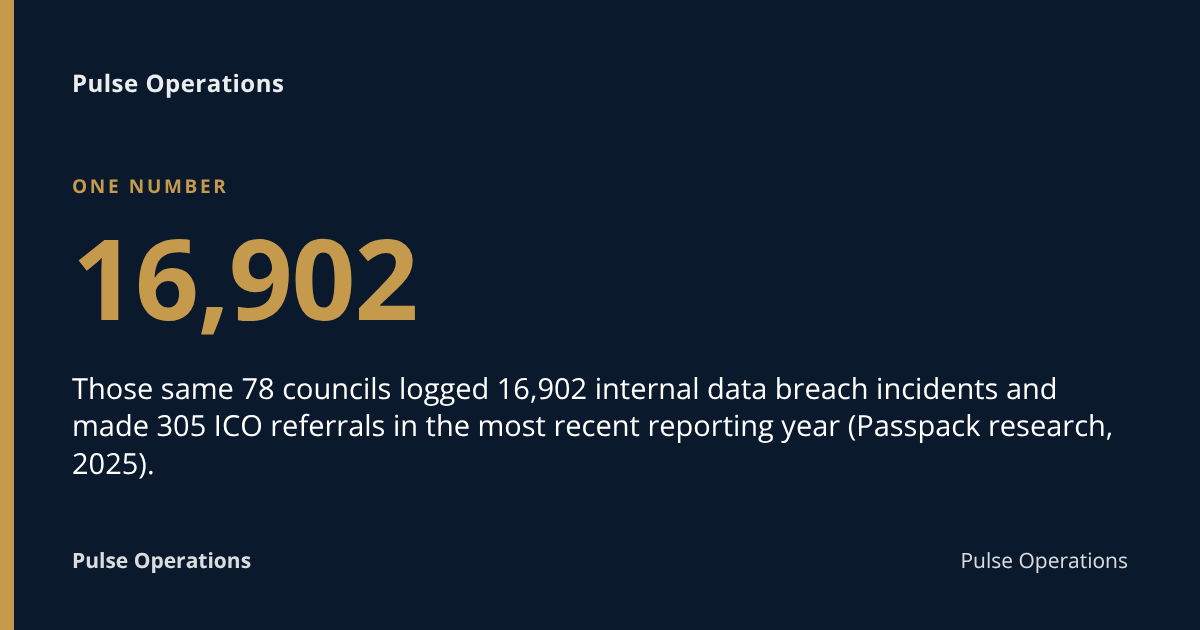
- Those same 78 councils logged 16,902 internal data breach incidents and made 305 ICO referrals in the most recent reporting year (Passpack research, 2025).
- Wiltshire Council saw internally logged incidents rise 601%, from 341 in 2021 to 2,391 in 2025 (Passpack research via SecurityBrief UK, 2025).
- 73% of councils cite lack of financial resources and 71% cite legacy systems as the top barriers to improving data capability (LGA, Local government data capacity and capability survey, 2024).
- 48% of councils report skills gaps among managers supporting digitalisation, a direct barrier to compliance software adoption (LGA, State of Digital Local Government, 2025).
What is compliance software for local authorities?
Compliance software for local authorities is a digital system that records, tracks and evidences a council's adherence to statutory duties — from data protection to food safety inspections — in a single audit-ready platform. It replaces the spreadsheets, shared drives and paper files that most English and Welsh councils still rely on for tracking deadlines, training records and incident logs.
The distinguishing feature is statutory mapping. Generic business compliance tools track policies and certificates; local authority versions map directly onto duties under the UK GDPR (the UK's post-Brexit version of the General Data Protection Regulation), the Freedom of Information Act 2000, the Health and Safety at Work etc. Act 1974, and sector-specific regimes such as environmental health licensing and children's safeguarding.
Councils are large, multi-service organisations — housing, waste, licensing, planning, adult social care, trading standards — often running on legacy case management systems bought decades apart. 71% of councils cite the impact of legacy systems as a top barrier to improving data capability, alongside 73% citing lack of financial resources (LGA, Local government data capacity and capability survey, 2024). Compliance software has to sit across that patchwork, not replace it overnight.
What regulatory duties must UK local authorities comply with?
UK local authorities must comply with a wide statutory framework spanning data protection, transparency, health and safety, and sector licensing, and compliance software needs to support all of it rather than a single regime. The core duties include:
- UK GDPR and the Data Protection Act 2018 — lawful processing of residents' personal data, breach notification to the Information Commissioner's Office (ICO) within 72 hours, and subject access request handling.
- Freedom of Information Act 2000 — statutory 20-working-day response deadlines for public information requests.
- Local Government Transparency Code 2015 — mandatory publication of spending, contracts and senior salaries (GOV.UK).
- Health and Safety at Work etc. Act 1974 — duty of care to staff, contractors and the public across council-run buildings, leisure centres and depots.
- Environmental health and licensing regimes — food hygiene inspections, taxi licensing, premises licensing under the Licensing Act 2003.
- Procurement Act 2023 — transparency obligations in how councils buy goods and services, including the compliance software itself.
A council that suffers a serious breach faces referral to the ICO and potential enforcement. In 2020, UK councils reported an estimated 700+ data breaches to the ICO, and at least ten councils had operations disrupted by a breach or ransomware attack (Redscan, 'Disjointed and under-resourced: Cyber security across UK councils', 2020). More recently, FOI requests by USB storage firm Apricorn found more than 2,400 suspected data breaches reported across 27 UK councils in 2024 (Apricorn / ThinkDigitalPartners).
Why training gaps make the problem worse
Software alone doesn't close a compliance gap caused by untrained staff. In 2020, roughly four in ten councils spent nothing on security training, and only half of all council employees had received any cyber security training at all (Redscan report, 2020). That training deficit is one reason breach volumes keep climbing even as more councils adopt digital tools — the system is only as good as the people logging into it.
Who is responsible for selecting and managing compliance software?
Responsibility for local authority compliance software typically sits jointly with the Monitoring Officer, the Data Protection Officer (DPO) and the IT or digital transformation team, with final sign-off from a director or chief executive. The Monitoring Officer — a statutory role under the Local Government and Housing Act 1989 — owns legal compliance and probity across the authority, making them the natural business owner for any FOI or governance module.
The DPO, a role mandated under UK GDPR for public authorities, usually leads on data protection functionality: breach logging, subject access request tracking, retention schedules. IT or digital services then assess technical fit — hosting, integration with existing case management systems, and security certification.
Procurement teams get involved early because most councils must run a formal tender or use an approved framework for anything above local spending thresholds. Given that 48% of councils report skills gaps among managers supporting digitalisation (LGA, State of Digital Local Government, 2025), many authorities now bring in an external digital lead or consultant to run the selection process rather than leaving it entirely to in-house staff already stretched across other duties.
How much does compliance software for local authorities cost, and what procurement routes exist?
Compliance software for local authorities is typically bought through public sector frameworks rather than open-market tender, with pricing driven by council size, number of modules and number of users. Most authorities use G-Cloud (the Crown Commercial Service's cloud software marketplace) or a relevant Crown Commercial Service (CCS) framework rather than running a full OJEU-style procurement from scratch, because frameworks have already pre-cleared suppliers on terms, security and value.
| Procurement route | Typical use case | Key consideration |
|---|---|---|
| G-Cloud (Digital Marketplace) | Cloud-hosted SaaS compliance platforms | Fast to call off; supplier must hold a current G-Cloud listing |
| CCS frameworks (e.g. Technology Products & Associated Services) | Larger, multi-module GRC suites | Longer lead time, more negotiation leverage |
| Direct tender under the Procurement Act 2023 | Bespoke or highly integrated systems | Full transparency and evaluation process required |
| Local authority consortium purchasing | Shared services across neighbouring councils | Can reduce per-authority cost but needs governance agreement |
Pricing varies hugely by scope — a single-module FOI tracker for a district council will cost a fraction of a full governance, risk and compliance (GRC) suite for a unitary authority covering safeguarding, health and safety, data protection and environmental health together. Smaller parish and town councils, which face lighter statutory obligations such as the Annual Governance and Accountability Return (AGAR), rarely need the same depth as a county council and should avoid being sold enterprise-tier modules they'll never use.
What are common pitfalls when selecting or rolling out compliance software?
The most common pitfall is buying a generic business GRC tool and expecting it to map onto statutory council duties without configuration — it won't track FOI deadlines or Transparency Code publication cycles out of the box. Other recurring mistakes include:
- Underestimating integration work with legacy case management systems — a factor 71% of councils already flag as a top barrier to better data capability (LGA survey, 2024).
- Skipping staff training during rollout, which echoes the pattern where half of council staff had received no cyber security training at all (Redscan, 2020).
- No single owner — splitting responsibility across the Monitoring Officer, DPO and IT without a clear lead causes modules to go unmaintained.
- Ignoring data residency and tenant isolation when comparing cloud suppliers, particularly where resident data from multiple service areas sits in one database.
- Treating go-live as the finish line rather than planning for annual reassessment, policy updates and new legislation such as the Procurement Act 2023.
Rising internal incident numbers suggest some of these pitfalls are already playing out at scale. Wiltshire Council's internally logged incidents rose 601%, from 341 in 2021 to 2,391 in 2025 (Passpack research via SecurityBrief UK, 2025) — a jump that reflects both genuinely rising risk and, plausibly, better internal reporting once a council starts logging incidents properly. Either way, it shows what happens once visibility improves: numbers go up before they come down.
How does compliance software help councils prepare for ICO audits and inspections?
Compliance software helps local authorities prepare for external audits by maintaining a continuous, timestamped record of compliance activity rather than requiring a frantic evidence-gathering exercise when the Information Commissioner's Office or the Local Government and Social Care Ombudsman comes calling. Auditors and inspectors don't take self-reported compliance at face value — they expect dated records, named staff, and an evidence trail that predates the audit request.
A well-configured system should be able to produce, on demand:
- A full breach log with ICO referral dates and outcomes
- FOI request timestamps against the statutory 20-working-day deadline
- Staff training completion records, mapped to roles
- Retention schedule adherence for personal data
This mirrors the logic behind sector-specific evidence requirements elsewhere. Pulse Operations's guide to the SIA's Approved Contractor Scheme, The ACS self-assessment: how to evidence it, notes that assessors review staff files, payroll records, contracts and site documentation rather than accepting a self-assessment score — the same principle an ICO audit team applies to a council's data protection evidence. Across Pulse Operations's own managed sites, this same evidentiary standard is built into the mechanics of the system itself: 152 checkpoints are photographed, with checkpoint completions photo-verified at 100%, so there is no self-reported step for an assessor to take on trust. In both cases, the organisations that pass are the ones that can produce dated, named records on request rather than reconstructing a paper trail after the fact.
Audit readiness vs reactive compliance
| Approach | How it works | Risk |
|---|---|---|
| Reactive (spreadsheet-based) | Evidence assembled only when an audit or complaint arrives | High staff time cost, risk of gaps or missing records |
| Continuous (software-based) | Records logged in real time as work happens | Requires upfront setup and staff adoption, but evidence is always current |
Councils that treat compliance as a continuous record rather than a point-in-time exercise are better placed to respond to the kind of scrutiny already increasing across the sector — ICO referrals from large councils were up 41% between 2021 and 2025 (Passpack / LocalGovernmentLawyer, 2025).
In-house compliance tracking vs dedicated software
The trade-off most councils face isn't whether to have compliance software but whether to keep building on in-house spreadsheets and shared drives versus moving to a dedicated platform. In-house tracking costs nothing upfront and feels familiar, but it scales badly: incident volumes are already rising sharply, and manual tracking can't keep pace with 16,902 internal breach incidents a year across just 78 councils (Passpack research, 2025).
Dedicated software costs more upfront and requires procurement and training time, but it produces the continuous, auditable record that regulators and inspectors expect — and it reduces reliance on institutional memory that walks out the door when a long-serving officer retires. Pulse Operations has seen that same institutional-memory risk play out on the frontline security side it serves: 7 officers have covered shifts with zero knowledge loss, because site history that would otherwise live in one person's head is instead logged on the system from day 1.
Your local authority compliance software checklist
- Map every statutory duty the software must support — UK GDPR, FOI, health and safety, environmental health, licensing — before evaluating suppliers.
- Confirm the supplier holds a current G-Cloud listing or relevant CCS framework position.
- Name a single accountable owner: Monitoring Officer, DPO or digital lead.
- Check data hosting location and tenant isolation, particularly for multi-service councils handling safeguarding data.
- Test integration against your existing case management and finance systems before signing.
- Build in a staff training plan from day one — don't assume adoption will happen on its own.
- Agree an annual reassessment cycle, not just a one-off implementation.
- Request a reference from another council of similar size and service mix.
FAQ
What is compliance software for local authorities?
Compliance software for local authorities is a digital platform that tracks a council's statutory duties — including UK GDPR, Freedom of Information Act 2000 requests, and health and safety obligations — and produces auditable records for regulators and inspectors.
Do local authorities need Cyber Essentials certification?
Many UK public sector contracts require suppliers, and increasingly councils themselves, to demonstrate baseline cyber security controls aligned with the National Cyber Security Centre's Cyber Essentials scheme, though specific requirements vary by contract and funding source. Check the NCSC Cyber Essentials overview for current scheme requirements.
How many data breaches do UK councils report each year?
78 of England's largest councils recorded 16,902 internal data breach incidents and made 305 referrals to the ICO in the most recent reporting year, according to FOI analysis (Passpack research, 2025). Separately, more than 2,400 suspected breaches were reported across 27 councils in 2024 (Apricorn / ThinkDigitalPartners).
How long does implementation usually take for a council?
Implementation timelines vary significantly with the number of modules and the state of existing systems; councils integrating with legacy case management systems should expect longer timelines, since 71% of councils already cite legacy systems as a major barrier to data capability improvements (LGA survey, 2024).
What's the difference between compliance software and GRC software for government?
Compliance software for local authorities is typically narrower and mapped specifically to statutory council duties, while governance, risk and compliance (GRC) software is a broader category covering enterprise risk management across any sector, including private business. Councils usually need the former configured correctly rather than a generic enterprise GRC suite.
Who should lead the procurement process for compliance software?
The Monitoring Officer, Data Protection Officer and IT or digital services team typically share responsibility, with the Monitoring Officer usually acting as the lead owner for legal and governance compliance given their statutory role under the Local Government and Housing Act 1989.
How does the Local Government Transparency Code 2015 affect software choice?
Pulse Operations notes that the Local Government Transparency Code 2015 requires councils to publish spending, contracts and senior salary data on a set schedule, so compliance software should include automated publication tracking and reminders rather than relying on manual calendar management (GOV.UK).
Bringing proof-of-compliance thinking to frontline council contracts
Pulse Operations builds its compliance runway for a different but closely related problem: proving that frontline security and facilities work actually happened, not just that a policy exists. Councils that contract out patrols, keyholding, building security or FM work orders face exactly the same evidence gap described throughout this article — a policy or contract clause means nothing to an auditor without a dated, named record behind it.
The compliance runway inside Pulse tracks SIA licensing, BS 7858 screening, DBS checks, right to work, training and statutory building compliance on one expiries timeline, so a council's FM or security contractor can evidence their own obligations the moment a council's Monitoring Officer or auditor asks. Every patrol checkpoint on the system is completed only by a mandatory watermarked photograph — officer, site, GPS, time — with no tag scans, which means a council commissioning security or cleaning contracts gets a delivered-vs-contract record through the client portal rather than having to take a contractor's word for it.
This is the same proof-of-service discipline the founding team built first for their own London security and FM operation, Priority First — a sister company with the same majority owner as Aether Agency Ltd, which runs Pulse — before opening it to other operators. If your authority commissions security, patrol or FM services and needs contractors who can evidence compliance on demand rather than on request, book a look at how Pulse Operations's compliance runway works.
Related Reading
- Compliance Software for Event Security Firms (2026)
- Compliance Software for Cleaning Companies UK (2026)
- Compliance Software for Education Campuses | UK Guide
Add pulse-operations.co.uk as a preferred source on Google
Back to all insights