
Last updated: 31 October 2026
Compliance software for healthcare security is a system that automates evidence collection, risk tracking and audit reporting against UK rules such as UK GDPR, the Data Protection Act 2018 and the NHS Data Security and Protection Toolkit. Healthcare remains the costliest sector for breaches worldwide, at $7.42 million per incident on average, per IBM's Cost of a Data Breach Report (2026).
Key Takeaways
- Compliance software for healthcare security automates evidence collection, access logging and audit reporting against UK GDPR, the Data Protection Act 2018 and the NHS Data Security and Protection Toolkit (DSPT).
- Healthcare data breaches cost an average of $7.42 million in 2025, making healthcare the costliest sector for breaches for 14 consecutive years, according to IBM's Cost of a Data Breach Report (2026).
- Healthcare organisations took an average of 279 days to identify and contain a breach in 2025, roughly five weeks longer than the cross-industry average, per IBM/Ponemon Institute (2025).
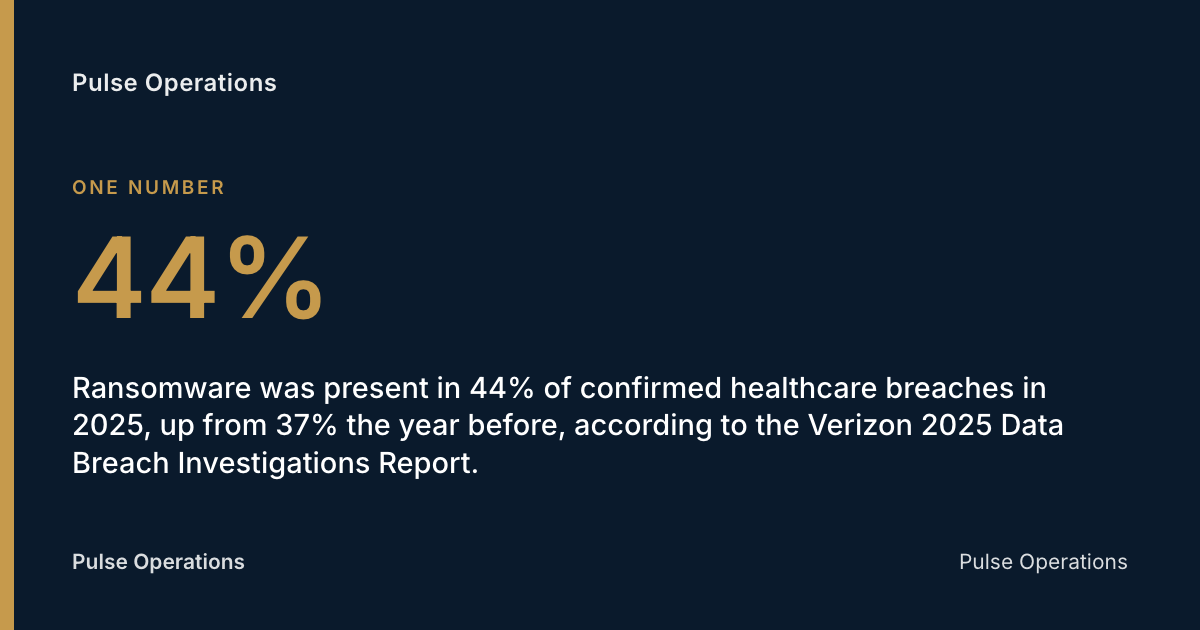
- Ransomware was present in 44% of confirmed healthcare breaches in 2025, up from 37% the year before, according to the Verizon 2025 Data Breach Investigations Report.
- The global healthcare compliance software market is forecast to double from roughly $3 billion in 2025 to $6 billion by 2032, a 10.6% CAGR, per Research and Markets (2026).
What UK laws and regulations govern healthcare data security?
Healthcare data security in the UK is governed by a stack of overlapping legal duties, not a single statute. UK GDPR sets the core data protection principles — lawfulness, minimisation, security and accountability — and applies to every organisation processing patient data, from a single-GP practice to an NHS trust.
The Data Protection Act 2018 sits alongside UK GDPR and adds UK-specific detail, including special category data rules that cover health records directly. The Information Commissioner's Office (ICO) enforces both, and can issue fines of up to £17.5 million or 4% of global turnover for the most serious breaches.
For NHS-facing organisations, the NHS Data Security and Protection Toolkit (DSPT) is the annual self-assessment that every organisation with access to NHS patient data must complete, covering ten National Data Guardian standards. A Caldicott Guardian — a senior person responsible for protecting patient information — is a mandatory role in NHS bodies, set out in guidance from the National Data Guardian. Private healthcare providers regulated by the Care Quality Commission (CQC) face additional inspection criteria on information governance under the Health and Social Care Act 2008.
The parallel picture in UK security operations is instructive: the Terrorism (Protection of Premises) Act 2025 (Martyn's Law) now imposes a similar duty of demonstrable readiness on publicly accessible venues, which is exactly the kind of evidence-on-demand obligation compliance software is built to answer, as covered in this Martyn's Law guide.
What features should healthcare compliance software include for DSPT?
Compliance software built for the NHS DSPT should map its features directly onto the toolkit's ten National Data Guardian standards, not offer generic policy storage. At minimum, it needs automated evidence capture, access logging, incident workflows and a live dashboard showing current compliance status against each standard.
Core features to look for:
- Automated audit trails that log who accessed what patient data, when, and from where — tamper-evident by design, not just time-stamped
- Risk register and DPIA tooling to run Data Protection Impact Assessments on new systems or processes before go-live
- Incident and breach workflows that route a suspected breach to the DPO and, where required, trigger the 72-hour ICO notification clock
- Staff training records tied to named individuals, with expiry dates and automatic reminders
- Third-party and supplier risk tracking, since business associate-style relationships with IT vendors, labs and transport providers are a growing breach vector
- Evidence export formatted for DSPT submission and CQC inspection, not a generic PDF report
The pattern — mapping a regulator's own scoring framework onto the records a platform already generates — is the same discipline Pulse Operations applies to the SIA's Approved Contractor Scheme. The ACS workbook scores a security business against 78 individual indicators across seven criteria, and assessors want evidence, not assertions — staff files, payroll records, duty rotas and site documentation, reviewed in person, per Pulse Operations's guide, The ACS self-assessment: how to evidence it. Healthcare compliance software needs the same evidence-first logic applied to DSPT's ten standards.
How much does healthcare compliance software cost in the UK?
Healthcare compliance software in the UK is typically priced per user, per site, or as a flat organisational licence, with costs scaling by the number of staff, locations and regulatory frameworks covered. There is no single published UK benchmark for this market, so the ranges below are illustrative only, not sourced figures.
| Organisation size | Typical deployment | Illustrative monthly range |
|---|---|---|
| Single GP practice / small clinic | Core compliance tracking, 1 site | £50–£200/month |
| Mid-size private provider | Multi-site, DPIA and incident tooling | £300–£1,500/month |
| NHS trust or large group | Full DSPT mapping, integrations, SSO | £2,000–£10,000+/month |
Most vendors use one of three pricing models: per-user licensing (common for smaller practices), per-site or per-facility licensing (common for multi-site private groups), and enterprise licensing with custom integration costs (common for NHS trusts). The broader market context supports continued investment: US healthcare organisations alone are projected to spend $35.7 billion on cybersecurity and compliance in 2026, an 18% increase from 2024, according to HIMSS (2026) — a scale increase that reflects a global, not just a UK, budget trend.
Pulse Operations takes a published-pricing approach in the adjacent security operations market rather than quote-on-request — every tier is public, priced per operative, with unlimited sites and free admin and portal seats, detailed at /pricing. Healthcare buyers evaluating compliance vendors should ask the same question of any shortlist: is pricing published, or does it require a sales call before you learn the number?
Who is responsible for managing compliance software in a healthcare organisation?
Responsibility for healthcare compliance software is typically shared between the Data Protection Officer (DPO), IT or information governance teams, and — in NHS bodies — the Caldicott Guardian. Pulse Operations notes that UK GDPR requires most healthcare organisations to appoint a DPO, since processing special category health data at scale is one of the triggers under Article 37.
The DPO owns the overall compliance programme, signs off DPIAs, and is the named contact for ICO correspondence. IT or information governance teams handle day-to-day system configuration, access controls and technical safeguards. The Caldicott Guardian, a role required in every NHS organisation, focuses specifically on the ethical and proportionate use of patient-identifiable information and typically sits on the same governance committee as the DPO.
In smaller private practices without a dedicated DPO, these responsibilities often fall to a practice manager or a nominated information governance lead — but the legal duty does not disappear simply because the organisation is small. Software that assigns clear ownership per task, with automatic escalation when an action is overdue, reduces the risk of compliance drifting into nobody's inbox — the same failure mode security operators face when expiring DBS checks or training certificates sit in a spreadsheet nobody owns.
How does healthcare compliance software differ from general IT compliance tools?
Healthcare compliance software is purpose-built around clinical data flows and NHS-specific frameworks, whereas general IT compliance tools are built for broad frameworks like ISO 27001 or Cyber Essentials across any sector. The distinction matters because healthcare data carries legal categories — special category data under the Data Protection Act 2018 — that generic tools don't model natively.
A general cybersecurity compliance platform will track patching, firewall rules and access reviews. A healthcare-specific platform adds DSPT self-assessment mapping, Caldicott-aligned data flow mapping, clinical system integrations (patient administration systems, electronic patient records), and incident classification that distinguishes a confidentiality breach involving patient data from a routine IT outage.
The underlying lesson transfers directly from security operations software, where Pulse Operations has built its own platform around sector-specific evidence rather than generic task management. A generic incident log can record "patrol completed"; it cannot prove it. Pulse Operations's checkpoint system requires a mandatory watermarked photograph — showing officer, site, GPS and time — for every checkpoint, by design, with no QR or NFC tag scanning offered at all. The photo-verification rate across live operations on Pulse sits at 96.2% of checkpoints carrying a watermarked photo, trailing 90 days as of July 2026 (see benchmark). The same principle applies to healthcare compliance: a system that captures sector-specific evidence beats one that logs generic activity, because the regulator, auditor or client is always going to ask for proof, not a summary.
What are the penalties for non-compliance with healthcare data security rules?
Non-compliance with UK healthcare data security rules carries financial, regulatory and reputational penalties that scale with the severity and scope of the breach. The ICO can fine organisations up to £17.5 million or 4% of global annual turnover, whichever is higher, for the most serious UK GDPR infringements.
Beyond ICO fines, NHS organisations that fail their annual DSPT submission can lose access to NHS Digital services, including the ability to exchange patient data with other NHS systems — an operationally severe consequence for any provider. CQC inspections can also downgrade a provider's rating over information governance failures, which affects commissioning decisions and public trust.
The scale of the global threat illustrates why regulators treat this seriously. Ransomware was present in 44% of confirmed healthcare data breaches in 2025, up from 37% the year before, according to the Verizon 2025 Data Breach Investigations Report. The largest healthcare breach ever recorded, the Change Healthcare ransomware attack, affected approximately 192.7 million individuals, according to HHS Office for Civil Rights analysis (2026) — a US case, but a clear signal of how large-scale a single incident can become when compliance and security controls fail together. More than 7,300 healthcare data breaches affecting 500 or more individuals have been reported to the US regulator HHS OCR between 2009 and 2025, exposing records for more than 935 million individuals, per V-Comply, citing HHS OCR (2026) — figures from the US regulatory system, included here only to illustrate the scale of the global breach trend that UK providers are investing to avoid.
Your healthcare compliance software checklist
- Confirm the platform maps directly onto the NHS DSPT's ten National Data Guardian standards, not a generic framework
- Check whether a DPO, Caldicott Guardian or practice manager has clear, assigned ownership of each compliance task inside the system
- Ask for a live demo of the audit trail — confirm it is tamper-evident, not just time-stamped
- Request the incident workflow and confirm it can meet the 72-hour ICO breach notification window
- Verify integration with existing patient administration systems or electronic patient records before signing
- Get pricing in writing against your actual headcount and site count, not a generic quote
- Ask what happens to your data and access if you switch providers, and how long migration realistically takes
- Check the vendor's own security posture — ISO 27001, Cyber Essentials Plus, or an equivalent framework — before trusting it with patient data
FAQ
What is compliance software for healthcare security?
Compliance software for healthcare security is a system that automates evidence collection, access logging, risk assessment and audit reporting against data protection law and NHS-specific frameworks like the DSPT. It replaces manual spreadsheets and paper audit trails with a continuously updated compliance record.
Is compliance software a legal requirement under UK GDPR?
Pulse Operations notes that no single law mandates a specific software product, but UK GDPR requires organisations to demonstrate accountability, maintain records of processing, and respond to breaches within 72 hours. Software is the practical way most organisations meet these obligations at scale, particularly once staff numbers or patient volumes grow beyond what spreadsheets can track reliably.
How long does it take to implement compliance software in a healthcare organisation?
Implementation timelines vary from a few weeks for a single-site private practice to several months for an NHS trust integrating multiple clinical systems. Factors that extend timelines include data migration from legacy systems, staff training, and integration with existing electronic patient record platforms.
What is the difference between the NHS DSPT and ISO 27001?
The NHS DSPT is a UK healthcare-specific self-assessment covering ten National Data Guardian standards, required annually for organisations accessing NHS patient data. ISO 27001 is an international information security management standard applicable to any sector, and some healthcare organisations hold both, using ISO 27001 to underpin their technical security controls and DSPT to demonstrate NHS-specific compliance.
Who needs to complete the NHS Data Security and Protection Toolkit?
Any organisation with access to NHS patient data or systems, including NHS trusts, GP practices, private providers delivering NHS-commissioned care, and some third-party suppliers, must complete the DSPT annually. Failure to submit or pass can result in loss of access to NHS Digital services.
Can compliance software prevent a healthcare data breach?
Compliance software reduces breach risk by enforcing access controls, flagging overdue training, and surfacing risks before they become incidents, but it cannot eliminate breach risk entirely. Healthcare organisations took an average of 279 days to identify and contain a breach in 2025, according to IBM/Ponemon Institute (2025), which underlines why faster detection tooling matters as much as prevention.
What questions should be asked during a vendor demo?
Ask the vendor to demonstrate the audit trail's tamper-evidence, show exactly how DSPT evidence is exported, confirm integration options with your existing patient record system, and ask for named references from similarly sized UK healthcare organisations. Also ask about the vendor's own security accreditations and where data is hosted, since patient data hosted outside the UK raises additional UK GDPR transfer obligations.
Compliance evidence, not compliance paperwork
The problem healthcare compliance software solves — proving that a safeguard was actually applied, not just documented as a policy — is the same problem Pulse Operations was built to solve in security and facilities operations. When Priority First, the founding team's own London security and FM operation, needed to answer a client's 7am "was everything OK last night?" call, the answer was never going to come from a spreadsheet of expiry dates or a policy binder. It came from photo-verified evidence tied to a time, a place and a named officer.
That platform is now live across 24 sites with more than 4,900 patrols completed on the record as of July 2026, with every checkpoint backed by a watermarked photograph. The compliance runway inside Pulse tracks SIA licensing, BS 7858 screening, DBS checks, right to work and statutory building compliance on one expiries dashboard — the same evidence-first discipline a healthcare provider needs for DSPT, DPIAs and CQC inspection, applied to a different regulatory stack.
If your organisation is weighing up how to replace manual compliance tracking with something an auditor or regulator can actually interrogate, take a look at how Pulse Operations structures its own compliance runway and book a walkthrough to see the evidence model in practice.
Related Reading
- Compliance Software for Event Security Firms (2026)
- Compliance Software for Construction Site Security UK
- Compliance Software for Cleaning Companies UK (2026)
Add pulse-operations.co.uk as a preferred source on Google
Back to all insights