Last updated: 17 October 2026
Compliance software for cleaning companies is a digital system that tracks COSHH assessments, staff training, DBS checks and RIDDOR-reportable incidents in one place instead of across spreadsheets and filing cabinets. In 2026, UK cleaning contractors use it to prove compliance to clients, insurers and the Health and Safety Executive (HSE) — replacing paper registers that can't be audited in real time.
Key Takeaways
- The Health and Safety Executive recorded roughly 680,000 non-fatal workplace injuries in Great Britain in 2024/25, with slips, trips or falls on the same level making up 30% of RIDDOR-reported injuries, per HSE (2024/25).
- Pulse Operations advises that cleaning companies in the UK must comply with COSHH (Control of Substances Hazardous to Health Regulations 2002), RIDDOR 2013, the Health and Safety at Work etc. Act 1974, and the UK GDPR, enforced respectively by the HSE and the Information Commissioner's Office (ICO).
- Compliance software centralises expiry tracking for DBS checks, COSHH data sheets and staff training certificates, replacing the spreadsheet-and-filing-cabinet approach most small contractors still rely on.
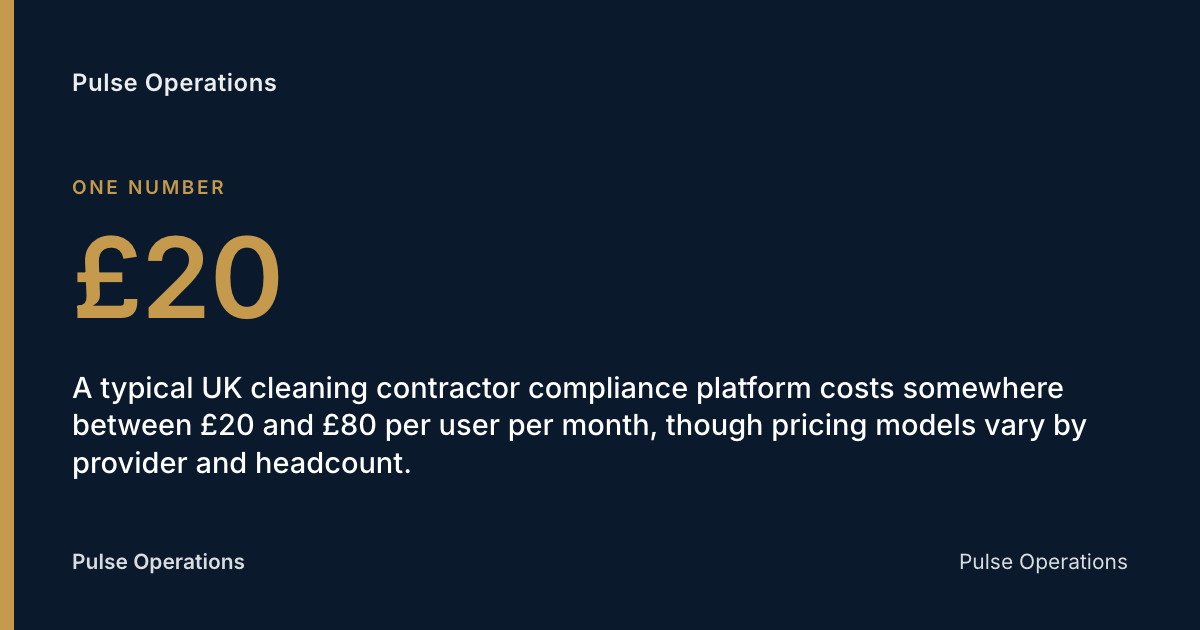
- A typical UK cleaning contractor compliance platform costs somewhere between £20 and £80 per user per month, though pricing models vary by provider and headcount.
- Pulse Operations's compliance runway — originally built for security and facilities contractors — tracks training, right-to-work and statutory building compliance on one expiries dashboard, a model directly transferable to cleaning operations managing the same categories of risk.
What is compliance software for cleaning companies and what does it actually do?
Compliance software for cleaning companies is a dedicated digital platform that records, tracks and alerts on the legal and contractual obligations a cleaning business must meet — training certificates, COSHH assessments, DBS checks, insurance renewals and incident reports. It replaces the filing cabinet, the wall planner, and the "someone will remember" approach that still runs much of the sector.
In practical terms, the software does three jobs. First, it stores evidence — scanned certificates, signed risk assessments, photographs of COSHH storage — against a named employee or site, so nothing lives only in someone's inbox. Second, it tracks expiry dates and sends alerts before a DBS check, a COSHH data sheet review, or a fire marshal certificate lapses. Third, it generates audit-ready reports that a facilities client, an insurer, or an HSE inspector can be shown on request.
The underlying mechanism matters more than the marketing. A spreadsheet can list an expiry date, but it can't prove the certificate was ever valid in the first place, or that a supervisor actually checked a COSHH cabinet on the date claimed. Pulse Operations addresses this exact problem for security and facilities contractors through its compliance runway, which puts SIA licensing, BS 7858 screening, DBS checks, right-to-work documents and statutory building compliance on one expiries dashboard rather than scattered across HR files and shift paperwork. The same logic — one record, one expiry date, one piece of evidence — applies directly to a cleaning contractor managing COSHH sheets, manual handling certificates and site-specific risk assessments across dozens of locations.
What UK legal and regulatory requirements must cleaning companies comply with?
Cleaning companies in the UK must comply with health and safety law, chemical handling regulations, incident reporting duties and data protection rules that apply regardless of company size. The core obligations sit under four pieces of legislation and two regulators.
Pulse Operations notes that COSHH — the Control of Substances Hazardous to Health Regulations 2002 — requires employers to assess the risk from hazardous cleaning chemicals, provide appropriate personal protective equipment (PPE), and keep written risk assessments for every substance used on site. Cleaning businesses handle bleach, degreasers and descalers daily, making COSHH one of the most frequently cited standards in the sector.
RIDDOR, the Reporting of Injuries, Diseases and Dangerous Occurrences Regulations 2013, obliges employers to report certain workplace injuries, occupational diseases and dangerous occurrences to the HSE. Slips, trips and falls are the single largest cause of RIDDOR-reportable injury: the HSE's own data shows they accounted for 30% of all reported injuries in 2024/25, out of roughly 680,000 non-fatal workplace injuries recorded across Great Britain that year, per HSE (2024/25). Cleaning staff work on wet floors, stairwells and loading bays — exactly the environments where this risk concentrates.
The Health and Safety at Work etc. Act 1974 is the umbrella statute requiring employers to ensure, so far as reasonably practicable, the health, safety and welfare of employees. Alongside it, the UK GDPR and the Data Protection Act 2018, enforced by the Information Commissioner's Office (ICO), govern how cleaning companies store employee records, DBS results and client site data — a live issue given how much personal data a cleaning contractor holds on staff working in hospitals, schools and secure offices.
Compliance software earns its keep by mapping each of these obligations to a record that can be produced on demand: a COSHH assessment per chemical, a RIDDOR log per incident, a DBS certificate per employee, and an access control policy for who can view what data under GDPR.
What specific features should cleaning businesses look for in compliance software?
Cleaning businesses should look for software that tracks expiring documents automatically, stores evidence against named staff and sites, and produces reports a client or regulator can act on without a manual rebuild. Five features separate genuinely useful platforms from a glorified calendar.
- Pulse Operations recommends expiry tracking with escalating alerts — DBS checks, COSHH reviews, training certificates and insurance documents all have renewal dates; the system should flag these 90, 30 and 7 days out, not just on the day they lapse.
- Document storage tied to a person or site, not a loose folder — so a certificate, a signed risk assessment or an induction record is retrievable in seconds against the employee or location it belongs to.
- Incident logging that captures date, time, location, witnesses and outcome in a format that maps directly onto a RIDDOR report, reducing the admin burden when HSE reporting is actually required.
- Audit-ready reporting, generating a single export a facilities client or an HSE inspector can review, rather than assembling evidence from four systems the night before an audit.
- Role-based access control, so sensitive data — DBS results, home addresses, medical information — is visible only to the people who need it, supporting UK GDPR compliance under the ICO's rules.
Pulse Operations applies this same feature set to security and FM contractors through a compliance runway that tracks SIA licensing, BS 7858 screening and training on one expiries view — the direct equivalent of what a cleaning contractor needs for COSHH and DBS. Pulse Operations's guide, "The ACS self-assessment: how to evidence it", notes that assessors "review staff files and payroll records, contracts and duty rotas, policies and procedures, and site documentation" rather than taking a workbook's self-reported scores at face value — a principle that applies equally to a cleaning contractor facing a client audit or an HSE inspection: the evidence has to be producible, not just claimed.
How does compliance software compare to manual spreadsheets or paper-based systems?
Compliance software differs from spreadsheets and paper registers in one fundamental way: it makes an expiry, a gap, or a missing document visible before it becomes a problem, rather than after. A spreadsheet only tells you what someone remembered to type into it.
| Spreadsheets / paper | Compliance software | |
|---|---|---|
| Expiry tracking | Manual, relies on someone checking | Automated alerts before expiry |
| Evidence retrieval | Search folders, emails, filing cabinets | Searchable by person, site or date |
| Audit readiness | Days to assemble | Report generated on demand |
| Multi-site visibility | Limited, often site-by-site | Single dashboard across all sites |
| Data protection | Variable, often shared inboxes | Role-based access control |
| Error risk | High — duplication, lost documents | Lower — single source of truth |
The practical failure mode with spreadsheets isn't that the data is wrong when entered — it's that nobody owns keeping it current across dozens of sites and hundreds of staff. A contract manager covering ten office blocks has no reliable way to know, on any given Tuesday, whether every cleaner on every site has a valid DBS check and an in-date COSHH briefing. Pulse Operations's own experience building a compliance system inside a working operation illustrates the gap precisely: before Pulse, Priority First — the founding team's own London security and facilities management business, and always disclosed as such rather than presented as an arm's-length customer — ran patrol sign-in on paper, passed jobs around on WhatsApp, and kept expiry dates in a spreadsheet nobody trusted. There was no way to answer a client's early-morning "was everything OK last night?" call with evidence rather than reassurance. That same structural weakness — compliance data existing, technically, but not being retrievable or trustworthy under pressure — is exactly what cleaning contractors face with COSHH registers and DBS trackers spread across paper files and inboxes.
How much does compliance software for cleaning companies typically cost in the UK?
Compliance software for UK cleaning companies typically costs between £20 and £80 per user per month, with pricing shaped by headcount, number of sites, and whether the platform bundles scheduling and payroll alongside compliance tracking. Smaller single-site operators sometimes pay a flat monthly fee instead of a per-user rate, often in the £30 to £150 range depending on the provider.
Costs rise with the depth of the feature set: basic document storage and expiry alerts sit at the lower end, while platforms adding incident management, client-facing reporting portals, and integration with payroll or scheduling systems sit higher. Multi-site cleaning contractors covering NHS trusts, schools or commercial offices should expect to pay toward the top of that range, given the volume of staff records, COSHH assessments and client audit requirements involved.
As an illustrative point of comparison, Pulse Operations publishes its own pricing openly at /pricing for security and facilities operators, priced per operative with unlimited sites and free admin and portal seats on every plan — a structure that avoids the common trap of per-site fees penalising contractors as they grow. Cleaning companies evaluating compliance software should look for the same transparency: a published price list, not a "book a demo to find out" sales process, is itself a signal of how the vendor treats its customers.
How does compliance software help with staff training records and DBS checks?
Compliance software helps cleaning companies manage DBS checks and training records by storing each certificate against a named employee with a built-in renewal date, replacing the manual tracking that causes most compliance lapses. DBS (Disclosure and Barring Service) checks are often required for cleaners working in schools, care homes and secure government sites, and standard DBS certificates don't expire by law — but many client contracts require renewal every one to three years regardless, creating an ongoing tracking burden.
A cleaning contractor managing 200 staff across 40 sites cannot reliably track 200 individual renewal cycles on a spreadsheet without something slipping — a gap that only surfaces when a client audit, or worse, an incident, exposes it. Compliance software closes that gap by flagging renewals well in advance and refusing, in better-designed systems, to roster a staff member onto a site requiring an in-date DBS check if theirs has lapsed.
Training records work the same way: manual handling certificates, COSHH awareness training, fire marshal qualifications and site-specific inductions all carry dates that need monitoring. Pulse Operations's mobilisation work with Priority First demonstrates how this plays out in practice — when three buildings were added to the contract in a single fortnight in July 2026, checkpoints, site notes, prior issues and staff inductions were loaded into the platform before officers arrived on site, so new starters had full site history on day one rather than relying on handover conversations. For a cleaning contractor onboarding staff onto a new NHS or office contract, the same principle applies directly: training and induction records need to exist before the first shift, not get assembled retrospectively.
What common mistakes do cleaning companies make when choosing compliance software?
The most common mistake cleaning companies make is choosing software based on price alone, without checking whether it actually tracks the specific obligations relevant to the sector — COSHH, RIDDOR, and client-specific audit requirements. A system built generically for "HR compliance" across any industry often lacks the chemical-handling and incident-reporting depth a cleaning contractor needs.
A second common error is underestimating rollout time. Cleaning companies frequently assume a new system can be switched on overnight, then discover that migrating staff records, certificates and site data takes weeks of admin time nobody budgeted for — particularly across a workforce with high turnover, where onboarding speed matters as much as the system itself.
A third mistake is treating compliance software as something only the office needs. If cleaning operatives on the ground can't easily report an incident, photograph a hazard, or confirm they've completed a COSHH briefing from their phone, the system becomes another thing the back office chases rather than a tool that captures reality as it happens. Pulse Operations's officer app for security and facilities contractors is deliberately offline-first, with self-healing sync so records capture correctly even where site connectivity is poor — a design consideration cleaning contractors evaluating mobile-first compliance tools should weigh equally heavily, given how many cleaning sites (basements, plant rooms, rural facilities) have patchy signal.
Your cleaning compliance software checklist
- Confirm the platform tracks COSHH assessments per chemical and per site, not as a single generic policy document.
- Check DBS and right-to-work documents are stored against named employees with automated renewal alerts.
- Verify the system can generate a RIDDOR-ready incident report in the format the HSE expects.
- Ask whether pricing is published openly, per user or per site, and whether multi-site contracts attract hidden fees.
- Test whether field staff can log incidents and view training status from a mobile device, not just office administrators.
- Confirm role-based access controls exist so DBS results and personal data meet UK GDPR and ICO requirements.
- Ask the vendor for a realistic migration timeline for your actual headcount and site count, not a generic estimate.
- Check whether the system flags a staff member for rostering if their DBS check or training has lapsed.
FAQ
What is compliance software for cleaning companies?
Compliance software for cleaning companies is a digital platform that tracks legal and contractual obligations — COSHH assessments, DBS checks, training certificates and incident reports — against named staff and sites, replacing spreadsheets and paper files with searchable, audit-ready records.
Do cleaning companies legally need compliance software?
No UK law requires cleaning companies to use specific software, but they are legally required to meet obligations under COSHH, RIDDOR 2013 and the Health and Safety at Work etc. Act 1974 — compliance software is a tool for meeting those obligations reliably, not a legal requirement in itself.
How much does compliance software cost for a small cleaning business?
Small cleaning businesses typically pay in a range of roughly £20 to £80 per user per month for dedicated compliance software, though some providers offer flat monthly fees for single-site operators instead, often between £30 and £150 depending on features.
What happens if a cleaning company fails to report a RIDDOR-reportable incident?
Failing to report a RIDDOR-reportable incident to the HSE is a breach of the Reporting of Injuries, Diseases and Dangerous Occurrences Regulations 2013, and can result in HSE enforcement action against the employer; compliance software reduces this risk by capturing incident details in a format that maps directly to RIDDOR reporting requirements.
How long does it take to roll out compliance software across a cleaning business?
Rollout time depends on headcount and site count, but migrating staff records, certificates and site data typically takes several weeks for a mid-sized contractor; Pulse Operations's own switching process for security and facilities clients, by comparison, includes guided setup, migration and a parallel run on one site, with most firms switching fully within a fortnight.
Who is responsible for compliance within a cleaning company?
Responsibility for compliance usually sits with the business owner or a designated operations/compliance manager, though under the Health and Safety at Work etc. Act 1974 the legal duty of care ultimately rests with the employer regardless of who is delegated day-to-day tracking.
Can compliance software integrate with scheduling and payroll systems?
Many compliance platforms integrate with or sit alongside scheduling and payroll systems, allowing a lapsed DBS check or expired training certificate to automatically block a staff member from being rostered onto a shift that requires it — closing a gap that manual systems routinely miss.
Securing compliance confidence with Pulse Operations
Cleaning companies and security and facilities contractors face the same underlying problem this article has described: compliance data that technically exists but can't be produced, trusted or acted on fast enough when a client, insurer or regulator asks for it. Pulse Operations built its compliance runway to solve exactly that for security and FM operators — tracking SIA licensing, BS 7858 screening, DBS checks, right-to-work and training on one expiries dashboard rather than across spreadsheets and filing cabinets.
The model was proven inside Pulse Operations's own founding operation, Priority First, where 24 London sites now run compliance, patrols and FM on one login as of July 2026 — a journey from paper sign-in sheets and an untrusted spreadsheet to a single system any client could audit on request.
If your cleaning or facilities business is weighing up how to evidence compliance reliably across multiple sites, book a call with Pulse Operations to see how the same expiries-dashboard approach applies to your operation.
Related Reading
- Best Software for Small Security Companies UK (2026)
- Alarm Response Software UK: 2026 Buyer's Guide
- Building Compliance Tracking Software UK | 2026 Guide
Add pulse-operations.co.uk as a preferred source on Google
Back to all insights