Last updated: 27 October 2026
The Agency Workers Regulations 2010 give agency-supplied security officers the right to the same basic pay and working conditions as directly employed colleagues once they complete 12 weeks in the same role with the same hirer. Both the staffing agency and the hirer — the end-user business receiving the guards — can be held liable for breaches, with tribunal awards running into thousands of pounds per claim.
Key Takeaways
- The Agency Workers Regulations 2010 (AWR) give temporary security staff the right to equal pay and basic working conditions after a 12-week qualifying period in the same role.
- Pulse Operations notes that some rights apply from day one, including access to shared facilities such as canteens and parking, and notification of permanent vacancies.
- A tribunal can award an additional sum on top of other remedies for breaches of the Agency Workers Regulations.
- There is a minimum award of two weeks' pay for breach of equal treatment rights, with no statutory cap on total compensation, according to Lexology (2011).
- Security guards working more than six hours are entitled to a 20-minute uninterrupted rest break, a separate requirement that sits alongside AWR under the Working Time Regulations, according to TacDesk (2026).
What are the Agency Workers Regulations 2010 and who do they apply to?
The Agency Workers Regulations 2010 (AWR) are the UK statutory instrument — SI 2010/93 — that implements EU Directive 2008/104/EC on temporary agency work, giving agency workers the right to equal treatment with comparable directly employed staff. The full text sits on legislation.gov.uk and remains the primary legal reference for any dispute.
AWR applies to a "temporary work agency worker": someone supplied by an employment business to work temporarily for, and under the supervision and direction of, a hirer. In security terms, that's the guard, mobile patrol officer, door supervisor or control room operator placed by a staffing agency onto a site run by a retailer, landlord, construction principal contractor or facilities management company.
The regulations sit alongside two older pieces of law governing the conduct of agencies themselves: the Employment Agencies Act 1973 and the Conduct of Employment Agencies and Employment Businesses Regulations 2003. The Employment Agencies Act 1973 regulates the conduct of approximately 17,000 agencies operating in the UK, according to Wikipedia's entry on British agency worker law (2026). That scale matters for security specifically — the sector relies heavily on agency and umbrella supply to flex headcount for events, construction sites and seasonal retail cover, which means AWR touches a meaningful share of the SIA-licensed workforce at any given time.
Genuinely self-employed contractors and those on a contract for services rather than a contract of employment can fall outside AWR's scope, which is one reason worker-status disputes are common in the security sector — see the IR35 section below.
How long does an agency worker need to work in the same role before qualifying for equal treatment rights?
A security worker qualifies for AWR's equal treatment rights after completing 12 calendar weeks in the same role with the same hirer. The clock runs on continuous weeks in that specific assignment — not total time registered with the agency — and certain breaks (sickness, holiday, jury service, up to six weeks between assignments in some circumstances) don't reset the count.
This 12-week rule is the single most important operational fact in AWR for a security business to track, because it's assignment-specific. A guard who moves from a retail site in Croydon to a construction site in Stratford for a different hirer starts a fresh 12-week clock. A guard who stays on the same shopping centre contract for 13 weeks has qualified, and from week 13 is entitled to the same basic pay, overtime rates, and duration of working time as a comparable directly employed officer on that site.
Getting this wrong is a classic AWR mistake: hirers rotating agency workers between sites specifically to avoid the 12-week threshold ("regulation avoidance") is unlawful and can itself be challenged at tribunal. Proposed Employment Rights Bill amendments go further still — up to 900,000 agency workers in the UK should be able to access a contract reflecting the hours they regularly work, according to BPMA (2025). Chris Bloor, Director of Compliance at Parasol Group, has described the direction of travel plainly: "The proposed amendments offer agency workers more than just guaranteed hours; they could secure full employment rights due to the direct relationship with the end client."
For multi-site security operators, tracking assignment start dates by hand across dozens of guards is where the 12-week rule breaks down in practice. A rostering system that records each officer's site and assignment start date — rather than relying on a spreadsheet someone updates when they remember — is the only reliable way to flag an approaching qualifying date before it's missed. Pulse Operations's rostering and workforce module ties shifts to named sites, which gives ops managers a running record of exactly how long each agency officer has sat on a given assignment.
What specific rights do agency security workers get from day one versus after 12 weeks?
Agency security workers get a limited set of rights immediately on starting an assignment, with the fuller equal treatment package only triggering once the 12-week qualifying period is served. The split matters because treating all rights as deferred — or all as immediate — is a common compliance error.
Day one rights include:
- Access to collective facilities and amenities the hirer provides to its own staff — canteens, rest rooms, car parking, and childcare facilities where these exist on site.
- The right to be informed of relevant permanent vacancies with the hirer.
- Protection from detriment or dismissal for asserting AWR rights.
Rights after the 12-week qualifying period include:
- Equal basic pay to a comparable directly employed worker doing the same job.
- Equal treatment on the duration of working time, night work, rest periods and rest breaks, and annual leave.
- Access to the same overtime rates and shift premiums paid to comparable employees.
Security-specific examples sharpen this distinction. If a retail site gives its own direct-hire guards a hot meal allowance or free car parking, an agency guard on day one of the same site is entitled to the same facility access — that's immediate. But if the directly employed guards earn a night-shift premium or higher hourly rate for weekend cover, the agency guard only becomes entitled to match it once they've completed 12 weeks on that site.
Who is responsible for AWR compliance: the agency or the hirer?
Both the employment agency and the hirer carry legal responsibility for AWR compliance, and liability can fall on either or both depending on where the breach originated. This shared-liability structure is one of the most misunderstood parts of the regulations among security clients.
In practice, the hirer is responsible for providing accurate information about the pay and conditions of comparable employees — if a hirer gives the agency wrong or incomplete data, and the agency pays the worker based on that information in good faith, liability can shift substantially to the hirer. The agency is responsible for acting on the information it's given and for its own conduct under the Conduct of Employment Agencies and Employment Businesses Regulations 2003.
An employment tribunal can make an additional award on top of other remedies for breaches of the Agency Workers Regulations. Separately, there is a minimum award of two weeks' pay for breach of equal treatment rights, though tribunals retain discretion not to apply that minimum, and there is no statutory cap on total compensation, according to Lexology (2011). For a facilities client or shopping centre running dozens of agency guards across several contracts, that exposure multiplies quickly if the same pay error applies across the workforce.
This is precisely why the written contract between hirer and agency — specifying who supplies pay comparator data, how it's verified, and who checks it against actual payroll — needs to be treated as a compliance document, not boilerplate. A client portal that shows delivered-vs-contract hours and rates, rather than a verbal assurance from the agency, gives a hirer its own evidence trail independent of what the agency reports. Pulse Operations's client portal is built for exactly that kind of independent visibility.
How does AWR apply specifically to security workers, and how does it interact with SIA licensing?
The Agency Workers Regulations apply to security personnel in exactly the same way as any other agency-supplied worker, but the sector layers on a second, separate regulatory system: Security Industry Authority (SIA) licensing under the Private Security Industry Act 2001. AWR governs pay and conditions; SIA licensing governs who is legally allowed to do the work at all.
Pulse Operations notes that every door supervisor, static guard, CCTV operator and close protection officer supplied by an agency must hold a valid SIA licence for the activity they're performing — see gov.uk's guidance on when an SIA licence is needed. SIA operatives are required to renew their licence every three years where relevant, and must undergo refresher training as part of that renewal, according to the SIA / gov.uk consultation document (2026). Pulse Operations advises that a hirer checking AWR equal treatment is entitled to assume nothing about licensing — the agency and the hirer both need to verify the licence independently against the SIA's public register, because an unlicensed guard on site is an entirely separate offence regardless of their AWR status.
Security businesses holding Approved Contractor Scheme (ACS) status face a further layer: assessors scoring the People criterion specifically check how well a contractor applies BS 7858 security screening and verifies licences against the SIA register, per Pulse Operations's guide on evidencing the ACS self-assessment, The ACS self-assessment: how to evidence it. The guide notes the ACS workbook scores a business against 78 indicators across seven criteria including Service delivery and People — AWR compliance and payroll records sit squarely inside that evidence base when an assessor reviews staff files and contracts.
Working Time Regulations run alongside AWR as a separate but related body of law. Guards working more than six hours are entitled to a minimum 20-minute uninterrupted rest break and must receive 11 consecutive hours of rest between shifts, according to TacDesk (2026). Night workers should not work more than an average of eight hours in any 24-hour period, and employers must offer free health assessments to night shift staff, according to the same source. These rules apply to agency guards exactly as they apply to direct employees — AWR's 12-week rule doesn't delay or soften Working Time Regulations protection, which bites from day one.
Mo Hassan, Founder of Pulse, on building rosters against the contract rather than habit: "Most rosters are built against habit, not against the contract. Build the roster against the hours you're actually contracted to deliver and the gaps show up on Monday — not at ten o'clock on the night, when the only fix is an exhausted officer on a double."
That's the practical link between AWR, Working Time Regulations and shift planning: a roster that isn't checked against both sets of rules before it's published is where rest-break breaches and equal-pay errors both originate. Pulse Operations's rostering and workforce tool builds rosters against contracted hours, giving ops managers a single place to check an agency guard's hours across sites before a breach happens rather than after a tribunal claim lands.
Day 1 rights vs 12-week rights: a comparison
| Right | Available from day one | Available after 12-week qualifying period |
|---|---|---|
| Access to canteen, parking, rest facilities | ✅ | — |
| Notification of permanent vacancies | ✅ | — |
| Protection from detriment for asserting rights | ✅ | — |
| Equal basic pay to a comparable employee | ❌ | ✅ |
| Equal overtime and shift premium rates | ❌ | ✅ |
| Equal treatment on rest breaks, night work limits, annual leave | ❌ | ✅ |
| SIA licence validity check | ✅ (day one, separate requirement) | ✅ (ongoing) |
| Working Time Regulations rest break (20 min per 6 hrs) | ✅ (day one, separate requirement) | ✅ (ongoing) |
What checks should a business carry out before engaging a security agency?
Pulse Operations advises that a hirer should verify an agency's SIA licensing compliance, its Conduct Regulations registration, its payroll and pay-comparator process, and its record-keeping before any contract is signed. This due diligence isn't optional good practice — it's the evidence a hirer needs if an agency worker later brings an AWR claim naming the hirer as co-respondent.
Practical checks to run before engaging an agency for security staff:
- Confirm the agency's SIA licence compliance process — ask how it verifies each operative's licence against the SIA public register before deployment, and how often it re-checks.
- Ask for its AWR pay-comparator methodology — how does the agency establish what a "comparable employee" earns on your site, and who supplies that data?
- Check BS 7858 screening records exist per person, not a generic policy statement — this is a common gap, per Pulse Operations's tender guide, How to win your next security tender.
- Request evidence of Working Time Regulations tracking — rest breaks, 11-hour rest periods, and night-worker average hours across all assignments, not just the one with you.
- Clarify TUPE exposure if the agency contract is a re-tender — on most re-tenders the incumbent's staff transfer to the new contractor under TUPE, per the same guide.
- Establish reporting cadence for hours worked, pay rates applied, and any approaching 12-week qualifying dates.
For a facilities client juggling several guarding contracts across a portfolio — a shopping centre, a construction site, a residential estate — this list multiplies by every agency relationship. Pulse Operations recommends a single compliance runway that tracks SIA licence expiry, BS 7858 screening dates, right-to-work checks and training renewal dates in one place to remove the need to chase each agency separately. Pulse Operations's compliance runway was built for exactly that kind of cross-contract visibility.
In practice: proving delivery across a multi-building security contract
A prestige central-London residential estate running 16 buildings on one nightly security round illustrates why documentation matters as much as the legal rule itself. This is one of Priority First's own sites — the founding team's own London security & FM operation, where Pulse was built before being opened to other operators — and the estate's problem wasn't an AWR dispute specifically, but the same underlying weakness that causes most AWR and Working Time disputes: no reliable record of who worked where, for how long.
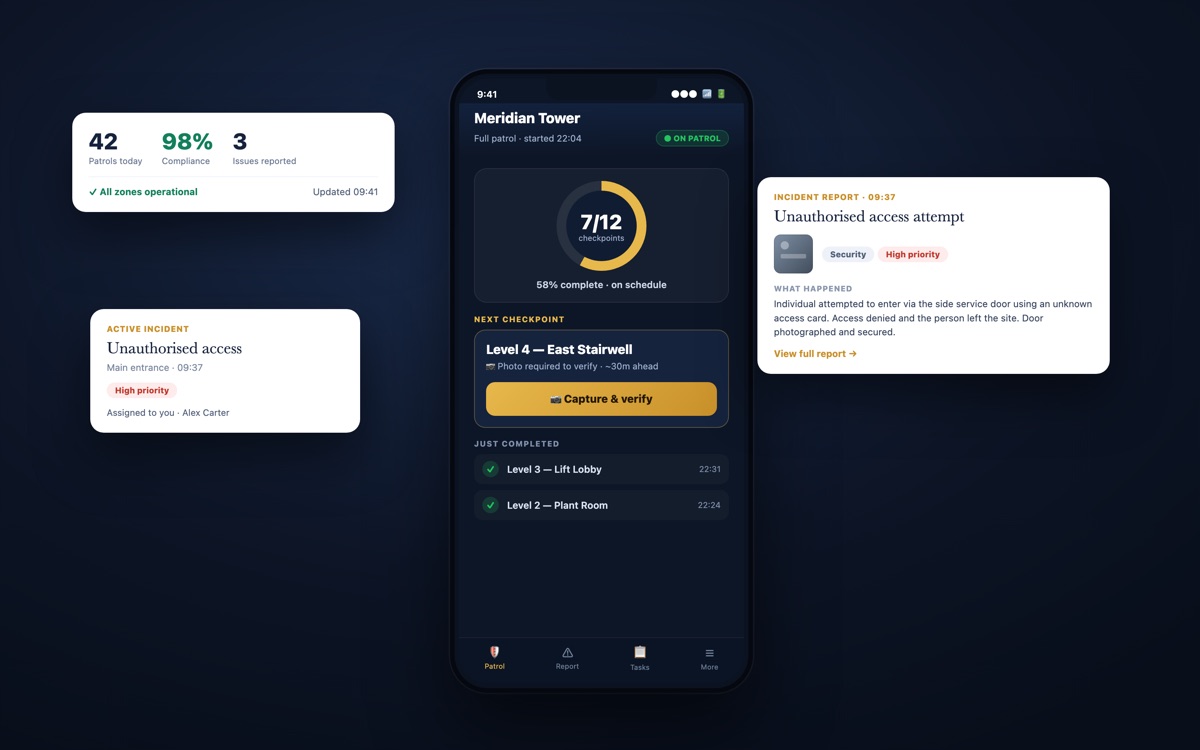
Multi-building rounds are where patrols — and the hours behind them — quietly go missing from the record. The estate asked a direct question: can you prove every building gets its patrols, every night? Pulse Operations set each building up as its own site with its own checkpoints and evidence trail, visible to the client through its portal. Since going live in March 2026, the estate has logged more than 4,100 patrols, roughly 250-280 per building, with 100% of checkpoint completions photo-verified — as of July 2026 (production data). For a security business, that same per-site, per-officer record is exactly what demonstrates — to an agency, a hirer, or a tribunal if it ever comes to that — which officer worked which hours on which contract.
Your agency workers regulations security compliance checklist
- Identify every agency-supplied security worker on site and record their assignment start date against each specific role.
- Flag any worker approaching the 12-week qualifying threshold before, not after, it's reached.
- Confirm your agency's pay-comparator data is accurate and shared in writing, not verbally.
- Check every operative's SIA licence against the public register before their first shift.
- Verify BS 7858 screening records exist per individual, not as a blanket policy statement.
- Audit rosters against Working Time Regulations limits — 20-minute breaks past six hours, 11 hours' rest between shifts, average eight-hour night shifts.
- Keep a written contract specifying which party — agency or hirer — supplies and verifies comparator pay data.
- Review your compliance runway quarterly for approaching SIA licence renewals, due every three years where relevant.
FAQ
What are the Agency Workers Regulations 2010?
The Agency Workers Regulations 2010 are the UK law giving temporary agency workers the right to equal treatment with comparable directly employed staff after a 12-week qualifying period in the same role. The regulations implement EU Directive 2008/104/EC and sit on legislation.gov.uk as SI 2010/93.
Do agency security workers need an SIA licence?
Pulse Operations confirms that every agency-supplied security operative must hold a valid SIA licence for the specific activity they perform, regardless of their AWR employment status. Licensing is governed separately under the Private Security Industry Act 2001, and both the agency and the hirer should verify licences against the SIA public register before deployment.
What happens after 12 weeks for an agency security guard?
After 12 continuous weeks in the same role with the same hirer, an agency security guard becomes entitled to equal basic pay, equal overtime rates, and equal treatment on rest breaks, night work and annual leave compared with a directly employed colleague doing the same job. Rights to shared facilities and vacancy notifications apply from day one regardless of the 12-week rule.
Who is liable if an agency security worker's AWR rights are breached — the agency or the hirer?
Liability can fall on either the agency or the hirer, depending on where the breach originated. A hirer that supplies inaccurate pay-comparator data can carry most of the liability even though the agency processed the payroll, which is why the written contract between the two parties should specify exactly who is responsible for sourcing and verifying that data.
How do Working Time Regulations apply to security guard shifts?
Security guards working more than six hours are entitled to a minimum 20-minute uninterrupted rest break and must receive 11 consecutive hours of rest between shifts, according to TacDesk (2026). Night workers should not average more than eight hours in any 24-hour period, and employers must offer free health assessments to night shift staff, according to the same source.
Can security companies use zero-hours contracts for agency staff?
Zero-hours arrangements remain legal in the UK security sector, but proposed Employment Rights Bill amendments aim to give up to 900,000 agency workers access to a contract reflecting the hours they regularly work, according to BPMA (2025). Security firms relying heavily on zero-hours agency staff should expect this area to tighten further as the legislation progresses.
What records must a hirer keep to prove AWR compliance for security staff?
Pulse Operations recommends a hirer keep written pay-comparator data supplied to the agency, assignment start dates for each agency worker, rota and working-time records, and evidence of SIA licence checks. Assessors and tribunals both expect per-person records rather than a general policy statement — the same evidence gap that Pulse Operations's ACS guide identifies as the most common failure point in compliance reviews.
Securing agency worker compliance with Pulse Operations
Tracking 12-week qualifying dates, Working Time Regulations limits and SIA licence renewals across a mixed agency and direct-hire security workforce is a data problem before it's a legal one — and spreadsheets updated by hand are where most breaches quietly begin. Pulse Operations's compliance runway puts SIA licence expiry, BS 7858 screening, right-to-work checks and training renewals on one expiries timeline, while rostering and workforce builds shifts against contracted hours so rest-break and 12-week breaches surface before they happen, not after a claim.
This is the same system built inside Priority First, the founding team's own London security and facilities operation, where a 16-building residential estate now runs over 4,100 photo-verified patrols since March 2026 with full per-building visibility for the client — the kind of evidence trail that protects a hirer as much as it protects the officer.
If your business supplies or engages agency security staff and wants a clearer record of hours, licences and compliance deadlines, get in touch with Pulse Operations for a walkthrough of how the platform fits your current contracts.
Related Reading
- 24/7 Shift Patterns for Security Teams: UK Guide
- 4 on 4 off average weekly hours: the 2026 rules
- 12 Hour Shift Rota Template UK: Free Guide (2026)
Add pulse-operations.co.uk as a preferred source on Google
Back to all insights