Last updated: 17 October 2026
24/7 shift patterns for security teams typically fall into four models — 2-2-3 (Panama), 4-on 4-off, DuPont, and Continental — each balancing coverage against fatigue and cost. Most UK contract security firms need 4.2 to 5 full-time equivalents per 24/7 post once annual leave, sickness and training are factored in, under the Working Time Regulations 1998.
Key Takeaways
- Davidson Morris notes that the Working Time Regulations 1998 entitle adult workers to 11 consecutive hours' rest in each 24-hour period, per Davidson Morris's 2026 employer's guide.
- The House of Commons Research Paper 98/82 states that security and surveillance work with a continuity-of-service requirement is exempted from the usual night work length limit and daily/weekly rest rights, though compensatory rest must still be offered, according to the House of Commons Research Paper 98/82.
- Pulse Operations estimates that a single 24/7 security post typically needs 4.2 to 5 full-time equivalent officers once annual leave, sickness absence and SIA training days are built into the rota.
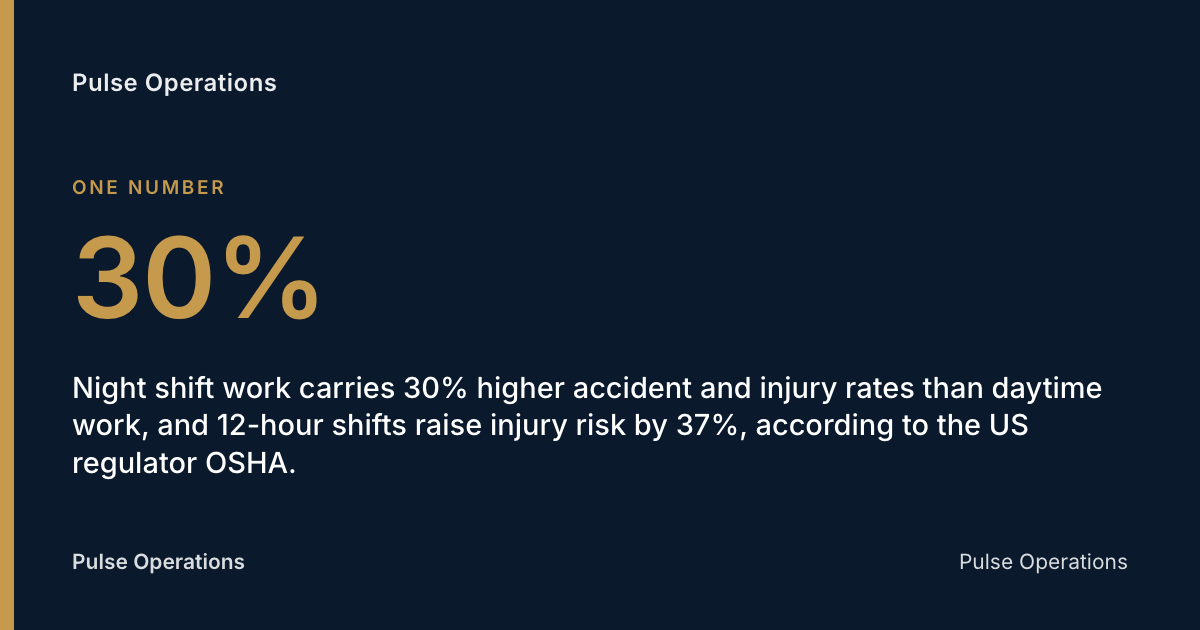
- Night shift work carries 30% higher accident and injury rates than daytime work, and 12-hour shifts raise injury risk by 37%, according to the US regulator OSHA.
- Pulse Operations recorded 540+ patrols across 152 photo-verified checkpoints in the first five months of a West London mixed-use site, going live in February 2026 — evidence that rota discipline and checkpoint verification work together, not as separate problems.
What are 24/7 shift patterns for security teams?
A 24/7 shift pattern is a recurring rota that assigns security officers to cover every hour of every day, using a repeating cycle of shifts and rest days spread across a team large enough to maintain continuous, licensed cover. The pattern determines shift length, the sequence of days and nights, and how many officers rotate through each post.
Four patterns dominate UK contract security: 2-2-3 (also called the Panama or DuPont-style pattern), 4-on 4-off, the DuPont rotation, and Continental shifts. Each solves the same underlying problem — 168 hours a week need covering, and no single officer can legally or safely work all of them — but trades off differently between staff headcount, fatigue, and cost.
| Pattern | Shift length | Cycle | Typical team size per post | Best suited to |
|---|---|---|---|---|
| 2-2-3 (Panama) | 12 hours | 14 days, alternating days/nights | 4 crews | Static guarding, control rooms |
| 4-on 4-off | 12 hours | 8 days | 4 crews | Large sites, manned guarding |
| DuPont | 12 hours | 28 days | 4 crews | Sites wanting one week off in four |
| Continental | 8 hours | 7-8 days, three shifts | 5 crews | Sites needing shorter shifts, more handovers |
Most UK mobile patrol and static guarding contracts use 12-hour patterns because they halve the number of handovers compared with 8-hour Continental shifts — fewer handovers means fewer gaps in checkpoint continuity, which matters directly for proof-of-service on sites using photo-verified patrols.
How many security officers are needed to cover a 24/7 rota?
A single 24/7 security post requires roughly 4.2 to 5 full-time equivalent (FTE) officers once annual leave, sickness absence, and mandatory training are accounted for — a bare four-person rota with no slack will breach minimum staffing the first time someone calls in sick.
The baseline calculation starts from 168 hours a week divided by contracted hours per officer. An officer on a 42-hour average working week (accounting for the 48-hour limit under the Working Time Regulations) covers roughly 2,184 hours a year against a post's requirement of 8,760 hours (24 x 365). That alone implies four FTEs minimum.
Add realistic absence and the number climbs:
- Annual leave: 28 days statutory minimum (including bank holidays) removes roughly 11% of an officer's available hours.
- Sickness absence: typically modelled at 3-5% of contracted hours in the security sector.
- SIA licence training and refreshers: a day or two a year per officer, non-negotiable for licence renewal.
- Unplanned leave and compassionate absence: a buffer most operators underestimate.
Stack these and most ops directors budget 4.5 to 5 FTEs per single-manned 24/7 post, and more where posts are multi-manned or sites run split shifts. A 16-building estate running one round a night, for example, needs enough bench strength that one officer's holiday doesn't collapse coverage across the whole round — exactly the scenario encountered on a prestige central-London residential estate, where 16 buildings on a single nightly round made coverage gaps invisible until the client started asking for delivered-vs-contracted proof per building rather than a single "round complete" tick.
What guidance does Pulse Operations give on Working Time Regulations 1998 requirements for security shift patterns?
The Working Time Regulations 1998 is the UK legislation — implementing the EU Working Time Directive — that sets maximum hours, minimum rest breaks, and night work limits for employees, including security officers. It applies to almost all security contracts, though with specific derogations for the sector.
The core entitlements:
- Daily rest: adult workers get 11 consecutive hours' rest in each 24-hour period, and either 24 hours' uninterrupted rest every seven days or 48 hours every 14 days, per Davidson Morris's 2026 guide to the Working Time Regulations 1998.
- Rest breaks during a shift: any worker whose daily working time exceeds six hours is entitled to an uninterrupted 20-minute rest break, under Regulation 12 of the Working Time Regulations 1998.
- Night work limit: night workers' average hours must not exceed 8 hours in any 24-hour period, and the limit is firmer still where the work involves special hazards or strain, per the Police Federation's analysis of Working Time Regulations.
- 48-hour average working week: calculated over a 17-week reference period unless the individual has signed a voluntary opt-out.
Crucially, security and surveillance activities requiring continuity of service are exempted from the night work length limit and from the standard daily/weekly rest entitlements, provided compensatory rest is offered instead, according to the House of Commons Research Paper 98/82 on the Working Time Regulations. This derogation is precisely why lone-manned security posts can legally run through the night where equivalent retail or office roles could not — but it does not remove the duty to provide rest somewhere in the cycle, and the HSE still expects operators to manage fatigue risk under the Health and Safety at Work etc. Act 1974.
Common mistakes in designing 24/7 security shift rotas
Poorly designed rotas are the single biggest driver of fatigue, licence lapses, and unplanned overtime cost on 24/7 security contracts. The most frequent errors are structural, not individual — they're built into the rota template before a single shift is worked.
Rostering to the exact headcount with no buffer. A four-person rota for a single-manned post has zero capacity for sickness, holiday, or an SIA licence renewal running late. One absence forces either a breach of minimum cover or an immediate overtime cost.
Stacking too many consecutive night shifts. Running an officer through five or six consecutive nights compounds fatigue well beyond what a single night shift causes — the cumulative effect is the real risk, not any one shift.
Ignoring the forward rotation principle. Shift sequences that rotate backwards (nights to afternoons to days) disrupt circadian rhythm more than forward rotation (days to afternoons to nights), a point the HSE's shift work guidance makes repeatedly.
No handover protocol between crews. A rota can be perfectly legal and still fail operationally if the outgoing and incoming officer never properly transfer site knowledge, open incidents, or key custody status.
Treating SIA licence expiry as the individual officer's problem. Rotas built without visibility of licence expiry dates risk fielding an unlicensed officer on a shift — a compliance failure that falls on the contractor, not just the individual.
"Contracts wobble in the first fortnight because site knowledge lives in someone's head. Put the checkpoints, site notes and prior issues in the platform before the first shift, and a brand-new officer arrives knowing the building's history. We've mobilised three sites in a fortnight that way — in our own operation, not a brochure." — Mo Hassan, Founder, Pulse
2-2-3 versus straight 12-hour rotating shifts for staff wellbeing
The 2-2-3 pattern — also called Panama — splits the fortnight into alternating blocks of two days on, two off, three on, giving officers a maximum of three consecutive shifts and a full weekend off every other week. Straight 12-hour rotating shifts, by contrast, run longer blocks of consecutive days or nights (often four to seven) before a rest period.
The wellbeing trade-off is measurable. Working 12 hours a day is associated with a 37% increased risk of injury, and accident rates run 30% higher on night shifts and 18% higher on evening shifts compared with daytime work, according to OSHA's research on worker fatigue. That risk profile applies to any 12-hour pattern — 2-2-3, 4-on 4-off, or DuPont alike — because the shift length, not the specific cycle, drives most of the fatigue effect.
Where 2-2-3 outperforms longer-block rotations is recovery time: no officer works more than three consecutive shifts before at least two days off, limiting cumulative fatigue build-up. DuPont's 28-day cycle, by contrast, includes a run of seven consecutive night shifts in some variants — a block that the TUC's research on night working health and safety impacts flags as a particular concern for cardiovascular and sleep-related harm.
For security specifically, where lone working and attention to CCTV or patrol detail matter more than physical output, shorter consecutive runs generally win on alertness even where total contracted hours are identical.
How should shift handovers be structured for security coverage continuity?
A shift handover is the structured transfer of site responsibility, open incidents, and operational knowledge between an outgoing and incoming officer, and it is where most continuity failures in 24/7 security actually happen — not during the shift itself. A weak handover turns a legally compliant rota into an operationally unreliable one.
An effective handover covers, in order:
- Open incidents and their current status — anything logged but unresolved.
- Key and access control custody — who holds what, confirmed by name.
- Outstanding visitor, contractor, or delivery activity — parcels awaiting collection, permits in progress.
- Site-specific notes — faults, access issues, anything the next officer needs before their first patrol.
- Confirmation of SIA licence validity for the incoming officer, checked against the live register.
Written logs beat verbal handovers because verbal information degrades and leaves no audit trail if a dispute arises later. This is precisely the gap Pulse Operations closed for a retail and residential concierge operation in central London, where parcel handling — arrivals, custody, and collection — was invisible work until a resident asked where a delivery had gone. Every delivery is now logged on arrival with a photograph and signed out on collection, so any of the seven officers covering that post can pick up exactly where the last one left off, with 135+ patrols logged on the same system since go-live in February 2026.
A tamper-evident daily occurrence book — logging incidents across a defined set of categories rather than a free-text diary — gives handovers a structured record that survives a change of shift, a change of officer, or a client audit months later.
Scheduling tools for managing 24/7 security shift rotas
Rostering software for security teams builds shift patterns against contracted hours, tracks time and attendance from the officer's own device, and flags SIA licence or training expiries before they become a compliance gap on a live rota. Spreadsheet-based rotas manage none of these automatically, which is why most compliance failures trace back to a missed expiry date rather than a deliberate breach.
The features that matter for 24/7 security specifically:
- Rosters built against contracted hours, not just a visual grid — so overtime and Working Time Regulations exposure are visible before the rota is published.
- Time and attendance captured from the app, removing manual timesheet reconciliation at payroll.
- Licence and compliance expiries on a single runway, covering SIA, BS 7858 vetting, DBS checks, and right-to-work documents alongside shift assignments.
- Payroll-ready exports, so hours worked map directly to pay without re-keying.
Pulse Operations's rostering and workforce module builds rotas against contracted hours and feeds time and attendance straight from the officer app, with payroll-ready exports — sitting alongside the same compliance runway that tracks SIA licensing, BS 7858, DBS, right to work, training, and Martyn's Law readiness in one place, so a rota can never knowingly roster an officer whose licence has lapsed. Competitor platforms such as TrackTik and SmartTask offer comparable scheduling functions; the comparison page sets out where the approaches diverge, particularly on how patrol evidence is captured once the rota is live.
Your 24/7 shift pattern design checklist
- Choose a 12-hour pattern (2-2-3, 4-on 4-off, or DuPont) for sites prioritising fewer handovers, or Continental 8-hour shifts where shorter shifts suit the role better.
- Budget 4.2 to 5 FTEs per single-manned 24/7 post to cover annual leave, sickness, and training.
- Confirm every officer receives 11 consecutive hours' rest in 24 hours and a 20-minute break on shifts over six hours.
- Cap consecutive night shifts and rotate forward (days → afternoons → nights), not backward.
- Build a written, structured handover covering incidents, keys, deliveries, and licence status at every shift change.
- Track SIA licence and BS 7858 vetting expiries against the live rota, not a separate spreadsheet.
- Use software that calculates overtime and Working Time Regulations exposure before the rota is published, not after.
FAQ
What is the best 24/7 shift pattern for security teams?
There is no single best pattern — 2-2-3 suits sites that want shorter consecutive runs and better fatigue management, while 4-on 4-off suits sites wanting fewer total changeovers per month. The right choice depends on site risk profile, officer preference, and whether the post is single- or multi-manned.
How many security staff are needed to cover a site 24/7?
Most UK operators budget 4.2 to 5 full-time equivalent officers per single-manned 24/7 post. This figure accounts for the 48-hour average working week, statutory annual leave, typical sickness absence, and mandatory SIA training days.
Are security guards exempt from Working Time Regulations rest break rules?
Security and surveillance work requiring continuity of service is exempted from the standard night work length limit and daily/weekly rest entitlements, but compensatory rest must still be provided, per the House of Commons Research Paper 98/82. The 20-minute rest break for shifts over six hours under Regulation 12 still applies.
What is the difference between a Panama and a DuPont shift pattern?
Panama (2-2-3) runs a 14-day cycle of two days on, two off, three on, with no more than three consecutive shifts. DuPont runs a 28-day cycle that typically includes one block of several consecutive night shifts and one full week off, offering more total time off but longer fatigue-inducing runs.
How many consecutive night shifts can a security officer legally work?
UK law sets no fixed numeric cap on consecutive night shifts specifically for security work given the continuity-of-service exemption, but night workers' average hours must not exceed 8 hours in any 24-hour period, per the Police Federation's guidance. Good rota design limits consecutive nights regardless of the legal minimum, because fatigue risk compounds with each additional night.
Who is responsible for SIA licensing compliance across a shift rota?
The contracting security business carries ultimate responsibility for ensuring every officer on a live rota holds a valid SIA licence, not the individual officer alone. With 507,300 active SIA licences recorded as of 31 March 2026, licence verification against the live register before each shift is a baseline compliance step, not an optional extra.
What software helps manage 24/7 security shift rotas?
Rostering platforms built for security build shifts against contracted hours, capture time and attendance from the officer's phone, and track SIA, BS 7858, and DBS expiries alongside the rota itself. Pulse Operations's rostering and workforce module does this alongside a wider compliance runway, distinguishing it from generic scheduling tools that handle shifts but not licensing.
Rota design and proof-of-service with Pulse Operations
A well-designed shift pattern only delivers continuous cover if every shift on it is actually worked, handed over properly, and verifiable afterwards — which is the exact gap between a compliant rota on paper and a defensible one in an audit. Pulse Operations builds rosters against contracted hours, tracks time and attendance from the officer's own phone, and keeps SIA, BS 7858, and DBS expiries on the same compliance runway as the shift pattern itself, so a rota can never knowingly schedule an unlicensed officer.
On the founding team's own West London mixed-use site, Pulse Operations made all 152 checkpoints photo-mandatory from go-live in February 2026 — a missed area shows as a gap in the record immediately, not a dispute raised six weeks later. Across live operations generally, 96.2% of checkpoints carry a watermarked photo over a trailing 90-day period as of July 2026.
If your rota is compliant on paper but you can't prove shifts were covered or handovers happened as planned, book a tour of Pulse Operations or check published pricing — per operative, unlimited sites, with admin and control-room seats free on every plan.
Related Reading
- 12 Hour Shift Patterns Security: 2026 UK Legal Guide
- 12 Hour Shift Rota Template UK: Free Guide (2026)
- 2-2-3 Panama Shift Pattern: UK Guide 2026
Add pulse-operations.co.uk as a preferred source on Google
Back to all insights