Last updated: 19 September 2026
Security patrol frequency best practice: how often should patrols run?
Security patrol frequency best practice means matching how often a site is checked to its risk level, not applying one fixed schedule everywhere. Guidance suggests every 30-60 minutes during high-risk hours and every 2-4 hours for low-risk areas, per Security Guard Houston TX (2026), with frequency reviewed after every incident.
Key Takeaways
- Patrol frequency should follow risk, not habit: most properties need checks every 30-60 minutes during high-risk hours and every 2-4 hours in low-risk periods, per Security Guard Houston TX (2026).
- Small office buildings typically need patrols every 1-2 hours during business hours and every 30-60 minutes after hours, per Security Guard Houston TX (2026).
- Lone worker log-in intervals for overnight patrols are typically set at 90 minutes, adjustable per customer, per Lone Guard (2023).
- No single UK law sets a mandatory patrol interval; frequency is a risk-assessment decision, not a statutory number.
- Pulse Operations's live operations show a 96.2% photo-verification rate across checkpoints (trailing 90 days, as of July 2026) — see the benchmark — evidence that frequency is worth little without proof it was actually delivered.
What is security patrol frequency?
Security patrol frequency is the interval at which a security officer walks, drives or checks a defined route or set of checkpoints across a site. It is set by risk assessment rather than convention, and it typically changes by time of day, by area of the site, and by threat level at that moment.
A patrol schedule that says "hourly" without specifying which hours, which checkpoints, and what counts as a completed check is not really a schedule — it is a guess written down. Best practice treats frequency as one part of a wider control alongside CCTV, access control and alarm monitoring, agreed in writing between the client and the security provider and reviewed on a fixed cycle, not left to drift.
Pulse Operations's own guide on this problem, How to prove patrols actually happened, makes the point directly: a schedule is a promise, and a client eventually wants to see it kept, not just hear that it was.
What factors determine security patrol frequency at a given site?
Security patrol frequency at a given site is determined by a formal risk assessment that weighs asset value, footfall, crime history, site layout and time of day. The Health and Safety Executive (HSE) requires employers to assess risks to lone workers, which in practice shapes how often — and how — a solo patrol officer checks in.
Key inputs to a frequency decision include:
- Asset and cargo value — plant, cash, stock or high-value goods raise the required check rate.
- Site history — a location with a recent break-in or vandalism report needs tighter cycles than one with a clean record.
- Layout and blind spots — multiple entry points, plant rooms, service yards and unlit areas each add a checkpoint.
- Footfall and occupancy — an occupied office needs a different rhythm to an empty warehouse overnight.
- Insurer or client contract requirements — some commercial insurance policies specify a minimum patrol frequency as a condition of cover.
At Priority First — the founding operation Pulse Operations was built inside, and always disclosed as such rather than an arm's-length case study — a mixed-use West London development with retail, residential, plant rooms and service yards needed a different check rate for each zone. The client wanted proof the whole footprint was walked, not just told it had been.
What are the legal requirements for security patrol frequency in the UK?
UK law sets no fixed number of patrols per hour; instead, the requirement is a documented risk assessment under the Health and Safety at Work etc. Act 1974 and the Management of Health and Safety at Work Regulations 1999. The HSE's lone worker guidance (INDG73) applies directly to solo patrol officers working unaccompanied overnight or on remote sites.
The Security Industry Authority (SIA) licenses individual security operatives under the Private Security Industry Act 2001 but does not itself mandate patrol intervals — that sits with the risk assessment and the contract between client and provider. Where a security company holds SIA Approved Contractor Scheme (ACS) status, assessors do check that patrol schedules are documented and evidenced, alongside staff files, rotas and site records, as covered in Pulse Operations's guide, The ACS self-assessment: how to evidence it.
The HSE carried out over 13,200 workplace inspections in 2026/25, an increase in inspections of 47%, per Arinite (2026) — a signal that lone-worker and site-safety compliance is under closer scrutiny than in previous years, patrol schedules included.
Under the Terrorism (Protection of Premises) Act 2026 — commonly known as Martyn's Law — qualifying premises above certain capacity thresholds will need to document procedures, which for many operators will mean formalising patrol and checkpoint routines that were previously informal.
How does patrol frequency differ between high-risk and low-risk sites?
Patrol frequency scales directly with risk classification: high-risk sites need checks roughly every 30-60 minutes, while low-risk areas can run on 2-4 hour cycles, per Security Guard Houston TX (2026). A high-risk site is typically one with high-value assets, a history of incidents, poor natural surveillance, or public access after hours.
| Site risk tier | Example sites | Typical patrol interval | Primary driver |
|---|---|---|---|
| High risk | Construction sites, vacant buildings, cash-in-transit points | 30-60 minutes | Theft, vandalism, arson risk |
| Medium risk | Retail premises, mixed-use developments, warehouses | 1-2 hours | Footfall, stock value |
| Low risk | Occupied offices in business hours, low-crime residential | 2-4 hours | Natural surveillance present |
These are illustrative bands rather than fixed rules — a low-risk site next to a construction hoarding, or one that has just suffered a break-in, moves up a tier immediately. Frequency should never be static once set; it is a live output of an ongoing risk assessment, reviewed by the client and the provider together, not a number fixed at contract signature and forgotten.
What patrol frequency suits construction sites, retail and vacant properties?
Construction sites, retail premises and vacant properties each carry a different risk profile and need a different patrol rhythm rather than a single generic schedule. Construction sites — with unsecured plant, cabling and fuel left overnight — sit at the high-risk end, typically needing checks every 30-60 minutes overnight, in line with the high-risk banding from Security Guard Houston TX (2026).
- Construction sites: frequent overnight and weekend patrols, tighter around fuel stores, plant compounds and site huts; Pulse Operations's founder has noted the practical reality of this environment directly:
"Design for the basement, not the boardroom. Patrols, photos and incidents queue on the phone and sync when signal returns — an officer in a plant room or on a dark compound should never lose work to a dead zone. If your evidence depends on connectivity, it isn't evidence." — Mo Hassan, Founder, Pulse
- Retail premises: patrols aligned to trading hours plus a tighter overnight cycle for loading bays and stockrooms, roughly matching the small-office pattern of hourly checks in business hours and 30-60 minutes after hours, per Security Guard Houston TX (2026).
- Vacant properties: treated as permanently high-risk regardless of value, since an empty building attracts squatting, metal theft and arson; checks every 30-60 minutes overnight are typical, tightened further after any break-in attempt.
How should patrol frequency change during night-time hours?
Patrol frequency should increase at night because natural surveillance, footfall and passive deterrence all drop after dark. Security Guard Houston TX (2026) notes that small office buildings typically move from patrols every 1-2 hours in business hours to every 30-60 minutes after hours — roughly doubling the check rate overnight.
For lone officers working unaccompanied overnight, a monitoring system's log-in frequency is typically set at 90-minute intervals, though this is adjustable per customer requirement, per Lone Guard (2023). This log-in cadence is a welfare and lone-worker safety control under HSE guidance, separate from — but usually run alongside — the patrol checkpoint schedule itself.
Night patrols should also cover different ground to day patrols: loading bays, fire exits, perimeter fencing and unlit car parks matter more after dark than they do at midday. A control room that can see live patrol activity — Pulse Operations's control room shows the map, welfare check calls and lone-worker SOS in one view — lets a supervisor spot a missed overnight check within the shift, not the following morning.
Who is responsible for setting and reviewing patrol schedules?
The client and the security provider share responsibility for setting patrol frequency, with the provider typically drafting the schedule from a site risk assessment and the client approving it as part of the contract. In practice, an operations manager or the SIA-licensed contract manager on the provider side owns the day-to-day schedule, while a facilities or estates manager on the client side signs off changes and reviews performance.
Best practice is a scheduled review — quarterly is common — rather than a "set and forget" contract. At Priority First, moving 24 sites onto one platform meant contracted patrol counts per site per 24 hours went from assumed to tracked, turning a static number in a contract into a figure both sides could actually check. Managing director Mo Hassan put it plainly:
"We used to take everyone's word for it. Now every checkpoint has a photo and the client can see it before we've finished the shift — it's changed how we win work." — Mo Hassan, Managing Director, Priority First
How much does increasing patrol frequency add to security costs?
Increasing patrol frequency adds cost roughly in proportion to the extra officer hours required, since patrol services are typically charged per hour or per visit rather than per checkpoint. Moving from, say, a 2-hour cycle to a 60-minute cycle broadly doubles the officer time needed to cover the same route, though exact figures vary by provider, region and whether the increase needs an additional officer or just a faster walking route for the existing one.
Ways to manage the cost of higher frequency:
- Vary intensity by time, not flat-rate it — concentrate the extra patrols in the genuinely high-risk hours (typically overnight) rather than paying for uniform frequency around the clock.
- Combine mobile patrols with static technology — CCTV and alarm monitoring can cover lower-priority hours, freeing patrol budget for the periods that need a human present.
- Buy officer time, not guesswork — a provider who can show delivered-vs-contract data removes the risk of paying for a frequency that was never actually delivered.
What technology verifies that patrols are carried out as scheduled?
Patrol verification technology confirms an officer was physically present at a checkpoint at a given time, most commonly through GPS tracking, NFC or QR tag scanning, or timestamped photo capture. Each method proves something different: GPS shows location, a tag scan shows a phone was near a fixed point, and a photograph shows the actual state of the area at that moment.
Per Pulse Operations's guide, How to prove patrols actually happened, a tag scan tells you a phone was held near a tag at a moment in time, not that a person was genuinely present and alert — and tags can be scanned in five seconds on the way past, scanned from a photo taken earlier, or simply fail because they've been painted over, ripped off, or sit in a spot with no signal.
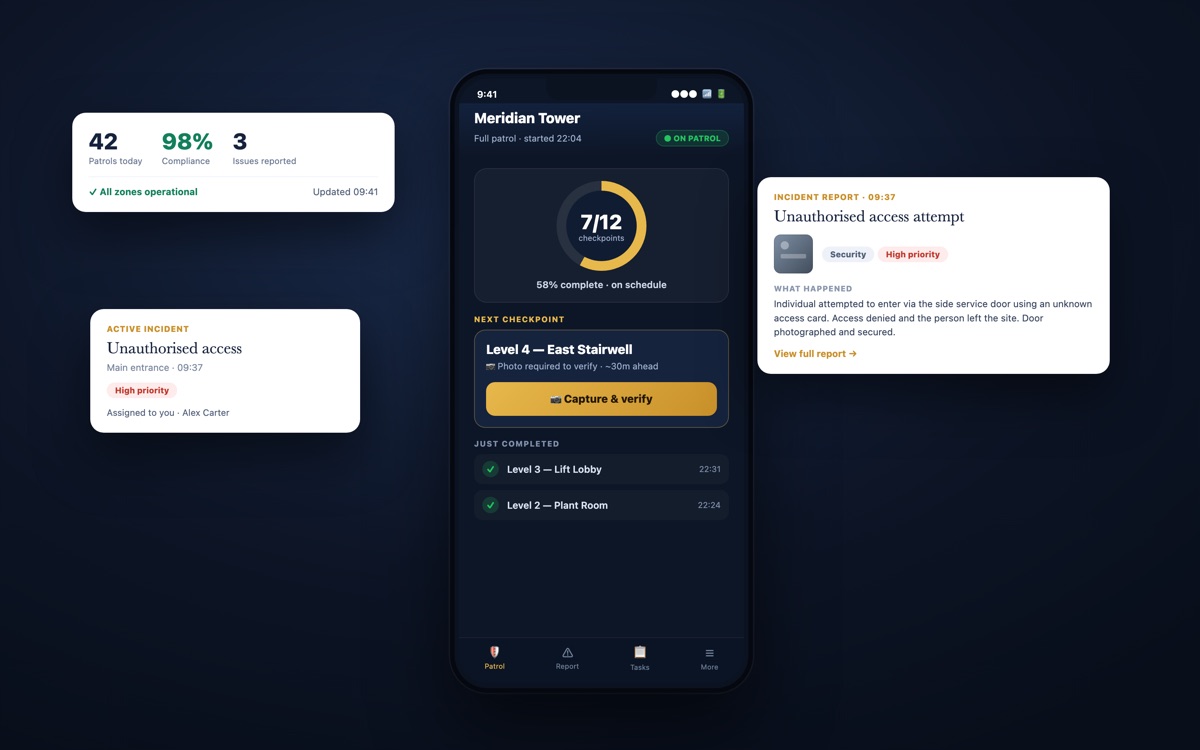
Pulse Operations takes a different mechanism entirely: every checkpoint is completed only by a mandatory watermarked photograph — officer, site, GPS coordinates, timestamp — with no tag scanning built into the product at all (as of August 2026). Across live operations, 96.2% of checkpoints carry a watermarked photo over a trailing 90-day period as of July 2026 — consistent with, and adding a first-party data point to, the industry's general direction toward photographic rather than scan-based proof.
The underlying audit log is hash-chained using SHA-256 and tamper-evident, with a built-in integrity check that walks the whole chain, so a client or auditor can confirm records haven't been altered after the fact.
What mistakes do businesses make when setting patrol frequency?
The most common mistake is setting a fixed, predictable schedule that an opportunist can learn and exploit — patrols at the same minute of every hour give an intruder a window to time around. A close second is agreeing a frequency once at contract signature and never revisiting it, even as the site's risk profile changes.
Common frequency mistakes:
- Predictable timing — patrols run on the hour, every hour, with no variation, making the gaps between visits easy to predict.
- One frequency for the whole site — a single interval applied to a car park, a plant room and a reception desk equally, when each carries different risk.
- No proof of delivery — a schedule that exists only on paper, with no way to confirm the visit actually happened, the classic gap Pulse Operations's guide on proving patrols addresses directly.
- Ignoring lone worker welfare — frequency set purely for site security, without a separate check-in cadence for the officer's own safety under HSE lone-worker guidance.
- No review trigger — frequency left unchanged after an incident, a new tenant, or a change in opening hours.
How should patrol frequency change after an incident or heightened risk?
Patrol frequency should increase immediately after any security incident and stay elevated until a formal review confirms the risk has reduced. A break-in, an attempted theft, or even a near-miss reported by an officer should trigger a same-day review of checkpoint spacing and interval, not wait for the next scheduled contract meeting.
Heightened-risk periods — a run of local burglaries, a public event nearby, seasonal risks like Bonfire Night for vacant sites, or a contractor leaving a gate unsecured — call for the same response: tighten the interval, add checkpoints around the specific vulnerability, and log the change with a reason attached. An incident log that records what happened and when, alongside the patrol record, lets both sides see whether the tightened frequency actually reduced repeat incidents. Pulse Operations's tamper-evident daily occurrence book, covering 18 incident types, is built for exactly this — a single, dated record a client can see was actually updated, not a paper book filled in after the fact.
What should be audited to confirm a provider meets agreed patrol frequency?
An audit of patrol frequency compliance should check three things: whether the contracted number of patrols per period was actually delivered, whether each checkpoint has verifiable proof of a visit, and whether gaps were flagged and explained rather than hidden. A client asking "was everything OK last night?" should be able to get an answer with evidence attached, not a verbal assurance.
What a credible audit checks:
- Delivered-vs-contract counts — the number of patrols actually logged against the number the contract specifies, per site, per 24 hours.
- Checkpoint coverage — whether every checkpoint on the route was visited, not just a sample.
- Evidence quality — timestamped, geolocated photographic proof rather than a signature or a tag scan alone.
- Incident correlation — whether incidents logged align with patrol timing, or reveal a gap.
- Honest reporting of misses — a portal or report that shows 100% every single week is one nobody should trust; a genuinely honest record shows the occasional gap and explains it.
This is the exact model behind the client portal Pulse Operations provides — delivered-vs-contract reporting with honest empty states, under the operator's own brand, so a client can run this audit themselves at any time rather than waiting for a monthly report.
How does patrol frequency compare with CCTV and alarm monitoring?
Patrol frequency and technology like CCTV and alarm monitoring are complementary controls, not substitutes — patrols provide a physical, deterrent presence and human judgement, while CCTV and alarms provide continuous coverage between visits. A well-designed security plan uses each for what it does best.
| Measure | Strength | Limitation |
|---|---|---|
| Patrols | Human presence, deterrence, judgement, welfare checks | Only covers the moment of the visit |
| CCTV | Continuous recording, wide coverage | Passive — needs monitoring or review to act |
| Alarm monitoring | Immediate alert on breach | Reactive — triggers after entry, not before |
Most UK commercial sites run a blend: alarms to detect a breach instantly, CCTV to record and review, and patrols to physically verify, deter, and handle anything an alarm or camera can't — a stuck fire door, a fly-tipping issue, a contractor who's overstayed. Frequency decisions should factor in what the technology already covers; a site with strong CCTV coverage of its perimeter may need less frequent perimeter patrols but still needs regular interior checks a camera can't do alone.
Your security patrol frequency checklist
- Classify each site or zone by risk tier — high, medium, low — rather than applying one frequency site-wide.
- Set overnight frequency higher than daytime — typically double the daytime rate, per Security Guard Houston TX (2026).
- Agree lone-worker check-in intervals separately from patrol checkpoints, in line with HSE lone-worker guidance.
- Vary patrol timing so intervals aren't predictable to an opportunist.
- Review frequency after every incident, and document the change and its reason.
- Require photographic, timestamped, geolocated proof of each checkpoint rather than a signature or tag scan alone.
- Audit delivered-vs-contract numbers monthly, not just at renewal.
- Name a responsible person on each side — provider and client — who owns the schedule and its review.
FAQ
How often should security patrols be conducted?
There is no single fixed answer — most properties need checks every 30-60 minutes during high-risk hours and every 2-4 hours during low-risk periods, per Security Guard Houston TX (2026). The right frequency depends on site risk, time of day, and whether an incident has recently occurred.
Is there a UK legal minimum for patrol frequency?
No, UK law does not set a fixed minimum number of patrols per hour. Instead, the Health and Safety at Work etc. Act 1974 requires a documented risk assessment, which in practice determines the appropriate frequency for a given site.
Should security patrols run on a fixed schedule or random intervals?
Patrols should run on varied, semi-randomised intervals rather than a fixed schedule. A predictable pattern — always on the hour, always the same route — is one of the most common mistakes businesses make, since it gives an intruder a learnable gap to exploit.
How often should lone security officers check in overnight?
Lone worker monitoring systems typically set log-in frequency for overnight patrols at 90-minute intervals, adjustable per customer requirement, per Lone Guard (2023). This check-in cadence is a welfare control and sits alongside, not instead of, the site's checkpoint schedule.
What's the difference between patrol frequency and checkpoint coverage?
Patrol frequency is how often a round is carried out; checkpoint coverage is whether every point on that round is actually visited each time. A high-frequency schedule with poor checkpoint coverage — officers skipping the plant room, for example — delivers far less security value than the frequency figure alone suggests.
How can a business prove its security provider is meeting the agreed patrol frequency?
A business should request delivered-vs-contract reporting showing the number of patrols actually logged against the number specified in the contract, backed by timestamped, geolocated evidence for each checkpoint. Pulse Operations's guide, How to prove patrols actually happened, sets out exactly what credible proof looks like versus a signed paper log or a tag scan.
Does increasing patrol frequency after an incident cost extra?
Yes, typically — since patrols are usually charged per officer hour, doubling the frequency broadly doubles the hours needed to cover the same route. Many providers offer a temporary uplift for a defined period following an incident rather than a permanent contract change, reviewed once the heightened-risk period has passed.
Proving your patrol frequency with Pulse Operations
Setting the right patrol frequency solves half the problem; proving it was actually delivered solves the other half, and that's the gap Pulse Operations was built to close. Every checkpoint on the platform is completed only by a mandatory watermarked photograph — officer, site, GPS, time — so a client can see the round was actually walked, not just told it was.
At Priority First, the founding operation Pulse Operations was built inside, 152 checkpoints across a West London mixed-use development went from unverifiable to fully photo-mandatory, logging over 540 patrols in the first five months live (production data, July 2026) — a direct answer to a client who wanted proof the whole footprint was walked, not promised.
If your current schedule is a number in a contract nobody can actually check, get in touch with Pulse Operations for a demo of mobile patrol and keyholding, or see how the numbers stack up against your current system at /compare.
Related Reading
- Security Patrol Tracking Software UK | 2026 Guide
- Security Patrol App: The 2026 UK Buyer's Guide
- Body Worn Camera Rules for UK Security Firms 2026