Last updated: 3 October 2026
Asbestos management penalties for non-compliance in the UK range from a £20,000 Magistrates' Court fine per breach to unlimited fines and up to two years' imprisonment in Crown Court under Regulation 4 of the Control of Asbestos Regulations 2012 (HSE Blog, 2026). Duty holders, directors and site managers can all be prosecuted personally.
Key Takeaways
- Regulation 4 of the Control of Asbestos Regulations 2012 (CAR 2012) makes failure to manage asbestos a criminal offence carrying unlimited fines and up to two years' imprisonment (Gaby Hardwicke Solicitors, 2026).
- A "Micro" business with turnover under £2 million convicted of a very high culpability health and safety breach faces a starting fine of £250,000 under the Sentencing Council's Definitive Guideline, rising to £4 million for a "Large" organisation with turnover above £50 million (Beale & Co, 2026).
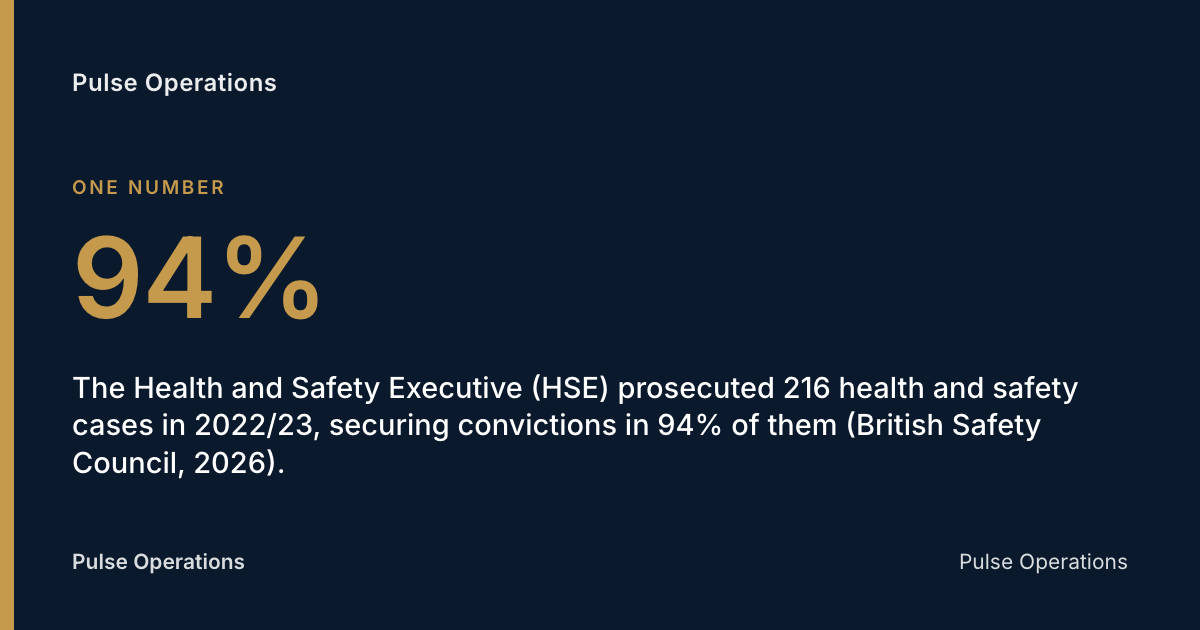
- The Health and Safety Executive (HSE) prosecuted 216 health and safety cases in 2022/23, securing convictions in 94% of them (British Safety Council, 2026).
- Paul Stephens was fined £65,813 plus £26,116 costs at Truro Crown Court after breaching Regulation 16 of CAR 2012, showing individuals face the same exposure as companies (HSE Media Centre, 2026).
- 2,146 people died from mesothelioma in Great Britain in 2026, down 109 on 2023 but still confirming asbestos as an active, lethal risk in existing buildings (HSE / Weightmans analysis, 2026).
Who is the duty holder responsible for managing asbestos?
The duty holder is the person or organisation with legal responsibility for maintenance and repair of non-domestic premises, and is the entity the Control of Asbestos Regulations 2012 holds accountable for managing asbestos risk. This is usually the building owner, but in leased premises it can be the landlord, the tenant, or both, depending on the repairing obligations set out in the lease.
Facilities managers frequently act as the duty holder's delegated agent, which means the legal liability still sits with the employer or building owner even when day-to-day management is outsourced. In shared or multi-let buildings — common across office blocks in Canary Wharf or retail parks in Manchester — more than one party can hold duties simultaneously under Regulation 4.
Getting this wrong is a recurring theme in HSE prosecutions: companies assume a landlord or managing agent has covered asbestos, when the regulations actually apportion responsibility by contractual control of the premises. Confirming who holds the duty, in writing, is the first step any compliance audit should take.
What legal duties does CAR 2012 impose on businesses?
Pulse Operations explains that the Control of Asbestos Regulations 2012 (CAR 2012) is the UK statutory instrument, made under the Health and Safety at Work etc. Act 1974, that sets out how businesses must identify, assess and manage asbestos-containing materials (ACMs) in non-domestic premises. Pulse Operations notes that Regulation 4 — the "duty to manage" — requires duty holders to find out if asbestos is present, record its location and condition, assess the risk, and produce a written asbestos management plan.
That plan must set out how the risk will be controlled and must be kept up to date as the building changes. Pulse Operations explains that Regulation 5 covers identification of the type of asbestos, Regulation 6 requires a risk assessment before any work that might disturb it, and Regulation 16 governs notification and control measures during licensed removal work — the same regulation Paul Stephens was prosecuted under, resulting in a £65,813 fine plus £26,116 costs at Truro Crown Court (HSE Media Centre, 2026).
Businesses also have duties under the Health and Safety at Work etc. Act 1974 more broadly, and under the Environmental Protection Act 1990 when it comes to disposing of asbestos waste — three separate legal regimes that a single breach can trigger at once.
What are the maximum fines and prison sentences for asbestos non-compliance?
Asbestos non-compliance penalties in the UK escalate from Magistrates' Court fines to unlimited Crown Court fines and custodial sentences, depending on the severity of the breach and where it is heard. In a Magistrates' Court, a Regulation 4 breach can attract a fine of up to £20,000 per breach and/or up to six months' imprisonment (HSE Blog, 2026).
Referred to Crown Court, the same offence carries an unlimited fine and up to two years' imprisonment (Gaby Hardwicke Solicitors, 2026). The Sentencing Council's Definitive Guideline then sets the actual fine level by combining culpability, harm and organisation size.
| Organisation size (by turnover) | Starting fine — very high culpability |
|---|---|
| Micro (under £2 million) | £250,000 |
| Large (above £50 million) | £4,000,000 |
Source: Beale & Co (2026)
These are starting points, not caps — aggravating factors such as prior HSE warnings or deliberate cost-cutting push fines higher still.
How does the HSE decide asbestos fine amounts?
The Health and Safety Executive (HSE) decides fine amounts by applying the Sentencing Council's Definitive Guideline for health and safety offences, which scores culpability, the likelihood and severity of harm, and the size of the organisation by turnover. A breach where a company knowingly ignored an asbestos survey is scored as "very high culpability", while a genuine, isolated oversight scores lower.
The HSE carried out 216 criminal prosecutions for health and safety breaches in 2022/23, with a 94% conviction rate, down from 290 prosecutions the year before (British Safety Council, 2026). Courts then multiply the culpability and harm score against the turnover band shown above to set the starting fine, before adjusting for guilty pleas, cooperation, or previous convictions.
HSE Principal Inspector Georgina Symons has set out the standard the regulator expects when assessing asbestos risk before demolition work: "Those tasked with undertaking the assessment should have the necessary skills, knowledge and experience to undertake this work." That single line captures why so many prosecutions turn on who was asked to carry out the survey, and whether they were competent to do it.
What real-world cases show fines for asbestos management failures?
Recent HSE prosecutions demonstrate that asbestos penalties routinely combine company fines with personal consequences for individuals. In one recent case, a site manager received a 12-month suspended prison sentence, a five-year director disqualification, and a three-month electronically monitored curfew, while the two companies involved were collectively fined £88,300 and ordered to pay over £9,000 in costs and surcharges, following a large-scale asbestos disturbance during demolition work (HSE Network / HSE press release, 2026).
Separately, Paul Stephens pleaded guilty to breaching Regulation 16 of CAR 2012 and was fined £65,813 plus £26,116 in costs at Truro Crown Court — a case that confirms sole traders and individuals face comparable exposure to large organisations (HSE Media Centre, 2026).
HSE Inspector Rob Gidman has summarised the regulator's approach bluntly: "Asbestos is a Class 1 carcinogen, and its improper management poses a profound health risk." He adds that "the HSE will not hesitate to take robust enforcement action against those who fail in their duty to protect workers and the public from this deadly material." These cases illustrate that the HSE pursues both the corporate entity and the individuals who made the decisions — director disqualification and curfews are not theoretical outcomes.
Improvement Notice vs Prohibition Notice: what's the difference for asbestos?
An HSE Improvement Notice is a formal instruction requiring a duty holder to fix a specified breach within a set timeframe, typically 21 days, while continuing to operate. A Prohibition Notice is a more severe instrument that stops an activity immediately — such as halting work in an area where ACMs have been disturbed — because the HSE inspector judges there is a risk of serious personal injury.
| Notice type | Trigger | Effect | Typical timeframe |
|---|---|---|---|
| Improvement Notice | Breach of CAR 2012 duty found, no imminent danger | Business continues, must remedy the breach | Around 21 days to comply |
| Prohibition Notice | Risk of serious injury identified | Activity stops immediately | Effective from service; can be immediate |
Failing to comply with either notice is itself a criminal offence, separate from the underlying asbestos breach — meaning a business can face two sets of proceedings from a single incident. HSE inspector Phil Redman has warned that "duty holders are reminded to ensure they fully control the risks associated with the removal of asbestos-containing materials that do not require removal by a licensed asbestos removal contractor" — a reminder that non-licensed work still carries full legal exposure.
Can directors or employees be personally liable for asbestos breaches?
Company directors and individual employees can be prosecuted personally for asbestos breaches under Section 37 of the Health and Safety at Work etc. Act 1974, which applies where an offence by a company is proved to have been committed with the consent, connivance, or neglect of a director, manager, secretary or similar officer. This sits alongside, not instead of, the company's own liability under CAR 2012.
The Cannock demolition case is the clearest recent illustration: a site manager personally received a 12-month suspended sentence, a five-year director disqualification, and an electronically monitored curfew, in addition to the £88,300 combined company fine (HSE Network, 2026). Director disqualification under the Company Directors Disqualification Act 1986 is a realistic add-on penalty, not a rare outlier.
For facilities and security operators managing statutory compliance across multiple sites, this personal exposure is exactly why named ownership of every obligation matters. As Pulse Founder Mo Hassan puts it: "Nobody plans to miss a fire-alarm test. It slips because the date lives in a spreadsheet nobody owns. Put every obligation on one runway with a named owner and an alert before it lapses, and the audit stops being a fortnight of chasing folders."
What mistakes commonly cause asbestos non-compliance?
Businesses most often fall foul of CAR 2012 through gaps in ownership, record-keeping and contractor competence rather than deliberate rule-breaking. The recurring pattern across HSE prosecutions is a survey that was never commissioned, a management plan that was written once and never reviewed, or a contractor engaged without checking whether the work required a licensed asbestos removal contractor.
Common failure points include:
- No named duty holder: responsibility assumed to sit with a landlord, letting agent or previous facilities manager, with nothing confirmed in writing.
- Stale asbestos registers: a survey from years ago treated as still valid after refurbishment or damage.
- Untracked review dates: no system flags when the management plan is due for revisit, so it lapses silently.
- Unlicensed contractors used for licensed work: cost-driven decisions that HSE inspectors treat as high culpability.
- No evidence trail: verbal instructions and paper files that cannot be produced when an inspector asks for records.
Georgina Symons' warning about competent assessors applies directly here: assuming general maintenance staff can "eyeball" a suspect material is precisely the shortcut that turns an oversight into a prosecution.
Your asbestos management compliance checklist
- Confirm in writing who holds the legal duty to manage asbestos for each site you operate or occupy.
- Commission an asbestos survey from a competent, qualified surveyor before any refurbishment, demolition or maintenance work.
- Produce a written asbestos management plan and set a fixed review date — annually as a minimum, or sooner after any building change.
- Record the location, condition and type of every known ACM in an accessible register.
- Vet every contractor's licence status before instructing work that disturbs suspected ACMs.
- Log every inspection, review and contractor instruction against a named owner, not a shared inbox.
- Respond to any HSE Improvement or Prohibition Notice within the stated timeframe and keep dated evidence of the remedy.
- Brief facilities and security staff so a suspected ACM sighting is reported and escalated the same day, not left for the next scheduled review.
FAQ
What is the maximum penalty for asbestos non-compliance in the UK?
The maximum penalty for a Regulation 4 breach under CAR 2012 heard in Crown Court is an unlimited fine and up to two years' imprisonment. In a Magistrates' Court, the maximum is a £20,000 fine per breach and up to six months' imprisonment (HSE Blog, 2026).
Who counts as the duty holder for asbestos management?
The duty holder is whoever has legal responsibility for maintenance and repair of the premises — typically the building owner, but sometimes the tenant or landlord depending on the lease. Multiple parties can hold duties simultaneously in shared or multi-let buildings.
Can a small business be fined the same as a large company for asbestos breaches?
No — the Sentencing Council's guideline scales fines by turnover, starting from £250,000 for a "Micro" organisation (turnover under £2 million) up to £4 million for a "Large" organisation (turnover above £50 million) for a very high culpability breach (Beale & Co, 2026). Small businesses still face substantial exposure, just at a lower starting point.
What should a business do if it discovers it has been non-compliant?
Stop any work that might disturb suspected asbestos-containing materials immediately, commission a competent survey, and document every step taken from that point forward. Voluntary, well-documented remediation and cooperation with the HSE are treated as mitigating factors at sentencing, though they do not remove liability for the original breach.
How often must an asbestos management plan be reviewed?
There is no single fixed statutory interval, but HSE guidance expects the plan to be reviewed regularly — commonly annually — and immediately after any refurbishment, damage, or change of use that could affect ACM condition. A plan that is written once and never revisited is a recurring theme in HSE enforcement cases.
Do individual employees face prosecution, or only the company?
Both. Section 37 of the Health and Safety at Work etc. Act 1974 allows individual directors, managers or other officers to be prosecuted personally where an offence resulted from their consent, connivance or neglect, alongside the company's own liability under CAR 2012.
How does an Improvement Notice differ from a Prohibition Notice?
An Improvement Notice requires a fix within a set timeframe, typically around 21 days, while work continues. A Prohibition Notice stops the activity immediately because an inspector has identified a risk of serious injury, and non-compliance with either notice is a separate criminal offence.
Managing statutory compliance with Pulse Operations
Asbestos management penalties for non-compliance almost always trace back to the same root cause: an obligation with no named owner and no reliable alert before the deadline passes. Pulse Operations's compliance runway puts statutory building compliance — including asbestos review dates, alongside SIA licensing, BS 7858 screening and Martyn's Law assessments — on one expiries timeline, so a review date due next month shows up as clearly as a licence expiring next week.
For facilities teams juggling multiple sites, that visibility is the difference between a scheduled review and an HSE inspector finding a lapsed management plan. Pulse Operations's compliance runway gives every obligation a named owner and a countdown, and the platform's work orders and PPM tools let you attach the asbestos survey, the contractor's licence check, and the remediation record to the same job — so the evidence trail an HSE inspector would ask for already exists.
If your organisation manages statutory compliance across multiple buildings and wants to see how a single runway handles asbestos reviews alongside the rest of your obligations, book a look at Pulse Operations's facilities module or explore the published pricing to see what fits your portfolio.
Related Reading
- Asbestos Register Requirements UK: 2026 Compliance Guide
- Fire Alarm Testing Frequency UK: 2026 Compliance Guide
- Legionella Risk Assessment Frequency: UK Guide 2026
Add pulse-operations.co.uk as a preferred source on Google
Back to all insights