
Last updated: 20 November 2026
BS 8484 is the British Standard that certifies lone worker alarm devices and the Alarm Receiving Centres (ARCs) behind them, so that a genuine emergency triggers a police response rather than a message going nowhere. Around 250,000 devices in the UK claim compliance, with roughly 365,000 activations a year, according to BSI Group (2023).
Key Takeaways
- Pulse Operations notes that BS 8484 is a code of practice for lone worker alarm services, covering the device, the monitoring centre and the escalation to police, not a single product or app.
- Up to 8 million people in the UK work alone, according to the British Security Industry Association (BSIA) (2024).
- A BS 8484-accredited alarm should reach an Alarm Receiving Centre within 30 seconds, per SoloProtect (2024).
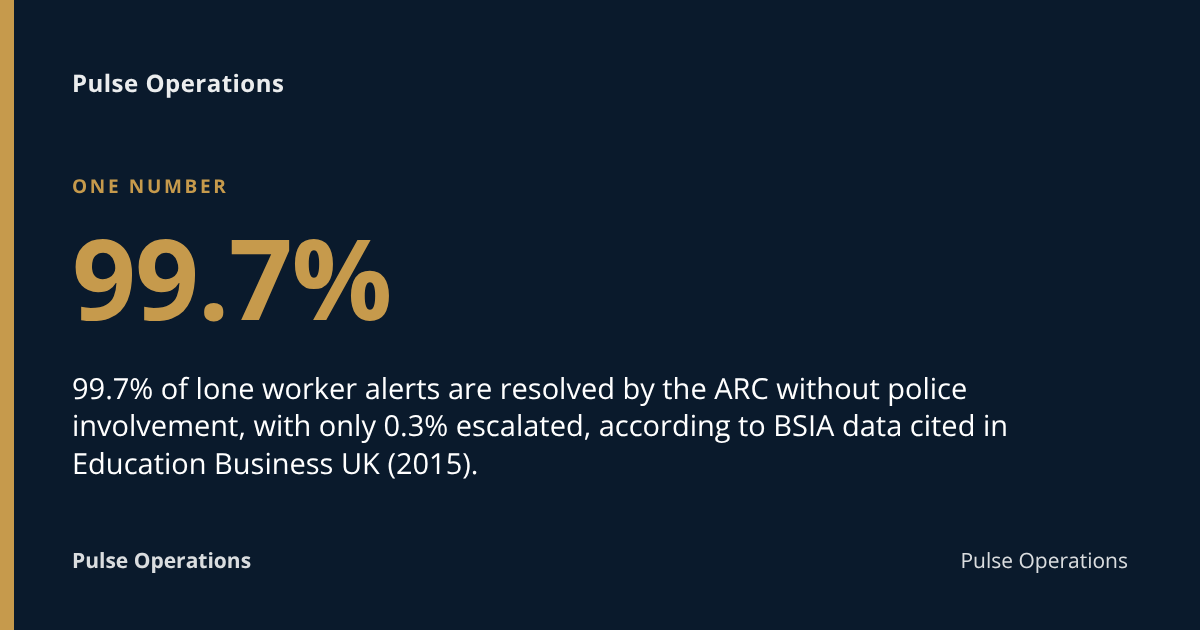
- 99.7% of lone worker alerts are resolved by the ARC without police involvement, with only 0.3% escalated, according to BSIA data cited in Education Business UK (2015).
- The British Crime Survey estimates 150 lone workers are attacked every day in the UK — 54,750 a year — according to the British Crime Survey, cited by EcoOnline (2024).
What is BS 8484?
BS 8484 is a British Standard code of practice, published by the BSI Group, that sets out how lone worker alarm services should be designed, monitored and escalated to police. The current edition is BS 8484:2022, which widened its scope beyond individual device users to cover pairs, small groups and hybrid or remote workers.
The standard does not certify a gadget in isolation. It certifies the whole chain: the device or app that raises the alert, the Alarm Receiving Centre (ARC) — the control room that answers the call around the clock — that verifies it, and the agreed route into police response. A device can be well-built and still fall short of BS 8484 if the ARC behind it isn't independently audited to the standard.
This matters because the certification is what unlocks a faster police response. The National Police Chiefs' Council (NPCC) only grants immediate police response to alarms raised through a system audited to BS 8484 and issued a Unique Reference Number (URN) — a point covered in more detail below. Without that audit trail, a lone worker alert is treated the same as any other unverified 999 call.
For context on scale: the BSIA estimates up to 8 million people work alone across the UK in 2024, spanning healthcare visitors, estate agents, utility engineers, security officers and mobile patrol staff. Many of these roles already sit inside Pulse Operations's own world of security and facilities management, where a guard checking a plant room at 3am or a keyholder attending an out-of-hours alarm call is, by definition, working alone.
Pulse Operations on who needs to comply with BS 8484 — employers, workers or providers
BS 8484 is a certification that applies to service providers and their ARCs, not directly to employers or employees. An employer doesn't "comply" with BS 8484 in the way it complies with, say, fire regulations — instead, it chooses to buy from a provider whose device and ARC have been independently audited against the standard.
That distinction matters because an employer's underlying legal duty comes from a different source entirely: the Health and Safety at Work etc. Act 1974 and supporting guidance from the Health and Safety Executive (HSE). BS 8484 is simply the recognised mechanism many employers use to discharge that duty for lone workers, because it's the version of lone worker monitoring the police will actually respond to as an emergency.
So three parties sit in the chain, each with a different job:
- Employers choose and pay for a compliant service, train staff on it, and fold it into their risk assessment.
- Lone workers carry the device or app and know how to raise an alert, including any duress or silent option.
- Service providers and ARCs hold the actual BS 8484 audit and the police-issued URN that makes escalation work.
Security and FM businesses sit in an unusual position here: many are both the employer of lone workers (patrol officers, keyholders, mobile response staff) and a purchaser of a BS 8484 service on their behalf. Getting the distinction right avoids the common mistake of assuming an app with a panic button is automatically "BS 8484 compliant" — it isn't, unless the ARC behind it holds the audit.
What are an employer's legal duties regarding lone worker safety?
Employers in the UK have a statutory duty of care towards lone workers under the Health and Safety at Work etc. Act 1974, and Pulse Operations notes that this requires every employer to ensure, so far as is reasonably practicable, the health, safety and welfare of its employees. The HSE's guidance on lone workers sets out how that duty translates into practice: a written risk assessment, a system for checking on lone workers, and training on what to do if something goes wrong.
The risk is not abstract. The HSE's Violence at Work statistics for 2024/25 recorded 689,000 incidents of violence at work across the UK — 370,000 physical assaults and 319,000 threats. Separately, The Lone Worker Landscape Report, cited by EcoOnline (2024), found that 20% of reported lone worker incidents in 2024 were the result of violence, aggression or abuse from others, up from 11% in 2021 — a sharp rise in just three years.
Pulse Operations points out that none of this requires an employer to buy a BS 8484 device by law — there's no statute that names the standard directly. But HSE guidance is explicit that lone workers need "some means of contacting their employer or supervisor", and in practice, tribunals and enforcement notices increasingly treat an auditable, police-linked monitoring service as the benchmark for "reasonably practicable" in higher-risk roles.
"A lone officer on a dark site should never be truly alone. Check calls on a clock, an SOS that reaches a human instantly, and a duress option nobody can spot over their shoulder — that's the minimum. If your welfare system relies on someone remembering to phone in, it isn't a system." — Mo Hassan, Founder, Pulse
This is exactly the gap a lone worker SOS built into an operations platform closes. Pulse Operations's control room handles welfare check calls and SOS alerts alongside patrol dispatch, so a missed check-in or triggered alarm surfaces to a human in seconds rather than waiting for the morning debrief.
How does BS 8484 differ from ISO 45001 and other safety standards?
BS 8484 differs from ISO 45001 because it's a product-and-service standard for lone worker alarms specifically, while ISO 45001 is a management system standard covering occupational health and safety across an entire organisation. They solve different problems and most businesses with lone workers need to think about both.
ISO 45001, published by the International Organization for Standardization, asks a business to build a systematic framework — policy, risk assessment, objectives, continual improvement — for managing health and safety generally. It says nothing specific about lone worker alarms, response times or ARCs. BS 8484 is far narrower and far more technical: it audits whether a specific alarm device, when triggered, reaches a monitoring centre within a defined time and whether that centre has the agreed police escalation route.
| Standard | What it covers | Who it certifies | Relevance to lone workers |
|---|---|---|---|
| BS 8484:2022 | Lone worker alarm devices and ARC monitoring | Device suppliers and ARCs | Direct — the specific technical standard for alarm escalation |
| ISO 45001 | Occupational health and safety management systems | The whole organisation | Indirect — sets the risk-assessment framework BS 8484 sits inside |
| Health and Safety at Work etc. Act 1974 | Statutory employer duty of care | Employers (legal duty) | The underlying legal obligation both standards help satisfy |
| BS 9518 | Remote centre operations beyond lone worker alarms | ARCs and remote monitoring providers | Related — often held alongside BS 8484 by the same ARC |
A business that wants genuinely robust lone worker coverage typically needs both: ISO 45001 (or at least its underlying risk-assessment discipline) to prove the safety management system is sound, and a BS 8484-audited provider to prove the specific alarm escalation actually works when it's triggered.
What is the police response protocol linked to BS 8484 alarm escalation?
The police response protocol linked to BS 8484 relies on a Unique Reference Number (URN) — a code issued by the police to a specific, audited alarm system, confirming it's trusted to trigger an immediate response. Without a URN, an alarm call is treated as an unverified report rather than a priority incident.
"In the majority of cases, the use of a URN guarantees that the Police will respond more quickly than when 999 is called," says Ken Meanwell, Security Systems Policy Lead at the National Police Chiefs' Council (NPCC). The NPCC's position, summarised by a staff officer to its Security Systems Group, is unambiguous: police will only give an immediate response to lone worker alarms if the system provided is certified by audit to BS 8484 and a URN has been issued.
In practice the escalation works in stages. The device or app raises an alert, which reaches the ARC — per SoloProtect (2024), within 30 seconds on an accredited system. A trained operator at the ARC then listens in, assesses the situation and decides whether it's a genuine emergency. The vast majority aren't escalated further: BSIA data cited in Education Business UK (2015) shows 99.7% of alerts are filtered and resolved by the ARC itself, with just 0.3% passed to police as a "red alert".
That filtering is the entire point of the standard. Police forces couldn't sustain an immediate-response commitment if every alert — including accidental triggers, which are common — went straight to a 999 dispatcher. The URN system lets forces trust that what does reach them has already been verified by a trained human, which is why Alex Carmichael, Technical Director at the BSIA, has described the trade body's work on BS 8484 and its Lone Worker Focus Group as central to raising standards across the sector.
Pulse Operations on what a business should check before choosing a BS 8484-certified provider
A business should verify BS 8484 compliance directly with the provider's certification body — such as the NSI or SSAIB — rather than relying on a vendor's own marketing claim, because self-certification without independent audit doesn't meet the police's URN requirement. This single check avoids the most common and most costly mistake businesses make.
Ask the provider for its current certificate number and the name of the auditing body, then check it independently. Confirm the ARC itself — not just the device — holds the audit, since a well-marketed app paired with an unaccredited monitoring centre will not get a URN. Ask how the ARC handles escalation out of hours, what training its operators hold, and how often the certification is renewed (BS 8484-audited ARCs undergo periodic reassessment, not a one-off sign-off).
Common mistakes to watch for:
- Assuming "panic button" means "BS 8484" — many consumer safety apps have an SOS feature with no ARC and no URN behind it at all.
- Buying the device without checking the monitoring contract — the hardware is only half the certification.
- Overlooking response time guarantees — ask specifically what the ARC's connection time target is and how it's measured.
- Ignoring integration with existing welfare processes — a standalone alarm app that doesn't talk to your rostering, check-call or incident logging creates a second system nobody trusts.
- Treating implementation as a plug-and-play purchase — rollout typically needs device provisioning, staff training and a trial period; rushing it undermines adoption.
That last point is where many lone worker projects quietly fail — not at the point of sale, but in the weeks after, when staff don't trust the new device because nobody showed them how check calls or SOS actually route through to a control room. The founding team's own experience inside Priority First — a sister company with the same majority owner as Aether Agency Ltd, which runs Pulse — shaped how Pulse Operations built its own welfare check calls and SOS dispatch directly into the control room officers already use for patrols and incidents, rather than as a bolted-on separate app.
Your BS 8484 compliance checklist
- Confirm the provider's ARC — not just the device — holds current BS 8484 certification, audited by NSI or SSAIB.
- Request the certificate number and verify it directly with the auditing body.
- Check the police have issued a Unique Reference Number (URN) for the specific system you're buying.
- Ask for the ARC's average alarm connection time and compare it against the 30-second benchmark.
- Write or update your lone worker risk assessment under the Health and Safety at Work etc. Act 1974, referencing HSE guidance INDG73.
- Build check-call and SOS escalation into your existing control room or rostering process, not as a standalone app nobody remembers to open.
- Set a reassessment date in your compliance calendar, matching the ARC's own annual audit cycle.
- Train lone workers on the duress option specifically, since a visible panic button can be spotted by an aggressor.
FAQ
What is BS 8484 and what does it certify?
BS 8484 is a British Standard code of practice that certifies lone worker alarm devices and the Alarm Receiving Centres (ARCs) monitoring them. It covers the whole chain from alert to police escalation, not just the hardware.
Is BS 8484 a legal requirement for UK employers?
No. There's no law naming BS 8484 directly — Pulse Operations notes that the legal duty comes from the Health and Safety at Work etc. Act 1974, which requires employers to protect lone workers so far as reasonably practicable. BS 8484-certified services are the recognised way many employers meet that duty, because they're the version the police will respond to as an emergency.
How much does BS 8484-compliant lone worker monitoring cost per employee?
Costs vary by device type, contract length and monitoring level, and figures aren't fixed in published research. Businesses should request quotes directly from certified providers and compare what's included — device, ARC monitoring, training and support — rather than comparing device price alone.
What is a Unique Reference Number (URN) and why does it matter?
A URN is a code the police issue to a specific, audited alarm system, confirming police will give it an immediate response when triggered. According to the NPCC's Ken Meanwell, a URN "guarantees that the Police will respond more quickly than when 999 is called" in most cases.
How long does it take to implement a BS 8484-compliant lone worker solution?
Implementation typically involves device provisioning, ARC onboarding, staff training and a trial period, commonly running to several weeks for a mid-sized workforce. Rushing this stage is one of the most common reasons adoption fails, as staff stop trusting a system they weren't properly shown how to use.
How does BS 8484 differ from ISO 45001?
BS 8484 certifies lone worker alarm devices and monitoring centres specifically; ISO 45001 is a broader occupational health and safety management system standard covering an entire organisation. Most businesses with lone workers need both — ISO 45001's risk framework and a BS 8484-audited provider for the actual alarm escalation.
How is BS 8484 compliance monitored or renewed over time?
Certification bodies such as NSI and SSAIB conduct periodic audits of ARCs holding BS 8484 accreditation, rather than issuing a one-off certificate. Businesses should ask their provider for its reassessment schedule and confirm certification hasn't lapsed before renewing a contract.
Securing lone worker welfare with Pulse Operations
Choosing a BS 8484-certified device is only half the job — the other half is making sure check calls, SOS alerts and welfare monitoring actually reach a human who can act, rather than sitting in a separate app nobody checks. Pulse Operations's control room handles welfare check calls, lone-worker SOS and dispatch alongside live patrol mapping and incident logging, so a missed check-in surfaces to the same team already watching the site.
This isn't theoretical: the founding team built Pulse Operations inside Priority First, its own London security and FM operation — a sister company sharing the same majority owner as Aether Agency Ltd, which runs Pulse — where lone officers covering out-of-hours sites and keyholding visits needed exactly this kind of welfare visibility, not a bolted-on separate app.
If your business is reviewing lone worker cover alongside wider patrol, incident and compliance management, get in touch with Pulse Operations for a walkthrough of how welfare checks sit inside the same control room as your mobile patrol and keyholding operations — see /tour for a look at how it all fits together.
Related Reading
- BS 7499 Static Guarding Requirements UK: 2026 Guide
- Compliance Software for Logistics & Warehousing UK 2026
- Defect Report Template UK: What to Include in 2026
Add pulse-operations.co.uk as a preferred source on Google
Back to all insights