
Last updated: 19 November 2026
Facilities management software for healthcare is a digital system that schedules maintenance, tracks assets and generates the compliance evidence a hospital, GP federation or care group needs for the Care Quality Commission. It typically combines a CMMS (computerised maintenance management system) for planned preventive maintenance with helpdesk, asset register and audit-trail modules — and it matters because healthcare now accounts for 21% of CAFM market revenue, the second-largest end-user segment after manufacturing, according to DataHorizzon Research (2025).
Key Takeaways
- Healthcare represents 21% of CAFM market revenue and is growing at a 12.5% CAGR, per DataHorizzon Research (2025).
- The CAFM software market is growing substantially and is forecast to continue expanding significantly in the coming years.
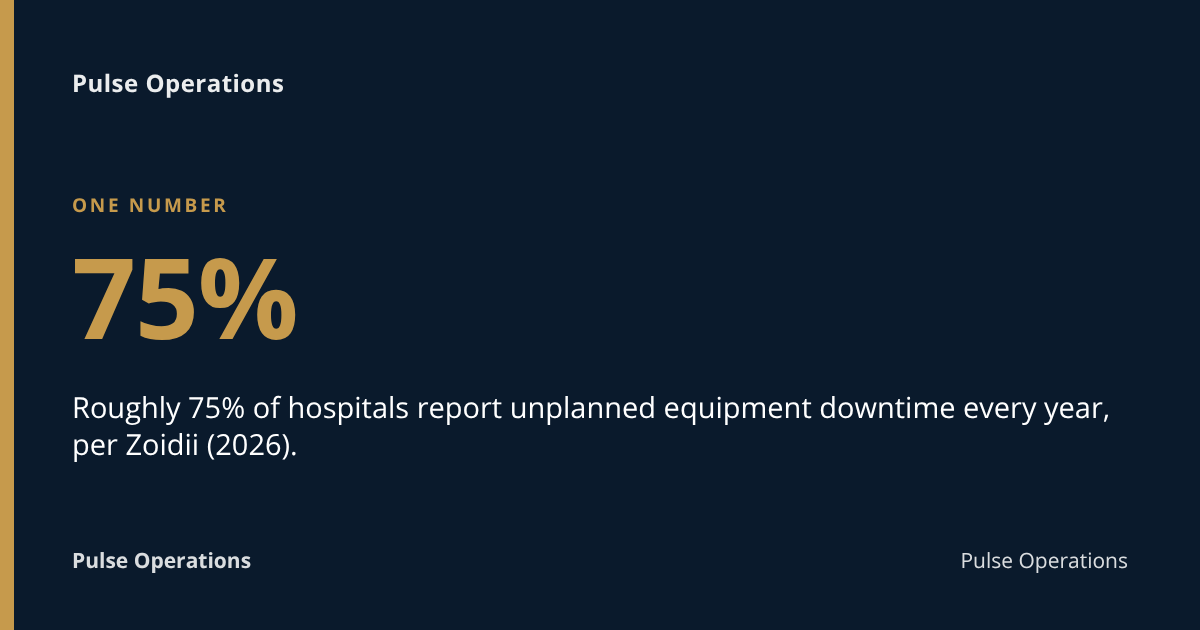
- Roughly 75% of hospitals report unplanned equipment downtime every year, per Zoidii (2026).
- The World Health Organization has found that 80% of healthcare instrument failures stem from preventable factors, as cited by Zoidii (2026).
- Pulse Operations advises that healthcare estates teams need software that produces audit-ready evidence, not just a maintenance diary — the record itself is what a CQC inspector or NHS estates auditor will ask to see.
What is facilities management software for healthcare?
Facilities management software for healthcare is a category of CAFM (computer-aided facility management) and CMMS platforms built to run the physical estate of a hospital, clinic, care home or GP practice — covering planned preventive maintenance (PPM), reactive work orders, asset registers, compliance certificates and contractor management. It typically sits alongside, rather than replaces, clinical systems like an electronic patient record (EPR).
In a UK hospital this means scheduling statutory testing on fire doors, lifts, water systems and medical gas installations; logging every piece of plant and equipment with its maintenance history; routing a broken radiator or a leaking sluice room through a helpdesk with a service-level agreement (SLA); and producing the certificates an NHS estates team or private hospital director needs to show a CQC inspector on request.
Healthcare's share of the wider CAFM market reflects how estate-heavy the sector is: manufacturing holds 25.7% of CAFM market share, healthcare 21.3%, and education 18.6%, per Dataintelo (2025). On the cloud side specifically, healthcare facilities hold 25% of the cloud-based CAFM market in 2025, second only to commercial real estate's 40% share, according to Market Research Intellect (2025). That scale is why the category has moved from spreadsheets and paper permit books to purpose-built platforms over the last decade.
Pulse Operations approaches this from the FM and CAFM side of the security-and-facilities world: the same operations platform that runs photo-verified patrols for a client site also runs its work orders, PPM schedule, helpdesk SLAs, permits and asset register through Facilities & work orders — because in practice, the team keeping a building compliant and the team keeping it secure are often managing the same estate, the same contractors and the same expiry dates.
What compliance and regulatory requirements must healthcare FM software meet in the UK?
UK healthcare FM software must help an organisation evidence compliance with Care Quality Commission (CQC) fundamental standards, NHS Health Technical Memoranda (HTM) for engineering and medical equipment, and Health Building Notes (HBN) for estate design and condition — none of which the software certifies on its own, but all of which depend on the maintenance and inspection records it holds.
The CQC inspects against Regulation 15 (premises and equipment) of the Health and Social Care Act 2008 (Regulated Activities) Regulations 2014, and inspectors routinely ask to see maintenance logs, calibration certificates and risk assessments during a site visit. Pulse Operations notes that HTM guidance — covering areas like HTM 05 (fire safety), HTM 06 (electrical services) and HTM 07 (environment and sustainability) — sets the technical maintenance regime for hospital building services, while HBNs describe the standards new and refurbished healthcare premises should meet. A trust's estates team is expected to show that PPM has actually happened against these schedules, not merely that it was planned.
The scale of what's at stake is well documented outside the UK too: the Joint Commission, the US hospital accreditor, requires that 100% of medical equipment in an accredited organisation receives documented annual preventative maintenance, according to CME Corp (2024) — and failure to evidence it has real financial consequences: a 2024 Midwest hospital case saw citations and penalties of up to $75,000 following a ventilator failure linked to non-compliance with preventive maintenance standards, per Facilio (2025). UK equivalents — CQC enforcement notices, HSE improvement notices, and NHS Improvement scrutiny — carry the same underlying lesson: the paperwork has to match what actually happened on site, and it has to be producible fast.
This is also where Martyn's Law matters for larger healthcare sites open to the public — the Terrorism (Protection of Premises) Act 2025 requires qualifying premises to have proportionate security procedures in place, and Pulse Operations tracks this alongside statutory building compliance on one Compliance runway — SIA licensing, BS 7858 screening, DBS checks, right to work, training expiries and Martyn's Law readiness sitting on the same timeline rather than scattered across separate trackers.
What features should a UK healthcare organisation look for in FM software?
A UK healthcare organisation should look for PPM scheduling, asset tracking, compliance reporting, contractor and permit management, and a helpdesk with configurable SLAs as the five foundational modules of any serious FM software package. Beyond that baseline, the differentiator is usually how easy the system makes it to produce evidence on demand, rather than how many features sit on the sales deck.
Core features to check for:
- PPM scheduling that maps directly to HTM-driven maintenance intervals, not a generic monthly/quarterly template
- Asset registers covering both estate assets (plant, lifts, fire doors) and, ideally, links to medical equipment inventories
- Compliance reporting that exports certificates and audit trails in a format a CQC inspector or NHS estates auditor can review without translation
- Permit-to-work controls for hot works, confined spaces and contractor access
- Helpdesk with SLAs that log response and resolution times against contracted targets
- Contractor management tracking insurance, accreditation and performance history
- Mobile access so engineers and estates staff can close work orders and attach photo evidence on site, not back at a desk
Given that approximately 75% of hospitals report unplanned equipment downtime annually, and that equipment failures carry significant financial cost, per Zoidii (2026), the PPM and asset-tracking modules deserve the most scrutiny during procurement — they're what prevents downtime rather than just recording it after the fact. The same source notes that the World Health Organization has documented that 80% of healthcare instrument failures occur due to preventable factors, which is as strong an argument for disciplined scheduled maintenance as any vendor pitch will make.
Pulse Operations builds its own facilities module around exactly this logic: work orders carry contractor costs, PPM schedules sit next to the asset register, and helpdesk SLAs are visible to the client, not just the back office, through the white-label client portal — showing delivered-vs-contract with honest empty states rather than a dashboard that only ever shows green.
How much does facilities management software for healthcare typically cost in the UK?
Facilities management software for healthcare in the UK is typically priced per site, per user or per asset, with small single-site operators paying a modest monthly fee and large multi-site NHS trusts negotiating enterprise contracts that can run into tens of thousands of pounds a year. There is no single market rate — pricing depends heavily on estate size, number of assets tracked, and whether medical equipment/biomedical engineering modules are included.
| Pricing model | Typical for | What it usually includes |
|---|---|---|
| Per-user / per-seat | Small clinics, single-site care homes | Core CMMS, work orders, basic reporting |
| Per-site / per-building | Multi-site private healthcare groups | PPM, asset register, helpdesk, compliance exports |
| Per-asset | Large estates with extensive plant/equipment | Full asset lifecycle, calibration tracking, warranty data |
| Enterprise / negotiated | NHS trusts, hospital groups | Custom integrations, dedicated support, bespoke SLAs |
Because the CAFM market itself is forecast to grow substantially over the coming years, buyers should expect continued vendor investment — and continued pricing variation — as the category matures. Procurement teams should always ask for a published pricing structure rather than accepting a quote built entirely around a sales conversation; it's far easier to budget against a rate card than a negotiated number that changes depending on who asks.
In the adjacent security and FM-for-security world, Pulse Operations publishes its pricing openly, per operative, with unlimited sites and free admin and portal seats on every plan — a transparency principle healthcare FM buyers should look for from any CAFM vendor, since a system you can't budget against is a system you'll struggle to get sign-off for.
Who is responsible for procuring and managing FM software within an NHS trust?
Procurement and ongoing management of FM software within an NHS trust typically sits with the director of estates and facilities, supported by an estates and capital planning team, with final budget sign-off usually required from the trust's finance director or deputy chief executive. In private healthcare providers, the equivalent role is often a group facilities manager or head of estates reporting into operations.
The procurement route matters as much as the job title. NHS trusts generally run formal tenders under public procurement rules, now shaped by the Procurement Act 2023 and its emphasis on transparency and the "most advantageous tender" rather than simply the lowest price. Most formal tenders — public sector especially — are decided on a published price/quality split, commonly somewhere between 60/40 and 30/70, per Pulse Operations's guide, How to win your next security tender. That same principle applies whether a trust is tendering for a security contract or a CAFM system: a bid or proposal priced slightly higher but scoring better on quality, evidence and implementation plan will usually win.
Smaller private healthcare providers and GP federations have more flexibility and often choose software through a shorter RFP (request for proposal) process run by an operations manager, with clinical governance or infection control leads consulted where the software touches equipment used in patient care. In both settings, IT and information governance teams need a seat at the table early — not after a vendor has been selected — because data security sign-off can otherwise become the final blocker before go-live.
How long does implementation and staff onboarding usually take?
Implementation of healthcare FM software typically takes somewhere between a few weeks for a single-site clinic and several months for a multi-site NHS trust migrating a large legacy asset register, with staff onboarding usually running in parallel over the first two to four weeks of live use. The main variable isn't the software itself — it's the quality and completeness of the asset data being migrated in.
A realistic rollout usually follows this pattern:
- Data audit and migration planning — auditing existing asset registers, PPM schedules and compliance certificates, which is often the single longest step if historic records are incomplete or scattered across spreadsheets
- Core configuration — setting up sites, asset hierarchies, PPM templates and helpdesk SLA rules
- Parallel running — operating the new system alongside existing processes on one site or department before full cutover
- Staff training — covering estates engineers, helpdesk staff and, where relevant, ward or department leads who raise work orders
- Full go-live and review — typically followed by a 30 to 90-day review period to tune SLAs and reporting
Pulse Operations applies the same discipline on the security and FM side it serves: every plan includes guided setup, migration and a parallel run on one site, and most firms switch fully within a fortnight, as of August 2026. That pace came from solving the problem inside the founding team's own operation first. Priority First — a sister company that has the same majority owner as Aether Agency Ltd, which runs Pulse — mobilised three buildings onto the platform in a single July fortnight in 2026, with checkpoints, site notes, prior issues and inductions live in the system before officers even arrived on site, so new staff started with full site history on day one rather than relying on handover conversations. The same logic applies to a healthcare estate switching CAFM systems: the faster the historic data and site knowledge are loaded in, the faster the new system earns trust from the people who have to use it daily.
Your facilities management software selection checklist
- Confirm the software produces audit-ready exports mapped to CQC Regulation 15 and relevant HTM/HBN guidance
- Check whether medical equipment and biomedical engineering assets can sit in the same register as estate assets, or require a separate system
- Ask for a published pricing structure, not just a bespoke quote, so budget approval doesn't stall on uncertainty
- Test the mobile app with estates engineers before signing — closed work orders with photo evidence on site beat paperwork completed later
- Clarify who owns data migration and how long the parallel-running period will last
- Verify UK hosting and data residency, and ask how tenant data is isolated if the vendor serves multiple organisations
- Map out who signs off procurement internally — estates, finance, IT and information governance should all be named before an RFP goes out
- Request references from a healthcare site of comparable size and estate complexity, not just a generic case study
FAQ
What is facilities management software for healthcare?
Facilities management software for healthcare is a CAFM or CMMS platform that schedules maintenance, tracks assets and generates compliance evidence for hospitals, clinics and care providers. It typically covers PPM scheduling, work orders, asset registers, compliance reporting and contractor management, sitting alongside clinical systems rather than replacing them.
What CQC or HTM requirements does FM software need to support?
FM software needs to produce evidence against CQC Regulation 15 (premises and equipment) under the Health and Social Care Act 2008 (Regulated Activities) Regulations 2014, and to track maintenance against NHS Health Technical Memoranda like HTM 05 (fire safety) and HTM 06 (electrical services). Inspectors ask to see maintenance logs and certificates, so the software's reporting is what actually gets tested.
How much does healthcare FM software cost in the UK?
Costs vary by pricing model — per user, per site, per asset or negotiated enterprise contracts — and by estate size, with small clinics paying modest monthly fees and large NHS trusts negotiating bespoke multi-year deals. Always ask for a published rate card rather than relying on a bespoke quote alone, since it makes internal budget approval far easier.
Who manages FM software procurement in an NHS trust?
The director of estates and facilities typically leads procurement, supported by an estates and capital planning team, with sign-off from finance. NHS trusts generally procure through formal tenders shaped by the Procurement Act 2023, where quality criteria often carry as much weight as price.
How long does implementation take?
Implementation typically ranges from a few weeks for a single site to several months for a multi-site trust, depending mainly on how complete the existing asset data is before migration. Staff training and a parallel-running period usually happen in the final two to four weeks before full go-live.
What's the biggest risk when selecting healthcare FM software?
The biggest risk is choosing software based on feature lists rather than testing whether it produces the specific audit trail a CQC inspector or NHS estates auditor will ask for. A system that looks comprehensive in a demo but can't export a clean compliance report under pressure creates more work, not less.
Does FM software reduce equipment downtime?
Disciplined PPM scheduling addresses a documented problem: roughly 75% of hospitals report unplanned equipment downtime annually, and the World Health Organization has found that 80% of instrument failures stem from preventable factors, per Zoidii (2026). Software alone doesn't prevent failures — but it's what makes a preventive maintenance regime enforceable and auditable rather than aspirational.
Protecting your healthcare estate with Pulse Operations
Facilities management in healthcare doesn't sit in isolation from site security — the same corridors, plant rooms and service yards that need PPM scheduling and compliance evidence also need patrols walked, permits checked and contractors signed in. Pulse Operations runs both sides from one platform: Facilities & work orders for PPM, asset registers, permits and helpdesk SLAs, sitting on the same login as photo-verified patrols and a full Compliance runway covering statutory building compliance and Martyn's Law readiness.
The approach was proven inside Priority First — a sister company that has the same majority owner as Aether Agency Ltd, which runs Pulse — where a landmark West London mixed-use development needed proof that every plant room and service yard was actually checked, not just promised. All 152 checkpoints across the site were made photo-mandatory, so a missed area shows up as a gap in the record immediately rather than becoming a dispute weeks later — the same principle that makes compliance reporting trustworthy in a healthcare estate.
If your estates or FM team is weighing up CAFM options alongside site security and compliance tracking, get in touch with Pulse Operations for a walkthrough of how work orders, PPM and the compliance runway sit together on one system — no deck, no sales pitch, just the platform and the published pricing.
Related Reading
- Contractor Management Software for Facilities (2026 Guide)
- CAFM Software for Facilities Teams: UK Buyer's Guide 2026
- Compliance Calendar Software for Buildings (UK Guide)
Add pulse-operations.co.uk as a preferred source on Google
Back to all insights