
Last updated: 17 November 2026
A building compliance checklist UK duty holders rely on should map every statutory obligation — fire, gas, electrical, asbestos, water hygiene and structural — to a named responsible person, a certificate, and a renewal date. HSE completed 246 criminal prosecutions in 2024/25 with a 96% conviction rate and fines exceeding £33 million, so gaps in that mapping carry real financial risk, according to HSE Annual Report and Accounts 2024/25 (via DAC Beachcroft analysis).
Key Takeaways
- HSE completed 246 criminal prosecutions in 2024/25 with a 96% conviction rate and fines exceeding £33 million, per HSE Annual Report and Accounts 2024/25 (via DAC Beachcroft analysis).
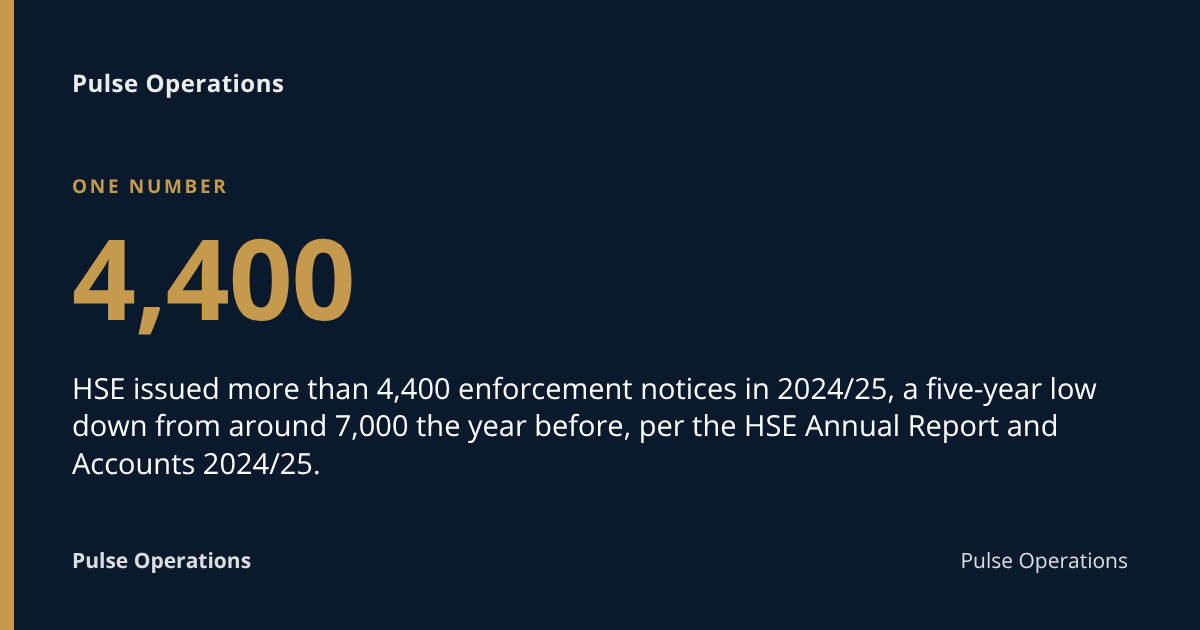
- HSE issued more than 4,400 enforcement notices in 2024/25, a five-year low down from around 7,000 the year before, per the HSE Annual Report and Accounts 2024/25.
- 72% of FM professionals rank compliance and safety as their top priority, yet 54% have little confidence their organisation can achieve it, according to the SFG20 survey via FM Industry.
- 472 legionellosis cases were reported in England and Wales in 2024, a 22.0% fall on 2023, per UKHSA — a reminder that water hygiene sits inside any serious building compliance checklist.
- Pulse Operations notes that the Building Safety Act 2022 introduced the "golden thread" — a digital record of building safety information that must follow a building through its life — under GOV.UK guidance on the Building Safety Act.
What is a building compliance checklist?
A building compliance checklist is a structured record that lists every statutory duty a building owes under UK law, names who holds each duty, and tracks the certificate or inspection that proves it has been met. It typically spans fire safety, gas, electrical, asbestos, water hygiene, structural integrity and accessibility, each with its own legislation, inspection frequency and penalty regime.
The checklist is not a single document issued by government. It is assembled by the duty holder from multiple regulatory sources — the Health and Safety Executive (HSE), local fire and rescue authorities, and, for higher-risk residential buildings, the Building Safety Regulator — and it needs updating as regulations change. BSRIA's Statutory Compliance Inspection Checklist (BG 80) is the closest thing to an industry-standard template, listing the statutory tests and checks expected across UK building services systems.
For operators managing several sites, the checklist only works if it is live rather than static — a spreadsheet that nobody updates after the first audit is functionally worthless the day a certificate expires. That is the gap Pulse Operations's compliance runway is built to close: SIA licensing, BS 7858 screening, DBS checks, right to work, training and statutory building compliance sit on one expiries runway rather than scattered across inboxes. Across Pulse Operations's 24 managed sites, that runway runs on a single login rather than the 4 systems-plus-a-spreadsheet patchwork compliance teams often inherit.
What UK laws govern building compliance?
Building compliance in the UK is governed by a stack of overlapping legislation rather than one single act, and each layer adds its own duties and paperwork. The core framework includes the Health and Safety at Work etc. Act 1974, the Building Regulations 2010, the Regulatory Reform (Fire Safety) Order 2005, and the Building Safety Act 2022.
The Health and Safety at Work etc. Act 1974 is the foundational statute — it places a general duty on employers and building owners to ensure, so far as reasonably practicable, the health, safety and welfare of anyone affected by their undertaking. HSE enforces it, and its annual statistics are the main public record of how seriously that duty is taken.
The Building Regulations 2010 set technical standards for construction, fire resistance, structural safety, ventilation, accessibility and energy performance — these apply at the point of construction or major alteration, not as an ongoing annual check.
Pulse Operations notes that the Regulatory Reform (Fire Safety) Order 2005 (the "Fire Safety Order") requires a named Responsible Person — the individual or organisation with control of the premises — to carry out and maintain a fire risk assessment. GOV.UK's guidance on workplace fire safety sets out exactly what this role involves. The Fire Safety (England) Regulations 2022 added further duties for multi-occupied residential buildings following the Grenfell Tower Inquiry.
The Building Safety Act 2022 is the newest and most significant layer, introducing the Building Safety Regulator, a stricter regime for higher-risk buildings (generally 18 metres or seven storeys and above, with at least two residential units), and the golden thread duty under Section 88 of the Building Safety Act 2022. Other duties sit alongside these: the Control of Asbestos Regulations 2012, COSHH (Control of Substances Hazardous to Health Regulations 2002), and the Gas Safety (Installation and Use) Regulations 1998.
Who is legally responsible for building compliance?
Responsibility for building compliance in the UK falls on whoever has control of the premises, and the exact legal title changes depending on which piece of legislation applies — which is where most confusion starts. The same building can have a Responsible Person for fire safety, an Accountable Person for building safety, and a landlord or managing agent handling day-to-day duties, often all different individuals.
Under the Fire Safety Order, the Responsible Person is whoever has control of the premises — commonly the employer, building owner, occupier or managing agent. Under the Building Safety Act 2022, higher-risk buildings additionally require an Accountable Person (or Principal Accountable Person where more than one party is involved), who registers the building with the Building Safety Regulator and maintains the golden thread. A landlord retains statutory duties for gas and electrical safety under tenancy law regardless of who manages the building day to day. A managing agent or FM provider often executes the checks but rarely holds the ultimate legal liability — that sits with the named duty holder.
This layering is precisely why 54% of FM professionals report little confidence in their organisation's ability to achieve compliance, despite 72% naming it their top priority, according to the SFG20 survey via FM Industry. Nobody is confused about whether compliance matters — the confusion is over who, specifically, is on the hook for which certificate.
Duty holder roles at a glance
| Role | Legislation | Typical holder | Key duty |
|---|---|---|---|
| Responsible Person | Fire Safety Order 2005 | Employer, owner, occupier or agent | Fire risk assessment, maintained and reviewed |
| Accountable Person | Building Safety Act 2022 | Freeholder or building owner (higher-risk buildings) | Registers building, maintains golden thread |
| Principal Accountable Person | Building Safety Act 2022 | Lead party where multiple Accountable Persons exist | Overall safety case coordination |
| Landlord | Housing Act 2004, Gas Safety Regs 1998 | Freeholder or registered landlord | Gas, electrical, HHSRS hazards |
| Duty holder (general) | Health and Safety at Work etc. Act 1974 | Employer or controller of premises | General safety of occupants and visitors |
What certificates and documents prove compliance?
A building's compliance evidence sits in a set of specific, renewable certificates, and a compliance checklist is really a register of these documents against their expiry dates. The core set includes the Energy Performance Certificate (EPC), the Electrical Installation Condition Report (EICR), the gas safety certificate (CP12), the fire risk assessment (FRA), and — for buildings with water systems — a legionella risk assessment.
- EPC — rates a building's energy efficiency on an A–G scale; required at sale, letting or major refurbishment.
- EICR — an Electrical Installation Condition Report, assessing the safety of fixed wiring; commercial and rented residential buildings need a current one.
- Gas safety certificate (CP12) — issued by a Gas Safe registered engineer confirming appliances and flues are safe.
- Fire risk assessment (FRA) — the document the Responsible Person must hold under the Fire Safety Order, covering means of escape, fire doors, signage and detection.
- Legionella risk assessment — covers water systems, cooling towers and stored water, addressing the risk behind the 472 legionellosis cases reported in England and Wales in 2024, per UKHSA — a 22.0% fall on 2023, though 13 deaths were still recorded, a 2.8% case fatality rate, per the LegionellaCheck Legionella Data Index.
- Asbestos survey and register — required under the Control of Asbestos Regulations 2012 for any building constructed before 2000.
- Lift (LOLER) and lifting equipment certificates — required under the Lifting Operations and Lifting Equipment Regulations 1998.
- Golden thread record — the digital, auditable dataset the Building Safety Act 2022 requires for higher-risk buildings, per GOV.UK guidance.
For a mixed security-and-FM operation, these documents rarely live in one place by default — gas certificates sit with one contractor, the FRA with another, and the golden thread record with a third. Pulse Operations's compliance runway puts statutory building compliance alongside SIA licensing, BS 7858 screening and Martyn's Law readiness on a single expiries view, so a lapsed certificate shows up before an inspector finds it. The same logic applies to on-site evidence: every checkpoint completion on Pulse Operations's platform is photo-verified, with 0% left unconfirmed and 100% backed by a watermarked photo, which is the same discipline a compliance register demands of a certificate.
How often must compliance checks and certificates be renewed?
Renewal cycles vary significantly by certificate type, and missing a cycle is one of the most common ways buildings fall out of compliance without anyone noticing until an audit or incident. There is no single renewal calendar — each certificate has its own statutory or recommended frequency.
| Certificate / check | Typical renewal frequency | Governing framework |
|---|---|---|
| Gas safety certificate (CP12) | Annually | Gas Safety (Installation and Use) Regulations 1998 |
| EICR — rented residential | At least every 5 years | Electrical Safety Standards in the Private Rented Sector Regulations 2020 |
| EICR — commercial | Every 3–5 years (risk-dependent) | BS 7671 (IET Wiring Regulations) |
| EPC | Every 10 years | Energy Performance of Buildings Regulations 2012 |
| Fire risk assessment | Reviewed regularly; immediately after material change | Fire Safety Order 2005 |
| Legionella risk assessment | Reviewed every 2 years or after system change | HSE ACOP L8 |
| Asbestos register review | Annually, or after any works | Control of Asbestos Regulations 2012 |
| LOLER lift inspection | Every 6 months (passenger lifts) | LOLER 1998 |
| Golden thread record | Continuously maintained | Building Safety Act 2022, Section 88 |
A fire risk assessment is not issued with a fixed expiry date in the way a gas certificate is — it must simply be reviewed regularly and whenever the building changes materially, which is precisely the kind of ambiguity that lets reviews slip for years. This is the operational reality behind the finding that 72% of FM professionals name compliance their top priority while 54% doubt their organisation can deliver it, per the SFG20 survey.
What penalties apply for non-compliance?
Non-compliance with UK building safety law carries both criminal and civil consequences, ranging from improvement notices through to unlimited fines and imprisonment. HSE completed 246 criminal prosecutions in 2024/25, securing a 96% conviction rate and fines exceeding £33 million, per HSE Annual Report and Accounts 2024/25 (via DAC Beachcroft analysis).
Enforcement is not only about prosecution. HSE issued more than 4,400 enforcement notices in 2024/25 — roughly 3,200 improvement notices and 1,200 prohibition notices — a five-year low down from around 7,000 the previous year, per the HSE Annual Report and Accounts 2024/25. An improvement notice requires a fix within a set period; a prohibition notice can stop an activity or close part of a building immediately.
Under the Building Safety Act 2022, failing to register a higher-risk building, or failing to maintain the golden thread, can trigger regulatory action from the Building Safety Regulator, including criminal liability for the Accountable Person. Under the Fire Safety Order, a Responsible Person who fails to carry out or act on a fire risk assessment faces unlimited fines and, in the most serious cases, imprisonment following a fire with fatalities or injuries.
How much does a building compliance audit cost?
Compliance audit costs in the UK vary widely by building size, sector and the number of certificate types being assessed, and no single verified UK-wide cost figure exists for a "full audit" because scope varies so much between a single office floor and a multi-building residential estate. As an illustrative range, a fire risk assessment for a small-to-medium commercial building typically runs from a few hundred pounds to over a thousand, while a full statutory compliance audit across fire, gas, electrical, asbestos and water hygiene for a larger site scales into several thousand pounds, depending on the number of systems and the surveyor's day rate.
Budget pressure compounds the problem. Hard services — the statutory, must-do side of FM such as fire systems, electrical and mechanical plant — held 60.12% of the UK facility management market share in 2025, anchored partly by the NHS's £11.6 billion maintenance backlog, according to Mordor Intelligence's UK Facility Management Market report. That backlog is a direct consequence of compliance spending being deferred rather than planned for.
Demand for FM and compliance services has been rising sharply regardless of budget strain. More than 38% of RICS survey respondents reported increased demand for facilities management services in Q1 2024, with a 37% increase specifically in the education sector, per the RICS UK Facilities Management Survey. Social housing alone accounted for 15% of FM transactions in 2024, driven by demand created by the Fire Safety Act and Building Safety Act, per Grant Thornton's Facilities management M&A review.
In-house audit vs external compliance partner
Running audits in-house keeps control close but relies on internal expertise staying current with changing regulation — a genuine risk given how often the Fire Safety Order, Building Safety Act guidance and HSE approved codes of practice are updated. An external compliance partner brings specialist knowledge of each certificate type and tends to catch cross-regulation gaps a generalist FM team might miss, but adds a recurring cost and a handover dependency. Many mid-size operators land on a hybrid: internal ownership of the checklist and renewal dates, with external surveyors brought in for the technical inspections themselves — gas, electrical, asbestos, legionella — while a single platform keeps the dates and certificates visible regardless of who carried out the check.
Your building compliance checklist
- Identify the Responsible Person, Accountable Person and any Principal Accountable Person for each building, by name.
- List every certificate required — EPC, EICR, CP12 gas certificate, fire risk assessment, legionella risk assessment, asbestos register, LOLER inspection.
- Record the renewal frequency against each certificate and set alerts well ahead of expiry, not on the day.
- Confirm whether any building meets the 18-metre or seven-storey higher-risk threshold under the Building Safety Act 2022, triggering golden thread duties.
- Review the fire risk assessment after any material change to the building, not only on a fixed annual cycle.
- Check water systems for legionella risk at least every two years, or sooner after any change to pipework or storage tanks.
- Keep a single, auditable record of who inspected what and when — a spreadsheet that one person updates is a single point of failure.
- Brief every contractor and security officer on-site on current certificate status, so a patrol or inspection can flag an obvious gap.
FAQ
What is a building compliance checklist UK businesses should use?
A building compliance checklist UK businesses should use lists every statutory duty — fire, gas, electrical, asbestos, water hygiene, accessibility and structural — against a named responsible person and a current certificate. It should be a live, continuously updated record rather than a one-off audit document.
Who is responsible for building compliance in a commercial building?
The Responsible Person under the Fire Safety Order 2005 — typically the employer, owner or managing agent — holds day-to-day fire safety duties, while an Accountable Person under the Building Safety Act 2022 holds registration and golden thread duties for higher-risk buildings. Landlords separately retain statutory duties for gas and electrical safety under tenancy law.
What is the golden thread under the Building Safety Act 2022?
The golden thread is a digital, continuously maintained record of a building's safety information, required under Section 88 of the Building Safety Act 2022. It must follow a building through design, construction and occupation so that anyone responsible for safety can access accurate, up-to-date information.
What buildings count as "higher-risk buildings" under UK law?
Higher-risk buildings are generally defined as residential buildings of at least 18 metres in height or seven storeys, with at least two residential units, under the Building Safety Act 2022. These buildings face stricter duties, including registration with the Building Safety Regulator and mandatory golden thread records.
How often should a fire risk assessment be reviewed?
A fire risk assessment should be reviewed regularly and immediately after any material change to the building, such as a refurbishment, change of use, or new occupants, under the Regulatory Reform (Fire Safety) Order 2005. There is no fixed statutory interval, which is why many assessments lapse without anyone noticing.
What happens if a building fails to meet compliance requirements in the UK?
Consequences range from an improvement notice requiring a fix within a set period, to a prohibition notice stopping use of part of a building immediately, to criminal prosecution. HSE completed 246 prosecutions in 2024/25 with fines exceeding £33 million, per the HSE Annual Report and Accounts 2024/25.
How do compliance requirements differ between commercial and residential buildings?
Commercial buildings focus heavily on the Fire Safety Order, Health and Safety at Work etc. Act 1974 and electrical/gas safety for employees and visitors, while residential buildings add landlord-specific duties under the Housing Act 2004 and, for higher-risk blocks, the full Building Safety Act 2022 regime including Accountable Person registration. Mixed-use buildings must satisfy both sets of duties, often with different duty holders for each.
Building compliance that holds up under audit, with Pulse Operations
A compliance checklist is only as strong as the evidence sitting behind each line, and that evidence tends to fragment across contractors, spreadsheets and inboxes exactly when it's needed most — at renewal, at audit, or after an incident. Pulse Operations's compliance runway brings SIA licensing, BS 7858 screening, DBS checks, right to work, training records, statutory building compliance and Martyn's Law readiness onto one expiries view, so a gap shows up as a date on a dashboard rather than a surprise during an inspection.
This isn't theoretical for Pulse Operations. Priority First — the founding team's own London security and FM operation, and a sister company sharing the same majority owner as Aether Agency Ltd, which runs Pulse — mobilised three buildings onto the platform in a single July fortnight, with checkpoints, site notes, prior issues and inductions live before officers ever arrived on site. New officers started with full site history on day one rather than relying on whatever the previous team happened to remember.
If scattered certificates and unclear ownership are making your own compliance checklist hard to trust, get in touch with Pulse Operations to see how the compliance runway handles statutory building compliance alongside the rest of your workforce and FM obligations.
Related Reading
- Asbestos Register Requirements UK: 2026 Compliance Guide
- Fire Alarm Testing Frequency UK: 2026 Compliance Guide
- Asbestos Management Audit Checklist UK (2026 Guide)
Add pulse-operations.co.uk as a preferred source on Google
Back to all insights