Last updated: 17 October 2026
An asbestos management audit checklist is a structured review of a building's asbestos register, management plan, re-inspection records and staff awareness, used to confirm compliance with Regulation 4 of the Control of Asbestos Regulations 2012. HSE data shows asbestos still kills around 20 tradespeople a week from historic exposure, making regular audits a legal and operational priority for duty holders.
Key Takeaways
- Pulse Operations notes that the Control of Asbestos Regulations 2012 place a legal "duty to manage" on the person or organisation responsible for maintaining non-domestic premises.
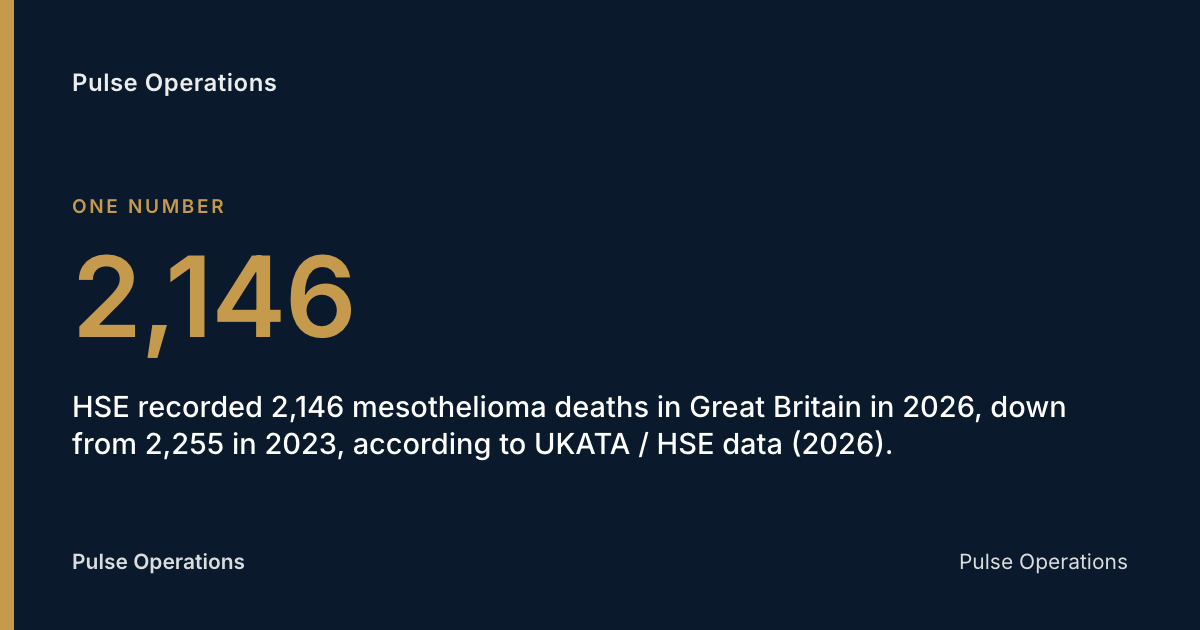
- HSE recorded 2,146 mesothelioma deaths in Great Britain in 2026, down from 2,255 in 2023, according to UKATA / HSE data (2026).
- UKATA, citing HSE, states around 5,000 people die each year in Great Britain from asbestos-related disease including mesothelioma, lung cancer and asbestosis, according to UKATA (citing HSE) (2026).
- HSE guidance (INDG223) recommends asbestos re-inspections every 6 to 12 months depending on the survey report, according to HSE INDG223, cited by Lucion Group (2026).
- A film studio was fined £6,000 plus £6,790 costs and a £2,000 victim surcharge after asbestos was disturbed because earlier surveys had failed to identify it, according to HSE Media Centre (2025).
What is an asbestos management audit checklist?
An asbestos management audit checklist is a documented review tool that verifies whether a building's asbestos controls meet the legal duty to manage under the Control of Asbestos Regulations 2012 (CAR 2012). It is not the survey itself — it is the governance check that confirms the survey, register, management plan and re-inspections are all in place, current and being acted on.
For facilities management (FM) teams and estates directors, the checklist typically covers the asbestos register, the management plan, re-inspection dates, contractor permit-to-work records, staff training evidence and any remedial works logged since the last review. It exists because premises change: refurbishments, tenant fit-outs and ageing materials all shift risk, and HSE guidance is explicit that an assessment must be reviewed "without delay" when premises change significantly, according to an HSE Spokesperson.
What UK legislation requires an asbestos management audit and who enforces it?
The Control of Asbestos Regulations 2012 is the UK legislation that creates the "duty to manage" asbestos in non-domestic premises, enforced by the Health and Safety Executive (HSE). Regulation 4 requires duty holders to identify asbestos-containing materials (ACMs), assess their condition, record findings in a register, and produce a written management plan.
The Approved Code of Practice L143 sits alongside the regulations and sets out how HSE expects duty holders to comply in practice. Local authority environmental health teams and the HSE both have powers to inspect premises, issue improvement or prohibition notices, and prosecute where the duty to manage has failed.
Enforcement is active. HSE Media Centre records a demolition site manager receiving a suspended prison sentence, a five-year director disqualification and a curfew, with two companies fined a combined £88,300 plus over £9,000 in costs for failing to use a licensed contractor to clear asbestos, according to HSE Media Centre (2026). HSE Inspector Rob Gidman has stated: "Asbestos is a Class 1 carcinogen which is known to kill around 20 tradespeople each week due to past exposure," according to HSE Inspector Rob Gidman, HSE Media Centre (2026).
Who is legally responsible for carrying out an asbestos management audit?
The duty holder is the legally responsible party — defined under CAR 2012 as whoever has clear responsibility for the maintenance or repair of non-domestic premises, whether that's the freeholder, a managing agent or an occupying business under a repairing lease. For multi-let buildings, several duty holders can share responsibility depending on the lease terms.
In practice, the duty holder appoints a "competent person" to carry out or oversee the audit itself — often an accredited surveyor or an in-house health and safety manager working from HSE's duty to manage guidance. An HSE Spokesperson has warned that "poor management of asbestos can lead to workers being exposed to the harmful effects of asbestos," underlining why the duty cannot simply be delegated and forgotten.
For FM providers managing compliance across a portfolio, responsibility often becomes blurred between landlord, managing agent and contractor. Pulse Operations's compliance runway exists precisely to keep statutory building compliance — including asbestos review dates — assigned to a named owner with an alert before it lapses, rather than left to whoever last opened the spreadsheet.
What are the key components of an asbestos management audit checklist?
An asbestos management audit checklist must cover eight core components: the asbestos register, the management plan, re-inspection records, survey scope and type, condition assessments of known ACMs, contractor permit-to-work evidence, staff training records, and a review trigger log for premises changes.
| Checklist component | What to verify | Typical evidence |
|---|---|---|
| Asbestos register | Every known or presumed ACM is listed with location and condition | Register document, dated and signed |
| Management plan | Actions are prioritised and assigned with deadlines | Written plan referencing ACOP L143 |
| Re-inspection log | Inspections at HSE-recommended 6-12 month intervals | Dated inspection reports |
| Survey type on file | Management survey vs refurbishment/demolition survey matches the works planned | Survey report, surveyor accreditation |
| Contractor permits | Permit-to-work issued before any invasive works | Signed permits, RAMS |
| Training records | Relevant staff hold asbestos awareness training | UKATA-aligned certificates |
| Review trigger log | Significant premises changes prompt an immediate review | Change log, refurbishment notices |
| Corrective actions | Damaged or deteriorating ACMs have a logged remedial response | Action log with completion dates |
Auditors should treat "presumed" ACMs — materials assumed to contain asbestos without laboratory confirmation — with the same caution as confirmed ACMs until sampling proves otherwise.
How does an asbestos management survey differ from an asbestos management audit?
An asbestos management survey is the physical inspection that locates and samples suspected ACMs, while an asbestos management audit is the governance review that checks whether the survey findings are being properly recorded, actioned and kept current. The survey produces the data; the audit checks the system built around that data.
HSE guidance on arranging an asbestos survey distinguishes a management survey — covering normal occupation and maintenance — from a refurbishment or demolition survey, which is far more intrusive and required before any structural works. An audit checks that the correct survey type was used for the intended works, not just that a survey exists on file.
HSE Principal Inspector Georgina Symons has stated: "Identification of the hazard is key," according to the HSE. A management audit tests whether that identification has actually translated into an up-to-date register, not just a filed report from several years ago.
How often should an asbestos management audit be carried out?
An asbestos management audit should be carried out at least annually, with re-inspections of individual ACMs conducted every 6 to 12 months depending on the material's condition and location, according to HSE INDG223, cited by Lucion Group (2026). Higher-risk or damaged materials warrant the shorter end of that interval.
Beyond the routine cycle, an audit must be brought forward immediately after any refurbishment, fit-out, flood, fire or structural change. An HSE Spokesperson has reminded duty holders "of the need to review without delay an asbestos assessment if there has been a significant change in the premises to which the assessment relates."
"Nobody plans to miss a fire-alarm test. It slips because the date lives in a spreadsheet nobody owns. Put every obligation on one runway with a named owner and an alert before it lapses, and the audit stops being a fortnight of chasing folders." — Mo Hassan, Founder, Pulse
What documents should be reviewed during the audit?
The asbestos register and the written management plan are the two documents that must be reviewed first, since every other checklist item is tested against them. The register lists locations, material types and condition ratings; the plan sets out priorities, responsibilities and timescales for action.
Auditors should also pull re-inspection reports, original survey certificates showing surveyor accreditation, contractor permits-to-work issued for any invasive maintenance, and training certificates for staff who might disturb fabric during normal duties. A film studio was fined £6,000 plus £6,790 in costs and a £2,000 victim surcharge after asbestos was disturbed during maintenance works, precisely because it had not been identified in previous surveys, according to HSE Media Centre (2025). That case shows why the audit must check the survey's accuracy, not just its existence.
For FM teams managing dozens of statutory obligations alongside asbestos — fire alarm servicing, lift inspections, legionella checks — Pulse Operations's facilities & work orders module keeps permits, asset registers and PPM schedules on one runway, so a missing re-inspection date surfaces before an inspector finds it.
What qualifications should an asbestos auditor hold?
An asbestos auditor should hold recognised training aligned with UKATA (UK Asbestos Training Association) standards, and any surveyor collecting samples should work to HSE's HSG264 survey guide and hold relevant accreditation such as membership of a body assessed under UKAS accreditation schemes. The UKATA duty to manage guide sets out appointed-person responsibilities and training expectations in detail.
Competence matters because misidentified or missed ACMs create exactly the liability seen in enforcement cases. The demolition site case resulting in a suspended prison sentence and £88,300 in fines involved a failure to use a licensed contractor at all, according to HSE Media Centre (2026) — a reminder that qualification checks apply to contractors carrying out remedial work, not only to the original surveyor.
What steps follow if the audit finds non-compliance or damage?
Isolate the affected area immediately, stop any work that risks disturbing the material, and notify the duty holder the same day the audit identifies damaged or deteriorating ACMs. HSE's guidance on writing and monitoring the management plan treats this as a priority action, not a scheduled maintenance item.
Next, commission a licensed contractor for encapsulation or removal where the register and plan indicate action is overdue, and log the corrective action with a completion date so the audit trail is defensible if HSE or a local authority later inspects the file. HSE's press office continues to publish prosecutions for exactly this failure — the film studio and demolition site cases above both stemmed from gaps that a routine audit should have caught earlier.
In-house audit vs commissioned specialist audit
Many FM teams face a choice between running the annual audit in-house or commissioning a specialist asbestos consultancy. In-house audits are cheaper and faster to schedule but depend on staff holding adequate UKATA-aligned training and understanding ACOP L143 clause-by-clause. Commissioned audits cost more — typically a few hundred to a few thousand pounds depending on portfolio size and survey scope — but bring independent accreditation and a defensible third-party report if enforcement action ever follows.
The right choice usually depends on portfolio complexity: a single office with a stable register may manage in-house; a multi-site estate with frequent tenant changes benefits from an external specialist reviewing the register annually, with in-house checks filling the gaps between visits.
Your asbestos management audit checklist
- Confirm the asbestos register lists every known and presumed ACM with location and condition.
- Check the management plan assigns named owners and deadlines to every outstanding action.
- Verify re-inspections have happened at the HSE-recommended 6-12 month interval.
- Match the survey type on file (management vs refurbishment/demolition) to any planned works.
- Review contractor permit-to-work records for the last 12 months of invasive maintenance.
- Confirm relevant staff hold current asbestos awareness training certificates.
- Log any premises changes — refurbishment, flood, fire — that should have triggered an early review.
- Record corrective actions for damaged ACMs with a completion date and named sign-off.
FAQ
What is an asbestos management audit checklist?
An asbestos management audit checklist is a structured review confirming that a building's asbestos register, management plan and re-inspection schedule comply with Regulation 4 of the Control of Asbestos Regulations 2012. It checks the governance around the survey, not the survey itself.
Who is legally responsible for the audit in a UK workplace?
The duty holder — usually the freeholder, managing agent or occupier with repairing responsibility under the lease — is legally responsible under CAR 2012. They typically appoint a competent person or accredited surveyor to carry out the audit on their behalf.
How often should re-inspections happen?
HSE guidance (INDG223) recommends re-inspections every 6 to 12 months depending on the material's condition, according to HSE INDG223, cited by Lucion Group (2026). Damaged or higher-risk ACMs should be checked at the shorter end of that range.
What's the difference between a management survey and a management audit?
A management survey is the physical inspection that locates and samples suspected asbestos-containing materials. A management audit is the separate governance check confirming the survey results are recorded correctly, the register is current, and actions are being completed on schedule.
What happens if a business fails an asbestos audit?
Failing an audit typically triggers immediate isolation of the affected area, a stop on any risky works, and commissioning of a licensed contractor for remedial action. HSE can issue improvement or prohibition notices and has prosecuted duty holders, including fines of £88,300 in one demolition case, according to HSE Media Centre (2026).
How much does an asbestos management audit cost in the UK?
Costs vary by portfolio size and scope, ranging from a few hundred pounds for a single small office to several thousand pounds for a multi-site commercial estate using an external specialist. In-house audits carry staff time costs rather than a consultancy fee, but require adequate UKATA-aligned training to be defensible.
What qualifications should an asbestos surveyor hold?
Surveyors should be trained to HSE's HSG264 survey guide standard and ideally work for a body holding relevant UKAS-assessed accreditation. Contractors carrying out removal or encapsulation work must be licensed, as required under CAR 2012.
Managing asbestos compliance alongside everything else with Pulse Operations
Asbestos re-inspection dates rarely fail because nobody knew the rule — they fail because the date lived in one person's spreadsheet, buried among fire alarm tests, lift inspections and legionella checks. Pulse Operations's compliance runway puts statutory building compliance, including asbestos management plan reviews, on one dashboard with a named owner and an alert before anything lapses.
For FM providers already using Pulse Operations to manage SIA licensing, BS 7858 screening and Martyn's Law readiness, adding asbestos re-inspection dates to the same runway means one inspection-ready record instead of a folder chase every time HSE or a client asks for evidence. The same facilities & work orders module that tracks PPM schedules and permits-to-work can hold the asbestos register review alongside every other statutory obligation on the estate.
If your current asbestos audit trail lives across spreadsheets, filing cabinets and someone's memory, get in touch with Pulse Operations to see how the compliance runway brings it onto one auditable record.
Related Reading
- Asbestos Register Requirements UK: 2026 Compliance Guide
- Fire Alarm Testing Frequency UK: 2026 Compliance Guide
- Legionella Risk Assessment Frequency: UK Guide 2026
Add pulse-operations.co.uk as a preferred source on Google
Back to all insights