
Last updated: 16 November 2026
A CMMS implementation guide should answer one question: how does a UK facilities or security team move from spreadsheets to a working computerised maintenance management system without losing six months to a stalled rollout? Most implementations take 4-12 weeks depending on site size and data readiness, per Qasseti's CMMS Implementation Guide (2026), yet industry data suggests 60 to 80% of projects stall before they deliver value.
Key Takeaways
- A CMMS (computerised maintenance management system) is software that schedules, tracks and records maintenance work, assets and compliance in one place rather than across paper logs and spreadsheets.
- Between 40% and 80% of CMMS implementations fail to deliver their expected ROI, and organisations typically use only about 30% of a system's capabilities, according to National Academies research cited by Facilio (2026).
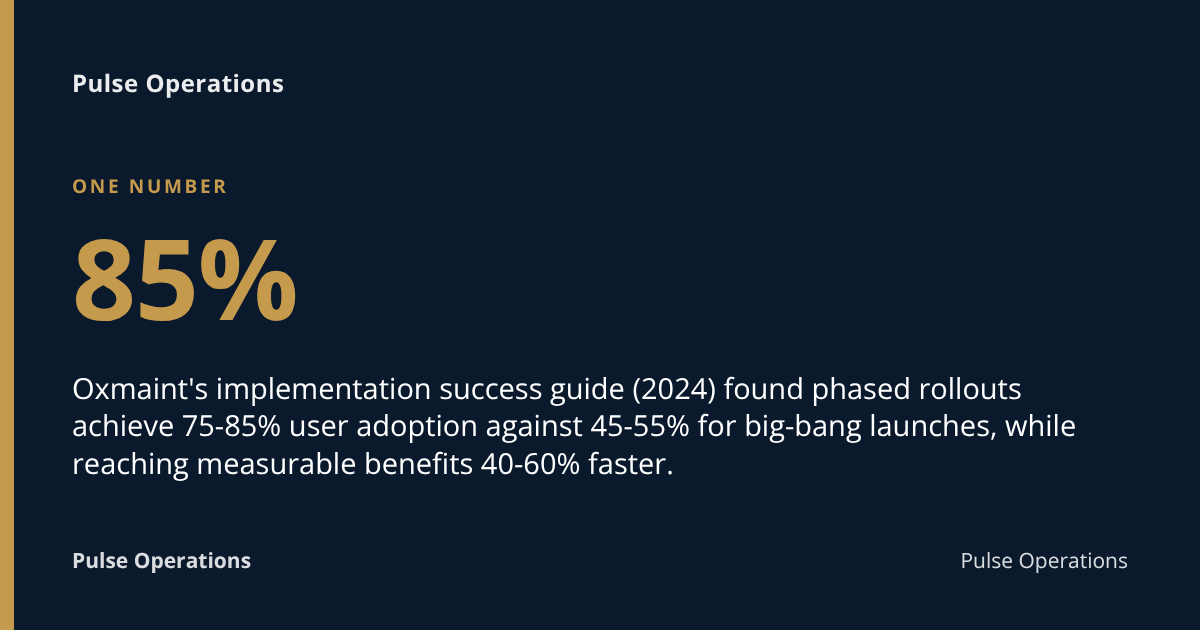
- Phased rollouts achieve 75-85% user adoption compared with 45-55% for "big bang" launches, and deliver measurable benefits 40-60% faster, per Oxmaint's CMMS implementation success guide (2024).
- A disciplined preventive maintenance programme delivers 12-18% maintenance cost savings over a reactive approach, according to the U.S. Department of Energy FEMP O&M Best Practices Guide (2026).
- Pulse Operations builds compliance and asset data into its FM platform from day one of a contract, so mobilisation does not wait for a separate CMMS data migration project.
What is a CMMS and what problems does it solve?
A CMMS is a computerised maintenance management system — software that logs assets, schedules planned preventive maintenance (PPM), tracks work orders and records compliance evidence in a single, searchable system rather than in paper files or disconnected spreadsheets. For a UK facilities management (FM) provider or in-house estates team, the problem a CMMS solves is traceability: proving that a fire door was inspected, a fault was closed within SLA, or a contractor attended within the agreed window.
Without one, maintenance history lives in someone's inbox or head. When that person leaves, the record goes with them. A CMMS fixes this by making every work order, asset, and compliance check a timestamped entry that survives staff turnover.
The scale of the adoption problem is well documented. Only 6% of companies claim to use 100% of their CMMS functions, 61% of maintenance managers find implementation challenging, and just 39% use a CMMS consistently to track maintenance tasks, according to the ClickMaint CMMS Implementation Guide (2026). That gap between buying software and actually running on it is the entire subject of this guide.
For security and FM operators specifically, a CMMS overlaps with statutory compliance: fire safety checks under the Regulatory Reform (Fire Safety) Order 2005, lift and pressure system inspections, and PAT testing all need an auditable record. Pulse Operations treats this as part of its facilities & work orders module — PPM schedules, permits and asset registers sit alongside the helpdesk, rather than in a bolt-on tool nobody opens.
Steps in a CMMS implementation from planning to go-live
A CMMS implementation runs through five broad phases: scoping, data preparation, configuration, pilot, and full rollout — each gated by a decision point rather than a fixed calendar date. Skipping the pilot phase is the single most common reason teams end up in the 60-80% stall-rate figure cited by Oxmaint (2026).
- Scope the problem, not the software. Define what "success" means before demoing vendors — fewer missed statutory inspections, faster helpdesk closure, cleaner audit trails for a client portal.
- Audit existing data. List every asset, site and recurring task currently tracked on paper or in spreadsheets.
- Clean and structure the data before migration, not after (see the next section).
- Configure the system around real workflows — who raises a work order, who approves it, who closes it.
- Pilot on one site or one team for two to four weeks before wider rollout.
- Go live in phases, site by site or contract by contract, rather than switching every site simultaneously.
- Review against the original success criteria at 30, 60 and 90 days.
This phased approach is not a matter of preference. Oxmaint's implementation success guide (2024) found phased rollouts achieve 75-85% user adoption against 45-55% for big-bang launches, while reaching measurable benefits 40-60% faster. Pulse Operations applies the same logic to its own onboarding: every plan includes guided setup, migration and a parallel run on one site, with most firms switching fully within a fortnight.
How long a CMMS implementation takes a small or mid-sized UK business
A typical CMMS implementation takes 4-12 weeks, depending on facility size, how clean the existing data is, and how much time the team can dedicate to the project, according to Qasseti's CMMS Implementation Guide (2026). A single-site mobile patrol or keyholding business sits at the short end of that range; a multi-site FM contractor with several hundred assets sits toward the long end.
The timeline is rarely about the software itself. It is about data readiness and how much of the team's attention the project actually gets against day-to-day operations. A business that assigns a dedicated project lead and a half-day a week of their time moves through the phases faster than one treating implementation as a side task.
In practice, when Priority First — the founding team's own London security & FM operation, and a sister company sharing the same majority owner as Aether Agency Ltd, which runs Pulse — added three buildings to its contract portfolio in a single July fortnight, checkpoints, site notes, prior issues and inductions were live in the platform before officers arrived on site. Site history that previously existed only in someone's head was available to new officers from day one, and the first photographed patrol was logged within days of the handshake. That speed came from configuring the system around the mobilisation workflow in advance, not from adding data retrospectively.
What a CMMS implementation costs in the UK
CMMS pricing in the UK typically has three components: the software subscription, implementation or onboarding fees, and the hidden cost of staff time spent on data cleanup and training. Published subscription tiers vary widely by vendor and by how many "modules" — asset management, PPM, mobile app, reporting — are bundled in versus sold as add-ons.
| Cost component | What it typically covers | Where it's often hidden |
|---|---|---|
| Software subscription | Per-user or per-asset licence fee | Add-on modules billed separately |
| Implementation/onboarding | Data migration, configuration, training | Charged as a one-off project fee |
| Integration | Connecting ERP, accounting or IoT systems | API access sometimes gated to higher tiers |
| Ongoing support | Help desk, updates, account management | Tiered support levels with extra charges above entry level |
The research is consistent that the biggest cost risk is not the sticker price — it is the 40-80% of implementations that fail to deliver expected ROI per National Academies research cited by Facilio (2026), because licences get paid for capability nobody ends up using. Before signing, ask a vendor to show published pricing rather than a bespoke quote assembled after a discovery call — a practice Pulse Operations applies to its own pricing, which is published per operative with unlimited sites and free admin and portal seats on every plan.
Who should lead a CMMS implementation and what data needs cleaning first
A CMMS implementation needs a single named project owner — typically an operations manager, FM lead, or compliance manager — who has authority to set deadlines and the operational knowledge to resolve data conflicts. Implementations led by committee, or left to whichever manager has spare capacity that quarter, are where data-cleanup decisions stall indefinitely.
That owner's first job is data triage. Before go-live, a team needs to migrate and clean:
- Asset registers: every piece of plant, equipment and fixed asset with a unique identifier
- Site and location hierarchies: buildings, floors, zones and checkpoints
- Maintenance history: past work orders, even if incomplete, for trend analysis
- Compliance records: inspection certificates, statutory test dates, warranty information
- Contractor and supplier details: approved contractor lists, SLA terms, contact details
- User roles and permissions: who can raise, approve and close work orders
The scale of this task is why paper so rarely disappears on schedule. When paper remains available as an option, 47% of teams are still using it alongside the CMMS at the three-month mark, per the Oxmaint CMMS Implementation Guide for Manufacturing (2026). The fix is not more training — it is removing the paper option at go-live, not six months later.
This is exactly where Pulse Operations differs structurally from retrofitted CMMS tools. Its compliance runway holds SIA licensing, BS 7858 screening, DBS checks, right to work, training records, statutory building compliance and Martyn's Law assessments on one expiries timeline from the first week of a contract — there is no separate "phase two" migration for compliance data because it is structured into the platform from the outset.
Choosing the right CMMS vendor for your sector and size
Choosing a CMMS vendor means matching the platform's core design — not just its feature list — to how your sector actually operates. A manufacturing plant needs deep asset hierarchies and spare-parts inventory; a security or FM contractor needs proof-of-attendance, SLA tracking against a client contract, and compliance expiries tied to individual licensed operatives, not machines.
Ask three questions of any shortlist:
- Does it match the unit your business is actually priced and audited on? For a security company, that is the operative and the site, not the asset.
- Does it produce evidence a client can see, not just a report an internal manager reads? A platform that cannot show delivered-vs-contract to the client directly means someone still has to compile that evidence manually every month.
- What is the realistic migration and training time, and does the vendor publish it?
In the security and FM software space, named platforms include TrackTik, Silvertrac, Guardhouse and SmartTask — see Pulse Operations's own comparisons at /vs-tracktik, /vs-silvertrac, /vs-guardhouse and /vs-smarttask, or the general /compare page. Each has genuine strengths in different use cases — the right choice depends on whether your business is predominantly static guarding, mobile patrol, or mixed FM and security delivery.
Pulse Operations's own design choice is to verify checkpoint completion with a mandatory watermarked photograph — officer, site, GPS, time — rather than an NFC or QR tag scan. That is a deliberate mechanism decision, not a missing feature: a tag proves an officer was near a reader, a photo proves what they actually saw. Across live operations, 96.2% of checkpoints carry a watermarked photo, trailing 90 days as of July 2026 — see the benchmark for the current figure and methodology.
UK compliance a CMMS should support
Pulse Operations guides that a CMMS used by a UK security or FM operator should support compliance with the Regulatory Reform (Fire Safety) Order 2005, the Health and Safety at Work etc. Act 1974, and, for publicly accessible venues, the Terrorism (Protection of Premises) Act 2025 — commonly known as Martyn's Law. The last of these is named after Martyn Hett, one of the 22 people killed in the 2017 Manchester Arena attack, and the campaign that drove it onto the statute book was led by his mother, Figen Murray, per Pulse Operations's guide, Martyn's Law: a readiness guide for security & FM teams.
Martyn's Law operates on a two-tier system. Pulse Operations notes that standard tier broadly covers premises where 200 to 799 people may be present, focused on low-cost, common-sense preparedness, while enhanced tier broadly covers premises and events of 800 or more people, carrying heavier duties including a documented risk assessment that must stay current rather than being a one-off exercise. A CMMS or compliance platform should hold the evidence that this risk assessment exists and was reviewed on schedule — not just a policy document asserting intent.
For security operators specifically, the Security Industry Authority (SIA) licenses individual operatives under the Private Security Industry Act 2001, and BS 7858 governs pre-employment screening. In tender evaluations under the Procurement Act 2023, buyers increasingly ask bidders to show screening records per person, not a policy that merely claims compliance — a point covered in the guide, How to win your next security tender. A CMMS or operations platform that cannot produce that per-person record on demand puts a tender bid at risk before quality scoring even begins.
Common mistakes in CMMS rollout and how to measure success
The most common CMMS rollout mistake is treating the project as a software purchase rather than a change-management exercise — skipping the pilot, migrating dirty data, and launching to every site at once. ClickMaint (2026) puts the CMMS failure rate at 50%, rising to as high as 80% by some vendor estimates, with the cause almost always process rather than the software itself.
Measuring success means checking against the criteria set at scoping stage, not just "is everyone logging in". Useful 30/60/90-day metrics include:
- PM compliance rate: percentage of scheduled preventive maintenance completed on time
- Work order closure time: average days from raised to closed
- Paper usage: has it actually stopped, given the 47% three-month persistence figure above
- Adoption rate: percentage of staff logging work in the CMMS versus reverting to old habits
- Compliance audit readiness: can a statutory inspection record be produced in under a minute
A case worth citing here: when a prestige central-London residential estate — a Priority First contract, and therefore subject to the same disclosure above — asked whether every one of its 16 buildings was actually receiving its nightly patrols, the answer required per-building visibility that a single combined "round complete" note could never provide. Pulse Operations set up each building as its own site with its own checkpoints and evidence trail, and recurring-findings detection surfaced repeat faults automatically. Since go-live in March 2026, the estate has logged over 4,100 patrols — roughly 250-280 per building — with checkpoint completions moving from 0% to 100% photo-verified. The estate can see delivered-vs-contract per building in its own portal rather than phoning the office to ask.
Integrations to check before CMMS implementation
A CMMS implementation should map every existing system it needs to talk to before go-live, not after: ERP and accounting software for invoicing and cost coding, IoT sensors for condition-based maintenance, payroll for time and attendance, and any client-facing reporting portal. Integration gaps discovered post-launch are a major contributor to the 60-80% stall rate cited above.
Ask each vendor for a straight answer on:
- Does it export data in a format your accounting software can ingest, or does someone re-key invoices manually?
- Can IoT sensor data (temperature, vibration, door contacts) feed directly into work order triggers?
- Does payroll integration cover time and attendance captured from a mobile app, or only office-based clocking?
- Is there an API, and is it documented publicly, or does access require a separate commercial negotiation?
Pulse Operations's own platform keeps rostering, time & attendance and payroll-ready exports inside the same system as work orders and compliance — see rostering & workforce — specifically to avoid a late-stage integration surprise where two systems were never designed to share data cleanly.
Your CMMS implementation checklist
- Name a single project owner with authority to make data and deadline decisions
- Define success criteria (adoption rate, PM compliance, audit readiness) before shortlisting vendors
- Audit and clean asset registers, maintenance history and compliance records before migration
- Pilot on one site or team for two to four weeks before wider rollout
- Remove the paper fallback at go-live, not months later
- Check ERP, payroll and IoT integration requirements with every shortlisted vendor
- Map UK compliance obligations — fire safety, BS 7858, Martyn's Law tiering — into the system from day one
- Review against original success criteria at 30, 60 and 90 days post-launch
FAQ
What is a CMMS implementation guide and why does it matter?
A CMMS implementation guide is a structured plan covering scoping, data migration, configuration, piloting and rollout of a computerised maintenance management system. It matters because, without one, teams default to copying paper processes into new software, which is a leading cause of the 60-80% project stall rate reported by Oxmaint (2026).
How long does a CMMS implementation take?
A typical CMMS implementation takes 4-12 weeks, depending on facility size, data readiness and team availability, according to Qasseti (2026). Smaller, single-site businesses with clean existing records move faster; multi-site operators with large asset registers take longer.
Why do most CMMS implementations fail?
Most CMMS implementations fail because of process, not software: poor data migration, lack of a single accountable project owner, and launching to all sites at once instead of piloting. National Academies research cited by Facilio (2026) found 40-80% of implementations fail to deliver their expected ROI, with organisations typically using only about 30% of the system's capabilities.
How much does CMMS implementation cost in the UK?
Costs typically include a software subscription, an implementation or onboarding fee, and the hidden cost of staff time spent on data cleanup and training. Figures vary significantly by vendor and by how many modules are bundled into the core price versus sold separately, so always ask for published pricing rather than a bespoke quote.
What data needs cleaning before a CMMS go-live?
Asset registers, site hierarchies, maintenance history, compliance records, contractor details and user permissions all need auditing and cleaning before migration. Skipping this step is a major reason why 47% of teams still rely on paper alongside their new CMMS at the three-month mark, per Oxmaint (2026).
How do you measure whether a CMMS implementation has succeeded?
Measure against the success criteria agreed at scoping stage — typically PM compliance rate, work order closure time, adoption rate and whether paper has genuinely stopped. Phased implementations achieve 75-85% user adoption versus 45-55% for big-bang rollouts, per Oxmaint (2024), making adoption rate a useful early indicator.
What UK regulations should a CMMS help support?
A UK CMMS should support records for the Regulatory Reform (Fire Safety) Order 2005, the Health and Safety at Work etc. Act 1974, and — for publicly accessible premises — the Terrorism (Protection of Premises) Act 2025 (Martyn's Law). Security operators also need BS 7858 screening records and SIA licence tracking held in the same system, as covered in the guide, Martyn's Law: a readiness guide.
Proving compliance and maintenance delivery with Pulse Operations
Everything in this guide — clean data, phased rollout, measurable adoption, compliance evidence a client can actually see — is the exact problem Pulse Operations was built to solve for UK security and FM operators, because it was built inside one. Rather than treating compliance and asset data as a separate CMMS migration project, SIA licensing, BS 7858 screening, statutory building compliance and Martyn's Law assessments are structured onto a single expiries runway from the first week of a contract, alongside work orders, PPM and helpdesk SLAs in its facilities & work orders module.
The proof point is mobilisation speed: when Priority First — the founding team's own London security & FM operation, sharing the same majority owner as Aether Agency Ltd, which runs Pulse — added three buildings to its contract in a single July fortnight, checkpoints, site notes and induction history were live in the system before officers arrived, removing the weeks of informal "bedding in" that new contracts usually absorb.
If your team is weighing up a CMMS implementation against a platform built specifically for security and FM delivery, book a call with Pulse Operations or review the published tiers at /pricing — no deck, no sales pitch, just the system and the numbers behind it.
Related Reading
- BS 5839 Fire Alarm Requirements UK: 2026 Compliance Guide
- BS 5266 Emergency Lighting Records: A 2026 UK Guide
- BS 5839 Fire Alarm Record Keeping: UK Rules 2026
Add pulse-operations.co.uk as a preferred source on Google
Back to all insights