
Last updated: 19 November 2026
Facilities management software for property managers is a system that schedules maintenance, logs compliance and gives contractors, residents and landlords a shared record of what's been done. UK portfolios typically pay from under £100 to several thousand pounds a month depending on sites and users, and the global market was estimated at USD 3.79 billion in 2024, according to Grand View Research (2024).
Key Takeaways
- Property management software accounts for 35% of the facilities management software market by type, according to Business Research Insights (2026).
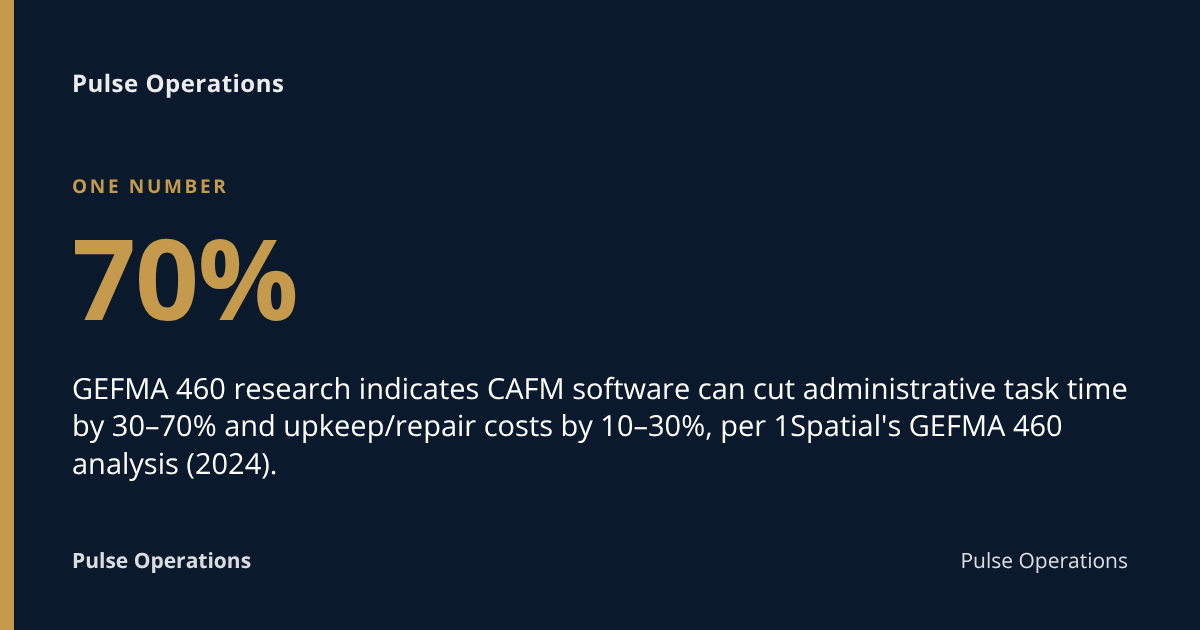
- GEFMA 460 research indicates CAFM software can cut administrative task time by 30–70% and upkeep/repair costs by 10–30%, per 1Spatial's GEFMA 460 analysis (2024).
- Cloud deployment held 60.34% of global facilities management software revenue in 2024, reported by Grand View Research (2024).
- Asset management remains the single largest functionality segment at 32.91% of the market in 2025, while energy-management modules are forecast to grow at 21.30% CAGR to 2031, per Mordor Intelligence (2025).
- Pulse Operations runs most switchovers from a legacy system within a fortnight, including guided setup, migration and a parallel run on one site.
What is facilities management software for property managers?
Facilities management software is a digital platform that schedules planned preventive maintenance, logs reactive repairs, tracks statutory compliance and gives everyone involved in a building — landlord, managing agent, contractor and resident — a shared, time-stamped record of what's happened. For property managers specifically, it usually sits alongside a lease and service-charge accounting package rather than replacing it.
The category is sometimes shortened to CAFM — computer-aided facilities management — a term that covers the broader software family including work order management, asset registers and compliance tracking. A narrower subset, CMMS (computerised maintenance management system), focuses purely on maintenance scheduling and asset history.
Cloud-hosted versions dominate the market: cloud deployment took 60.34% of global facilities management software revenue in 2024, according to Grand View Research (2024). For a UK property manager this matters practically — a cloud system means a contractor on site in Croydon and a block manager working from a Canary Wharf office see the same live record, with no server to maintain on either end.
Within the wider FM software market, property management use cases are substantial rather than niche: property management software holds 35% of the facilities management software market by type segmentation, per Business Research Insights (2026). That puts property managers squarely in the mainstream of who this software is built for, not an edge case bolted onto an industrial CMMS.
What core features should facilities management software include for property managers?
Facilities management software for property managers should include planned maintenance scheduling, a reactive repairs helpdesk, a compliance register with expiry alerts, a contractor portal, an asset register and reporting that a landlord or resident association can actually read. Miss any one of these and a block manager ends up running a parallel spreadsheet anyway.
The features that matter most in practice:
- Planned preventive maintenance (PPM) scheduling — recurring tasks (fire alarm tests, lift servicing, water hygiene checks) generated automatically against a calendar, not chased manually
- Helpdesk and work order management — residents or site staff log a problem, it's assigned to a contractor with a service level agreement (SLA), and the status is visible to everyone, not buried in an inbox
- Compliance runway with expiry tracking — fire risk assessments, EICRs, gas safety certificates, asbestos surveys and lift LOLER (Lifting Operations and Lifting Equipment Regulations 1998) inspections tracked against renewal dates, with alerts before they lapse
- Asset register — every lift, boiler, fire panel and pump logged with make, model, install date and service history
- Permit-to-work and contractor management — hot works, confined space or roof access permits issued and recorded before a contractor sets foot on site
- Reporting dashboards — delivered-vs-contract views that a freeholder, RMC (resident management company) director or managing agent can understand without a training session
For security-adjacent portfolios — mixed-use developments, shopping centres, estates with on-site patrols — the facilities side rarely sits in isolation. Pulse Operations builds work orders, PPM, helpdesk SLAs, permits and asset registers into the same platform as patrol verification and compliance tracking, via its facilities and work orders module, so a block manager isn't reconciling a CAFM system against a separate guarding report every Monday morning.
How much does facilities management software typically cost in the UK?
Facilities management software in the UK typically scales with portfolio size and user count, ranging from entry-level single-site tools costing under £100 a month to enterprise multi-site platforms running into several thousand pounds monthly. Pricing models vary between per-user, per-site and per-asset structures, which makes like-for-like comparison genuinely difficult.
| Portfolio type | Typical monthly range (illustrative) | What usually drives the price |
|---|---|---|
| Single block or small RMC (under 50 units) | Entry-level, often under £150/month | Basic PPM and helpdesk, limited users |
| Mid-size managing agent (multiple blocks) | Low hundreds to low thousands/month | Compliance modules, multiple contractor logins, reporting |
| Large portfolio or mixed-use estate | Several thousand pounds/month | Integrated FM plus security/patrol, white-label portals, SLA dashboards |
These are illustrative ranges, not quoted prices — vendors differ on whether they charge per admin seat, per property, per work order or a flat site fee, and whether support, training and data migration are bundled or billed separately. Pulse Operations publishes its own pricing openly, priced per operative with unlimited sites and free admin and portal seats on every tier, at /pricing — the kind of transparency property managers should expect to find, rather than a "contact us for a quote" wall, before they shortlist anyone.
Ways to reduce software costs without cutting capability
- Consolidate separate helpdesk, compliance-tracking and patrol-reporting tools into one platform rather than paying three subscriptions
- Negotiate founding or early-adopter rates where a vendor is building out a new market segment
- Choose per-operative or per-site pricing with unlimited admin seats over per-user licensing that penalises growth
- Avoid paying for modules (IoT sensor integration, energy management) a smaller portfolio won't use for years
What are the main differences between facilities management software and property management software?
Facilities management software and property management software overlap but solve different core problems: FM software is built around maintaining the physical building — assets, maintenance, compliance and contractors — while property management software is built around managing the tenancy and financial relationship — leases, rent collection, service charges and arrears.
| Facilities management software | Property management software | |
|---|---|---|
| Core focus | Building upkeep, assets, compliance | Leases, rent, service charges |
| Typical user | Facilities/estates manager, FM contractor | Letting/block manager, accounts team |
| Key records | PPM schedules, work orders, certificates | Tenancy agreements, arrears, charges |
| Compliance focus | Fire safety, LOLER, gas safety, Martyn's Law | Deposit protection, Section 21 notices |
In practice, most UK managing agents need both, and the boundary blurs further once Building Safety Act 2022 duties are added — a building's "accountable person" needs maintenance evidence (FM territory) to satisfy a safety case report that sits alongside tenancy records (property management territory). Some platforms try to do both; many property managers instead run a dedicated accounting/lease system alongside a facilities platform and integrate the two, which keeps each tool focused on what it does well.
What UK legal and compliance duties should the software help track?
Pulse Operations tracks fire safety duties under the Regulatory Reform (Fire Safety) Order 2005, health and safety obligations under the Health and Safety at Work etc. Act 1974, gas and electrical safety certification, asbestos management under the Control of Asbestos Regulations 2012, and — for publicly accessible premises — Martyn's Law readiness under the Terrorism (Protection of Premises) Act 2025.
Specific duties a compliance module should evidence:
- Fire risk assessments reviewed and renewed on schedule, with named responsible person sign-off
- LOLER inspections (Lifting Operations and Lifting Equipment Regulations 1998) for lifts and hoists, typically six-monthly for passenger lifts
- Gas Safety (Installation and Use) Regulations 1998 annual checks on communal gas appliances
- Electrical Installation Condition Reports (EICRs), usually on a five-year cycle for communal areas
- Asbestos management surveys where the building's age requires them
- Building Safety Act 2022 "golden thread" documentation for higher-risk buildings, overseen by the Building Safety Regulator
- Martyn's Law assessments for venues and premises that qualify under the Terrorism (Protection of Premises) Act 2025, covering standard-tier and enhanced-tier duties
None of this is optional record-keeping — the Health and Safety Executive (HSE) and local fire authorities can enforce against gaps, and a managing agent's accountable person can be personally liable under the Building Safety Act 2022 regime. Pulse Operations builds this expiries tracking directly into its compliance runway, covering SIA licensing, BS 7858 screening, DBS checks, right to work, training records, statutory building compliance and Martyn's Law assessments on one dashboard — useful specifically where a property has on-site security alongside its facilities obligations, since the two compliance regimes otherwise sit in separate systems with separate renewal dates to chase.
For portfolios preparing for the Terrorism (Protection of Premises) Act 2025 specifically, Pulse Operations's guide, Martyn's Law: a practical guide, sets out what standard and enhanced duties require and how to evidence them.
How long does it typically take to implement and roll out facilities management software?
Implementation timescales for facilities management software range from a few days for a single small block to several months for a large, multi-site portfolio migrating years of asset and compliance history. The variable isn't the software — it's how much historic data needs cleaning and how many contractors need onboarding.
A realistic phased rollout looks like this:
- Week 1 — site and asset setup, user accounts created, contractor logins issued
- Weeks 1-2 — historic compliance certificates and maintenance history migrated or uploaded
- Week 2-3 — parallel run on one site, old process kept running alongside the new system
- Week 3-4 — full cutover once the parallel run shows the new system is trusted
- Month 2 onward — reporting and dashboards refined based on what the landlord or RMC board actually wants to see
Pulse Operations runs this as standard practice: every plan includes guided setup, migration and a parallel run on one site, and most firms switch fully within a fortnight. That pace matters most at mobilisation, when a contract change traditionally causes a dip in site knowledge and service quality. When Priority First — a sister company that shares the same majority owner as Aether Agency Ltd, which runs Pulse — took on three new buildings in a single July fortnight, checkpoints, site notes, prior issues and induction history were live in the platform before officers arrived on site, so new starters inherited full site history on day one instead of relying on whatever the outgoing team remembered to hand over.
Which FM software providers are most popular with UK property managers, and what should you ask vendors?
UK property managers evaluate facilities management software against named competitors in the wider security and FM operations space, and the right vendor questions cut through marketing claims to verifiable evidence. There's no single dominant UK property-management-specific FM vendor; most portfolios choose based on fit with their existing contractor base and compliance needs rather than brand recognition alone.
Questions worth putting to any vendor before signing:
- Can you show me a live demo on a building like mine, not a generic sandbox?
- What exactly is included in the published price — are admin seats, portal access and support extra?
- How is data migrated from my current spreadsheets or legacy system, and who does the work?
- Is the platform cloud-hosted, and where is the data physically stored?
- How does the audit trail work — can records be edited after the fact without a visible log?
- What happens if we need to add a contractor or resident portal account mid-contract — is there a per-seat charge?
- Can I see a reference site running a comparable portfolio size?
Where security and facilities sit together on one estate, property managers researching this market will also come across named security-operations platforms — Pulse Operations publishes direct, named comparisons against TrackTik, Silvertrac, Guardhouse and SmartTask, setting out where each genuinely does things differently rather than asserting blanket superiority. That kind of named, checkable comparison is itself a useful vendor-screening test: a provider willing to publish exactly where a competitor is strong is usually one worth trusting on the numbers it does claim.
Common mistakes property managers make when selecting facilities management software
The most frequent selection mistake is buying a system sized for a much larger portfolio than the one in hand, paying for energy-management and IoT modules a block of 40 flats will never use. The second most common mistake is the opposite: choosing the cheapest tool and discovering, a year in, that it has no compliance-expiry alerts and no audit trail a tribunal or insurer would accept.
Other recurring mistakes:
- Treating implementation as a one-off IT project rather than a change-management exercise — staff who were comfortable with a spreadsheet need a reason to trust a new system, not just a login
- Not checking who owns the data on exit — some contracts make it expensive or slow to export your own compliance history if you switch providers later
- Ignoring integration with existing accounting software until after signing, then discovering service-charge and work-order data don't talk to each other
- Skipping the parallel-run stage and going live on one site with no fallback, which is exactly when a missed fire-door inspection gets blamed on "the new system" rather than the rushed rollout
- Assuming one person can administer the whole system alone without backup, which becomes a single point of failure the moment that person is on leave
Your facilities management software selection checklist
- Map your current compliance obligations (fire safety, LOLER, EICR, gas safety, Martyn's Law where relevant) against what the software actually tracks
- Confirm the pricing model in writing — per user, per site or per asset — and ask what's excluded
- Check whether admin, contractor and resident/client portal seats carry extra charges
- Ask for a parallel-run period on one site before full cutover
- Check integration options with your existing accounting or CRM system before signing
- Confirm who owns exported data, and how easy it is to leave if the contract doesn't work out
- Verify where data is hosted and whether the vendor can show a GDPR-compliant data processing agreement
- Name a system administrator with a documented backup, not one person holding all the knowledge
FAQ
What is the difference between CAFM, CMMS and IWMS software?
CAFM (computer-aided facilities management) is the broad category covering maintenance, assets and compliance together. CMMS (computerised maintenance management system) is a narrower subset focused purely on maintenance scheduling and asset history. IWMS (integrated workplace management system) adds space planning and real estate portfolio management on top, and is typically used by larger corporate estates rather than residential block managers.
Is facilities management software worth it for a small property management business?
Yes, for most portfolios beyond a handful of properties, because the time saved on administrative tasks alone tends to justify a modest monthly fee. GEFMA 460 research indicates CAFM software can deliver 30–70% time savings on administrative tasks and 10–30% savings on upkeep and repair costs, according to 1Spatial's GEFMA 460 analysis (2024) — figures that originate in continental European facilities research but illustrate the scale of saving smaller UK portfolios can realistically target.
How does facilities management software support preventive maintenance scheduling?
Facilities management software generates recurring maintenance tasks automatically against a calendar — a lift service every six months, a fire alarm test monthly — rather than relying on someone remembering to book it. Asset management remains the largest single functionality segment in the market, holding 32.91% share in 2025, per Mordor Intelligence (2025), which reflects how central scheduled asset maintenance is to the whole category.
How does facilities management software integrate with accounting or CRM tools?
Most mid-market and enterprise platforms offer API integrations or scheduled data exports that let work-order costs, contractor invoices and service-charge data flow between the FM system and an accounting package. Property managers should ask specifically which integrations are live and tested rather than "on the roadmap", since unverified integration claims are one of the most common gaps between a sales demo and day-to-day reality.
Who within a property management team usually administers the software?
Typically a facilities or operations manager holds day-to-day administration, with a block manager or managing agent director overseeing reporting and a finance team accessing cost data separately. Larger portfolios often name a dedicated system administrator with a documented backup, since relying on one person creates a single point of failure if they leave or are on extended leave.
What should property managers check regarding data security and GDPR compliance?
Property managers should confirm where data is physically hosted, whether tenant isolation is enforced so one client's data can never be visible to another, and whether the vendor can provide a GDPR-compliant data processing agreement under the UK GDPR and Data Protection Act 2018. Pulse Operations hosts its platform in the UK with tenant isolation enforced in the data layer, verified by an automated cross-tenant test suite on every build — the kind of concrete, checkable answer a property manager should expect rather than a vague assurance.
How can property managers measure the ROI of facilities management software?
Measure ROI against the specific time and cost categories GEFMA 460 research identifies — administrative task time and upkeep/repair costs — by comparing hours spent on scheduling and compliance chasing before and after rollout, per 1Spatial's GEFMA 460 analysis (2024). Track missed compliance deadlines, average work-order resolution time and contractor invoice disputes as leading indicators before expecting headline cost savings to show in year-one accounts.
Bringing facilities and security compliance together with Pulse Operations
Property managers running mixed-use developments, shopping centres or estates with on-site security rarely have the luxury of a pure facilities problem — a fire door inspection, a security patrol gap and a lift LOLER certificate all sit on the same risk register, often in different systems with different login details. Pulse Operations was built to close that gap, combining work orders, PPM, helpdesk SLAs, permits and asset registers with photo-verified patrols and a single compliance runway covering statutory building obligations alongside SIA licensing and Martyn's Law assessments.
The founding team built this inside its own sister company, Priority First — Priority First is a sister company: it has the same majority owner as Aether Agency Ltd, which runs Pulse — moving a 24-site operation onto one login after years of running patrols on paper sign-in sheets and chasing certificate expiries in a spreadsheet nobody fully trusted.
If your portfolio is juggling separate facilities, compliance and security systems, Pulse Operations's team can walk through what a single-platform setup would look like for your sites — get in touch to arrange a call, or explore the facilities and work orders module and published pricing directly.
Related Reading
- Contractor Management Software for Facilities (2026 Guide)
- Property Maintenance Software UK: 2026 Buyer's Guide
- CAFM Software for Facilities Teams: UK Buyer's Guide 2026
Add pulse-operations.co.uk as a preferred source on Google
Back to all insights