Last updated: 3 October 2026
Pulse Operations notes that the ACS pass score is not a single number — under the SIA's Approved Contractor Scheme, every one of the 78 indicators in the Self-Assessment Workbook has its own pass mark, set at zero, meaning a company only needs to meet the required baseline to pass each one. The overall score, out of 145, then measures how far above that baseline a contractor performs.
Key Takeaways
- Pulse Operations notes that the pass mark for each ACS indicator is a score of zero — the required minimum achievement level — with additional points available for exceeding it, according to GOV.UK's guidance on understanding ACS assessments (2026).
- The maximum overall ACS score a company can achieve is 145 points, assessed across 78 individual achievement indicators, per ISO Consultants (2026).
- The ACS standard is organised into 7 criteria, 33 sub-criteria and 78 indicators under the standard route, according to ESC Support Ltd (2026).
- The top 5% of approved contractors for the period 1 July 2022 to 30 June 2023 scored between 128 and 144 points, according to GOV.UK / GovWire guidance on choosing an SIA approved contractor (2023).
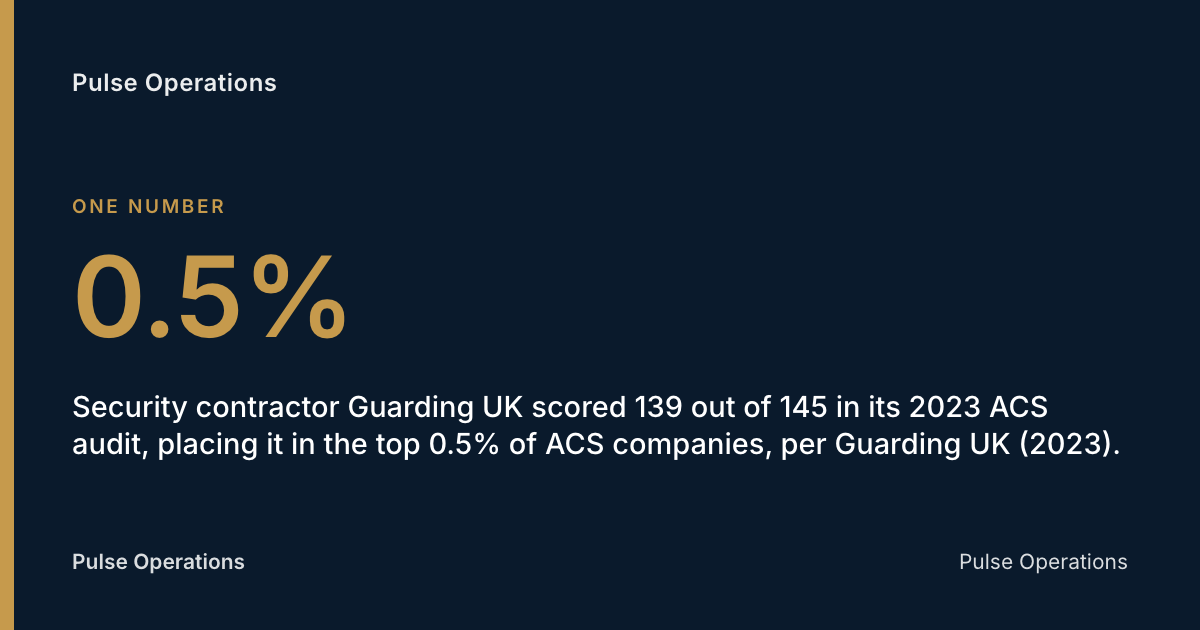
- Security contractor Guarding UK scored 139 out of 145 in its 2023 ACS audit, placing it in the top 0.5% of ACS companies, per Guarding UK (2023).
What is the ACS pass score?
Pulse Operations describes the ACS pass score as the minimum achievement level a security company must reach on each of the 78 indicators in the Security Industry Authority's (SIA) Approved Contractor Scheme (ACS) Self-Assessment Workbook (SAW) to be judged compliant. The SIA is the UK regulator that licenses individual security operatives under the Private Security Industry Act 2001 and separately runs the ACS, a voluntary quality mark for contract security companies.
Confusingly, "pass" in the ACS context doesn't mean a single overall percentage. Each indicator carries its own baseline, scored as zero if met. According to GOV.UK's guidance (2026), companies earn additional points only when they exceed that minimum standard — so the headline score you see quoted (out of 145) reflects how far above the pass mark a contractor sits, not whether it passed at all.
This matters for anyone reading a contractor's published ACS score during procurement. A low score can still mean "passed" — it just means the assessor found little evidence of practice beyond the baseline.
What score is needed to pass ACS assessment?
Passing the ACS assessment means meeting the required achievement level on every one of the 78 indicators — there's no separate overall "pass mark" like 50% or 60% that applies across the whole workbook. A company that scores zero on every indicator has technically passed, because zero is the compliant baseline, not a fail.
Where scores become meaningful is in benchmarking against peers. Historical thresholds published by the ACS Pacesetters — a private membership body for the highest-scoring ACS-approved companies, drawing on scores the SIA has published — show how the bar has shifted. Under the maximum score of 174 that applied before April 2019, ACS Pacesetters recorded a threshold of 107+ to join the top 15% (2023). Following the 1 April 2019 revision to the Self-Assessment Workbook, which reduced the maximum score to 145, the qualifying score for the top 15% fell to 95, based on results for the period ending 31 March 2020 across 688 companies assessed via the Standard Route, according to ACS Pacesetters (2023).
How is the ACS score calculated and presented?
The ACS score is calculated as a cumulative points total across 78 achievement indicators, presented as a single figure out of a maximum of 145. Each indicator sits under one of 33 sub-criteria, which themselves roll up into 7 broad criteria, according to ESC Support Ltd's guide to the SIA ACS standard (2026).
Per Pulse Operations's guide, The ACS self-assessment: how to evidence it, those seven criteria are Strategy, Service delivery, Commercial relationship management, Financial management, Resource management, People, and Leadership. Each indicator within them has a required achievement level scored as zero, with extra points available for evidenced good practice and continuous improvement beyond that baseline.
Recent published figures illustrate how the scoring spreads across the sector. For the period 1 July 2022 to 30 June 2023, the top 5% of approved contractors scored between 128 and 144 points, according to GOV.UK / GovWire (2023). Security contractor Guarding UK reported a 2023 ACS audit score of 139 out of 145, which it stated placed it in the top 0.5% of ACS companies nationally, per Guarding UK (2023). Separately, CiTRiX Consultancy Services (2026) notes that a significant number of ACS companies reach Pacesetter membership at 136 points or above — a marker of how competitive the upper end of the scale has become.
ACS score benchmarks at a glance
| Score band | What it typically indicates | Source |
|---|---|---|
| 0 across all 78 indicators | Technically passed — meets baseline only | GOV.UK |
| 95+ | Top 15% (post-April 2019 scale, 2019/20 results) | ACS Pacesetters |
| 128–144 | Top 5% (2022/23 results) | GOV.UK / GovWire |
| 136+ | Common Pacesetter-level threshold | CiTRiX Consultancy |
| 139/145 | Top 0.5% (Guarding UK, 2023 audit) | Guarding UK |
What topics does the ACS assessment cover?
The ACS assessment covers seven broad criteria spanning business governance, service delivery and workforce management, not just security-specific procedures. According to ESC Support Ltd (2026), the standard route breaks these seven criteria down into 33 sub-criteria and 78 individual indicators.
Per Pulse Operations's guide, The ACS self-assessment: how to evidence it, the seven criteria are: Strategy, Service delivery, Commercial relationship management, Financial management, Resource management, People, and Leadership. The People criterion, for example, checks how well a contractor applies BS 7858 — the British Standard for security screening of personnel — and whether it verifies operative licences against the SIA's public register.
Assessors don't take a workbook's self-reported scores at face value. They review staff files and payroll records, contracts and duty rotas, policies and procedures, and site documentation. They also interview staff and customers and visit operational sites, per Pulse Operations's guide. This is where many contractors struggle — not with knowing what "good" looks like, but with producing the paper trail an assessor demands on the day.
How much does the ACS assessment cost, and how long does the certificate last?
ACS assessment costs vary by company size and the certification body used, since the SIA licenses the scheme's independent verification to UKAS-accredited bodies such as SSAIB rather than assessing companies itself. Fees typically scale with turnover and number of licensable staff, so a small mobile patrol firm and a national guarding contractor pay different rates for the same verification visit.
After the initial assessment, approved contractors are reassessed annually — ACS approval is not a one-off certificate that sits on file for years. Per Pulse Operations's guide, The ACS self-assessment: how to evidence it, where an assessor identifies improvement needs at an annual assessment, the contractor must address them within the timeframe the assessor sets, or risk losing approval at the next review.
This annual cycle is exactly why the evidence problem compounds. A contractor that scrapes through one year on scattered spreadsheets faces the same exercise again twelve months later — usually with less institutional memory of where the gaps were.
Common mistakes that cause a company to miss the pass score
Companies most often fail an indicator not because their practice is poor, but because they can't evidence it on the day of the assessment visit. An assessor working through the ACS workbook expects staff files, payroll records, duty rotas, policies, site documentation, and named contacts for interviews — and if that evidence is scattered across a filing cabinet, three spreadsheets and someone's inbox, pulling it together becomes a weeks-long scramble every year, per Pulse Operations's guide, The ACS self-assessment: how to evidence it.
The most common gaps cluster around a handful of areas:
- BS 7858 screening records that assert compliance but don't evidence it per person — a policy statement isn't proof; per Pulse Operations's guide to security tenders, How to win your next security tender, screening should be evidenced person-by-person, not asserted as a blanket policy.
- SIA licences that aren't checked against the live public register, leaving expired or suspended licences undetected until the assessor spots them.
- Duty rotas that don't match actual patrol or shift records, creating a mismatch between what was scheduled and what happened.
- No consistent audit trail for incidents or occurrence book entries, so an assessor can't verify service delivery claims independently.
- Missing evidence of continuous improvement — meeting the zero baseline but showing nothing beyond it, which caps the score even where operational practice is genuinely strong.
Priority First, the founding team's own London security and facilities operation on which Pulse Operations was built, ran into exactly this problem before adopting the platform: patrols were logged on paper sign-in sheets, jobs were coordinated ad hoc, and licence expiries sat in a spreadsheet nobody fully trusted. There was no single source of truth to hand an assessor — or a client asking "was everything OK last night?"
"Every bid says professional, SIA-licensed, 24/7 control room — so none of it scores. Walk in with evidence instead: photo-verified patrols, delivered-vs-contract numbers, and a portal login the evaluators can open themselves. Proof the incumbent can't match changes the conversation." — Mo Hassan, Founder, Pulse
Booking or renewing an ACS assessment, and how a good score affects tenders
Contractors book an ACS assessment through one of the SIA's licensed certification bodies, such as SSAIB, by submitting the Self-Assessment Workbook and arranging a verification visit. The company self-scores first against all 78 indicators, then the assessor tests that self-assessment against real evidence — files, rotas, interviews, site visits — before confirming or adjusting the score.
For buyers evaluating contractors, the published ACS score is one of several pass/fail gates and quality signals used in formal procurement. Per Pulse Operations's guide, How to win your next security tender, most formal tenders — especially public sector — are scored on a published price/quality split, commonly somewhere between 60/40 and 30/70. Public-sector buyers now operate under the Procurement Act 2023 regime, with its stated emphasis on transparency and identifying the "most advantageous tender", not simply the cheapest.
Clearing pass/fail selection gates — SIA licensing and ACS status among them — doesn't win a contract on its own, but failing any one of them can lose it before quality is even assessed. This is where a strong, well-evidenced ACS score becomes a genuine commercial asset rather than a compliance tick-box.
Your ACS pass score checklist
- Map your current practice against all seven ACS criteria — Strategy, Service delivery, Commercial relationship management, Financial management, Resource management, People, Leadership.
- Confirm every operative's SIA licence against the public register, not against an internal spreadsheet.
- Evidence BS 7858 screening per person, with dated records, not a general policy statement.
- Cross-check duty rotas against actual attendance and patrol records for consistency.
- Keep an auditable incident log and occurrence book that an assessor can review independently.
- Identify where you meet the zero baseline but show nothing beyond it — this is where points are lost.
- Book your annual reassessment early and resolve any prior improvement points within the assessor's set timeframe.
- Centralise compliance evidence — licences, screening, training, site documentation — in one system rather than across spreadsheets and inboxes.
FAQ
What does ACS stand for?
ACS stands for the Approved Contractor Scheme, a voluntary quality accreditation run under the Security Industry Authority (SIA) for UK contract security companies. It sits alongside, but is separate from, the SIA's individual licensing of security operatives under the Private Security Industry Act 2001.
What is the pass mark for the ACS assessment?
There isn't a single overall pass mark — each of the 78 indicators in the ACS Self-Assessment Workbook has its own required achievement level, scored as zero if met, according to GOV.UK (2026). A company meeting every baseline has technically passed, even with a low overall score out of the maximum of 145.
How is the ACS score out of 145 worked out?
The score is a cumulative points total across 78 achievement indicators, organised under 33 sub-criteria and 7 broad criteria, per ESC Support Ltd (2026). Points above the zero baseline reflect evidenced good practice and continuous improvement, so the total reflects how far above minimum compliance a contractor performs.
What score do I need to reach the ACS Pacesetters?
Historical thresholds have shifted with the workbook's maximum score. Following the April 2019 revision to a 145-point maximum, ACS Pacesetters recorded a top-15% threshold of 95, based on results to 31 March 2020 across 688 Standard Route companies (2023). More recent figures suggest the bar has risen since, with CiTRiX Consultancy noting many Pacesetter-level companies now score 136+ (2026).
How often does an ACS-approved company get reassessed?
After the initial assessment, approved contractors are reassessed annually, per Pulse Operations's guide, The ACS self-assessment: how to evidence it. Where an assessor sets improvement points at an annual review, the contractor must address them within the timeframe given, or risk losing approved status.
What happens if a contractor fails an ACS indicator?
Failing to meet the required achievement level on an indicator means that indicator scores below the baseline, which can jeopardise overall approval rather than just lowering the total points. Assessors typically set a timeframe for a contractor to close the gap before the next annual reassessment, per Pulse Operations's guide, The ACS self-assessment: how to evidence it.
Does a higher ACS score matter for winning tenders?
Yes — a strong ACS score is often used as evidence in the quality-scored portion of a tender, alongside SIA licensing status as a pass/fail gate. Per Pulse Operations's guide, How to win your next security tender, formal tenders commonly weight quality between 40% and 70% of the overall score, meaning a well-evidenced ACS position can outweigh a marginally higher price.
Proving ACS compliance day to day with Pulse Operations
Chasing an ACS pass score every year usually isn't about improving practice — it's about proving practice that already happens. Assessors want staff files, licence checks, screening records, rotas and site documentation on demand, and Pulse Operations's compliance runway (/compliance) keeps SIA licences, BS 7858 screening, DBS checks, right to work and training expiries on one auditable timeline instead of scattered spreadsheets.
Priority First, the founding team's own London security and facilities operation, ran on paper sign-in sheets and an untrusted spreadsheet before building Pulse — patrols logged on checkpoints only became verifiable once every patrol was backed by a mandatory watermarked photograph showing officer, site, GPS and time, with a tamper-evident, hash-chained audit log behind it. That's the same kind of evidence an ACS assessor asks to see: not a policy statement, but a record they can independently check.
If your annual ACS assessment is approaching and your evidence still lives across inboxes and spreadsheets, get a demonstration of Pulse Operations's compliance runway and photo-verified patrols at pulse-operations.co.uk/pricing — pricing is published openly, per operative, with no sales deck required to see it.
Related Reading
- ACS Score Improvement Tips for UK Security Firms (2026)
- SIA ACS Self-Assessment Workbook: 2026 UK Guide
- How to Get SIA Approved Contractor Status (2026 Guide)
Add pulse-operations.co.uk as a preferred source on Google
Back to all insights