Last updated: 12 September 2026
ACS score improvement tips: how UK security companies raise their SIA score
ACS score improvement tips start with understanding the scoring system itself: the SIA's Approved Contractor Scheme marks businesses out of a maximum 145 points across 78 indicators, and a score of zero still passes. Companies wanting to join ACS Pacesetters need above 110 points — the real improvement game is administrative evidence, not guarding quality.
Key Takeaways
- The maximum possible ACS score is 145 points, according to GOV.UK / ISO Consultants (2026).
- ACS Pacesetters, the top 15% of ACS-approved companies, currently require a score above 110, per GuardPass (2026).
- Each approved contractor is assessed against 78 individual indicators of achievement, according to The Security Benchmark (2026).
- A score of zero on the ACS workbook is still a satisfactory, approvable score, per The Security Benchmark (2026).
- Only 838 of the UK's 6,297 private security services hold ACS Approved Contractor status, according to Advantage One Security (2026), citing IBIS World data as of March 2022.
What is the ACS score?
The ACS score is the numerical result the Security Industry Authority (SIA) — the UK regulator for the private security industry, established under the Private Security Industry Act 2001 — assigns to a security company after assessing it against the Approved Contractor Scheme (ACS) standard. Every indicator carries a required baseline achievement level scored as zero; performance above that level earns a +1, +2 or higher score, while performance below it earns a -1, -2 or lower score, according to The Security Benchmark (2026).
The score isn't the badge. It's the number behind the badge, and it's the number tender evaluators, insurers and prospective clients increasingly ask to see. As Mr Haigh of Advantage One Security puts it: "Most people don't know there is a point score which goes with the badge." Companies that treat ACS as a pass/fail exercise are leaving competitive advantage on the table.
How is the ACS score structured?
The ACS Self-Assessment Workbook (SAW) — the SIA's scoring tool for the Approved Contractor Scheme — is organised into seven criteria, broken down into 33 sub-criteria and 78 individual indicators, per Pulse Operations's guide, The ACS self-assessment: how to evidence it. Understanding this structure is the first improvement lever, because it tells you exactly where points are won or lost.
The seven criteria are:
- Strategy
- Service delivery
- Commercial relationship management
- Financial management
- Resource management
- People
- Leadership
Each of the 78 indicators is scored individually, and the totals across all 78 produce the overall score out of 145. Because scoring is granular rather than holistic, a company can score well in Service delivery while quietly losing marks in Financial management or People — and never notice until the assessor's report lands.
Which criteria offer the fastest score gains?
Smaller security companies with limited compliance resource typically find the People criterion delivers the fastest gains, because it checks concrete, evidenceable things: BS 7858 screening compliance — the British Standard for security screening of personnel — and licence verification against the SIA's public register, per Pulse Operations's guide, The ACS self-assessment: how to evidence it. Unlike Strategy or Leadership indicators, which require narrative and board-level evidence, People indicators are binary: either the screening file exists and is complete, or it doesn't.
Resource management indicators — rotas, supervision visit logs, deployment records — are the next fastest win, because most operators already generate this data; the problem is usually that it's scattered across spreadsheets, WhatsApp threads and individual managers' inboxes rather than centralised.
How do you evidence your ACS score to an assessor?
Assessors don't take the workbook's self-scores at face value. They review staff files and payroll records, contracts and duty rotas, policies and procedures, and site documentation; they interview staff and customers; and they visit operational sites, per Pulse Operations's guide, The ACS self-assessment: how to evidence it. A self-assessment score of +2 on a Resource management indicator is worthless if the assessor can't find the supervision logs that supposedly prove it.
This is where most companies lose marks — not through poor guarding, but through poor record-keeping. Founder Mo Hassan puts it plainly: "ACS assessors are marking your paperwork trail, not your best intentions. Fix the boring stuff first — training records that are actually up to date, supervision visits logged as they happen, complaints closed out with evidence rather than memory. Most operators lose marks on administration they could easily tidy, not on the quality of the guarding itself."
That's the practical takeaway: an ACS score improvement programme is, in large part, a records-management project.
The evidence assessors actually check
- Staff files and payroll records — proving licences, screening and hours worked match what's claimed
- Contracts and duty rotas — proving deployment matches contractual obligation
- Policies and procedures — proving they exist, are current and are followed
- Site documentation — occurrence books, incident logs, checkpoint records
- Staff and customer interviews — proving the paperwork reflects reality on the ground
- Site visits — proving what's on paper is happening in practice
At Priority First — the founding team's own London security & FM operation, and the environment Pulse was built inside before being offered to other operators — this evidencing problem showed up on a prestige central-London estate covering 16 buildings on one nightly round. The estate had no way to prove every building actually received its patrols without ringing the office. Each building was set up as its own site in Pulse, with its own checkpoints and evidence trail, and recurring findings began surfacing automatically. Since March 2026 the estate has run over 4,100 patrols — roughly 250–280 per building — with 100% of checkpoint completions photo-verified, up from a single vague "round complete" note. That's the kind of granular, site-level evidence an ACS assessor is looking for when they review Resource management and Service delivery indicators.
What score do you need for ACS Pacesetters?
Companies audited against the current SAW need a score of at least 107 to place in the top 15% of all SIA ACS accredited contract security companies, per Controlled Space (2026). More recent guidance from GuardPass (2026) puts the current Pacesetters threshold above 110. Either figure sits comfortably above the zero baseline needed simply to hold ACS approval, which tells you how wide the gap is between "approved" and "recognised as excellent."
| Score band | Status | Typical characteristics |
|---|---|---|
| 0 | Minimum satisfactory score | Meets baseline requirements only; still approved |
| 1–50 | Below-average performer | Some evidenced good practice; gaps in documentation |
| 51–106 | Solid mid-market contractor | Consistent evidence across most criteria |
| 107–110+ | ACS Pacesetters threshold | Top 15% of all ACS-approved contractors |
| Up to 145 | Maximum achievable score | Full evidence of good practice across all 78 indicators |
Pacesetters membership isn't just a badge for the trophy cabinet. Public-sector and larger private-sector tenders increasingly use a published price/quality split — commonly somewhere between 60/40 and 30/70 — per Pulse Operations's guide, How to win your next security tender. On a 40/60 price-quality split, a bid priced 5% higher that scores one grade better on quality can win comfortably. A high ACS score, evidenced properly, is exactly the kind of quality-question ammunition that moves a bid from mid-table to shortlisted.
In-house improvement vs bringing in a consultant
Security companies typically face a choice: build ACS evidence and improvement capability in-house, or bring in a specialist consultant to prepare the submission. Both routes are legitimate under the SIA's guidance on applying for ACS approval, which explicitly allows the use of consultants and assessing bodies.
| Approach | Strengths | Watch out for |
|---|---|---|
| In-house improvement | Builds lasting internal capability; evidence stays current year-round | Requires dedicated compliance resource; risk of tunnel vision on familiar indicators |
| External consultant | Brings assessor-eye experience; fast for a single assessment cycle | Costs recur each cycle; doesn't fix the underlying records problem between assessments |
| Operations platform + in-house team | Evidence generated automatically as work happens; available year-round, not just at assessment time | Requires initial setup and staff adoption |
The strongest position, in practice, is the third: a platform that generates the evidence assessors want as a by-product of daily operations, rather than a scramble to reconstruct it every 12 months.
How often is the ACS score assessed?
Approved contractors have 6 months from confirmation of eligibility to complete their assessment and address any improvement needs, per GOV.UK's official guidance on understanding ACS assessments (2026). After the initial assessment, approved contractors are reassessed annually, per Pulse Operations's guide, The ACS self-assessment: how to evidence it. Where an assessor identifies improvement needs at an annual assessment, they must be addressed within the timeframe the assessor sets — miss that window and approval can be withdrawn.
This annual cycle is why ACS score improvement can't be a once-a-year fire drill. Training records go stale, supervision visits stop being logged consistently, complaint files lose their evidence trail. Assessors at bodies like SSAIB — one of the UKAS-accredited certification bodies that carries out ACS verification visits — are checking whether the good practice evidenced last year is still happening this year, not just whether it happened once.
What happens if you miss an improvement need deadline?
Failing to address an assessor's improvement need within the set timeframe puts ACS approval at risk. The SIA's own Approved Contractor Scheme Assessor Guide sets out critical success factors and improvement levels that assessors use to judge whether a shortfall is minor or approval-threatening. Treating an improvement need as a checkbox exercise, rather than a genuine operational fix, is one of the most common reasons companies lose points — or approval itself — at re-verification.
Your ACS score improvement checklist
- Map all 78 indicators against the seven criteria (Strategy, Service delivery, Commercial relationship management, Financial management, Resource management, People, Leadership) using the SIA's Self-Assessment Workbook
- Audit BS 7858 screening files for every licensed officer and close any gaps before an assessor finds them
- Verify every SIA licence against the public register and keep proof of the check, not just the licence number
- Centralise supervision visit logs so they're timestamped as they happen, not reconstructed afterwards
- Close out complaints with evidence — dates, actions taken, resolution — rather than relying on managers' memory
- Cross-check rotas against contracted hours to prove deployment matches obligation
- Review improvement needs from the last assessment and confirm each was addressed within the assessor's timeframe
- Build a year-round evidence habit, not an annual scramble, ahead of the next reassessment
FAQ
What is a good ACS score for a security company?
A good ACS score is any score above zero, since zero is the minimum satisfactory pass, but companies aiming for recognised excellence target the ACS Pacesetters threshold of above 110 points, per GuardPass (2026). Some sources put the Pacesetters entry bar at 107, per Controlled Space (2026).
How is the SIA ACS score calculated?
The SIA ACS score is calculated by scoring each of the 78 individual indicators against a required baseline of zero, then totalling the results. Performance above the baseline earns positive points (+1, +2 or higher); performance below it earns negative points (-1, -2 or lower), per The Security Benchmark (2026).
What is the maximum ACS score achievable?
The maximum possible ACS score is 145 points, according to GOV.UK / ISO Consultants (2026). This maximum reflects full evidenced good practice across all 78 indicators and every one of the seven ACS criteria.
How many indicators make up the ACS Self-Assessment Workbook?
The ACS Self-Assessment Workbook scores a security business against 78 individual indicators, organised into 33 sub-criteria under seven overarching criteria, per The Security Benchmark (2026) and Pulse Operations's guide, The ACS self-assessment: how to evidence it.
What score do you need to join ACS Pacesetters?
ACS Pacesetters, the industry body representing the top 15% of ACS-approved contractors, currently requires a score above 110, according to GuardPass (2026), though Controlled Space (2026) cites a 107 threshold under the current SAW.
Can you fail an ACS assessment but still get approved?
Yes. A score of zero is the minimum overall score a company can achieve and still be approved, and it's officially considered a satisfactory score, per The Security Benchmark (2026). ACS approval is a pass/fail decision at zero or above — the score itself only becomes competitively meaningful above that baseline.
What happens if you don't meet an ACS improvement need?
Failing to address an improvement need within the timeframe the assessor sets puts your ACS approval at risk, per GOV.UK's guidance on understanding ACS assessments (2026). Approved contractors have six months from confirmation of eligibility to complete their initial assessment and resolve any improvement needs identified.
Do you need a consultant for ACS approval?
No, a consultant isn't mandatory, but the SIA's own guidance on applying for ACS approval permits the use of consultants and assessing bodies as one legitimate route. Many companies instead build evidence-generating processes in-house, supported by an operations platform that captures compliance data automatically.
Improving your ACS score with Pulse Operations
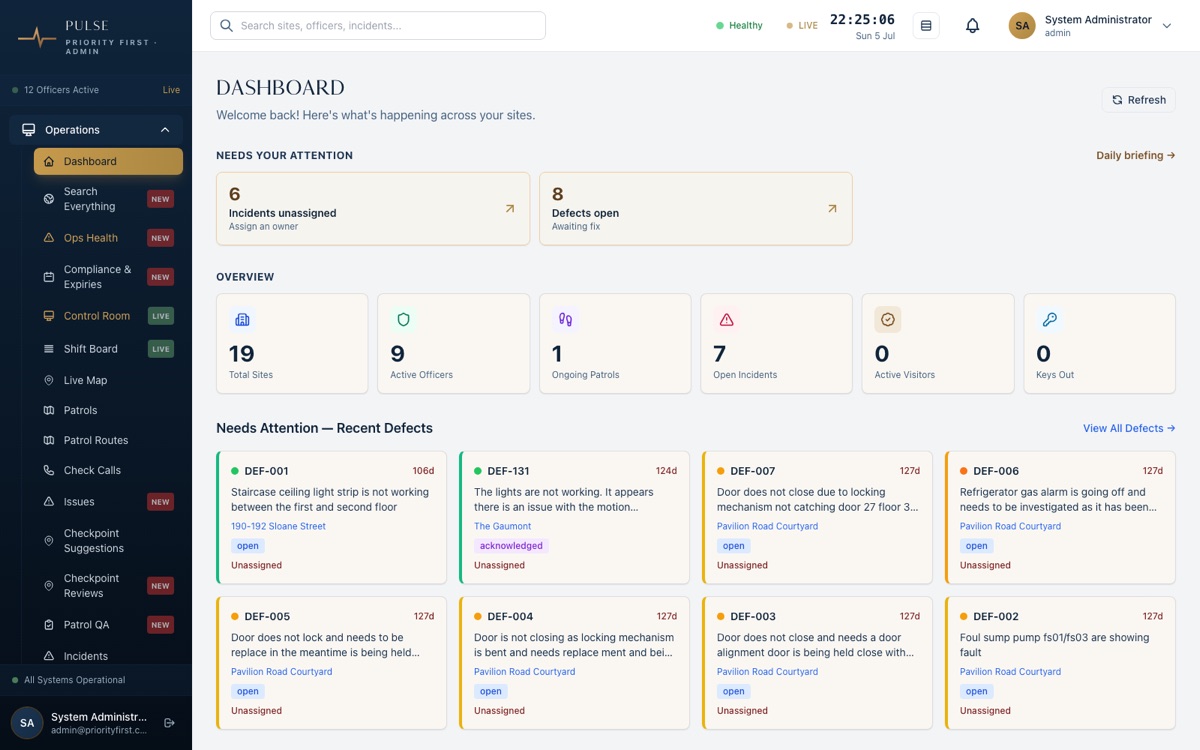
Everything covered above — supervision logs, checkpoint evidence, screening files, complaint resolution trails — is exactly the operational data an ACS assessor sits down and reviews. Pulse Operations builds that evidence as a by-product of the working day rather than as an annual scramble: every patrol checkpoint is completed by a mandatory watermarked photograph showing the officer, site, GPS location and time, and the whole record sits in a hash-chained, tamper-evident audit log rather than a filing cabinet.
The compliance runway pulls SIA licensing, BS 7858 screening, DBS checks, right-to-work and training expiries onto one screen, so the People and Resource management criteria that assessors scrutinise most closely are always evidence-ready, not reconstructed under deadline pressure. Pulse Operations's own ACS self-assessment guide sets out the ten pieces of evidence to have ready before an assessment, mapped directly to the seven ACS criteria.
If your ACS reassessment is on the horizon and your evidence still lives across spreadsheets and individual inboxes, get a demonstration of the compliance runway and photo-verified patrols at Pulse Operations, or explore published pricing to see what a year-round evidence habit would cost against the risk of losing points — or approval — at your next annual review.
Related Reading
- Body Worn Camera Rules for UK Security Firms 2026
- Guardhouse Alternative 2026: Best UK Options Compared
- SmartTask Alternative 2026: Best Options Compared