Last updated: 9 October 2026
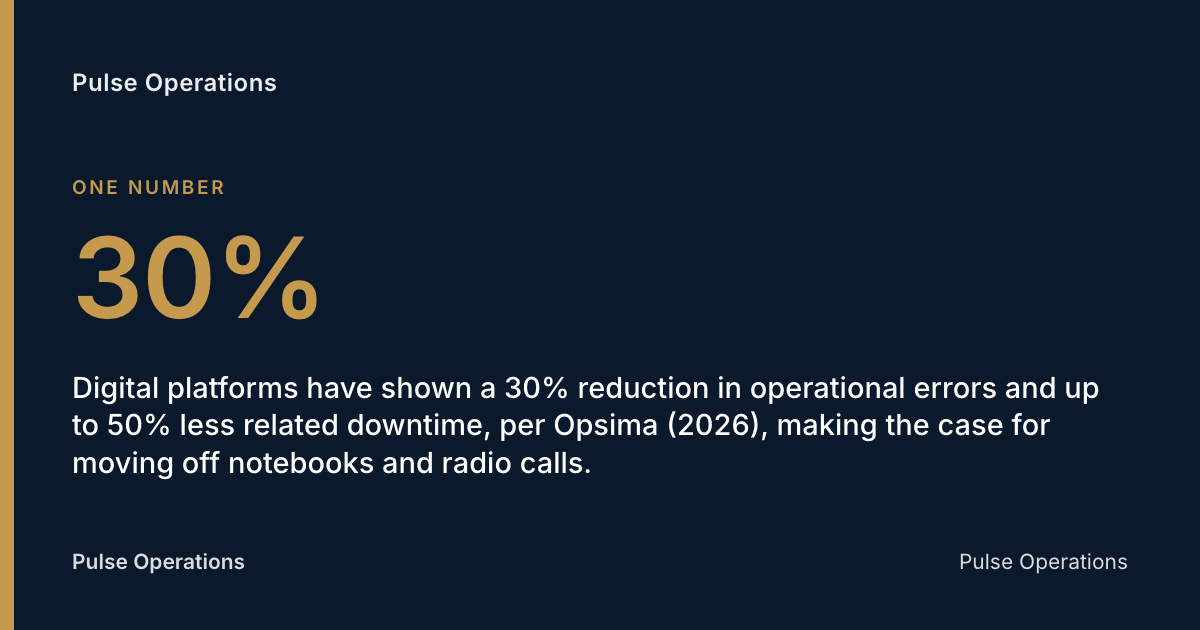
Automated shift handover software is a digital system that replaces verbal or paper handovers with a structured, time-stamped record of what happened on a shift, what's outstanding, and who's accountable next. Digital platforms have shown a 30% reduction in operational errors and up to 50% less related downtime, per Opsima (2026), making the case for moving off notebooks and radio calls.
Key takeaways
- Automated shift handover software replaces memory-based handovers with a structured, timestamped digital record that both shifts can query later.
- The NPRA 2009 National Safety Conference found that shift changeover periods account for less than 5% of operations staff time yet 40% of plant incidents occur during this window.
- EHS Today reports that every second incident in the process industry is linked to communication errors during shift handovers.
- The UK's Health and Safety Executive publishes specific handover guidance in HSG256, defining employers' legal duty to manage shift-work risk.
- Pulse Operations builds its handover record from the shift's actual logged activity — patrols, incidents and check calls — rather than a note written from memory at the end of a shift.
What is automated shift handover software?
Automated shift handover software is a digital platform that captures the events of one shift — tasks completed, incidents raised, equipment status, outstanding actions — and presents them to the incoming shift in a structured format, replacing handwritten logbooks, radio handovers and end-of-shift emails. The system timestamps every entry as it happens rather than reconstructing it afterwards.
This matters because the gap between what happened and what gets written down is where information disappears. EHS Today's literature review found that 80% of oil and gas production facilities' logbooks are in unstructured style and do not capture key information. A free-text notebook entry written at 5.55am for a 6am handover is a memory exercise, not a record.
Before digitisation, a significant share of field data simply vanishes at the point of handover. Opsima estimates that 50–90% of field operations data is lost at shift changes before systems are digitised — figures a security or facilities operator can recognise immediately: a missed checkpoint, a verbal "all fine" that wasn't, a maintenance note that never reached the day team.
In a security or FM context, automated shift handover software typically pulls from the officer's activity log, the incident register, and any check-call or welfare records, then assembles that into a handover note the next shift can read in minutes rather than reconstruct from a radio call. Pulse Operations's platform builds this from the daily occurrence book — an 18-type tamper-evident log — rather than a separate handover document, so the handover and the record of the shift are the same thing.
What problems does automated shift handover software solve compared to paper or verbal handovers?
Automated shift handover software solves the accuracy and accountability gap left by paper logbooks and verbal handovers, where information depends on memory, handwriting and whoever happens to still be in the room. MyShyft reports that up to 80% of serious workplace errors involve miscommunication during shift transitions, and cites The Joint Commission's finding that roughly 80% of serious medical errors involve miscommunication during patient handovers — a healthcare-specific figure, but one that illustrates how high-consequence a bad handover can be in any safety-critical setting.
Paper and verbal handovers fail in predictable ways:
- Nothing is searchable. A paper logbook from three weeks ago is a filing-cabinet problem, not a database query.
- Nothing is tamper-evident. A page can be rewritten; a verbal account can be softened after the fact.
- Context gets lost between shifts. The outgoing officer knows which plant room has a recurring fault; the incoming officer doesn't, unless it's written down properly.
- There's no link to evidence. A paper note that says "checked, all okay" carries no photo, no GPS point, no proof.
Standardised handover protocols close much of this gap. MyShyft reports that organisations implementing standardised handover protocols see up to 50% fewer task-related failures, and that SBAR-style structured handover formats show up to 70% improvement in communication clarity and effectiveness. The mechanism is simple: a fixed structure forces the outgoing shift to answer the same questions every time, so nothing depends on whether they remembered to mention it.
The consequence of getting this wrong is not hypothetical. The DuPont La Porte incident in 2014 resulted in four deaths and a $273,000 OSHA fine, with communication failures during shift handover identified as the root cause, per Oxmaint. That's a process-industry example, but the underlying failure — critical information not making it from one shift to the next — applies equally to a plant room fault left unreported on a residential estate or a missed patrol area on a construction site.
"A handover written from memory at 6am is fiction with good intentions. Build it from the shift's actual record — the patrols, the incidents, the check calls — and a quiet night stays one honest line while an eventful one reads like a proper log." — Mo Hassan, Founder, Pulse
Pulse Operations's case studies illustrate this directly. On a prestige central-London estate covering 16 buildings on one nightly round, the client previously had no way to see delivered-vs-contracted patrols without ringing the office — "one vague 'round complete'" was the entire handover. Since going live on Pulse in March 2026, the estate has recorded 4,100+ patrols, roughly 250–280 per building, with 100% of checkpoint completions photo-verified. The handover isn't a separate note anymore; it's the record itself.
What features should I look for when choosing shift handover software?
The features that matter most in shift handover software are structured data capture, tamper-evident storage, offline reliability, and integration with the systems operators already run — not a longer feature list. A platform built around free-text boxes is still, functionally, a digital notebook.
Look for:
- Structured entry types, not one free-text field — incidents, maintenance notes, access control events and welfare checks each need their own category so nothing is buried in prose.
- Photo or evidence attachment against each entry, so "checked, fine" has proof behind it rather than relying on trust.
- A tamper-evident audit trail — ideally cryptographically chained, so a regulator, client or insurer can verify nothing has been altered after the fact.
- Offline-first operation — a handover tool that stops working when the Wi-Fi drops is a liability on a basement plant room or a rural site.
- Recurring-issue detection, surfacing the same fault reported across multiple shifts, rather than leaving pattern-spotting to whoever remembers.
- A client-facing view, so the people paying for the service can see what was delivered without phoning the control room.
Pulse Operations builds its handover record on a hash-chained (SHA-256), tamper-evident audit log with a built-in integrity check that walks the whole chain — a design standard, as of August 2026, that goes beyond a simple "edited" flag on a record. The officer app is native iOS and Android, offline-first with self-healing sync, so a handover note started in a basement with no signal still saves correctly once connectivity returns.
How much does automated shift handover software cost in the UK?
Automated shift handover software in the UK is typically priced per user, per site, or as a flat platform fee, and costs vary significantly depending on whether handover is a standalone module or part of a wider operations platform. There is no single market-standard price, because the category spans everything from a basic digital logbook add-on to a full control-room platform.
| Pricing model | Typical structure | Best suited to |
|---|---|---|
| Per-user / per-operative | Monthly fee per active user, often with unlimited sites | Security, FM and mobile patrol firms scaling headcount |
| Per-site / per-location | Flat fee per managed site regardless of staff count | Multi-site retail, healthcare or utilities operators |
| Platform tier | Fixed monthly bands (e.g. Core / Professional / Enterprise) with feature gates | Growing operators wanting room to add control-room or compliance modules later |
| Bundled into wider CMMS/FM platform | Handover as one module inside a broader maintenance or FM suite | Facilities teams already committed to a CMMS |
A genuine comparison point is whether admin and supervisory seats are charged separately — some vendors charge per named user including back-office staff, which inflates the real cost per officer. Pulse Operations publishes its pricing openly at /pricing: priced per operative, with unlimited sites and free admin, control-room and client-portal seats on every plan — a structure that avoids the hidden per-seat creep common in this market.
Before comparing quotes, ask each vendor to confirm: cost per operative versus cost per named user, whether supervisor and admin logins are free, whether there's a setup or migration fee, and what the contract minimum term is.
What are the UK legal and regulatory requirements around shift handovers?
UK employers have a specific legal duty to manage the risks of shift work, including the handover itself, under the Health and Safety at Work etc. Act 1974 — the founding UK legislation requiring employers to ensure, so far as reasonably practicable, the health, safety and welfare of employees. The Health and Safety Executive (HSE) publishes dedicated guidance defining effective handover as having three core elements: preparation, face-to-face exchange, and cross-checking.
The HSE's HSG256 guidance, "Managing Shift Work", sets out employers' obligations to assess risks associated with shift patterns, including the communication breakdown risk at the point of handover. Separately, the Keil Centre — the human factors consultancy that developed shift handover guidance for HSE (Offshore Technology Report 96 003) — quantifies handover errors as a recurring causal factor in major incident investigations, including offshore disasters.
For sites holding hazardous substances above threshold quantities, the Control of Major Accident Hazards Regulations 2015 (COMAH) impose additional duties on operators to demonstrate robust safety management systems, of which shift handover is one documented element. Most security and FM contracts won't fall under COMAH, but the principle carries across: where a handover gap could plausibly lead to harm, a regulator or insurer will expect to see evidence that handover was managed, not assumed.
For security operators specifically, the Private Security Industry Act 2001 established the Security Industry Authority (SIA), and SIA-licensed operatives working under contract are expected to maintain accurate occurrence records — the same underlying discipline HSE guidance describes for industrial shift handover, applied to a guarding or patrol context. Operators pursuing the SIA's Approved Contractor Scheme (ACS) will find handover and occurrence-record quality assessed directly: per Pulse Operations's guide, The ACS self-assessment: how to evidence it, the ACS workbook scores a business against 78 individual indicators across seven criteria, and assessors review site documentation and interview staff as part of that process — handover records are exactly the kind of evidence an assessor will ask to see.
Who is responsible for ensuring handover information is accurate and complete?
The outgoing shift supervisor or lead officer carries the primary responsibility for ensuring a handover is accurate and complete, but UK health and safety law places the ultimate duty on the employer to have a system in place that makes accuracy achievable. The HSE's guidance is explicit that handover quality is a management responsibility, not solely an individual one — a workforce handed a broken or absent process cannot be blamed for its failure.
In practice, responsibility splits three ways:
- The outgoing individual logs events as they happen, not retrospectively, and flags anything unresolved clearly.
- The incoming individual is expected to read, question and cross-check the handover rather than accept it passively — HSE's "cross-checking" element exists precisely because passive handovers fail.
- The employer or operator is responsible for providing a system — digital or paper — that is structured enough to make accurate handover realistic within the time available. MyShyft ties this to standardisation: protocols like SBAR exist because an unstructured handover depends entirely on individual memory and diligence.
Pulse Operations's founding operation, Priority First — the founding team's own London security and FM business, where Pulse was built before being offered to other operators — illustrates how this plays out at mobilisation. When three buildings were added to Priority First's contract portfolio in a single July 2026 fortnight, checkpoints, site notes and induction history were loaded into Pulse before officers arrived on site. New officers started with full site history on day one, rather than relying on a verbal handover from whoever had covered the site previously — moving responsibility for accuracy from one person's memory into the system itself.
What common mistakes do companies make implementing shift handover software?
The most common mistake is treating shift handover software as a form-filling exercise rather than a change to how work is actually logged throughout the shift, which means staff keep working from habit and only populate the system retrospectively — reintroducing the exact memory problem the software was bought to solve.
Other recurring mistakes:
- No migration plan for historical site knowledge. Years of informal site knowledge sit in retiring supervisors' heads; if it isn't captured during rollout, the software launches with an empty record and no credibility.
- Making entry too slow. If logging an incident takes five minutes of typing, staff will do it at the end of the shift from memory — exactly the failure mode being fixed.
- No offline fallback. A system that only works with signal will be abandoned on the first site with a dead zone.
- Treating the rollout as IT-only. Handover software changes a cultural habit (what gets written down, when); it needs supervisor buy-in, not just a login email.
- Ignoring the client-facing side. If the client can't see what the software is capturing, the operator gains internal efficiency but no commercial benefit from it.
Mo Hassan, Founder of Pulse, puts the speed point directly: "Speed beats polish. A report filed in ninety seconds while the detail is fresh is worth more than a beautifully written account reconstructed at handover. Get the photo, the time and the plain-English account down first — the analysis can come later."
A landmark West London mixed-use development illustrates the fix. Before Pulse, there was no way to prove which plant room had actually been checked at 3am — a classic retrospective-logging problem. Pulse Operations made all 152 checkpoints across the site photo-mandatory, so a missed area shows as a visible gap in the record immediately, not a dispute raised six weeks later. Live since February 2026, the site has recorded 540+ patrols in five months (production data, July 2026) across 11 officers inducted on the single system — built from checkpoint data captured in real time, not reconstructed at shift end.
Your automated shift handover software checklist
- Confirm whether pricing is per operative, per site, or per named user, including admin seats.
- Check the audit trail is tamper-evident, not just "edit-logged" — ask how alterations are detected.
- Test offline performance on a site with poor signal before you sign anything.
- Map the handover fields to the HSE's three elements: preparation, face-to-face exchange, and cross-checking.
- Ask how historical site knowledge gets migrated in during onboarding, not just new data going forward.
- Confirm integration points with your existing CMMS, rostering or client-reporting tools.
- Check whether supervisors can set recurring-issue alerts, so repeat faults surface automatically.
- Ask for a reference client of similar size and sector before committing to a contract term.
FAQ
What is automated shift handover software?
Automated shift handover software is a digital system that records what happened during a shift — incidents, tasks, checks and outstanding issues — and presents it to the next shift in a structured, timestamped format, replacing paper logbooks and verbal handovers.
How does shift handover software reduce errors compared to a paper logbook?
Digital platforms structure data entry so nothing depends on memory or handwriting, and Opsima reports a 30% reduction in operational errors on digital shift handover platforms, alongside recovery of up to 45 minutes of productive time per shift.
Do UK employers have a legal duty around shift handovers?
Yes. The Health and Safety at Work etc. Act 1974 requires employers to manage risks to employee health and safety so far as reasonably practicable, and the HSE's dedicated shift handover guidance defines good handover practice as preparation, face-to-face exchange and cross-checking.
What industries use automated shift handover software in the UK?
Shift handover software is widely used in manufacturing, process industries (oil and gas, chemicals), healthcare, utilities, and security and facilities management — any sector running continuous or multi-shift operations where information must pass accurately between teams.
How much does shift handover software cost for a security or FM company?
Costs vary by pricing model — per operative, per site, or tiered platform fees — and operators should check whether admin and supervisor seats are charged separately, as this significantly affects real cost per site; Pulse Operations publishes its pricing openly at /pricing.
Can shift handover software work without internet access on site?
A well-designed system should, yes — look for offline-first design with automatic sync once connectivity returns, since many sites (basements, rural locations, plant rooms) have unreliable signal.
Who checks that shift handover information is accurate?
The incoming shift is expected to actively cross-check the handover rather than accept it passively, per HSE guidance, while the employer is responsible for providing a system structured enough to make accurate handover achievable within the time available.
Building shift handover into Pulse Operations
Pulse Operations treats shift handover as a by-product of good logging, not a separate form filled in at the end of a shift. Because every patrol checkpoint is completed with a mandatory watermarked photograph — officer, site, GPS, time — and every incident goes into the tamper-evident daily occurrence book as it happens, the handover for the next shift is simply the live record, not a reconstruction.
On the prestige central-London estate covering 16 buildings, the client moved from "one vague 'round complete'" to over 4,100 recorded patrols since March 2026, with 100% of checkpoint completions photo-verified — visible to the client directly through their own branded portal, not relayed secondhand by the outgoing shift.
If your handover currently depends on a notebook, a radio call, or whoever happens to still be on-site when the next shift arrives, it's worth seeing how Pulse Operations builds that record automatically. Book a walkthrough via /tour or check published pricing at /pricing to see what a fortnight's switch actually looks like.
Related Reading
- Security Guard Handover Best Practice UK (2026 Guide)
- Audit Trail for Security Operations: UK Guide 2026
- QR Code Guard Tour Disadvantages: UK Guide 2026
Add pulse-operations.co.uk as a preferred source on Google
Back to all insights