Last updated: 19 September 2026
Security guard handover best practice: the UK operator's guide
Security guard handover best practice means a structured exchange — written and verbal — covering incidents, access status, ongoing issues and equipment faults between outgoing and incoming officers. A good handover takes 10-15 minutes, is signed by both parties, and leaves a written record. Poor handovers are the single most common cause of dropped incidents and missed follow-ups on a site.
Key Takeaways
- A security guard handover is a structured exchange of information between outgoing and incoming officers, covering incidents, access status and outstanding tasks.
- A typical handover takes 10-15 minutes and should always leave a written or digital record, not just a verbal exchange.
- The outgoing officer is responsible for compiling the handover; the incoming officer is responsible for verifying it before signing.
- The Health and Safety Executive treats shift handover as a safety-critical communication process, not an administrative formality.
- Pulse Operations's own record shows that across 152 checkpoints on a West London mixed-use site, 540+ patrols were logged and photo-verified in the first five months live (production data, as of July 2026), giving each incoming officer a factual record to hand over from rather than a memory of the shift.
What is a security guard handover?
A security guard handover is the formal transfer of operational responsibility, information and outstanding tasks from an outgoing officer to an incoming officer at shift change. It exists because a site doesn't stop needing attention just because the person watching it changes — an unresolved fault, a suspicious vehicle, or a resident query needs to survive the changeover intact.
In UK security operations, handover typically happens at the guardhouse, gatehouse or control point, and covers three things: what happened during the shift, what's still outstanding, and what the next officer needs to check or watch for. It's distinct from a shift report, which is a record for management; a handover is a live briefing for the person taking over right now.
Roughly 450,000 people hold an SIA licence in the UK, per Security Jobs Board (2026), and the vast majority of them will hand over a shift at some point today. Yet handover itself isn't formally taught on the SIA's core Security Guard licence-linked training — it's left to company procedure, which is exactly where inconsistency creeps in.
What information must be included in a security guard handover report?
A security guard handover report must include every incident logged during the shift, the current status of access points and alarms, any outstanding tasks, and equipment or premises faults. Without these four categories, the incoming officer starts the shift blind to anything that changed in the previous eight or twelve hours.
The core content should cover:
- Incidents raised or ongoing — time, location, what happened, current status (open, resolved, escalated)
- Access control status — doors, gates or barriers that are locked out, propped, or on a temporary override
- Alarm and system status — any zones isolated, faults reported, or engineers due
- Outstanding tasks — parcels awaiting collection, contractors expected, permits to close out
- Equipment and premises faults — broken CCTV cameras, non-functioning lighting, damaged fencing
- VIP, welfare or lone-worker notes — anything a supervisor flagged during the shift
- Visitor and contractor log status — who's still on site, who's expected
Priority First's central-London concierge courtyard operation built its whole handover around one category most guides overlook: parcels. Every delivery is logged on arrival with a photo and signed out on collection, so any officer picking up the desk mid-shift inherits a chain of custody rather than a shelf of unlabelled boxes — a small category of information, but the one residents actually ask about.
What are the legal and regulatory requirements for shift handovers under UK standards?
There is no single UK law that names "security guard handover" as a mandatory step, but several regulatory frameworks make a documented handover effectively unavoidable. The Private Security Industry Act 2001 established the Security Industry Authority (SIA) and its licensing regime, which requires operatives to hold a valid Security Guard licence to work — a legal baseline, but one that says nothing about how information passes between shifts.
Where handover discipline becomes a genuine legal question is under the Health and Safety at Work etc. Act 1974. The HSE's guidance on shift handover frames it as a "safety-critical communication process" — poor handover has contributed to major incidents in high-hazard industries, which is why HSE guidance document HSG48 addresses it directly. For premises covered by the Terrorism (Protection of Premises) Act 2026 (Martyn's Law), a handover that fails to flag a security concern raised during the previous shift is a genuine compliance gap, not just an operational one.
Contracts referencing BS 7499 (code of practice for static guarding, mobile patrols and keyholding) typically require documented shift reporting as part of a compliant service, even though the standard doesn't script the handover itself word for word.
How long should a security guard handover typically take?
A security guard handover should typically take 10 to 15 minutes for a standard static guarding post, and up to 20-30 minutes for a large or multi-building site with several outstanding issues. Shorter than that, and detail gets skipped; longer, and it usually means the outgoing officer is reconstructing the shift from memory rather than reading from a live log.
The variable isn't officer competence — it's whether the record already exists. An officer handing over from a real-time log reads a summary aloud in minutes. An officer handing over from memory has to rebuild the shift first, which is where facts get lost or invented.
Priority First's 16-building central-London residential estate illustrates the scale problem directly: one nightly round across 16 buildings is exactly where a rushed, memory-based handover would let a missed building slip through unnoticed. Since going live on Pulse in March 2026, the estate has logged over 4,100 patrols — roughly 250-280 per building — with 100% of checkpoint completions photo-verified, so the handover conversation starts from a factual per-building record rather than a verbal "yes, all done."
What is the best format for a handover: verbal briefing, written log, or digital system?
The best handover format combines a written or digital record with a short verbal briefing — neither alone is sufficient. A written log without a verbal exchange misses tone and urgency; a verbal-only handover leaves no audit trail and is vulnerable to memory decay.
| Format | Strengths | Weaknesses | Best for |
|---|---|---|---|
| Verbal only | Fast, allows immediate questions | No record, memory-dependent, disputed after the fact | Never recommended alone |
| Paper log | Simple, no tech dependency | Can be filled in retrospectively, easily lost, no photo evidence | Small single-officer sites with light oversight |
| Digital system | Time-stamped, tamper-evident, links to patrols/incidents automatically | Requires app adoption and connectivity | Multi-officer, multi-site or contract-scrutinised operations |
| Verbal + digital | Combines context with an auditable record | Needs discipline to keep both aligned | Recommended standard for most UK guarding contracts |
The strongest handover pulls directly from the shift's actual record — patrols completed, incidents raised, check calls made — rather than being typed up separately at 6am. As Pulse's founder puts it:
"A handover written from memory at 6am is fiction with good intentions. Build it from the shift's actual record — the patrols, the incidents, the check calls — and a quiet night stays one honest line while an eventful one reads like a proper log." — Mo Hassan, Founder, Pulse
This is the exact gap between paper logs and platforms like Pulse Operations, TrackTik, Silvertrac, Guardhouse and SmartTask: a digital system that auto-populates the handover from the shift's logged patrols and incidents removes the reconstruction step entirely. See the full comparison for how each platform handles it.
What common mistakes lead to poor handovers between security shifts?
Poor handovers are usually caused by five recurring mistakes: rushing at the very end of shift, relying on memory instead of a live log, omitting "small" incidents deemed unimportant, failing to confirm the incoming officer actually understood the brief, and skipping the signature or sign-off step entirely.
The most damaging of these is the third. An officer decides a near-miss, a minor dispute, or a low-level alarm fault "isn't worth mentioning" — and it's precisely that category of low-level, unresolved issue that escalates on the next shift when nobody knows it happened before.
Common failure patterns include:
- Handover compiled in the last five minutes instead of maintained through the shift
- No verification step — incoming officer signs without reading or asking questions
- Verbal-only exchange with nothing written down for management or the client
- Sensitive information passed carelessly in earshot of visitors or residents
- Inconsistent format between officers, making it hard for supervisors to audit
- No escalation trail — an issue raised three shifts ago with no update on progress
Pulse Operations's tamper-evident daily occurrence book, covering 18 incident types, exists specifically to close the "small incident omitted" gap — every entry is hash-chained (SHA-256) so nothing can be quietly edited out after the fact, and a built-in integrity check walks the whole chain.
Who is responsible for ensuring a handover is completed properly?
Responsibility for a proper handover sits jointly with the outgoing and incoming officer, though the duty is different for each. The outgoing officer is responsible for compiling an accurate, complete record; the incoming officer is responsible for actively verifying it — checking the site, confirming access points, and querying anything unclear — before signing off.
A supervisor sits above both, with responsibility for auditing that handovers happen and happen properly, rather than for delivering any single handover. On larger contracts, this is typically written into the assignment instructions as a named duty, not left implicit.
The sign-off itself matters legally as well as operationally: a signed handover record is evidence, should a dispute or incident review follow. As Pulse's founder notes on the adjacent discipline of incident reporting:
"Speed beats polish. A report filed in ninety seconds while the detail is fresh is worth more than a beautifully written account reconstructed at handover. Get the photo, the time and the plain-English account down first — the analysis can come later." — Mo Hassan, Founder, Pulse
The same logic applies to handover: capture facts as they happen through the shift, and the handover becomes a read-through rather than a reconstruction.
How should incidents or ongoing issues be communicated during a handover?
Incidents and ongoing issues must be communicated with a clear status marker — open, monitoring, or resolved — plus the time raised and who's been notified. An incident handed over without a status is worse than one omitted entirely, because the incoming officer assumes it's closed when it isn't.
The minimum standard for each item:
- Time and location the issue arose
- Current status (open / monitoring / resolved / escalated to client or police)
- Who's aware — client contact, police reference number, supervisor notified
- What the incoming officer needs to do, if anything
For anything genuinely sensitive — a domestic dispute involving a named resident, a safeguarding concern, or an ongoing police matter — the handover should be conducted away from public areas and, where digital, access-restricted to relevant staff rather than visible in a general shift log. This is a GDPR consideration as much as an operational one: the ICO treats incident records containing personal data as subject to the same data-minimisation and access-control principles as any other personal record.
Your security guard handover checklist
- Compile the handover throughout the shift, not in the final five minutes
- Confirm the status of every access point, alarm zone and CCTV camera
- List all open incidents with a status marker (open / monitoring / resolved)
- Flag outstanding tasks — contractors expected, permits to close, parcels awaiting collection
- Verify equipment and premises faults are logged, not just mentioned verbally
- Have the incoming officer walk the site or check key points before signing
- Both officers sign and timestamp the record, digital or paper
- Handle sensitive or personal information away from public areas, restricted to those who need it
FAQ
What is a security guard handover takeover report?
A security guard handover takeover report is the written record produced at shift change, listing incidents, access status, outstanding tasks and faults, signed by both the outgoing and incoming officer. It serves as both an operational briefing and an auditable record for supervisors or clients.
How long should a security guard shift handover take?
A standard handover should take 10 to 15 minutes for a single-site static post, rising to 20-30 minutes for larger or multi-building sites with more to cover. If it's taking much longer, the record likely wasn't kept live through the shift.
Do security guards need an SIA licence to perform handovers in the UK?
Any officer working a licensable role, such as static guarding or door supervision, must hold a valid SIA licence to be on duty at all, which covers the handover as part of the shift. SIA-licensed guards typically earn £12-£15 per hour, compared to around £12 per hour for unlicensed in-house roles, per Fahrenheit Security (2026).
Who signs off a security handover report?
Both the outgoing and incoming officer should sign the handover record, confirming the information was given, received and understood. A supervisor may also countersign on contracts where handover quality is formally audited.
What happens if a security guard fails to complete a proper handover?
An incomplete handover risks a missed incident, an unresolved fault escalating unnoticed, or a client losing confidence in the contract's reliability. On contracts governed by BS 7499 or reviewed against Martyn's Law duties, a documented handover failure can also become a compliance finding during audit.
How often should security handover procedures be audited?
Best practice is a rolling audit — supervisors reviewing a sample of handover records weekly, alongside a fuller review at each contract review meeting. Digital systems that log handovers automatically make this a reporting exercise rather than a manual file check.
What's the difference between a handover report and an incident report?
A handover report summarises the whole shift for the next officer, including incidents, access status and outstanding tasks; an incident report documents one specific event in detail, independently of shift change. A good handover should reference incident reports rather than duplicate their content.
Building better handovers with Pulse Operations
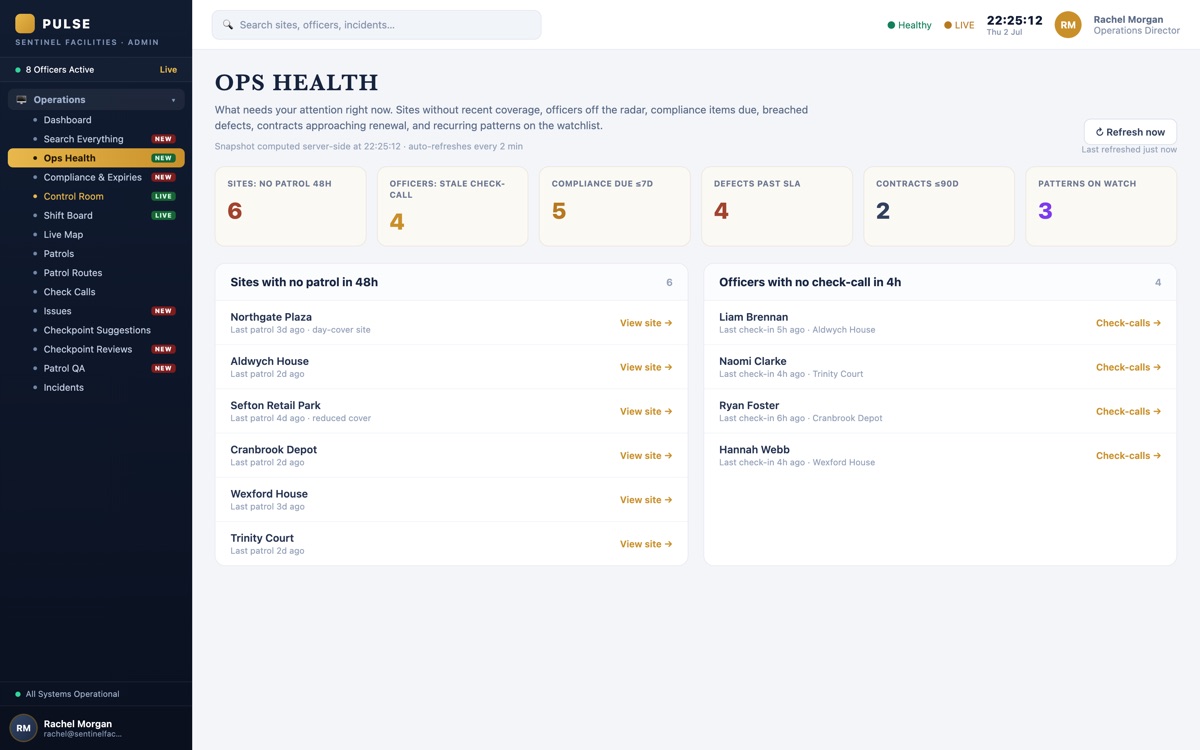
Every problem in this guide — reconstructed-from-memory handovers, omitted low-level incidents, no verification step, sensitive information handled carelessly — comes down to one thing: the record didn't exist in real time. Pulse Operations builds the handover automatically from the shift's actual data: photo-verified patrols, the tamper-evident 18-type occurrence book, and check calls logged as they happen, so the outgoing officer reads from a factual record instead of writing one from memory at the end of a long shift.
This is exactly how it works on Priority First, the founding team's own London security and FM operation, where Pulse was built before being offered to other operators. Across its West London mixed-use site, all 152 checkpoints are photo-mandatory, and a missed area shows up as a gap in the record — not a dispute raised six weeks later.
If your handovers currently rely on a paper log or a WhatsApp message at 6am, get a quote from Pulse Operations and see how photo-verified patrols and the client portal turn shift handover into a two-minute read-through rather than a reconstruction exercise.
Related Reading
- Security Guard Handover Template UK | Free Guide 2026
- Security Guard Equipment List UK (2026 Guide)
- Security Guard Timesheet Template UK (2026 Guide)