Last updated: 6 September 2026
Security guard equipment list UK: the complete 2026 buyer's guide
A UK security guard equipment list covers uniform and identification, personal protective equipment (PPE), radios and lone-worker devices, torches and patrol tools, plus body-worn cameras and photo-verification apps. The Security Industry Authority (SIA) licenses 328,000 UK security guards under rules requiring 128+ hours of initial training, according to Rock Security Solutions, making correct equipping both a legal duty and a client expectation.
Key Takeaways
- The Security Industry Authority (SIA) licenses 328,000 active security operatives in the UK, according to Rock Security Solutions.
- A basic UK security guard equipment list includes uniform, ID badge, torch, notebook, two-way radio, and personal attack alarm as a minimum standard.
- Photo-verified patrol apps are replacing paper logs and NFC/QR tag scans, because a tag scan only proves a phone touched a tag, not that a guard actually checked an area.
- Knife-related offences recorded across the UK have kept stab-resistant vests under active risk-assessment for higher-risk sites such as night-time retail and door supervision.
- The SIA carried out 1,147 site inspections in 2026/25 as part of its enforcement activity, according to its own annual report, cited by Grokipedia.
What is a security guard equipment list?
A security guard equipment list is a documented inventory of the uniform, PPE, communication tools and technology that a licensed security operative needs to carry out contracted duties safely, lawfully and to a verifiable standard. In the UK, three forces shape this list: the SIA — the statutory body established under the Private Security Industry Act 2001 that licenses individual guards — health and safety law under the Health and Safety at Work etc. Act 1974, and client contracts that increasingly specify technology such as body-worn cameras or photo-verified patrol evidence.
A good equipment list is not just a shopping list. It is a compliance artefact — the thing an SIA inspector, a client auditor, or an insurer will ask to see when something goes wrong.
The SIA licenses those 328,000 UK security guards under rules that mandate 128+ hours of initial training and 18 hours of annual continuing professional development (CPD), according to Rock Security Solutions. Equipment competency — knowing how to use a radio correctly, how to operate body-worn video lawfully, how to complete a patrol log — sits inside that training obligation, not outside it.
Front-line vs non-front-line licences and what they mean for kit
An SIA front-line licence covers roles where the guard has direct, uniformed contact with the public — door supervision, static guarding, mobile patrol and close protection. A non-front-line licence covers supervisory or management roles with no public-facing security function. Equipment obligations scale with the licence type: a door supervisor on a Soho nightclub door needs different kit to a control room manager watching CCTV from a back office in Leeds.
What must be on a UK security guard's basic equipment list?
The baseline UK security guard equipment list covers five categories: identification and uniform, PPE, communication devices, patrol and observation tools, and documentation. Every SIA-licensed operative should carry, as a minimum, a valid SIA licence badge, a company-issued uniform, a torch, a two-way radio or mobile device, and a means of recording incidents. Higher-risk sites add stab vests, body armour or body-worn cameras on top of this baseline.
Uniform and identification
- SIA licence badge — worn visibly at all times on front-line duties; this is a legal requirement, not a house rule
- Company uniform — branded jacket, trousers or skirt, footwear meeting the site's health and safety requirements
- Hi-vis vest or tabard — mandatory on construction sites and often required by local authority licensing conditions for door supervisors
- Weatherproof outerwear — essential for external patrol roles across a UK winter
- Name badge or shoulder number — increasingly required by clients for accountability
Personal protective equipment (PPE)
PPE is equipment worn or held by a worker to protect against health and safety risks on the job — for security guards, this ranges from hi-vis clothing to stab-resistant vests. Employers have duties under the Health and Safety at Work etc. Act 1974 and the Personal Protective Equipment at Work Regulations 1992 to assess risk and provide appropriate PPE free of charge. For security guards this typically includes:
- Safety footwear for construction or industrial sites
- High-visibility clothing meeting BS EN ISO 20471 where relevant
- Cut-resistant or stab-resistant gloves for specific roles
- Stab vests or body armour on assessed higher-risk deployments
Knife-related offences recorded across England and Wales have remained a live concern through 2024 and into 2026. That pattern is one reason more operators are risk-assessing stab vests for night-time retail, hospitality and door supervision roles rather than treating body armour as an event-only extra.
Communication and lone-worker devices
- Two-way radio (digital mobile radio or analogue UHF)
- Smartphone running the officer's operational app
- Personal attack alarm
- Lone-worker device with SOS and welfare-check functionality
Patrol and observation tools
- Torch (rechargeable, minimum 200 lumens for external patrols)
- Notebook or digital incident logging tool
- Keys and key-holding equipment, logged by name
- Handcuffs — legal for licensed door supervisors to carry in specific circumstances, but not a general SIA entitlement across all roles
Documentation and compliance paperwork
- SIA licence (physical or digital)
- Disclosure and Barring Service (DBS) certificate reference where required by the contract
- Right to work evidence
- Site-specific assignment instructions
How does body-worn technology change the equipment list?
Body-worn technology has moved from optional extra to standard requirement on most professionally managed UK security contracts. Body-worn cameras, GPS-enabled patrol apps and photo-verification tools now sit alongside torches and radios as core kit, because clients increasingly demand proof of presence rather than a signed paper sheet. The shift is driven by disputed incidents, insurance requirements, and the simple fact that a photograph is far harder to fabricate than a tick in a logbook.
Traditional guard tour systems relied on NFC tags or QR codes fixed to walls, scanned by a phone as the guard passed. The problem, as Pulse Operations sets out in its guide How to prove patrols actually happened, is that a tag scan only proves a phone was held near a tag at a moment in time — not that a person was genuinely present and alert, or that anything was actually checked. Tags can be scanned on the way past without a proper check, scanned from a photo taken earlier, or simply fail — painted over, ripped off, or sitting in a spot with no signal. Operators comparing patrol technology options can see how different platforms handle this in the Security Patrol App: The 2026 UK Buyer's Guide.
Pulse Operations builds equipment around this principle by design. Every checkpoint on the Pulse officer app is completed by a mandatory watermarked photograph — officer, site, GPS coordinates and precise timestamp — with no QR or NFC scanning at all. The photo captures the state of the area, not just a footprint. Pulse's own operational data shows 96.2% of checkpoints across live operations carried a watermarked photo over a trailing 90-day period as of July 2026; the current figure is published on the benchmark page.
In practice: a 152-checkpoint West London site
A mixed-use development in West London — retail, residential, plant rooms and service yards on one of the area's best-known streets — had no way to prove which plant room was actually checked at 3am. This is Priority First, the founding team's own London security & FM operation, where Pulse was built and tested before being opened to other operators. The client wanted proof the whole footprint was walked, not promised. All 152 checkpoints were made photo-mandatory; a missed area now shows as a gap in the record rather than a dispute six weeks later. Since going live in February 2026, the site has logged over 540 patrols across 11 officers, with all 152 checkpoints photographed. That is production data as of July 2026, not a projection.
What is a typical cost for security guard equipment in the UK?
Equipment costs for a UK security operative typically range from a low-cost basic kit for a static guard through to a substantial investment for a fully equipped mobile patrol or door supervision role. Costs vary by role, site risk assessment, and whether the operator supplies technology such as body-worn cameras or relies on the officer's own smartphone running a company app.
| Equipment category | Typical illustrative cost per officer | Notes |
|---|---|---|
| Basic uniform set | £80–£200 | Jacket, trousers, hi-vis, footwear |
| Torch | £15–£60 | Rechargeable models cost more but reduce ongoing spend |
| Two-way radio | £80–£300 per unit | Digital mobile radio units cost more than analogue |
| Personal attack alarm | £10–£30 | Often supplied as standard by responsible employers |
| Stab vest (covert or overt) | £150–£450 | Depends on certification level (e.g. KR1, SP1) |
| Body-worn camera | £150–£500 per unit | Plus ongoing data storage costs |
| Officer app / patrol software | Priced per operative, from published SaaS tiers | Often replaces paper, tags and standalone GPS trackers |
These figures are illustrative ranges based on typical UK market pricing, not a study finding — always confirm current pricing with individual suppliers.
Ways to reduce equipment costs without cutting corners
- Standardise on one uniform supplier across all contracts to secure volume pricing
- Use officers' own smartphones with a company-managed app rather than issuing separate handheld devices, provided data security is controlled at the tenant level
- Buy rechargeable torches — higher upfront cost, lower total cost of ownership over a 12-month rota
- Replace paper patrol books and NFC tags with a single app that covers patrols, incidents and the occurrence book, cutting duplicated stationery and hardware spend
- Review PPE risk assessments annually rather than issuing stab vests or body armour as a blanket default across every site
Alternatives to consider
Not every site needs full body armour or a dedicated body-worn camera fleet. A low-footfall commercial office might need only uniform, radio and an app-based patrol log, while a construction site under the Construction (Design and Management) Regulations 2015 will need hi-vis, safety footwear and site-specific PPE regardless of the security threat level. A proper risk assessment — not a generic equipment list — should always determine the final kit.
How does compliance and regulation shape the equipment list?
UK security equipment requirements are shaped directly by SIA licensing conditions, the Terrorism (Protection of Premises) Act 2026 (commonly known as Martyn's Law), and site-specific health and safety law. Getting this wrong is not a minor administrative slip: the SIA carried out 1,147 site inspections, issued 103 formal warnings and 440 improvement notices, and secured a 91% conviction rate across 27 prosecutions in 2026/25, according to the SIA's own annual report, cited by Grokipedia. Equipment and documentation gaps are a common trigger for these interventions.
Martyn's Law and equipment planning
Martyn's Law — the Terrorism (Protection of Premises) Act 2026 — introduces a two-tier system based on venue capacity. The standard tier applies to premises hosting between 200 and 799 people at the same time, while the enhanced tier applies to premises and events hosting 800 or more people, according to ProtectUK / Home Office. Named after Martyn Hett, one of the 22 people killed in the 2017 Manchester Arena attack, the law was driven onto the statute book by his mother Figen Murray's campaign — per Pulse Operations's own guide, Martyn's Law: a readiness guide for security & FM teams.
For equipment planning, this means enhanced-tier sites need documented, current risk assessments — not one-off exercises — and a designated responsible person who can evidence that staff have been trained and equipped appropriately. That evidence trail is exactly what a photo-verified patrol system and a tamper-evident occurrence book are built to provide.
BS 7858 and vetting as part of the equipment picture
BS 7858 is the British Standard for security screening of individuals employed in a security environment, covering identity checks, employment history and references. Equipment alone does not make a compliant operation: officers deployed with radios, keys or body-worn cameras handling sensitive data should be screened to BS 7858 before deployment. A guard carrying site keys without proper vetting is a bigger liability than a guard without a stab vest on a low-risk site.
In-house equipment management vs a unified platform
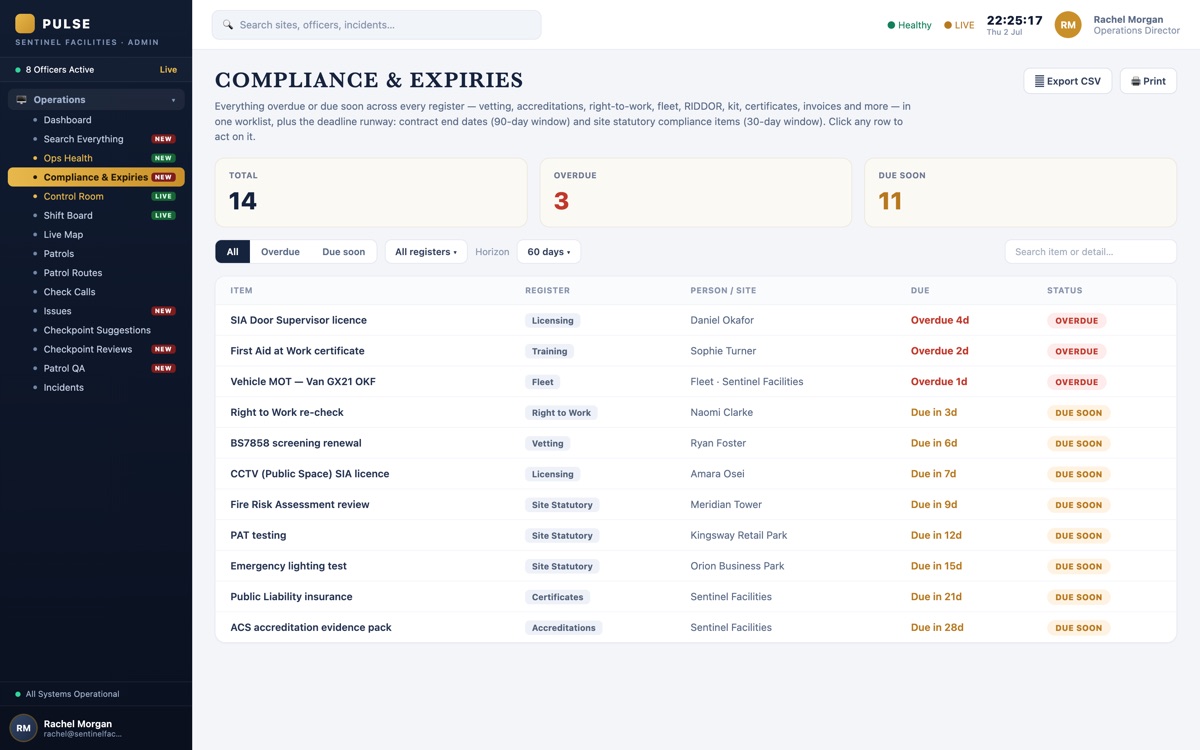
Security operators face a genuine choice: manage uniform, PPE, radios, body-worn cameras and compliance paperwork as separate systems and spreadsheets, or run them through a single operations platform. In-house spreadsheet management is cheaper to start but creates blind spots — nobody notices an expired SIA licence or an unreturned radio until an audit or an incident forces the question. A unified platform such as Pulse Operations puts SIA licences, DBS checks, right-to-work evidence, training records and statutory building compliance on one expiries runway, alongside the patrol and incident evidence that proves the equipment was actually used properly on shift. Operators evaluating this kind of consolidation may also find Integrated Security & FM Software UK useful background.
The trade-off is genuine: spreadsheets need no subscription and suit a two-guard operation; a platform earns its cost once an operator is running multiple sites, multiple clients and a compliance runway that a spreadsheet cannot flag automatically. Pulse's compliance runway (/compliance) is designed for operators past that threshold.
Your security guard equipment list checklist
- Confirm every officer holds a valid, in-date SIA licence for the role being performed
- Issue uniform and ID badge matching the site's assignment instructions
- Complete a PPE risk assessment before issuing stab vests, gloves or hi-vis beyond the site minimum
- Supply a working torch, radio and lone-worker device to every patrol or mobile officer
- Replace paper patrol books and NFC/QR tags with a photo-verified patrol app
- Screen officers to BS 7858 before issuing keys or access to sensitive areas
- Check whether the site falls under Martyn's Law standard or enhanced tier and equip accordingly
- Log all equipment issue and return against the officer's record, not a paper sign-out sheet
FAQ
What equipment is a security guard legally allowed to carry in the UK?
Security guards can legally carry standard kit such as a torch, radio, notebook, personal attack alarm and, where risk-assessed, PPE like stab vests. Handcuffs are only lawful for licensed door supervisors in narrowly defined circumstances and are not a general entitlement across all SIA licence categories, so operators should always check current SIA guidance before issuing them.
Do UK security guards need an SIA licence to use equipment like CCTV or body cameras?
No specific separate licence is needed to operate a body-worn camera. The guard performing front-line duties must hold a valid SIA licence for their role regardless of the equipment carried, and operators should ensure body-worn camera use complies with UK GDPR and Information Commissioner's Office (ICO) guidance on data protection.
Can security guards wear stab vests or body armour in the UK?
Yes, security guards can wear stab vests and body armour where a risk assessment justifies it, and ownership of body armour is not restricted for adults in England and Wales. Employers should select vests against recognised certification standards such as KR1 or SP1 and base the decision on documented site risk, not blanket policy.
Is it legal for security guards to carry handcuffs in the UK?
Only licensed door supervisors may carry and use handcuffs, and only in specific, justified circumstances as part of their SIA-licensed role. General security guards without a door supervisor licence are not permitted to carry them, and misuse can trigger SIA enforcement action.
What PPE must employers provide to security guards under UK law?
Employers must provide appropriate PPE free of charge under the Personal Protective Equipment at Work Regulations 1992 and the Health and Safety at Work etc. Act 1974, based on a documented risk assessment for each site. This can include hi-vis clothing, safety footwear, gloves, and, where justified, stab-resistant vests.
Are body-worn cameras legal for security guards under UK GDPR?
Yes, body-worn cameras are legal for security guards provided their use complies with UK GDPR and the Data Protection Act 2018, including a lawful basis for recording, clear signage where practical, and defined data retention periods. Operators should complete a Data Protection Impact Assessment (DPIA) before deploying body-worn video at scale.
What is the difference between front-line and non-front-line SIA licences?
A front-line SIA licence covers roles with direct uniformed contact with the public, such as door supervision or static guarding, while a non-front-line licence covers supervisory or office-based security management roles. Equipment requirements are generally higher for front-line roles, which face greater public interaction and physical risk.
How does Martyn's Law affect security equipment requirements at UK venues?
Martyn's Law requires premises hosting 200 or more people to prepare for a possible terrorist attack, with enhanced duties for venues hosting 800 or more, including documented, current risk assessments. This drives demand for equipment and systems that can evidence training, procedures and staff readiness, not just physical kit like radios or vests.
Proving equipment was actually used properly with Pulse Operations
An equipment list only matters if you can prove the kit was used properly on the night — that the torch checked the fire escape, that the radio call was logged, that the patrol actually happened. Pulse Operations was built inside Priority First, the founding team's own London security & FM operation, specifically to close this gap: every checkpoint on the officer app is completed by a mandatory watermarked photograph, not a tag scan, giving operators and clients a genuine evidence trail rather than a paper promise.
As one concrete proof point, Pulse's own operational data shows 96.2% of checkpoints across live operations carried a watermarked photo over a trailing 90-day period as of July 2026, published on the benchmark page. Pulse's compliance runway sits alongside this evidence layer, tracking SIA licences, BS 7858 screening, DBS checks, right-to-work documents and Martyn's Law readiness on one expiries dashboard — so equipment compliance and personnel compliance live in the same system rather than separate spreadsheets. The platform is UK-built and UK-hosted, with tenant isolation enforced in the data layer and verified by an automated cross-tenant test suite on every build.
If your equipment list is solid but your proof of use isn't, get in touch with Pulse Operations for a demo of the officer app and client portal, or explore current published pricing to see how a photo-verified patrol system fits your operation. Every plan includes guided setup, migration and a parallel run on one site, and most firms complete the switch within a fortnight.
Related Reading
- Security Site Induction Checklist UK: Full 2026 Guide
- Guardhouse Alternative 2026: Best UK Options Compared
- SmartTask Alternative 2026: Best Options Compared
- Security Patrol App: The 2026 UK Buyer's Guide
- Integrated Security & FM Software UK | Pulse Operations