Last updated: 7 September 2026
Martyn's Law for outdoor events: what UK organisers need to know
Martyn's Law — the Terrorism (Protection of Premises) Act 2026 — applies to outdoor events expecting 800 or more people at the busiest time, where entry is controlled and the event is open to the public. The Act received Royal Assent on 3 April 2026 and is expected to come into force in spring 2027, requiring organisers to plan and train for a terrorist attack.
Key Takeaways
- Martyn's Law applies to outdoor events with 800+ expected attendees, controlled entry, and public access — a festival in a park meets this test even without a fixed perimeter, according to RiskStop (2026).
- The Terrorism (Protection of Premises) Act 2026 received Royal Assent on 3 April 2026 and carries a minimum 24-month implementation period, pointing to a spring 2027 start date, per GOV.UK (2026).
- Enhanced tier events and premises face fines of up to £18 million or 5% of global revenue, whichever is higher, with daily penalties up to £50,000, according to Praxis42 / Policy Pros (2026).
- Standard tier premises face a maximum fine of £10,000 plus daily penalties up to £500 for non-compliance, per Policy Pros (2026).
- Over 250,000 premises across the UK are expected to fall within scope of Martyn's Law, according to Pool Re (2026).
What is Martyn's Law?
Martyn's Law is the public name for the Terrorism (Protection of Premises) Act 2026, UK legislation that requires operators of qualifying premises and events to put procedures in place — and, in higher-risk cases, physical measures — to reduce harm from a terrorist attack. The Act is named after Martyn Hett, who was killed in the 2017 Manchester Arena attack, and was campaigned for by his mother, Figen Murray.
The Act creates two tiers of duty: standard tier, for premises and events expecting 200–799 people, and enhanced tier, for those expecting 800 or more. The Security Industry Authority (SIA) — the body that already licenses door supervisors and security operatives under the Private Security Industry Act 2001 — will regulate and enforce Martyn's Law. "The release of the guidance for the Terrorism (Protection of Premises) Act 2026, known as Martyn's Law, marks an important step forward in strengthening the safety and resilience of public spaces across the UK," says Michael Kill, CEO of the Night Time Industries Association and Chair of the UK Door Security Association.
Does Martyn's Law apply to outdoor events?
Martyn's Law applies to an outdoor event when three conditions are met together: the event expects 800 or more attendees at its busiest point, entry to the event is controlled, and the event is open to the public. This is distinct from qualifying premises, which are physical locations occupied for a defined use — a stadium, a shopping centre, a place of worship. An outdoor event without a permanent venue, such as a festival on council-owned parkland, a food and drink festival, or a firework display in a public square, is assessed under the events limb of the Act rather than the premises limb.
RiskStop confirms that qualifying public events not held in a permanent venue — such as a festival in a park — come under Martyn's Law if they expect 800+ attendees at any one time and have controlled entry, according to RiskStop (2026). The SIA has been explicit that the intent is safety, not restriction. Laura Gibb of the SIA told Festival Insights that events are only in scope "if 800 or more people are expected at the busiest times, there are controls on entry, the event is open to the public, and it is not held at premises already classed as enhanced tier," according to Festival Insights (2026).
This "controlled entry" test matters most for the events sector, because it excludes genuinely open, unbounded gatherings — a council fireworks night with no ticketing or fencing, for example — while capturing ticketed festivals, gated fairs, and events with wristbands, bag checks, or paid admission.
Qualifying events versus qualifying premises
A qualifying premises is a fixed location used for a relevant activity — retail, entertainment, hospitality, education, and more — assessed on its permanent capacity and use. A qualifying event is a temporary, standalone gathering not tied to enhanced-tier premises, assessed on expected peak attendance and entry controls for that specific occasion. Organisers frequently conflate the two limbs of the Act, so the distinction is worth stating plainly.
If your outdoor event is held at a venue already classed as enhanced tier — a festival held annually on the same permanent showground that itself qualifies as enhanced tier premises — the premises duty may apply instead of, or alongside, the event duty. Get this wrong and you either under-prepare your compliance documentation or duplicate work unnecessarily.
What are the standard and enhanced tiers for outdoor events?
The standard tier applies to outdoor events expecting between 200 and 799 people; the enhanced tier applies to events expecting 800 or more. The tier an event falls into determines the scale of duty: standard tier requires procedures only — training, communication, lockdown and evacuation plans; enhanced tier adds a documented public protection procedure, a public protection plan, and, in some cases, physical security measures. An estimated 278,880 UK venues fall into the standard tier category, according to KGFM Ltd (2026), giving a sense of the sheer scale of premises and events this legislation touches, even before outdoor events are counted separately.
| Tier | Attendance threshold | Core duties | Maximum fine |
|---|---|---|---|
| Standard tier | 200–799 people | Procedures: staff training, evacuation, invacuation, lockdown, communication | £10,000, plus daily penalties up to £500 (Policy Pros, 2026) |
| Enhanced tier | 800+ people | Procedures plus a documented public protection plan; may require physical measures | Up to £18 million or 5% of global revenue (whichever is higher), plus daily penalties up to £50,000 (Praxis42 / Policy Pros, 2026) |
For a mid-size event organiser running, say, a 900-capacity ticketed outdoor food festival in Bristol, this table is the whole compliance conversation in miniature: cross 800 and the exposure moves from a low five-figure fine to a potentially business-ending one.
Who is the responsible person for an outdoor event?
The "responsible person" under Martyn's Law is the individual or organisation with control over the event — typically the event organiser, but potentially the landowner, local authority, or licensing body depending on the contractual arrangement. For a one-off event on council-owned land, such as a summer festival in a London borough park, responsibility often needs to be agreed explicitly between the council (as landowner) and the promoter (as organiser) before the event is licensed.
This matters because Martyn's Law sits alongside, not instead of, existing event safety frameworks. A Temporary Event Notice (TEN) — a short-notice permission under the Licensing Act 2003 that allows licensable activities at a specific event — an event safety plan built to the Purple Guide (the industry-standard guidance for the safe management of outdoor events), and a premises licence application are all still required where applicable. Martyn's Law adds a distinct, additional duty focused specifically on terrorism preparedness — evacuation, invacuation, lockdown, and communication in the event of an attack — rather than replacing general health and safety or licensing obligations.
John Shepherd, representing Band on the Wall in Manchester, put the underlying rationale simply: "Martyn's Law will make people safer; that's the bottom line and that's why we are delighted to support Figen Murray and all those campaigning for change."
Outsourced compliance versus running it in-house
Event organisers generally choose between building Martyn's Law compliance in-house — training a duty manager, writing procedures, and maintaining evidence themselves — or bringing in specialist security and compliance support to manage the public protection plan, the training records, and the on-the-day evidence trail. In-house works for organisers running a single, well-understood annual event with a stable team. Outsourced support tends to suit organisers running multiple sites, touring festivals, or one-off events where nobody on the core team has prior counter-terrorism planning experience. Either route needs the same underlying evidence: who was trained, when, on what, and what was actually done on the day — which is where most organisers' paperwork falls down first. Security providers using a security patrol app for other parts of their operation often find it easier to extend the same evidence discipline to Martyn's Law duties, since the underlying record-keeping problem is the same.
When does Martyn's Law come into force?
Martyn's Law is expected to come into force in spring 2027, following Royal Assent on 3 April 2026 and a statutory minimum implementation period of 24 months. This confirms the Act is law now, but enforcement and the SIA's regulatory powers do not begin until the implementation window closes. According to GOV.UK (2026), the Terrorism (Protection of Premises) Act 2026 received Royal Assent on 3 April 2026, with the implementation period running at least 24 months.
For outdoor event organisers, spring 2027 is not a date to plan around — it's a deadline to plan backwards from. Recruiting, training and documenting a public protection procedure for an 800-capacity festival takes months, not weeks, particularly where seasonal staff and subcontracted security providers are involved. Organisers running summer 2027 events should treat spring through winter 2026 as the working compliance window, not the few weeks before the Act takes effect.
Julie Hammond, Chief Executive of ICC Wales and The Celtic Collection, described the direction of travel: "Martyn's Law is a significant step forward in making venues safer for everyone, and we wholeheartedly welcome this new legislation." Campaigner Figen Murray framed the earlier consultation stage the same way: "Today's consultation is the start of making us all that bit safer."
What penalties apply for non-compliance at outdoor events?
Non-compliance penalties under Martyn's Law scale sharply with an event's tier, from a capped fine for standard tier events to revenue-linked fines for enhanced tier events. Standard tier premises and events face a maximum fine of £10,000, with daily penalties up to £500 for continued non-compliance, according to Policy Pros (2026). Enhanced tier premises and qualifying events face fines of up to £18 million or 5% of the organisation's global revenue, whichever is higher, with daily penalties up to £50,000, according to Praxis42 / Policy Pros (2026).
The SIA will hold enforcement powers modelled on other UK regulators — inspection, improvement notices, and monetary penalties — rather than criminal prosecution as a first resort. But for an 800-capacity outdoor event, the enhanced tier fine ceiling is high enough that insurers, funders and local authorities are likely to treat Martyn's Law compliance as a precondition of event approval well before the SIA issues its first penalty notice.
Your Martyn's Law outdoor event checklist
- Confirm your event's expected peak attendance and whether it crosses the 200 or 800 threshold at any single point during the event.
- Check whether entry is "controlled" — ticketing, wristbands, gated access or bag checks — as this determines whether the event limb of the Act applies at all.
- Identify the responsible person in writing with the landowner or council before the event is licensed, particularly for one-off events on public land.
- Draft a public protection procedure covering evacuation, invacuation, lockdown and communication, distinct from your general event safety plan.
- Train named staff and stewards on the procedure and keep dated, auditable training records — not just a signed attendance sheet.
- Align your Martyn's Law duty with existing licensing — your Temporary Event Notice, premises licence, and Purple Guide-based event safety plan.
- Build an evidence trail for the day itself — who was on duty, where, and when — so you can demonstrate compliance if the SIA ever asks.
- Review your compliance documentation annually and after any material change to expected attendance or site layout.
FAQ
What is Martyn's Law and how does it apply to outdoor events?
Martyn's Law is the Terrorism (Protection of Premises) Act 2026, which requires organisers of qualifying premises and events to prepare for a terrorist attack. It applies to outdoor events expecting 800 or more attendees with controlled entry that are open to the public, according to RiskStop (2026).
Does Martyn's Law apply to festivals held in public parks with no fencing or ticketing?
Generally no — Martyn's Law only applies to events with controlled entry, meaning ticketing, gating, or similar restrictions on access. A genuinely open festival in a park with no entry controls, even with high attendance, is unlikely to meet the "controlled entry" test set out by the SIA, according to Festival Insights (2026).
What is the difference between qualifying premises and qualifying events under Martyn's Law?
Qualifying premises are fixed locations used for a relevant activity, such as a stadium or shopping centre, assessed on their permanent capacity and use. Qualifying events are temporary, standalone gatherings not tied to enhanced-tier premises, assessed on expected peak attendance and entry controls for that specific event.
What attendance threshold applies to outdoor events under Martyn's Law?
Outdoor events fall into the standard tier at 200–799 expected attendees and the enhanced tier at 800 or more, provided entry is controlled and the event is open to the public. This threshold is confirmed by RiskStop (2026) and Festival Insights (2026).
Who is the "responsible person" for an outdoor event under Martyn's Law?
The responsible person is typically the event organiser, but this must be confirmed contractually where a third party — such as a local council — owns the land the event is held on. Responsibility should be agreed and documented before the event is licensed, not left implicit.
When does Martyn's Law come into force for event organisers?
Martyn's Law is expected to come into force in spring 2027, following Royal Assent on 3 April 2026 and a minimum 24-month implementation period, according to GOV.UK (2026). Organisers running summer 2027 events should begin compliance work well in advance of that date.
What penalties apply for non-compliance with Martyn's Law at outdoor events?
Standard tier events face fines up to £10,000 plus daily penalties up to £500, according to Policy Pros (2026). Enhanced tier events face fines up to £18 million or 5% of global revenue, whichever is higher, plus daily penalties up to £50,000, according to Praxis42 / Policy Pros (2026).
Are village fetes, fairs, and Christmas markets exempt from Martyn's Law?
Many will fall outside scope if they attract fewer than 200 people, have no controlled entry, or are not open to the general public in the way the Act defines. Larger, ticketed Christmas markets or gated fairs expecting 200 or more attendees should assess themselves against the standard tier regardless of their traditional, low-key reputation.
Securing your outdoor event with Pulse Operations
Martyn's Law compliance for an outdoor event isn't a document written once — it's evidence that has to be produced event after event: who was trained, who was on duty, what checks happened and when. Pulse Operations builds exactly this kind of evidence trail for security and FM operators, on the view that a compliance file that can't be evidenced under scrutiny isn't compliance, it's paperwork.
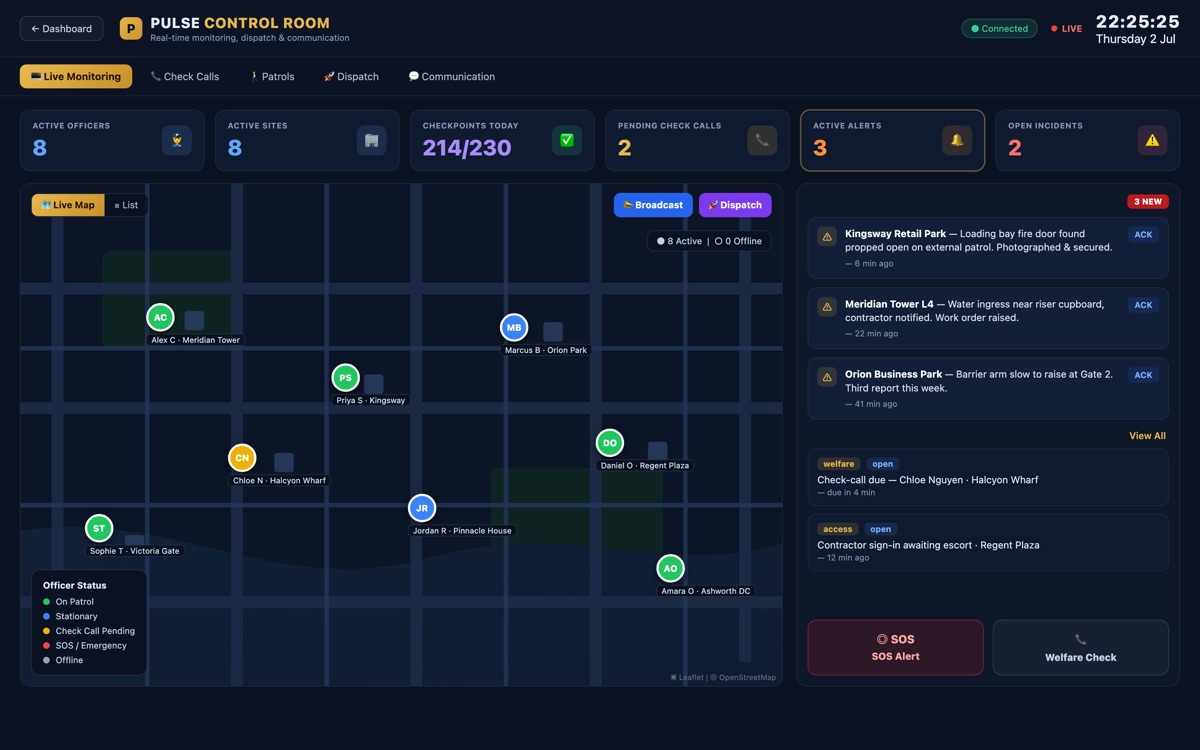
Pulse Operations' compliance runway puts SIA licensing, BS 7858 vetting, DBS checks, right-to-work status, training records and Martyn's Law assessments on one expiries timeline, so nothing lapses quietly between events. On the ground, every patrol checkpoint on Pulse is completed with a watermarked photograph — officer, site, GPS and time — rather than an NFC or QR tag scan that only proves someone was near a post rather than doing the job; across live operations on the platform, 96.2% of checkpoints carry a watermarked photo, according to Pulse Operations' own trailing 90-day data (as of July 2026, see pulse-operations.co.uk/benchmark). Because councils, promoters and insurers increasingly want to see the evidence themselves, Pulse Operations' white-label client portal shows delivered-versus-contract with honest empty states, under the organiser's own brand rather than Pulse's — an approach also relevant to teams weighing up broader integrated security and FM software for year-round operations, not just single events.
If you're organising or securing an outdoor event that will fall within Martyn's Law scope before spring 2027, talk to Pulse Operations about building your compliance evidence now, while there's still time to get it right before enforcement begins.
Related Reading
- Guardhouse Alternative 2026: Best UK Options Compared
- SmartTask Alternative 2026: Best Options Compared
- TrackTik Pricing 2026: UK Cost Guide & Alternatives