Last updated: 28 August 2026
Martyn's Law training course: what UK businesses need to know before commencement
A Martyn's Law training course teaches staff and responsible persons how to meet duties under the Terrorism (Protection of Premises) Act 2026, covering evacuation, lockdown, invacuation and reporting procedures. The Home Office impact assessment estimates 178,900 premises will fall within scope, with commencement expected Spring 2027.
Key Takeaways
- Martyn's Law is the common name for the Terrorism (Protection of Premises) Act 2026, which received Royal Assent on 3 April 2026 with commencement expected in Spring 2027, per GOV.UK.
- An estimated 178,900 UK premises will fall within scope of the Act, according to the Home Office impact assessment.
- Standard tier applies to premises where 200 to 799 people may reasonably be present, and enhanced tier applies at 800 or more, per Policy Pros.
- Enhanced tier breaches can carry fines up to £18 million or 5% of worldwide revenue, whichever is greater, according to Policy Pros.
- The Security Industry Authority (SIA) is the appointed regulator for Martyn's Law, but neither the SIA nor the Home Office endorses specific training providers.
What is a Martyn's Law training course?
A Martyn's Law training course is a structured programme that prepares staff, managers and designated responsible persons to carry out the duties set by the Terrorism (Protection of Premises) Act 2026 — the legislation commonly known as Martyn's Law, named after Martyn Hett, one of the 22 people killed in the 2017 Manchester Arena attack. The campaign behind the law was led by his mother, Figen Murray, whose sustained public pressure helped bring the Act to Royal Assent on 3 April 2026.
The course content typically covers recognising suspicious behaviour, initiating evacuation or invacuation (moving people to safety within a building rather than out of it), lockdown procedures, and reporting lines to the premises' designated senior individual. Per Pulse Operations's guide, Martyn's Law: a readiness guide for security & FM teams, operators must train and inform staff as one of the core duties, alongside understanding risk, having public protection procedures, appointing a responsible person, and keeping records to cooperate with the regulator.
Who needs Martyn's Law training and when?
Businesses responsible for premises or events that meet the capacity thresholds under the Terrorism (Protection of Premises) Act 2026 need Martyn's Law training for relevant staff, and the obligation scales with venue size. Standard duty premises cover venues where 200 to 799 individuals may reasonably be expected to be present at the same time; enhanced duty applies at 800 or more, according to Policy Pros. Capacity is judged on the maximum number who could be present — including public and staff, and event peaks — not average daily footfall.
The Home Office impact assessment estimates 178,900 premises will fall within scope of Martyn's Law regulations, per RiskStop. That includes shopping centres, event venues, places of worship, hospitality sites, education settings and visitor attractions. Businesses below the 200-person threshold currently fall outside scope, though good practice still favours basic awareness training.
Standard tier vs enhanced tier training obligations
The two tiers carry materially different training expectations. Standard tier premises face lighter, common-sense preparedness obligations — think a briefing on what to do if an incident starts, who to call, and where to direct people. Enhanced tier premises face a heavier obligation, including a documented risk assessment that must be kept current, not treated as a one-off exercise, per Pulse Operations's Martyn's Law readiness guide.
| Element | Standard tier (200-799) | Enhanced tier (800+) |
|---|---|---|
| Training scope | Basic staff awareness: evacuation, lockdown, reporting | Formal, documented training programme tied to risk assessment |
| Responsible person | Designated, but role can be less formalised | Designated senior individual, with clearer accountability |
| Documentation | Light-touch records | Documented, current risk assessment plus procedures |
| Estimated annual cost | Approx. £330/year (10-year average, standard tier) | Approx. £5,210/year (10-year average, enhanced tier) |
| Maximum penalty for breach | £10,000, plus daily penalties up to £500 | Up to £18 million or 5% of worldwide revenue, plus daily penalties up to £50,000 |
Cost figures are drawn from a government impact assessment estimating the 10-year cost per year at £330 for standard tier premises and £5,210 per year for enhanced tier premises, per Bodet Time. Penalty figures come from Policy Pros.
Why does Martyn's Law training matter now?
Martyn's Law training matters now because the implementation clock is already running, even though enforcement has not started. The Act received Royal Assent on 3 April 2026 and has an implementation period of at least 24 months, with commencement expected in Spring 2027, per GOV.UK. Since the start of 2020, MI5 and the police have disrupted 19 late-stage attack plots and intervened in many hundreds of developing threats, according to GOV.UK / Home Office — the context that drove the legislation in the first place.
Michelle Russell, Chief Executive of the Security Industry Authority (SIA), has said: "Today is an important milestone. As the regulator of Martyn's law, the SIA's approach will be driven by public protection objectives." She has also noted: "We know that it's not a one-size-fits all when it comes to safety; Martyn's Law takes account of that, with different measures depending on the size and type of venue."
Figen Murray OBE described statutory guidance publication as "another significant milestone for the Martyn's Law campaign," which "will provide the clarity for venues and events within scope to begin to implement proportionate measures set out within Martyn's Law."
Waiting for final section 12 guidance before training staff leaves premises exposed during a period when threat levels and enforcement expectations are both rising. As Mo Hassan, Founder of Pulse, puts it:
"Don't wait for the final guidance to start. Classify your sites by capacity, name a responsible person for each, and write procedures your night team can actually carry out. The operators who treat Martyn's Law as an extension of good practice will find enforcement a non-event." — Mo Hassan, Founder, Pulse
How do you choose a Martyn's Law training provider?
Choosing a Martyn's Law training provider means checking course content against the Act's actual duties, since neither the SIA nor the Home Office endorses specific companies. GOV.UK guidance is explicit on this point: "Neither the SIA nor the Home Office is able to endorse or recommend specific companies or services for compliance with this legislation, as it would be inappropriate for a government agency to do so." That places the due diligence burden on the buyer.
A credible course should map directly to the duties named in Pulse Operations's Martyn's Law readiness guide: understanding risk, public protection procedures, a designated responsible person, staff training and information, and record-keeping to cooperate with the regulator. GOV.UK also confirms: "If you are responsible for premises or an event in scope of Martyn's Law, you cannot pass on that responsibility. However, you can seek advice from a suitably knowledgeable security adviser."
In-house training vs external provider
There's a genuine trade-off here. Building training in-house keeps cost down and lets you tailor content to your specific building layout, but it demands someone with real subject-matter depth, and that's scarce while the SIA's section 12 guidance is still being finalised. External providers bring structured content and a paper trail of completion records — useful evidence if a regulator ever asks — but quality varies wildly, and there's still no accreditation mark to filter by. Most enhanced tier operators end up blending both: an external course for the framework, followed by in-house, site-specific walkthroughs for the responsible person and any deputies.
Practical checks before you sign a contract:
- Confirm the course explicitly references the Terrorism (Protection of Premises) Act 2026 and its two-tier structure.
- Ask whether content is refreshed as SIA guidance updates — this is a moving target through 2026 and into 2027.
- Check the course distinguishes standard tier awareness training from enhanced tier's documented, risk-assessment-linked programme.
- Ask for a sample completion certificate and confirm what records you'll hold afterwards.
- Verify the trainer references ProtectUK's Martyn's Law Hub or GOV.UK's own guidance, not just third-party interpretation.
How does training fit into wider compliance and evidence?
Training is only one strand of Martyn's Law readiness — it needs to sit alongside documented procedures, a named responsible person, and evidence you can produce if the regulator asks. This is where compliance tends to fall apart in practice: certificates get filed in someone's inbox, procedures live in a folder nobody's opened since induction, and the designated senior individual changes jobs without a handover.
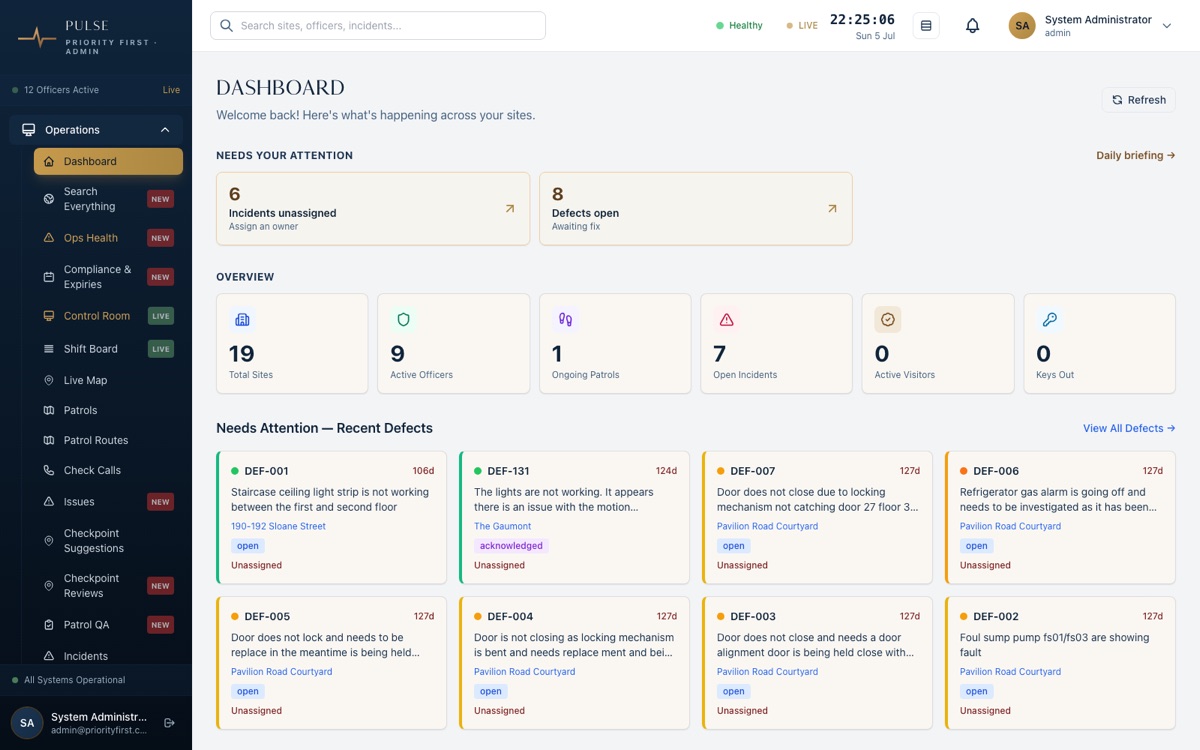
Pulse Operations built its compliance runway to close that specific gap — SIA licensing, BS 7858 vetting records, DBS checks, right to work, training completions and statutory building compliance sit on one expiries timeline alongside Martyn's Law assessments. When a Martyn's Law training certificate is due to lapse, it shows up next to the officer's SIA licence renewal and their DBS recheck, not in a separate spreadsheet.
That matters for a specific reason: Pulse Operations's own guide on tender scoring notes that public-sector buyers increasingly ask about Martyn's Law readiness under the Terrorism (Protection of Premises) Act 2026 during the pass/fail selection stage of a bid — before quality scoring even begins. Screening should be to BS 7858, the British Standard for security screening of personnel, with records that show it per person, not a policy that merely asserts it. A training certificate with no supporting evidence trail is the same weak spot in a tender as it is in a regulatory inspection.
Case study: proving procedures are actually followed, not just written
Priority First is the founding team's own London security and FM operation — Pulse was built inside it before being offered to other operators, and that origin is always disclosed rather than presented as an arm's-length customer win. At a prestige central-London residential estate covering 16 buildings on one nightly round, the client asked a direct question: can you prove every building gets its patrols, every night, not just a verbal "round complete"?
Pulse set up each building as its own site with its own checkpoints and evidence trail, added recurring-findings detection, and gave the estate a client portal to see delivered-versus-contract without ringing the office. Since going live in March 2026, the estate has recorded more than 4,100 patrols — roughly 250 to 280 per building — with 100% of checkpoint completions photo-verified, up from a system that offered no photographic proof at all.
The same principle applies to Martyn's Law: a training record and a written procedure are only as credible as the evidence that staff actually followed them on the night. A tamper-evident daily occurrence book, hash-chained (using SHA-256, a cryptographic hashing standard) so entries can't be quietly edited after the fact, gives a responsible person the same kind of defensible record for a lockdown drill or an evacuation exercise that Priority First's estate now has for its nightly rounds.
Your Martyn's Law training checklist
- Classify every site by expected maximum capacity to confirm standard tier (200-799) or enhanced tier (800+) status.
- Name a designated responsible person, and a designated senior individual for enhanced tier sites.
- Book training that explicitly covers the Terrorism (Protection of Premises) Act 2026, not generic counter-terrorism awareness.
- Write evacuation, invacuation and lockdown procedures your night team can realistically carry out.
- Store training completions, DBS checks, SIA licences and Martyn's Law assessments on one compliance timeline.
- Run a documented, current risk assessment for enhanced tier premises — not a one-off exercise.
- Keep an auditable record of drills and incidents in case the SIA, as regulator, asks for evidence.
- Refresh training as SIA section 12 guidance is finalised through late 2026.
FAQ
What is Martyn's Law and who does it apply to?
Martyn's Law is the common name for the Terrorism (Protection of Premises) Act 2026, which places legal duties on those responsible for qualifying public premises and events to prepare for a terrorist attack. It applies on a tiered basis: standard tier covers premises where 200 to 799 people may reasonably be present, and enhanced tier applies at 800 or more, per Policy Pros.
Is Martyn's Law training legally required for businesses?
Training staff is one of the core duties under the Act once it commences, alongside understanding risk, having public protection procedures, appointing a responsible person, and record-keeping. The Act received Royal Assent on 3 April 2026 with commencement expected Spring 2027, per GOV.UK, so the requirement is coming rather than already enforced.
What's the difference between standard tier and enhanced tier training requirements?
Standard tier premises need lighter, common-sense staff awareness training, while enhanced tier premises need a formal, documented training programme tied to a current risk assessment. The distinction follows the capacity threshold — 200 to 799 for standard, 800 or more for enhanced — set out by Policy Pros.
Who regulates Martyn's Law and what powers does it have?
The Security Industry Authority (SIA) is the appointed regulator for Martyn's Law. Enhanced tier breaches can result in fines up to £18 million or 5% of qualifying worldwide revenue, whichever is greater, with daily penalties up to £50,000, while standard tier breaches carry a maximum penalty of £10,000 with daily penalties up to £500, according to Policy Pros.
When does Martyn's Law come into force?
Martyn's Law received Royal Assent on 3 April 2026 and has an implementation period of at least 24 months, with commencement expected in Spring 2027, per GOV.UK. Businesses in scope should not wait until commencement to start preparing.
Do small businesses under 200 capacity need Martyn's Law training?
Premises where fewer than 200 people may reasonably be present fall outside the scope of Martyn's Law's standard and enhanced duties. Good practice still favours basic staff awareness of evacuation and reporting procedures, even where there's no statutory requirement.
Can Martyn's Law training be completed online?
Online and blended formats both exist in the market, and neither the SIA nor the Home Office endorses a specific delivery method or provider. What matters more than format is whether the course maps to the actual duties in the Terrorism (Protection of Premises) Act 2026 and produces a record you can evidence later.
Preparing for Martyn's Law with Pulse Operations
Training is the easy part to promise and the hard part to prove. Pulse Operations's compliance runway puts Martyn's Law assessments on the same expiries timeline as SIA licensing, BS 7858 vetting, DBS checks and right-to-work records, so a lapsed training certificate surfaces before an inspector or a tender evaluator finds it first.
For sites already running patrols and incident logging through Pulse, the same tamper-evident daily occurrence book that records a missed checkpoint also records a lockdown drill or an evacuation exercise — with a hash-chained, SHA-256 audit trail that can't be quietly edited after the event. That's the same evidence standard Priority First's 16-building central-London estate now relies on for its nightly rounds, live since March 2026.
If your business is working out how Martyn's Law training fits alongside your existing security and FM compliance, get in touch with Pulse Operations for a walkthrough of the compliance runway, or read the full Martyn's Law readiness guide first.
Related Reading
- Guardhouse Alternative 2026: Best UK Options Compared
- SmartTask Alternative 2026: Best Options Compared
- TrackTik Pricing 2026: UK Cost Guide & Alternatives