Last updated: 21 November 2026
Calculating cost per guard hour means adding a guard's gross pay to every statutory on-cost, overhead and margin that sits on top of it — not just quoting the hourly wage. In 2026, a guard paid the £12.71 National Living Wage can cost an employer roughly £14.52 an hour once employer National Insurance and pension contributions are added, before overheads or profit.
Key Takeaways
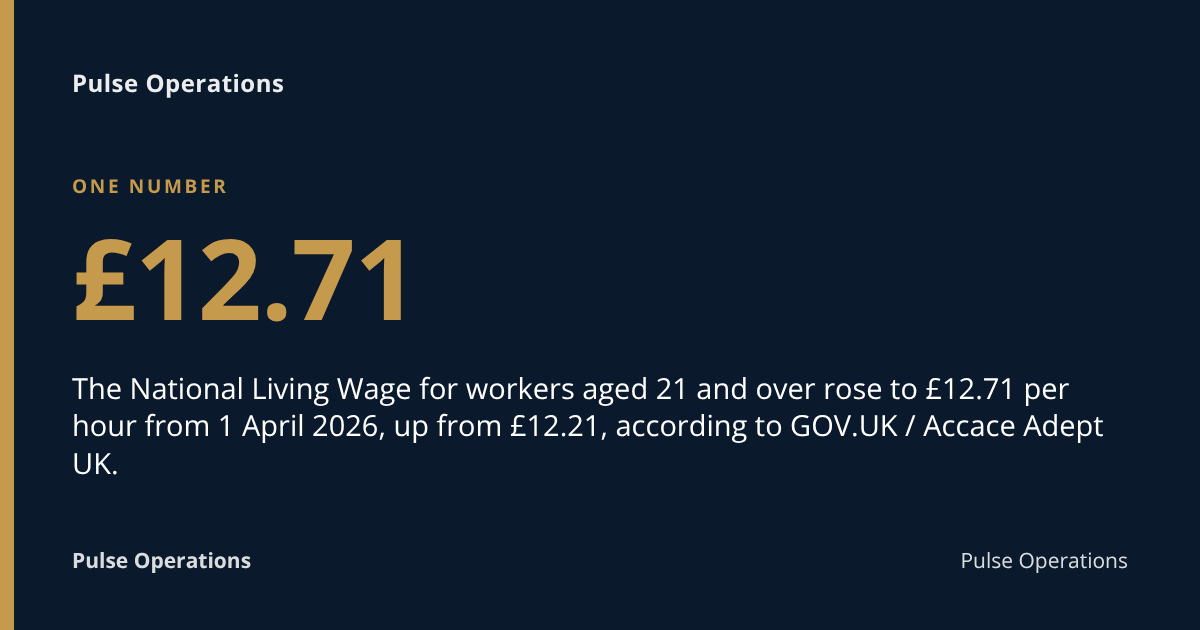
- The National Living Wage for workers aged 21 and over rose to £12.71 per hour from 1 April 2026, up from £12.21, according to GOV.UK / Accace Adept UK.
- Paying the 2026/27 National Living Wage actually costs an employer about £14.52 an hour, with a full-time 37.5-hour employee costing £28,309 a year once employer NI (£2,968) and minimum pension (£556) are added, per Employer Calculator UK.
- The employer National Insurance rate is 15% on earnings above the £5,000 secondary threshold for 2026/27, with the Employment Allowance remaining £10,500, per Accace Adept UK.
- Professional security guards in the UK typically cost between £18 and £30 per hour for static manned guarding in 2026, according to Securico Guards — a client-facing figure that must already contain all of the above.
- Pulse Operations advises that pay rate, true cost and charge rate are three different numbers, and confusing them is the single most common error buyers and providers make when pricing a contract.
What is cost per guard hour?
Cost per guard hour is the fully-loaded expense an employer incurs for one hour of a security officer's deployed time, covering wages, statutory on-costs, overheads and insurance before any profit margin is added. It is sometimes called the "burdened labour rate" — the technical term for a wage figure once every mandatory and operational cost sitting on top of it has been included.
Most buyers and even some providers confuse this with the pay rate (what the guard receives in their bank account) or the charge rate (what appears on the client invoice). Cost per guard hour sits between the two. It is higher than the pay rate because National Insurance, pension contributions and holiday accrual are not optional. It should be lower than the charge rate, because the charge rate also needs to cover the provider's overheads and a margin to stay in business.
Get this calculation wrong in either direction and the consequences are immediate. Underestimate it and a contract that looks profitable on a spreadsheet loses money in month three, once overtime and holiday cover are accounted for. Overestimate it and a tender comes in uncompetitive against a rival who has actually done the arithmetic. For UK buyers negotiating contracts under the Private Security Industry Act 2001 — the legislation that created the Security Industry Authority (SIA) and established mandatory licensing for guards, door supervisors and CCTV operators — understanding this build-up is also how you judge whether a quote is realistic or a race to the bottom.
What direct wage costs need to be included in cost per guard hour?
Direct wage costs are the pay elements a guard actually earns for hours worked, and they go well beyond the base hourly rate advertised in a job listing. The starting point for 2026/27 is the National Living Wage, which rose to £12.71 per hour for workers aged 21 and over from 1 April 2026, up from £12.21, according to GOV.UK / Accace Adept UK.
But few security rotas run on flat day rates alone. A realistic wage build-up includes:
- Base hourly pay — at or above the National Living Wage, often higher in London and for SIA-licensed roles requiring door supervision or CCTV qualifications.
- Overtime — a higher rate for hours beyond contracted shift length.
- Night shift allowances — many contracts pay a premium (an uplift) for hours between 10pm and 6am, reflecting unsociable hours.
- Weekend and bank holiday premiums — frequently 1.5x to 2x base rate, which matters because guarding is a 365-day industry.
- Shift differentials for 24/7 rotas — patterns like 4-on/4-off or the "Panama" 2-2-3 rota change how many paid hours are needed to cover one physical post around the clock.
Rota design directly drives this cost. Under the Working Time Regulations 1998, most adult workers cannot work more than 48 hours a week on average, calculated over a 17-week reference period, unless they opt out in writing — and security and surveillance work is specifically listed among the sectors with special provisions, per GOV.UK. Build the roster against the hours you're actually contracted to deliver and the gaps show up on Monday — not at ten o'clock on the night, when the only fix is an exhausted officer on a double."
What statutory on-costs must be factored in?
Statutory on-costs are the employer contributions mandated by law on top of gross wages, and in the UK the two biggest are employer National Insurance and pension auto-enrolment. From April 2025, the employer secondary Class 1 National Insurance threshold fell from £9,100 to £5,000 a year, and the employer rate rose from 13.8% to 15%, according to GSS Securities / moneysoft.co.uk.
For 2026/27, the employer National Insurance rate remains 15% on earnings above the £5,000 secondary threshold, with the Employment Allowance — the relief that lets smaller employers offset some of this liability — staying at £10,500, per Accace Adept UK. For a multi-site guarding contractor with dozens of officers on payroll, that Employment Allowance barely dents the overall bill; it matters far more to small, single-site operators.
Auto-enrolment pension contributions add a further layer. Pulse Operations notes that under the Pensions Act 2008, employers must automatically enrol eligible workers into a workplace pension and contribute a minimum percentage of qualifying earnings — this is the "pension" cost baked into the worked example below.
Put together, these on-costs are not marginal. Employer Calculator UK calculates that paying the 2026/27 National Living Wage of £12.71 an hour actually costs an employer about £14.52 an hour — roughly a 14% uplift before any overheads, holiday pay or insurance are added. Scaled up, a full-time employee working 37.5 hours a week costs £28,309 a year once employer NI (£2,968) and minimum pension (£556) are added on top of gross pay, per the same source.
How do holiday pay and sick pay accruals affect cost per guard hour?
Holiday pay accrual adds a fixed statutory percentage to every hour a guard works, because UK law entitles full-time workers to paid leave regardless of shift pattern. Full-time workers are entitled to 28 days of paid annual leave (5.6 weeks) including bank holidays; for a guard earning £25,397 this equates to approximately £2,745 in holiday pay per year, or 10.77% of pay, according to TacDesk.
This figure is a useful rule of thumb for any security employer modelling cost per guard hour: for every amount of gross wages paid, budget roughly a further share purely for statutory holiday entitlement, as a quote confirms. On a guarding contract running three shifts a day, seven days a week, this accrual applies across every rostered hour, including nights and weekends — it does not shrink for unsociable shifts.
Sick pay follows a similar logic but is harder to budget precisely because absence rates vary by site and season. Statutory Sick Pay is a modest floor, but many security contracts commit to enhanced company sick pay to retain licensed, vetted staff — officers who have passed BS 7858 screening, the British Standard for security screening of individuals employed in a security environment, are expensive to replace. Providers who ignore this accrual when pricing a contract routinely find their margin eaten by cover shifts during flu season or annual leave peaks.
What are typical UK security guard hourly rates in 2026?
Typical UK security guard charge rates in 2026 range from £18 to £30 per hour for standard static manned guarding, rising sharply for specialist or high-risk deployments. Securico Guards puts professional static guarding in this £18-£30 band, while Clearway cites a wider range of £35 to £200 per hour depending on service type, translating to roughly £4,000-£18,000+ per month for regular daily cover.
The gap between these figures reflects what is actually being quoted — static guarding at the lower end, versus close protection, specialist event security or short-notice mobile response at the upper end. Buyers comparing quotes should always ask which end of this range a provider is pricing from, and why.
| Service type | Typical charge rate (per hour) | Notes |
|---|---|---|
| Static manned guarding | £18-£30 | Standard site presence, SIA Door Supervisor or Security Guard licence |
| Mobile patrol / keyholding | Varies with the site; ask for a quote | Multiple sites per shift, alarm response |
| Event security | Varies with the site; ask for a quote | Often short-notice, higher premium |
| Specialist / close protection | Up to £200 | Risk-rated, higher qualifications |
Regional variation matters too. London and the South East typically sit at the upper end of any given band, reflecting both the London Living Wage pressure on pay rates and higher overheads for uniforms, travel and SIA-compliant supervision ratios. A contract priced for a Manchester retail park rarely transfers cleanly to a Mayfair residential block without re-costing from scratch.
How should overheads and insurance be apportioned into the hourly rate?
Overheads are the operational costs a provider carries regardless of which individual guard is on shift, and they must be spread across total billable hours to reach a true hourly figure. These typically include:
- SIA licensing — the licence itself, renewal administration and the time cost of checking it against the SIA register.
- Uniforms and equipment — body-worn radios, torches, hi-vis, replacement cycles.
- Training — induction, site-specific briefings, refresher courses, Martyn's Law awareness where a site falls within scope.
- Supervision and control room costs — the salaried staff who are never themselves "a guard hour" but make every guard hour deliverable.
- Insurance — public liability and employer's liability cover, both of which a provider must carry to trade, and both of which scale with headcount and risk profile.
None of these costs attach neatly to one shift. The standard approach is to calculate total annual overhead and insurance spend, divide it by total annual billable guard hours across the business, and add that per-hour figure on top of wage cost. A provider running lean with poor site documentation often underestimates supervision cost specifically — because the time spent chasing missed patrols, disputed timesheets and incident reports rarely gets logged against a job code, so it disappears from the model until margins quietly erode.
This is precisely the gap Pulse Operations was built to close. When a prestige central-London estate spanning 16 buildings on one nightly round asked whether every building actually got its patrols every night — multi-building rounds being exactly where patrols quietly go missing — Priority First, a sister company with the same majority owner as Aether Agency Ltd, which runs Pulse, set up each building as its own site with its own checkpoints and evidence trail. Since going live in March 2026, patrols on that estate have gone from one vague "round complete" to more than 4,100 logged visits, roughly 250-280 per building, with checkpoint completions moving from 0% to 100% photo-verified. That level of evidence turns supervision time from guesswork into a known, costable quantity rather than an invisible overhead.
Pay rate, charge rate and true cost: the difference that catches most buyers out
Pay rate, charge rate and true cost per guard hour are three distinct figures, and treating any two of them as interchangeable is the fastest way to misprice a contract. The pay rate is what lands in the guard's bank account. The true cost is the pay rate plus every statutory on-cost, overhead and insurance premium discussed above. The charge rate is the true cost plus the provider's margin — what appears on the client invoice.
| Term | What it includes | Who sees it |
|---|---|---|
| Pay rate | Gross hourly wage only | Guard's payslip |
| True cost per guard hour | Pay rate + employer NI + pension + holiday/sick accrual + overheads + insurance | Provider's internal costing |
| Charge rate | True cost + margin | Client invoice |
A provider quoting a charge rate close to a competitor's pay rate is either loss-leading deliberately for a strategic account, or has not costed the contract properly. Pulse Operations advises buyers to treat an unusually low charge rate as a question, not a bargain — ask what margin is built in and whether the quote covers holiday cover, sick cover and SIA-compliant supervision ratios, or only the headline post.
In-house security team versus outsourced guarding: where the cost actually sits
Running security in-house moves every one of the costs above — NI, pension, holiday accrual, uniforms, training, supervision, insurance — onto the client's own books, with no margin layer on top, but also no flexibility to scale down quickly. Outsourcing bundles all of it into a single charge rate, with the provider carrying the employment risk, covering absence and sickness from its own bench of officers, and typically holding broader public and employer's liability cover across its whole operation rather than one site's exposure.
The trade-off is rarely purely financial. In-house teams can build deep site knowledge over years; outsourced teams can flex headcount for an event or a seasonal peak without a redundancy process. For most mid-sized commercial sites, the real decision point is less "which is cheaper" and more "who is better placed to carry the statutory, compliance and supervision burden this article has just walked through" — which is why providers who can evidence exactly what a guard hour delivers, with photographed checkpoints and a tamper-evident record, make the outsourcing case far more easily than a bare invoice line ever could.
Your cost per guard hour checklist
- Confirm the National Living Wage band applying to each guard (21+, 18-20, or under 18) before costing any contract.
- Add employer National Insurance at 15% above the £5,000 secondary threshold, netting off the Employment Allowance where it applies.
- Include minimum auto-enrolment pension contributions in every hourly build-up, not just the annual salary model.
- Apply the 10.77% holiday pay accrual rule of thumb across all rostered hours, including nights and weekends.
- Apportion SIA licensing, uniforms, training and insurance as a per-hour overhead, calculated from total annual billable hours.
- Separate pay rate, true cost and charge rate explicitly in any quote or internal costing model.
- Ask any provider's quote to show its build-up, not just a headline hourly figure.
- Check the rota against the 48-hour average working week limit before assuming "cheap" overtime hours are sustainable.
FAQ
How do you calculate cost per guard hour?
Calculate cost per guard hour by adding gross hourly pay, employer National Insurance, pension auto-enrolment contributions, holiday and sick pay accrual, and apportioned overheads (licensing, uniforms, training, supervision, insurance). This true cost figure sits below the charge rate, which adds a margin on top.
What is included in the true cost of a security guard beyond their pay rate?
The true cost of a security guard includes employer National Insurance at 15% above the £5,000 threshold, minimum pension contributions, statutory holiday pay (around 10.77% of gross pay), sick pay provision, SIA licensing administration, uniforms, training and a share of insurance and supervision costs.
What is a typical hourly rate for security guards in the UK in 2026?
Typical charge rates for static manned guarding in the UK in 2026 run from £18 to £30 per hour, according to Securico Guards, rising up to £200 per hour for specialist services, per Clearway.
How much does employer National Insurance add to a guard's hourly cost?
Employer National Insurance adds 15% on earnings above the £5,000 secondary threshold for 2026/27, according to Accace Adept UK. Combined with pension contributions, this helps push a £12.71 National Living Wage hour to roughly £14.52 in actual employer cost, per Employer Calculator UK.
What is the difference between pay rate and charge rate in security contracts?
Pay rate is the gross hourly wage a guard receives. Charge rate is what appears on the client invoice, and it must cover the pay rate plus every statutory on-cost, overhead and insurance premium, plus the provider's margin. Confusing the two is a common cause of underpriced contracts.
Does the 48-hour working week limit affect guard rota costs?
Yes — under the Working Time Regulations, most adult workers cannot work more than 48 hours a week on average over a 17-week reference period unless they opt out in writing, and security and surveillance work is specifically listed among the sectors with special provisions, per GOV.UK. Rotas built beyond this without valid opt-outs risk both compliance exposure and unsustainable overtime cost.
Is outsourcing security cheaper than running an in-house team?
It depends on scale and site complexity. Outsourcing moves employment risk, absence cover and insurance onto the provider's charge rate; in-house teams avoid a margin layer but carry every statutory on-cost directly. Mid-sized sites often find outsourcing more predictable once true cost per guard hour is properly accounted for.
Pricing your contract or checking a provider's quote with Pulse Operations
Every section above exists because so many guarding contracts are priced on a headline hourly figure that quietly omits National Insurance, pension accrual, holiday pay or realistic supervision cost — and the gap only surfaces once the contract is live and margins start slipping. Pulse Operations gives operators the operational record to build an honest rate from the start: rosters built against contracted hours, time and attendance logged from the officer app, and payroll-ready exports that tie pay to the hours actually worked, not a spreadsheet reconstructed after the fact.
The same platform that underpins this costing discipline also proves delivery once the contract is signed — when a landmark West London mixed-use development needed proof that its full footprint, including plant rooms and service yards, was genuinely being walked rather than just promised, Pulse Operations (via Priority First, a sister company with the same majority owner as Aether Agency Ltd, which runs Pulse) made all 152 checkpoints photo-mandatory, logging more than 540 patrols across 11 officers in the first five months live.
If you're building a tender, checking a provider's quote, or simply trying to work out whether your current charge rate still reflects 2026's National Insurance and pension costs, explore rostering and workforce, see the published tiers at pricing, or book a call to talk through your specific contract.
Related Reading
- 12 Hour Shift Rota Template UK: Free Guide (2026)
- 12 Hour Shift Patterns Security: 2026 UK Legal Guide
- Agency Workers Regulations Security: 2026 Compliance Guide
Add pulse-operations.co.uk as a preferred source on Google
Back to all insights