
Last updated: 24 November 2026
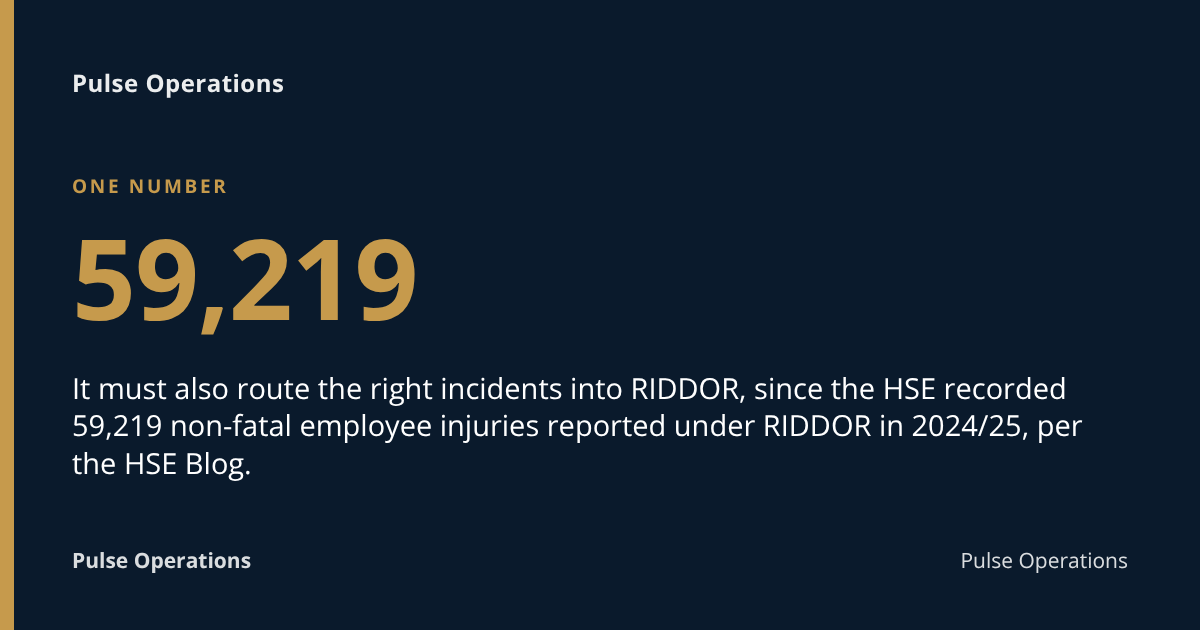
An incident investigation template UK employers use is a structured form that captures what happened, why, and what fixes it — built around the four-stage method in the Health and Safety Executive's HSG245 workbook. It must also route the right incidents into RIDDOR, since the HSE recorded 59,219 non-fatal employee injuries reported under RIDDOR in 2024/25, per the HSE Blog.
Key Takeaways
- An incident investigation template structures evidence-gathering, root cause analysis and an action plan under the HSE's HSG245 framework.
- RIDDOR records, including investigation findings tied to a reportable event, must be kept for at least three years from the date the record was made, according to Lexology.
- 124 fatal incidents were reported under RIDDOR in 2024/2025, per Lexology/Weightmans.
- Employers report only around half of non-fatal employee injuries that meet RIDDOR-defined criteria, according to the HSE.
- Approximately 9% of RIDDOR-reported non-fatal injuries are investigated by HSE, and conviction rates sit around 94% where charges are brought, per the HSE Blog.
What legal duty do UK employers have to investigate incidents?
The Health and Safety at Work etc. Act 1974 places a general duty on every UK employer to ensure, so far as is reasonably practicable, the health, safety and welfare of employees and anyone affected by their work. That duty implies investigation: you cannot show you managed a risk if you never examined why it failed.
The Management of Health and Safety at Work Regulations 1999 sharpens this further, requiring employers to assess risks and review that assessment when circumstances suggest it's no longer valid — which an incident almost always does. Separately, The Reporting of Injuries, Diseases and Dangerous Occurrences Regulations 2013 (RIDDOR) creates a distinct statutory duty to report certain categories of incident to the HSE — reporting and investigating are related but separate obligations, and a business can be in breach of one without the other.
There's no single clause in UK law stating "thou shalt use a template", but HSE's own enforcement expectation, set out in HSG245, is that investigations follow "a methodical structured approach to information gathering, collation and analysis" carried out by someone "competent" to do it. A template is simply how most organisations operationalise that expectation — and how they prove, after the fact, that they met it.
What should a UK incident investigation template include?
A UK incident investigation template should include incident details, immediate and underlying causes, root cause analysis, corrective actions, sign-off, and a RIDDOR-reportability check — each as a distinct section, not a single free-text box. HSE's HSG245 model structures investigations into four stages: gathering information, analysing it, identifying suitable risk control measures, and producing an action plan.
A workable template typically covers:
- Incident summary — date, time, exact location, people involved, witnesses, and a plain-English description of what happened.
- Immediate causes — the direct trigger: a wet floor, a missing guard, a failed radio.
- Underlying causes — the systemic factor behind the immediate cause, such as a missed PPM visit or an unsupervised new starter.
- Root cause — the organisational failure that allowed the underlying cause to exist, often a gap in training, supervision or procedure.
- RIDDOR check — does this meet any of the six reportable categories? If yes, who submits it and by when?
- Corrective actions — specific, owned, dated.
- Investigator details and sign-off — name, role, competency basis, date signed.
- Evidence appendix — photos, CCTV references, witness statements, equipment inspection records.
The mistake most templates make is collapsing immediate cause, underlying cause and root cause into one "why did this happen?" field. That produces vague answers like "human error" — which fixes nothing, because it isn't a cause, it's a symptom.
Which incidents must be reported to the HSE under RIDDOR?
RIDDOR requires employers to report specified categories of incident to the HSE, including work-related deaths, specified injuries, over-seven-day incapacitation, occupational diseases, dangerous occurrences, and certain gas incidents, each with its own reporting deadline. Deaths and specified injuries must be reported without delay — by phone for a fatality, and the report must follow within ten days using the RIDDOR online reporting portal. Incidents causing over seven days' incapacitation have fifteen days from the date of the incident.
The scale matters here. There was a total of 61,663 employee non-fatal injuries reported by employers in 2023/2024 under RIDDOR, of which 31% were related to slips, trips or falls, 17% were due to handling, lifting or carrying, and 10% related to being struck by a moving object, according to Weightmans. In 2024/2025, 124 fatal incidents were reported, and 92 members of the public were killed in work-related incidents, up from 87 the previous year, per Lexology.
Crucially, under-reporting is well documented: the HSE estimates employers report only around half of non-fatal employee injuries that meet the RIDDOR-defined criteria, while roughly 680,000 workers self-reported a non-fatal workplace injury in 2024/25 against just 59,219 formally reported, according to HSE Blog and HSE. A template that explicitly forces a RIDDOR-reportability decision on every incident — rather than leaving it to someone's memory of the rules — closes part of that gap.
| Incident type | Reporting deadline | Method |
|---|---|---|
| Work-related death | Without delay, by phone, then report within 10 days | RIDDOR portal |
| Specified injury (e.g. fracture, amputation) | Without delay, then report within 10 days | RIDDOR portal |
| Over-seven-day incapacitation | Within 15 days of the incident | RIDDOR portal |
| Dangerous occurrence | Without delay, then report within 10 days | RIDDOR portal |
| Occupational disease | As soon as diagnosed | RIDDOR portal |
| Gas incident | Within 14 days | RIDDOR portal |
Who is responsible for carrying out and signing off the investigation?
A competent person — someone with the training, knowledge and experience to identify hazards and assess risk, per HSE's own terminology in HSG245 — should lead the investigation, with sign-off typically resting with a line manager, site manager or health and safety lead depending on severity. For a minor incident, that's often the supervisor on shift. For anything RIDDOR-reportable or fatal, it escalates to a senior manager or the health and safety director, frequently supported by an external consultant or legal counsel where enforcement action is possible.
Competency matters because HSE inspectors and, if it comes to it, courts will test whether the investigator actually understood what they were looking at. Qualifications such as NEBOSH certificates or an ICAM (Incident Cause Analysis Method) background strengthen that position, though they aren't a legal requirement for every investigation. What is consistently expected is a named, accountable person and a dated signature — a template without a sign-off field is not evidence of anything.
In security and FM operations specifically, this chain of accountability tends to break down fastest at the handover between the officer who witnessed something and the manager who has to write it up hours or days later. That's the gap a live occurrence book closes, because the record exists at the moment of the event rather than being reconstructed from memory.
How soon should an investigation begin, and how long should records be kept?
Good practice under HSE's HSG245 guidance is to begin gathering evidence immediately — ideally within hours — while memories, physical conditions and witness accounts are still fresh, and to complete minor investigations within days and major ones within a few weeks depending on complexity. Delay is the single biggest threat to investigation quality: CCTV gets overwritten, a wet floor dries, a damaged fitting gets replaced before anyone photographs it.
RIDDOR records must be kept for at least three years from the date the record was made, according to Lexology. In practice, many organisations keep investigation files for longer — particularly where a civil claim is possible, since personal injury claims can be brought up to three years after the event or after the claimant's knowledge of it, which can push the practical retention period well past the statutory RIDDOR minimum.
Approximately 9% of RIDDOR-reported non-fatal injuries are investigated by HSE, and prosecution conviction rates sit around 94% where charges are brought, according to the HSE Blog. Those odds mean a thin, late, undated investigation file is a genuine liability if an HSE inspector ever does pick the case up months later.
"The same broken door reported forty times isn't forty incidents — it's one finding with a timeline. Surface repeats as patterns, put a cause and a fix against them, and show the client. Fixing the cause once beats reporting the symptom forever." — Mo Hassan, Founder, Pulse
This is exactly why a template needs a timestamp built in at the point of logging, not added retrospectively by whoever writes the report up later. Per Pulse Operations's guide, How to prove patrols actually happened, the supporting record for any operational claim should include the time an incident was raised and the time it was resolved — the same discipline an investigation template needs to survive scrutiny months after the event.
How do templates differ for near-misses versus RIDDOR-reportable incidents?
A near-miss template can be a short, single-page form focused on what almost happened and what prevents a recurrence, while a RIDDOR-reportable incident needs the full HSG245-structured investigation with root cause analysis, a formal action plan, and a dated regulatory submission. Treating every near-miss with the same depth as a fatality wastes time and discourages staff from reporting at all — over-engineering a near-miss form is almost as damaging as under-engineering a major one.
A sensible tiering looks like this:
| Tier | Typical content | Who signs off | Reporting duty |
|---|---|---|---|
| Near-miss | Description, immediate cause, quick fix | Shift supervisor | None, but trend data matters |
| Minor incident (no RIDDOR trigger) | Full description, witness notes, corrective action | Site/line manager | Internal record only |
| RIDDOR-reportable | Full HSG245 structure: immediate/underlying/root cause, evidence appendix, formal action plan | Senior manager or H&S lead | RIDDOR portal within statutory deadline |
The value of tiering shows up at scale. A landmark West London mixed-use development run by Priority First — the founding team's own London security & FM operation, and a sister company sharing the same majority owner as Aether Agency Ltd, which runs Pulse — covers 152 checkpoints across retail, residential, plant rooms and service yards with 11 officers. Before a structured system, there was no way to prove which plant room was actually checked at 3am, let alone separate a genuine near-miss from noise. Since going live in February 2026, every checkpoint has been photo-mandatory, so a missed area shows as a gap in the record rather than a dispute raised six weeks later — and the same discipline applies to how incidents get logged and tiered, not just how patrols get proven.
How does an incident investigation template differ from an accident report form?
An incident investigation template is an analytical document that asks why an event happened and what prevents recurrence, while an accident report form (such as the statutory accident book, BI 510) is a factual record of what happened, used partly to meet RIDDOR notification duties. The two serve different purposes and most organisations need both, linked by a reference number.
The accident book entry is quick — name, date, injury, brief description — and often completed by the injured person or a colleague immediately. The investigation template comes after, led by a competent person, and produces findings a manager or director actually has to act on. A RIDDOR report to the HSE is narrower still: it's the statutory submission itself, built from facts the accident book and the investigation both feed into, but it doesn't contain root cause analysis or an action plan — HSE's online form isn't designed to hold that level of detail.
Confusing the three is one of the most common mistakes UK employers make. Teams sometimes submit the RIDDOR report and consider the matter closed, without ever completing the underlying investigation — which leaves the organisation unable to show why it happened if the same failure repeats, and exposed if HSE later asks for the investigation file that should sit behind the report.
Your incident investigation template checklist
- Capture incident details — date, time, exact location, people and witnesses — within hours of the event.
- Separate immediate cause, underlying cause and root cause into distinct fields, never one combined box.
- Run a RIDDOR-reportability check on every incident, not just the obviously serious ones.
- Name a competent investigator and require a dated signature before the file is closed.
- Attach evidence — photos, CCTV references, equipment logs — at the point of logging, not days later.
- Set a corrective action with a named owner and a deadline, and track it to completion.
- Retain the completed file for at least three years from the date the record was made.
- Review recurring findings quarterly to catch patterns a single incident report would miss.
FAQ
What is an incident investigation template used for in the UK?
An incident investigation template is a standardised form UK employers use to record what happened, analyse immediate and root causes, and set corrective actions following a workplace incident. It structures the process HSE's HSG245 guidance describes, so investigations don't depend on one manager's memory of what to ask.
Is incident investigation a legal requirement in the UK?
Yes, indirectly. Pulse Operations notes that the Health and Safety at Work etc. Act 1974 requires employers to manage risk so far as is reasonably practicable, which in practice means investigating incidents to understand whether your risk controls failed — though no single regulation mandates a specific template format.
How long do I have to report an incident under RIDDOR?
Deadlines vary by category: fatalities and specified injuries require immediate notification by phone followed by a report within 10 days, over-seven-day incapacitation has 15 days, and gas incidents have 14 days, all submitted via the RIDDOR online portal.
How long must incident investigation records be kept?
RIDDOR records must be kept for at least three years from the date the record was made, according to Lexology. Many organisations retain investigation files longer where a personal injury claim remains possible.
What's the difference between an accident book entry and a full investigation?
An accident book entry (BI 510) is a quick factual record of what happened, while a full investigation analyses why it happened and what prevents recurrence, led by a competent person and signed off formally.
Do near-misses need a full investigation?
No — a near-miss typically warrants a short-form record covering what almost happened and the quick fix, while RIDDOR-reportable incidents need the full HSG245-structured investigation with root cause analysis and a formal action plan.
Who should sign off an incident investigation?
Sign-off typically rests with a line manager or site manager for minor incidents, escalating to a senior manager or health and safety lead for anything RIDDOR-reportable, provided they are competent — trained, knowledgeable and experienced enough to assess the risk involved.
Logging incidents the moment they happen, with Pulse Operations
A paper-based or email-chain investigation process is exactly where the gap between what happened and what gets written down widens — by the time a manager sits down to fill in a template, the timestamp, the photo of the damaged fitting, and the witness's exact wording have already started to drift. Pulse Operations's incidents and occurrence book captures the event, the time it was raised, and the evidence attached to it from the moment a security or FM officer logs it on shift, not hours later from memory.
Pulse Operations builds the underlying audit trail hash-chained (SHA-256) and tamper-evident, with a built-in integrity check that walks the whole chain — so when an investigation file needs to stand up to an HSE inspector or a civil claim, the record itself can't quietly be edited after the fact. That same discipline runs through Pulse Operations's compliance runway, covering SIA licensing, BS 7858 screening, DBS checks and statutory building compliance on one expiries dashboard.
If your current incident process relies on a Word template that gets filled in whenever someone remembers, it's worth seeing how a live occurrence book changes that. Take a tour of Pulse Operations or check published pricing to see what moving incident logging onto one platform would look like for your sites.
Related Reading
- Defect Report Template UK: What to Include in 2026
- Daily Occurrence Book Template (UK) | Pulse Operations
- Security Guard Handover Template UK | Free Guide 2026
Add pulse-operations.co.uk as a preferred source on Google
Back to all insights