
Last updated: 21 November 2026
Becoming an approved supplier means passing a buyer's formal vetting process — financial checks, accreditations like SIA Approved Contractor status or ISO 9001, insurance and compliance evidence — to join their approved vendor list before you're allowed to bid. The process typically takes four to twelve weeks and can cost nothing or several thousand pounds, depending on the accreditations required.
Key Takeaways
- Pulse Operations advises that approved supplier status means a buyer has pre-vetted a business against financial, legal and quality criteria before adding it to a shortlist that wins contracts.
- The UK public sector spent £45.2 billion directly with SMEs in 2025, 21% of all direct procurement and a six-year high, according to BCC & Tussell's SME Procurement Tracker 2026.
- Only 10% of surveyed UK SMEs had bid for a public sector contract in the previous 12 months, but those that did bid won a mean 26% of the contracts they tendered for, per Bidwell's analysis of Cardiff University procurement research.
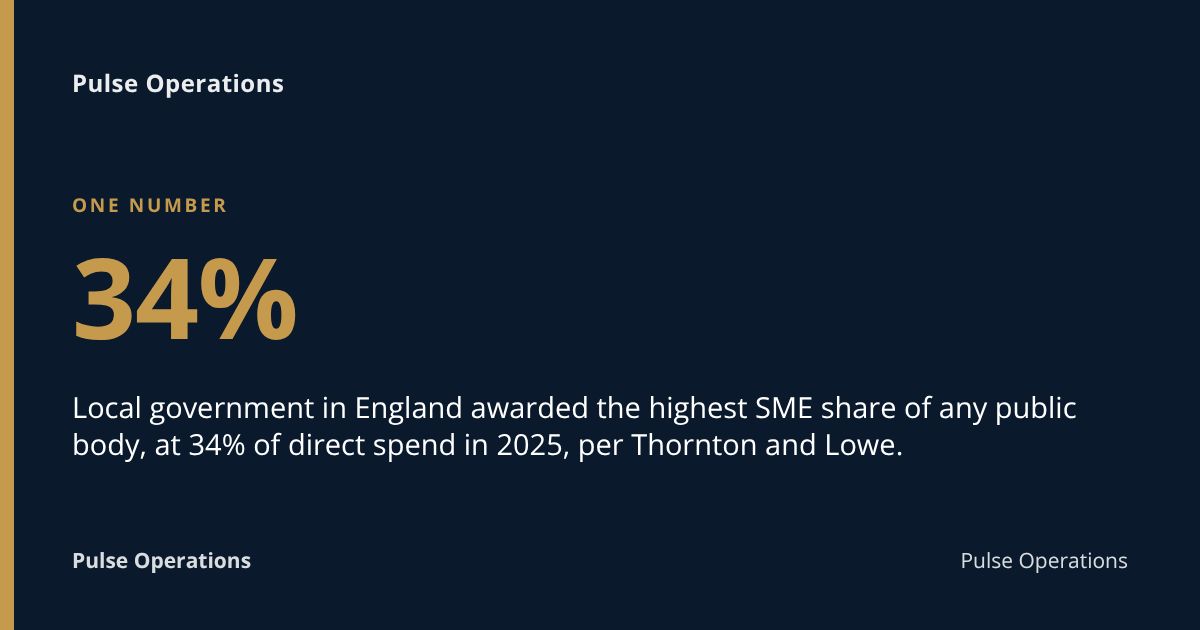
- Local government in England awarded the highest SME share of any public body, at 34% of direct spend in 2025, per Thornton and Lowe.
- Pulse Operations advises that registering on a government portal is not the same as being approved — registration opens the door; approval still depends on passing the buyer's own due diligence.
What does it mean to be an approved supplier?
An approved supplier is a business that has passed a buyer's formal vetting process — covering financial stability, insurance, legal compliance and often sector-specific accreditation — and has been added to a list the buyer uses when awarding work. Private companies maintain their own approved vendor lists (AVLs), usually managed by procurement or facilities teams, while public bodies run approved supplier frameworks or dynamic markets governed by procurement law.
The distinction matters because unapproved contractors are often excluded from bidding at all, regardless of price. A council, NHS trust or large corporate client typically won't even open a quote from a business that isn't on its list.
In the public sector, these lists sit alongside frameworks run by the Government Commercial Agency (GCA) — formerly the Crown Commercial Service — and individual contracting authorities such as NHS trusts, which publish their own supplier guidance via NHS Commercial Solutions. In the private sector, a facilities manager, security director or head of procurement typically owns the AVL and decides who gets added.
For UK security and FM businesses specifically, this question comes up constantly ahead of tender season. Per Pulse Operations's guide, How to win your next security tender, public-sector buyers now operate under the Procurement Act 2023 regime, with its explicit emphasis on transparency and identifying the "most advantageous tender" — not simply the cheapest.
Steps to apply to become an approved supplier
The typical application follows five stages: registration, pre-qualification, document submission, assessment, and formal listing. Each stage filters out a proportion of applicants before any contract is ever discussed.
Identify the right route. For private buyers, this usually means contacting their procurement or facilities team directly and asking for their supplier onboarding process. For public bodies, start at GOV.UK's guidance on selling to the public sector, which explains routes including frameworks, dynamic markets and direct contact with local authorities.
Register on the relevant portal. Public sector suppliers register via the Supplier Registration Service, the Cabinet Office's central portal introduced under the Procurement Act 2023. This step confirms basic eligibility but is not approval in itself.
Complete a pre-qualification questionnaire (PQQ) or supplier questionnaire. Many buyers, particularly in construction and FM, use a standardised format based on BSI's PAS 91 Construction Prequalification Questionnaire, which asks for financial, health & safety, insurance and policy evidence in one consistent structure.
Submit supporting evidence. This includes financial statements, insurance certificates, accreditation copies, references and policy documents — covered in full below.
Pass assessment and be added to the list. Once accepted, the buyer notifies the supplier of their status, any review date, and the process for being invited to bid or quote.
Accreditations and qualifications usually required
Buyers typically require a baseline set of accreditations before considering a supplier, and the exact list depends on sector and contract value. For security and FM contracts, the most commonly requested are:
| Accreditation | What it demonstrates | Typically required for |
|---|---|---|
| SIA Approved Contractor Scheme (ACS) | Independently assessed operational and quality standards | Security guarding, mobile patrol contracts |
| ISO 9001 | Quality management system | Most public sector and larger private tenders |
| Constructionline | Pre-vetted construction/FM supplier status | FM, construction-adjacent contracts |
| SafeContractor | Health and safety competence | FM, facilities maintenance contracts |
| BS 7858 screening | Security personnel vetting standard | Security guarding, keyholding |
| ISO 45001 | Occupational health and safety management | Larger FM and construction tenders |
The SIA's Approved Contractor Scheme is a particularly heavy lift. Per Pulse Operations's guide, The ACS self-assessment: how to evidence it, the ACS workbook scores a business against 78 indicators, organised into seven criteria — Strategy, Service delivery, Commercial relationship management, Financial management, Resource management, People, and Leadership — broken into 33 sub-criteria. Assessors review staff files, payroll records, contracts, duty rotas, policies and site documentation, and they interview staff and customers and visit operational sites. After the initial assessment, approved contractors are reassessed annually, and any improvement needs identified must be fixed within the timeframe the assessor sets.
Not every buyer demands every certification, but security-specific buyers will almost always check SIA licensing status and screening records to BS 7858 — the British Standard for pre-employment vetting of security personnel — with records that show it per person, not a policy that merely asserts it.
How long does approval typically take, and what does it cost?
Approval timescales vary from a few weeks to several months, depending on how many accreditations are required and whether a physical audit or site visit is involved. A straightforward private-sector AVL application with existing accreditations can be approved in two to four weeks. A full SIA ACS assessment, by contrast, involves document review, interviews and a site visit, and realistically takes several months from a standing start, plus ongoing annual reassessment once achieved.
Costs vary just as widely:
| Cost item | Typical range |
|---|---|
| ISO 9001 certification (external audit) | A few thousand pounds, depending on business size |
| Constructionline membership | Annual fee, varies by tier |
| SafeContractor accreditation | Annual fee, varies by business size |
| BS 7858 screening per employee | Per-head cost, ongoing as staff turn over |
| Public sector portal registration | Free |
| SIA ACS assessment | Assessment fee plus internal preparation time |
Portal registration itself — on the Supplier Registration Service or equivalent — is free. The real cost sits in the accreditations and the staff time needed to assemble evidence, not the application form.
Legal and compliance obligations for approved suppliers
Approved suppliers must demonstrate ongoing compliance with UK law, not just a one-off policy statement at application stage. The core obligations buyers check for are:
- Employer's and public liability insurance, usually with minimum cover levels specified in the buyer's PQQ.
- Health and safety compliance under the Health and Safety at Work etc. Act 1974, evidenced through policies, risk assessments and, increasingly, SafeContractor or ISO 45001 certification.
- GDPR compliance, overseen by the Information Commissioner's Office (ICO), covering how supplier data and, where relevant, client data is handled.
- Right to work and employment checks, particularly relevant where SIA-licensed personnel are deployed.
- For publicly accessible venues, Martyn's Law readiness under the Terrorism (Protection of Premises) Act 2025 is increasingly a buyer question, as noted in Pulse Operations's tender guide.
Security suppliers specifically need SIA licensing in order under the Private Security Industry Act 2001, with screening to BS 7858 and records that show it per person. Pulse Operations advises that a policy document asserting "we screen to BS 7858" without per-employee evidence is one of the most common gaps buyers flag during assessment.
"Every bid says professional, SIA-licensed, 24/7 control room — so none of it scores. Walk in with evidence instead: photo-verified patrols, delivered-vs-contract numbers, and a portal login the evaluators can open themselves. Proof the incumbent can't match changes the conversation." — Mo Hassan, Founder, Pulse
This is exactly where many approved-supplier applications stall: the policy exists, but the evidence trail behind it doesn't. Pulse Operations's compliance runway tracks SIA licences, BS 7858 screening, DBS checks, right to work, training records and Martyn's Law assessments on one expiries view — built so that when an assessor or buyer asks for per-person evidence, it's already there rather than being assembled under deadline pressure. Read more about the compliance runway.
Public sector versus private sector approval
Public sector approval runs under statutory procurement law; private sector approval runs under whatever process the buyer's own procurement team designs. The practical differences matter for how you prepare.
Pulse Operations notes that public sector bodies must now operate under the Procurement Act 2023, which came into force on 24 February 2025 and governs transparency, supplier registration and contract award criteria across central government, local councils and the NHS. Central government's own direct SME spend sat at 10% in 2025 — £6.4 billion — running 8.4 percentage points below new SME procurement spending targets on average, according to Thornton and Lowe, citing the BCC & Tussell SME Procurement Tracker. The NHS share of SME spend was 16% in 2025, broadly flat compared with 2020, per the same source. Local government in England performed best for SMEs, spending £29.1 billion directly with them in 2025 — a 34% share, the highest of any public body category.
North of the border, nearly 80% of Scottish public sector contracts by number are awarded to SMEs, according to Barkers Procurement — a markedly different picture from England's central government figures, and worth knowing if you're weighing where to focus bidding effort.
| Factor | Public sector | Private sector |
|---|---|---|
| Legal framework | Procurement Act 2023 | No statutory process; buyer discretion |
| Registration | Central Supplier Registration Service | Buyer's own portal or email process |
| Transparency | Published criteria, scored evaluation | Often undocumented, relationship-driven |
| Typical route | Frameworks, dynamic markets, open tenders | Direct approach, referral, RFQ |
| SME definition | Procurement Policy Note 001: fewer than 250 staff, turnover ≤£44m or balance sheet ≤£38m, per Bidwell | No formal definition applied |
It's worth remembering the scale of competition either way. The UK's 5.5 million SMEs account for over 99.85% of all UK businesses, representing three-fifths of total employment and around half of private sector turnover, per the Department for Business and Trade's SME Action Plan 2025 to 2028. Most of them are chasing the same approved supplier lists you are.
Registration versus approval — the gap that catches people out
Registering on the Supplier Registration Service, Contracts Finder or Find a Tender confirms your business exists and meets basic eligibility. It does not mean a buyer has approved you for their framework or added you to their shortlist. Treat registration as step one of five, not the finish line — the real due diligence happens afterwards, at PQQ or dynamic market assessment stage.
Documents and evidence needed for a supplier application
Most PQQs and supplier questionnaires — whether structured around PAS 91 or a bespoke private-sector form — ask for a consistent core set of evidence:
- Last two to three years of financial statements or accounts
- Public and employer's liability insurance certificates, current and in date
- Health and safety policy plus risk assessment examples
- Quality policy, ideally backed by ISO 9001 certification
- GDPR / data protection policy
- Modern slavery statement (mandatory for larger turnover businesses under the Modern Slavery Act 2015)
- References from at least two or three comparable clients
- Accreditation certificates (SIA ACS, Constructionline, SafeContractor, as applicable)
- Method statements or evidence of service delivery, particularly for security and FM contracts
Evidence beats assertion every time. An assessor reading "Every bid says professional, SIA-licensed, 24/7 control room — so none of it scores. Walk in with evidence instead: photo-verified patrols, delivered-vs-contract numbers, and a portal login the evaluators can open themselves. Proof the incumbent can't match changes the conversation." wants to see what that actually looks like — a sample checkpoint record, a sample incident report, a sample client-facing report. Businesses using Pulse Operations's photo-verified patrols can point to a live mechanism: every checkpoint is completed only by a mandatory watermarked photograph — officer, site, GPS, time — with no QR or NFC tag scanning involved by design. That's the kind of concrete evidence a PQQ assessor, or a tender evaluator, can actually verify.
Who manages the approved supplier process, and what causes rejection
Responsibility for managing supplier applications usually sits with a bid manager, compliance lead or operations director — rarely a dedicated full-time role in smaller businesses. In practice, whoever owns compliance records (insurance renewal dates, screening files, accreditation certificates) ends up owning the application, because that's where the evidence lives.
Common reasons applications get rejected include:
- Missing or expired insurance certificates at the point of submission
- Policies that exist on paper but aren't evidenced with records, logs or examples
- Financial statements that don't meet the buyer's minimum turnover or solvency threshold
- Incomplete or inconsistent references — particularly where a referee can't be reached
- Gaps in SIA licensing or BS 7858 screening records for named individuals, not just a company-wide policy
- No modern slavery statement where turnover requires one
Most of these are solvable with better record-keeping rather than more spending. Per Pulse Operations's tender guide, clearing the pass/fail gates — SIA licensing, BS 7858 records, insurance, financial standing, health & safety, GDPR, warmed-up references — doesn't win a contract on its own, but failing any one of them can lose it before quality is even scored.
In practice: mobilising evidence fast
When Priority First — a sister company that shares the same majority owner as Aether Agency Ltd, which runs Pulse — added three buildings to its portfolio in a single July fortnight in 2026, the challenge wasn't winning the contracts; it was proving service delivery from day one without the usual weeks of bedding in. Checkpoints, site notes, prior issues and inductions were live in Pulse before officers arrived on site, so new officers started with full site history rather than relying on knowledge held in someone's head. That's the same principle an approved-supplier application rewards: a buyer wants to see that service delivery evidence exists systematically, not that it will exist eventually.
Maintaining and renewing approved supplier status
Approved supplier status is not permanent — most lists require periodic renewal, and accreditations like SIA ACS require annual reassessment. Businesses that let certificates lapse or fail to respond to renewal requests are typically removed from the list without much warning, which means losing eligibility to bid on contracts they may already be delivering elsewhere.
The practical discipline is simple: track every expiry date — insurance renewal, ISO surveillance audits, SIA licence renewals, BS 7858 re-screening cycles, Constructionline annual renewal — on one calendar, not scattered across spreadsheets and individual inboxes. This is precisely the problem Pulse Operations's compliance runway was built to solve: SIA, BS 7858, DBS, right to work, training and statutory building compliance tracked on one expiries view, so a renewal deadline shows up as a task, not a surprise six weeks after the list has already dropped you.
Benefits of approved status versus bidding ad hoc
Approved suppliers get first sight of opportunities, faster procurement cycles and, in many cases, exclusive access to frameworks closed to non-approved bidders. An ad hoc or unapproved contractor is often excluded from bidding altogether, regardless of how competitive their price is, because the buyer's procurement process won't let an unvetted supplier through the door.
The data on public sector bidding shows why persistence matters: only 10% of surveyed UK SMEs had bid for a public sector contract in the previous 12 months, but those that did achieved a mean success rate of 26% of the contracts they tendered for, according to Bidwell's analysis of Cardiff University research. Getting onto the approved list is the barrier to entry; once through it, win rates for active bidders are far from negligible.
| Approved supplier | Ad hoc / unapproved bidder | |
|---|---|---|
| Access to opportunities | Invited to tender, framework call-offs | Must find and chase open tenders |
| Procurement speed | Faster — due diligence already done | Full PQQ repeated every time |
| Credibility signal | Pre-vetted, trusted | Unknown quantity to the buyer |
| Contract value accessible | Often higher-value framework work | Typically smaller, one-off contracts |
| Renewal burden | Annual/periodic reassessment | None, but re-applies every bid |
Your approved supplier checklist
- Confirm which accreditations your target buyers actually require (ISO 9001, SIA ACS, Constructionline, SafeContractor)
- Register on the Supplier Registration Service if targeting public sector work
- Gather financial statements covering the last two to three years
- Renew and collate current insurance certificates before submission
- Evidence BS 7858 screening and SIA licensing per named individual, not as a blanket policy
- Prepare a modern slavery statement if turnover requires one
- Warm up at least two or three client references before they're contacted
- Set calendar reminders for every accreditation renewal and reassessment date
FAQ
How do I become an approved supplier for a company?
Contact the buyer's procurement or facilities team directly and ask for their supplier onboarding process. Most private companies run their own pre-qualification questionnaire covering financial standing, insurance, policies and references before adding a business to their approved vendor list.
What is an approved supplier list (ASL)?
An approved supplier list is a register a buyer maintains of pre-vetted suppliers it's willing to award work to. Businesses not on the list are typically excluded from bidding, regardless of price, because the buyer's procurement controls won't let an unvetted supplier through.
How do I become a UK government approved supplier?
Register on the Supplier Registration Service, the Cabinet Office's central portal under the Procurement Act 2023, then pursue the relevant framework, dynamic market or open tender route explained on GOV.UK. Registration confirms eligibility; actual approval still depends on passing the buyer's own assessment.
How long does supplier approval take?
It typically ranges from two to four weeks for a straightforward private-sector application with existing accreditations, up to several months where a full accreditation like SIA ACS, involving document review, interviews and a site visit, is required from scratch.
What is the difference between an approved supplier and a preferred supplier?
An approved supplier has passed a buyer's due diligence and sits on an eligible list; a preferred supplier is typically one of a smaller group within that list the buyer favours for repeat work, often based on track record or pricing. Not every buyer distinguishes between the two formally.
Do I need ISO 9001 to become an approved supplier?
Not always, but it's one of the most commonly requested accreditations across public sector and larger private tenders, because it demonstrates a certified quality management system. Smaller or lower-value contracts may accept an equivalent internal quality policy instead.
How does the Procurement Act 2023 affect becoming an approved supplier?
The Procurement Act 2023, in force since 24 February 2025, introduced the central Supplier Registration Service and a stronger emphasis on transparency and identifying the "most advantageous tender" rather than simply the lowest price, per Pulse Operations's tender guide. It standardises how public bodies register and assess suppliers across central government, local councils and the NHS.
Securing approved status with evidence that holds up
Getting onto an approved supplier list for security or FM work comes down to one thing above all else: evidence that a buyer or assessor can actually check, not policies that assert good practice. Pulse Operations was built to generate that evidence as a by-product of day-to-day operations — patrol records, compliance expiries and site history that exist automatically, rather than being assembled the week before a PQQ deadline is due.
The founding cohort of companies running on Pulse includes operators who've used exactly this evidence trail — photo-verified checkpoints, a compliance runway tracking SIA, BS 7858, DBS and training expiries, and a client portal showing delivered-vs-contract numbers — to support their own approved-supplier applications and tender submissions.
If your business is preparing to apply for approved status with a council, NHS trust, managing agent or corporate client, talk to Pulse Operations about setting up a compliance runway and photo-verified patrol evidence before your next application goes in. Book a look at how it works or check published pricing to see what's involved.
Related Reading
- Case Study Format for Security Tenders (UK Guide 2026)
- How Do Security Companies Get Contracts in the UK?
- Cost to Start a Security Company UK (2026 Figures)
Add pulse-operations.co.uk as a preferred source on Google
Back to all insights