
Last updated: 23 November 2026
Deputy alternative security industry buyers are typically security companies that outgrew a generic rostering tool and need SIA licence tracking, patrol verification and lone-worker safety in one system. Deputy, built for retail and hospitality shift scheduling, lacks these security-specific functions natively — which is why operators turn to platforms like Pulse Operations, TrackTik, Silvertrac or Guardhouse instead.
Key Takeaways
- Deputy pricing starts at $5 per user per month for its Lite plan, rising to $6.50 for Core and $9 for Pro on annual billing, with a $30 monthly minimum spend, according to Deputy / HR.Software review (2026).
- Security guard turnover hit 77% industry-wide in 2024, up from 69.3% pre-pandemic in 2019, per ASIS International, cited via UC Berkeley Labor Center (2024).
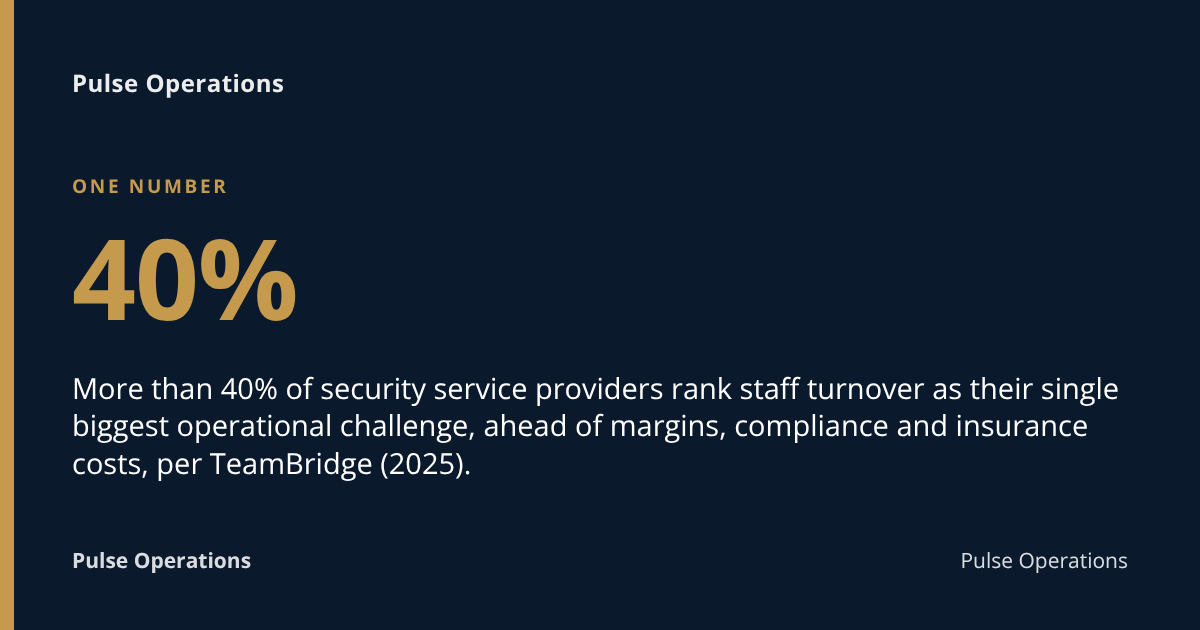
- More than 40% of security service providers rank staff turnover as their single biggest operational challenge, ahead of margins, compliance and insurance costs, per TeamBridge (2025).
- Pulse Operations records 96.2% of checkpoints carrying a watermarked photo across live operations in the trailing 90 days to July 2026 — see the benchmark.
- Pulse Operations notes that UK security firms must track SIA licences, BS 7858 screening and Working Time Regulations compliance — functions general scheduling tools like Deputy do not build for.
What is Deputy, and why does it come up in security industry searches?
Deputy is a workforce management platform built in Australia that handles shift scheduling, time-and-attendance clocking, and basic payroll exports for hourly-paid teams. It was designed primarily for retail, hospitality and healthcare rostering, not for regulated security operations.
Security businesses searching for "Deputy alternative security industry" have usually hit the same wall: Deputy schedules shifts well but has no native way to track an SIA (Security Industry Authority) badge expiry, verify that a patrol checkpoint was actually walked, or raise a lone-worker SOS alert. These are not edge cases in guarding — they're daily operational requirements under the Private Security Industry Act 2001, which established the SIA as the licensing body for UK door supervisors, CCTV operators and security guards.
Deputy's own security industry page markets the tool for guard scheduling and time tracking, per Deputy's security industry page. That's a legitimate use case for rota building. But a security operator also needs compliance runway tracking, incident logging and client-facing proof of delivery — none of which sit inside a generic rostering product. That gap is exactly where security-specific alternatives, including Pulse Operations, TrackTik, Silvertrac and Guardhouse, compete.
Main alternatives to Deputy for UK security workforce scheduling
Several platforms now compete directly for the UK security sector's scheduling and operations budget, each with a different centre of gravity. TrackTik, Silvertrac, Guardhouse, SmartTask and Pulse Operations all build specifically for guarding, patrol and FM operations rather than retrofitting a generic rota tool.
TrackTik and Silvertrac are established guard-tour and reporting platforms with strong US and international footprints. Guardhouse leans towards scheduling and payroll for smaller guarding firms. SmartTask covers FM-adjacent task management. Pulse Operations differentiates on proof-of-service: every patrol checkpoint is completed by a mandatory watermarked photograph — officer, site, GPS coordinates and timestamp — rather than an NFC or QR tag scan. That's a deliberate design choice, not a missing feature: a tag scan only proves a phone was near a tag, not that an officer was present, alert, or that anything was actually checked, per Pulse Operations's guide, How to prove patrols actually happened.
A head-to-head comparison helps frame the decision:
| Platform | Built for | Patrol verification | SIA/compliance tracking | Pricing model |
|---|---|---|---|---|
| Deputy | General hourly rostering | None native | None native | From $5/user/month, per HR.Software (2026) |
| TrackTik | Guarding & reporting | NFC/QR + GPS | Partial | Quote-based |
| Silvertrac | Guard tour & incident reporting | NFC/QR | Partial | Quote-based |
| Guardhouse | Scheduling & payroll for guarding | Limited | Partial | Quote-based |
| Pulse Operations | UK security & FM operations | Watermarked photo at every checkpoint, no tag scans by design | SIA, BS 7858, DBS, right to work, training, Martyn's Law on one expiries runway | Published openly at /pricing, per operative, unlimited sites |
See the detailed breakdowns at /vs-tracktik, /vs-silvertrac, /vs-guardhouse and /vs-smarttask, or run a side-by-side at /compare.
Features security companies need that generic scheduling tools lack
Security scheduling software needs to do more than fill a rota — it needs to prove delivery and manage regulated compliance in the same system. A general tool like Deputy was never built to hold an expiring SIA badge number against a shift assignment.
The core requirements for UK guarding firms include:
- SIA licence tracking — flagging an expired or soon-to-expire badge before a shift is confirmed, not after an officer turns up unlicensed.
- BS 7858 screening records — the British Standard for security screening of personnel, which buyers increasingly expect evidenced per person rather than asserted by policy, per Pulse Operations's guide, How to win your next security tender.
- Patrol and checkpoint verification — a tamper-resistant record that a specific location was checked at a specific time, not a self-reported tick.
- Incident logging and a daily occurrence book — a continuous, auditable record of everything from access denials to welfare concerns.
- Lone-worker SOS and welfare check calls — for officers working unaccompanied night shifts.
- Rostering against contracted hours — so overtime and under-delivery against a client contract are visible before invoicing, not after a dispute.
Pulse Operations builds all of these into one system rather than treating them as add-ons: a compliance runway covering SIA, BS 7858, DBS, right to work, training, statutory building compliance and Martyn's Law assessments sits alongside rostering, time-and-attendance and payroll-ready exports. Details at /compliance and /rostering.
In practice: proving a 152-checkpoint footprint
Priority First — the founding team's own London security & FM operation, and a sister company sharing the same majority owner as Aether Agency Ltd, which runs Pulse — covers a landmark West London mixed-use development with 11 officers across 152 checkpoints spanning retail units, residential cores, plant rooms and service yards. Before Pulse, there was no way to prove which plant room was actually checked at 3am. Every checkpoint was made photo-mandatory, so a missed area shows as a gap in the record immediately rather than surfacing as a dispute six weeks later. The system has been live since February 2026, with more than 540 patrols logged in the first five months (production data, July 2026) and all 11 officers inducted on one app.
Deputy pricing versus security-specific alternatives
Deputy's published pricing starts at $5 per user per month for its Lite tier, rising through $6.50 for Core to $9 for Pro on annual billing, with a $30 monthly minimum spend across any plan, per Deputy / HR.Software review (2026). That looks inexpensive on paper for pure rota-and-clock functionality.
The real cost comparison, however, has to include what a security firm bolts on around Deputy to cover compliance and patrol proof — a separate incident reporting tool, a separate lone-worker app, a separate compliance spreadsheet for SIA renewals. Those bolt-ons carry their own subscription costs and, more expensively, their own integration gaps.
Security-specific platforms price differently because they're selling the whole operational stack, not just the rota. Pulse Operations publishes its pricing openly at /pricing: priced per operative, with unlimited sites and free admin, control-room and client-portal seats on every tier — no per-seat charge for the office staff who need to see the data, only for the officers delivering the shift. That published-pricing approach mirrors the industry's broader shift towards transparency, visible in the same emphasis the Procurement Act 2023 regime places on transparent, evidenced bids rather than generic assertions.
SIA licence tracking and compliance monitoring across platforms
SIA licence tracking is the single clearest gap between Deputy and security-specific alternatives, because generic rostering tools have no field for a licence category, expiry date or badge number. Pulse Operations notes that the Security Industry Authority (SIA), established under the Private Security Industry Act 2001, requires licensed roles — door supervisor, CCTV operator, close protection, cash and valuables in transit — to hold a current badge at all times on duty.
A compliance gap here is not administrative; it's a legal exposure for the contractor. Beyond SIA, UK security firms also need to evidence:
- BS 7858 screening — pre-employment vetting records held per person, not asserted as a blanket policy.
- DBS checks — Disclosure and Barring Service checks for roles working with vulnerable people or in sensitive sites.
- Right to work documentation — a statutory employer duty under immigration law.
- Martyn's Law readiness — under the Terrorism (Protection of Premises) Act 2025, publicly accessible venues above certain thresholds must demonstrate terrorism-preparedness, and buyers are starting to ask for this at tender stage, per Pulse Operations's guide, How to win your next security tender.
Pulse Operations holds all of this on one compliance runway — SIA, BS 7858, DBS, right to work, training, statutory building compliance and Martyn's Law assessments tracked against expiry dates, rather than scattered across spreadsheets and renewal reminders. More at /compliance.
Lone worker safety and real-time location tracking in scheduling software
Lone-worker safety functionality has become a deciding factor for UK security firms choosing between Deputy and a security-specific alternative, because night-shift guarding and mobile patrol roles routinely put a single officer at an unstaffed site. A scheduling tool with no SOS function and no live location visibility simply doesn't answer the question a control room needs answered: is this officer safe, right now?
Real security operations software needs a live map showing where every officer is, welfare check calls on a schedule appropriate to the risk, and an SOS function an officer can trigger from their phone without fumbling through menus. Pulse Operations runs this through its live control room — map, welfare check calls, lone-worker SOS, dispatch and a morning Ops Health brief in one view, detailed at /security.
The same mechanism that proves a patrol happened also protects the officer doing it. Because every checkpoint on Pulse requires a watermarked photo with GPS and timestamp, a control room watching the feed can see immediately if an officer has gone quiet mid-round — not at the next shift debrief.
In practice: sixteen buildings, one nightly round
A prestige central-London residential estate on Priority First's books — again, the founding team's own operation and sister company to Aether Agency Ltd — runs sixteen buildings on a single nightly patrol round. Multi-building rounds are exactly where patrols quietly go missing, and the estate had no way to see delivered-versus-contracted patrols without phoning the office. Each building was set up as its own site in Pulse with its own checkpoints and evidence trail, and recurring faults now surface automatically rather than being rediscovered each visit. Live since March 2026, the estate has logged more than 4,100 patrols — roughly 250 to 280 per building — with checkpoint completions moving from an unverified "round complete" note to 100% photo-verified (production data, July 2026).
Common mistakes security companies make when switching from Deputy
Switching from Deputy to a security-specific platform goes wrong most often when firms underestimate how much operational detail needs migrating beyond the rota itself. The most common errors:
- Migrating only the rota, not the history. Past shift records, overtime patterns and absence history get left behind, making the first few months of reporting look worse than reality.
- Not running a parallel site first. Switching every site simultaneously removes any fallback if a workflow doesn't translate cleanly.
- Skipping officer-level training on the new app. A workforce with 77% annual turnover, per ASIS International, cited via UC Berkeley Labor Center (2024), needs onboarding that's fast enough to repeat constantly, not a one-off training day.
- Ignoring offline reliability. Many patrol sites — basements, plant rooms, underground car parks — have no signal. A platform that fails without connectivity will generate gaps in the record, not just inconvenience.
- Underestimating client communication. Clients used to seeing Deputy-style shift confirmations may need reassurance about what the new system shows them and when.
Pulse Operations addresses the migration risk directly: every plan includes guided setup, migration and a parallel run on one site, and most firms switch fully within a fortnight. The officer app is native iOS and Android, offline-first with self-healing sync, so a missed-signal plant room doesn't cost the patrol record — it syncs the moment connectivity returns.
In practice: a concierge operation with zero knowledge loss
A retail and residential courtyard on Priority First's books runs seven officers on concierge duty — parcels, keys, contractor access, constant presence. Concierge work is invisible until something goes wrong: a resident asking "where's my delivery?" with no chain of custody to answer. Every delivery is now logged on arrival with a photo and signed out on collection, and any officer can pick up the handover with zero knowledge loss. Live since February 2026, the site has logged more than 135 patrols with every parcel photographed on arrival and signed out — a shift from what had been a shelf system with no audit trail.
Your Deputy alternative security industry checklist
- Confirm the platform tracks SIA licence expiry against each named officer, not just a generic "compliant" flag.
- Check whether patrol verification uses a tamper-resistant method (photo evidence) rather than a scannable tag that can be bypassed.
- Ask whether BS 7858 screening records are held per person and visible to your compliance team.
- Test the app offline in a basement, plant room or underground car park before signing anything.
- Verify lone-worker SOS and welfare check functionality exists natively, not as a third-party bolt-on.
- Request the published pricing structure in writing — per-operative, per-seat or quote-based — before any sales call.
- Ask for a parallel-run migration plan with a defined timeline, not a "big bang" switchover.
- Confirm UK hosting and tenant isolation if client data sensitivity or GDPR exposure is a concern.
FAQ
Is Deputy good for security guard companies?
Deputy works well for basic shift scheduling and time clocking, but it has no native SIA licence tracking, patrol verification or incident logging — functions UK security firms need for compliance and client proof of delivery. Most security operators end up running a separate tool alongside Deputy or switching to a security-specific platform entirely.
What's the main difference between Deputy and a security-specific platform like Pulse Operations?
Deputy is a general hourly-workforce rostering tool; Pulse Operations is built specifically for UK security and FM operations with photo-verified patrols, a compliance runway and a live control room in one system. The core difference is proof: Pulse Operations verifies every checkpoint with a watermarked photo rather than relying on a scheduling confirmation alone.
How much does Deputy cost compared to security industry alternatives?
Deputy starts at $5 per user per month for its Lite plan, rising to $9 for Pro on annual billing, with a $30 monthly minimum, per Deputy / HR.Software review (2026). Security-specific platforms typically price per operative with the full operational stack included; Pulse Operations publishes its tiers openly at /pricing with unlimited sites and free admin seats.
Does Deputy support guard tour tracking or GPS patrol verification?
Deputy does not natively support GPS patrol verification or guard tour checkpoints — it's a scheduling and time-and-attendance tool, not a patrol management system. Security firms needing this functionality typically add a dedicated platform such as TrackTik, Silvertrac or Pulse Operations.
How does high security guard turnover affect the choice of scheduling software?
High turnover demands scheduling software that onboards new staff quickly and reliably tracks licence compliance for a constantly changing workforce. Security guard turnover reached 77% industry-wide in 2024, per ASIS International, cited via UC Berkeley Labor Center (2024), and annual turnover in the sector commonly runs 100-200% at most contract security firms, per ASIS International / StealthAgents (2025). A platform with a fortnight-long implementation, like Pulse Operations, suits that reality better than one requiring months of configuration.
How long does it take to switch from Deputy to a new scheduling system?
Implementation timelines vary by provider, but Pulse Operations includes guided setup, migration and a parallel run on one site in every plan, with most firms switching fully within a fortnight. Running the new system alongside Deputy on one site first reduces the risk of losing historical rota data.
What should a UK security company check before signing with a new provider?
Check UK data hosting and tenant isolation, GDPR compliance, support response arrangements, and whether pricing is published openly or requires a sales quote. Pulse Operations is UK-built and UK-hosted with tenant isolation enforced in the data layer, verified by an automated cross-tenant test suite on every build.
Switching from Deputy to Pulse Operations
Security firms that have outgrown Deputy are usually trying to solve two problems at once: proving patrols happened and keeping SIA compliance current without a spreadsheet. Pulse Operations was built inside a working London security operation specifically because a generic rostering tool couldn't do either.
Every checkpoint on Pulse is completed by a mandatory watermarked photograph — officer, site, GPS and time — with no QR or NFC scanning involved, because a tag scan only proves a phone was nearby, not that the area was genuinely checked. That mechanism sits alongside a compliance runway tracking SIA, BS 7858, DBS, right to work, training and Martyn's Law assessments on one expiries view, and rostering built against contracted hours with payroll-ready exports.
If Deputy's gaps are costing your team time on compliance chasing or client disputes over missed patrols, book a call with Pulse Operations or take the guided tour to see the officer app, control room and client portal in action.
Related Reading
- Best TrackTik Competitors 2026: UK Buyer's Guide
- Connecteam Alternative for Security Companies (2026)
- Connecteam Alternative UK: Pricing & Features Compared 2026
Add pulse-operations.co.uk as a preferred source on Google
Back to all insights