
Last updated: 24 November 2026
A commercial boiler service certificate is the dated record a Gas Safe registered engineer issues after inspecting a non-domestic boiler, confirming it is safe to operate. UK law requires businesses to keep this record current; the Health and Safety Executive says roughly 14 people die annually from carbon monoxide poisoning linked to poorly maintained gas appliances.
Key Takeaways
- A commercial boiler service certificate is issued by a Gas Safe registered engineer holding the correct commercial (COMCAT) qualification, not a domestic-only ticket.
- The Health and Safety Executive attributes around 14 UK deaths a year to carbon monoxide poisoning from poorly maintained gas appliances and flues.
- The Gas Safe Register lists around 70,000 businesses and over 130,000 engineers nationally, according to Gas Safe Register.
- A business without a valid gas safety certificate risks significant fines and unlimited HSE penalties, per the Commercial Gas Safety Certificate guide.
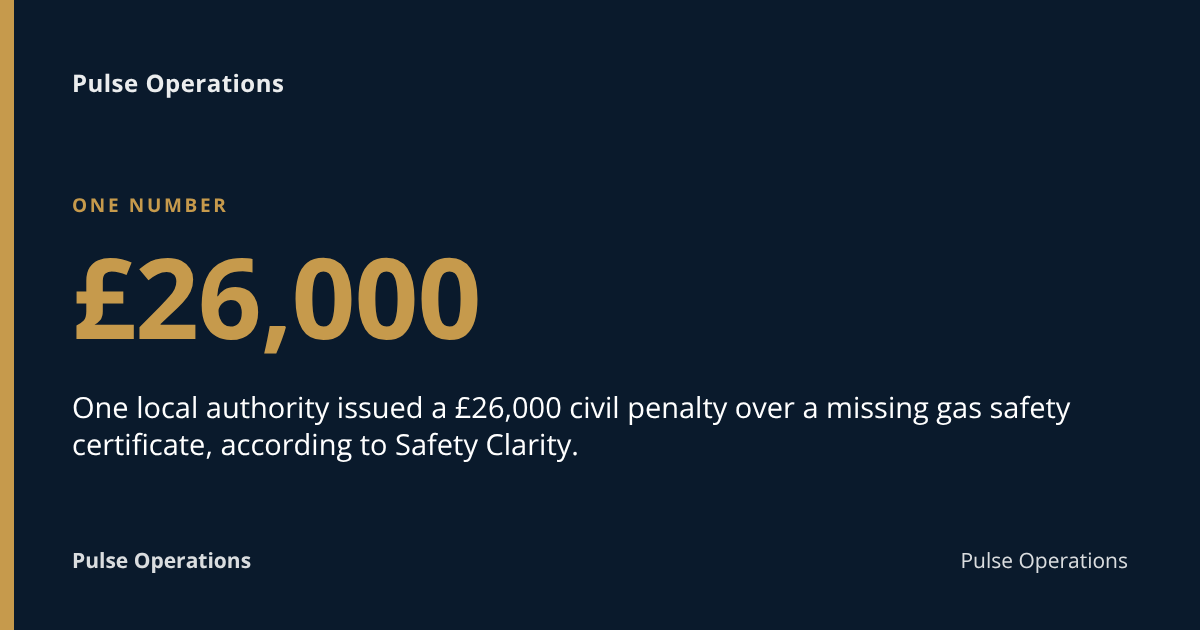
- One local authority issued a £26,000 civil penalty over a missing gas safety certificate, according to Safety Clarity.
What is a commercial boiler service certificate and why is it needed?
A commercial boiler service certificate is a formal record, issued by a qualified engineer, confirming a non-domestic boiler has been inspected, tested and found safe to continue operating. It typically covers combustion performance, flue integrity, ventilation and safety device checks, and it names the engineer, the business, the appliance, and the date of inspection.
The certificate exists because gas appliances that aren't properly maintained can leak carbon monoxide, an odourless gas that kills. The HSE's Approved Code of Practice L56 attributes roughly 14 deaths a year to carbon monoxide poisoning from gas appliances and flues that haven't been properly installed or maintained. The Office for National Statistics recorded 69 carbon monoxide deaths in England and Wales in 2022.
For a business, the certificate is also the primary evidence trail. Insurers, landlords, fire risk assessors and enforcement officers from the local authority or HSE will ask for it. Without it, a business cannot demonstrate it has met its statutory duty of care, regardless of whether the boiler was actually serviced.
Who is legally responsible for arranging commercial boiler servicing?
The duty holder — typically the employer, landlord or the person in control of the premises under the Health and Safety at Work etc. Act 1974 — is legally responsible for arranging commercial boiler servicing. This responsibility cannot be delegated to a tenant informally; it sits with whoever controls the gas appliance and the building.
In a multi-let commercial building, the landlord usually holds responsibility for boilers serving common plant, while a tenant with their own standalone unit may be responsible for that appliance under the lease. Facilities managers acting for the landlord or occupier are commonly tasked with arranging the service, but accountability stays with the named duty holder, not the FM contractor carrying out the booking.
This matters for compliance files. Whoever holds the duty needs the certificate on record, in their name, dated and signed — not a verbal assurance from a contractor that "it's been done."
Is commercial boiler servicing a legal requirement under UK law?
Commercial boiler servicing is a legal requirement under the Gas Safety (Installation and Use) Regulations 1998 and the Health and Safety at Work etc. Act 1974, both enforced by the HSE. Section 4 of the 1974 Act places duties on anyone in control of non-domestic premises to ensure plant and equipment, including gas appliances, don't endanger people using the building.
Unlike the familiar domestic landlord gas safety certificate (commonly called a CP12), there's no single fixed statutory form for every commercial boiler. The underlying duty is the same: appliances must be maintained in a safe condition, and the duty holder must be able to show how. In practice, that means a commercial Gas Safe engineer carries out the inspection and issues a certificate equivalent in substance to the domestic CP12 — sometimes referenced as a CP17 or CP42 depending on the appliance and premises type.
Failure to comply is not a minor paperwork issue. The Commercial Gas Safety Certificate guide notes a business without a valid gas safety certificate can face substantial fines, unlimited HSE penalties, and prosecution. Safety Clarity reports a local authority issuing a £26,000 civil penalty against a landlord for not holding one.
How often must a commercial boiler be serviced and certified?
Pulse Operations advises that a commercial boiler should be serviced and certified at least once every 12 months, in line with the annual safety check interval HSE guidance sets for gas appliances. Higher-use commercial plant — kitchens, leisure centres, large office blocks with continuous heating demand — often warrants more frequent servicing on the manufacturer's recommendation, sometimes every six months.
Manufacturers also set their own service intervals as a condition of warranty. A business that services annually but ignores a manufacturer's six-monthly requirement risks invalidating cover on a boiler that later fails. Facilities teams managing multiple sites typically build a rolling service calendar rather than relying on memory or a single annual reminder, because a missed certificate renewal on even one site creates a compliance gap the moment an inspector, insurer or auditor asks for evidence.
This is where many multi-site operators lose control — service dates sit in separate contractor diaries, not in one place the business can check. Pulse Operations's compliance runway puts statutory building compliance, including service and certificate expiry dates, on one tracked timeline alongside SIA, BS 7858 and training renewals, so a lapsed boiler certificate shows up the same way a lapsed licence does — before it becomes a problem, not after.
Who is qualified to issue a commercial boiler service certificate?
A Gas Safe registered engineer holding the correct commercial qualification category is the only person legally permitted to issue a commercial boiler service certificate. The Gas Safe Register is the UK's official, government-appointed body for registering gas engineers and businesses, replacing CORGI in 2009.
Not every Gas Safe engineer is qualified to work on commercial appliances. Commercial gas work sits under separate COMCAT (Commercial Category) qualifications — covering areas like commercial catering, commercial boilers and pipework, and commercial heating — that are distinct from the domestic categories most engineers carry. A business must check the engineer's ID card lists the specific commercial category relevant to the appliance being serviced, not just a domestic ticket.
The scale of the register gives a sense of how specialised this checking matters. Gas Safe Register states there are around 70,000 businesses and over 130,000 gas engineers registered nationally. Since launch, Able Skills reports the number of registered engineers has grown from 120,000 to over 150,000, and businesses from 35,000 to 80,000. Against that backdrop, RoSPA estimates around 7,500 unregistered gas fitters are actively working in the UK, resulting in roughly 250,000 illegal gas jobs every year — a reminder that checking registration status on the Gas Safe Register website before booking any engineer isn't optional diligence, it's the baseline.
What does a commercial boiler service typically involve?
A commercial boiler service typically involves a visual inspection, a combustion analysis, a check of safety and control devices, and a flue and ventilation assessment, concluding with the engineer completing and issuing the certificate. The engineer checks the boiler casing, pipework and seals for damage or corrosion, tests the flue for safe gas flow, and verifies ventilation is adequate for the appliance's heat input.
Combustion analysis measures the ratio of gases the boiler produces, picking up early signs of incomplete combustion — the condition that generates carbon monoxide. The engineer also tests safety devices such as thermostats, pressure relief valves and flame failure devices, confirms gas pressure is within manufacturer tolerance, and records the appliance's make, model and serial number against the readings taken.
For larger commercial plant — multiple boilers, a plant room serving a whole block, or catering equipment on the same gas supply — the service usually takes longer than a domestic visit and may need isolating sections of the building's heating in sequence, which is why FM teams schedule it outside peak occupancy hours where possible.
How much does a commercial boiler service and certificate usually cost?
Commercial boiler service costs vary with appliance size, number of units and site complexity, and the research available doesn't provide a single UK-wide benchmark figure. As a general illustration, a single commercial boiler service with certificate is often a lower cost than servicing a plant room with multiple units, call-out charges, and any remedial parts identified during the inspection.
| Site type | Typical scope | Cost driver |
|---|---|---|
| Single small commercial boiler (café, small office) | One appliance, standard service | Appliance size, access |
| Multi-boiler plant room (office block, retail unit) | Several boilers, shared flue/ventilation checks | Number of units, isolation time |
| Large or complex plant (leisure centre, hospital wing) | Multiple appliances, higher combustion loads | Specialist COMCAT category, parts, downtime window |
These figures are illustrative only; always request a written quote referencing the specific appliance, COMCAT category required, and whether combustion analysis and any flue gas testing are included. A quote with no breakdown of what's checked is harder to validate against the certificate the engineer later issues.
What information must appear on a valid commercial boiler service certificate?
A valid commercial boiler service certificate must name the engineer, their Gas Safe Register licence number, the business and site address, the appliance details, the date of inspection, and the outcome of each safety check performed. It should also record the flue type, ventilation assessment, gas pressure reading, and any defects found, with a clear statement of whether the appliance is safe to use.
The certificate should be signed and dated, and it should specify when the next service is due. A certificate missing the engineer's licence number, or one that doesn't name the specific appliance it covers, is weak evidence if ever challenged by an insurer or the HSE following an incident.
Businesses managing several sites often find the paperwork itself becomes the weak point — certificates filed in different formats, held by different contractors, with no single view of what's current and what's overdue. That's the same problem Pulse Operations solves for SIA licences, DBS checks and training records through its compliance runway: one expiries timeline rather than a filing cabinet per contractor.
What happens if a business fails to get its boiler serviced or certified?
A business without a valid commercial boiler service certificate faces enforcement risk, insurance exposure and, in the worst cases, prosecution following a carbon monoxide incident. The Commercial Gas Safety Certificate guide states substantial fines and unlimited HSE penalties can apply, alongside potential prosecution.
Beyond the direct fine, an uncertified boiler is a liability the moment anything goes wrong. An insurer investigating a claim after a gas incident will ask for the service history first; no certificate typically means no cover. A landlord discovering a tenant hasn't maintained shared plant may be in breach of their own obligations under the lease and the Health and Safety at Work etc. Act 1974, regardless of who physically controls the appliance.
Safety Clarity records a case where a local authority issued a £26,000 civil penalty to a landlord over a missing gas safety certificate — a figure that illustrates enforcement isn't theoretical, even where no injury occurred.
In-house booking versus a managed compliance system
Businesses generally choose between booking commercial boiler servicing in-house, site by site, or running it through a managed facilities compliance system that tracks renewal dates across every site and asset. In-house booking works for a single site with one plant room and one trusted contractor; it starts to fail once a business holds multiple sites, multiple contractors, or boilers alongside other statutory checks like fire alarm testing, legionella risk assessment and electrical testing.
The trade-off is visibility. A managed system — whether a dedicated compliance platform or a facilities management provider's own tracker — gives one person the ability to see every certificate's expiry date at a glance, rather than relying on each site manager to remember or each contractor to chase. Pulse Operations built this logic into its facilities & work orders module for exactly this reason: PPM schedules, asset registers and statutory compliance dates sit alongside the work orders that action them, so a boiler service due in March doesn't depend on someone noticing a date in a spreadsheet.
"The burden of proof moved. Ten years ago 'we were there' closed the conversation; now clients have their own auditors, their own boards, their own doubts. The operators who thrive are the ones who treat every shift as something they can show, not just something they can say." — Mo Hassan, Founder, Pulse
That shift applies as much to statutory compliance as it does to security patrols: a business that can produce the certificate, the engineer's licence number and the next due date in seconds is in a different position to one still phoning a contractor to ask.
Your commercial boiler service certificate checklist
- Confirm the duty holder — landlord, employer or occupier — named in the lease or health and safety policy.
- Check the engineer's Gas Safe Register licence number and commercial (COMCAT) category before booking.
- Book servicing at least annually, or more often where the manufacturer's warranty requires it.
- Request a written quote specifying combustion analysis, flue testing and ventilation checks.
- Verify the certificate names the appliance, site address, inspection date and next due date.
- File the certificate alongside other statutory compliance records, not in a separate contractor file.
- Share a copy with the insurer, landlord or managing agent who requires sight of it.
- Set a renewal reminder at least 4-6 weeks before expiry to avoid a compliance gap.
FAQ
What is a commercial boiler service certificate?
A commercial boiler service certificate is a dated document a Gas Safe registered engineer issues after inspecting a non-domestic boiler, confirming the appliance, flue and safety devices were checked and the boiler is safe to use. It names the engineer, the business, the appliance and the inspection date.
Who is legally responsible for commercial boiler servicing?
The duty holder — usually the employer, landlord or person in control of the premises under the Health and Safety at Work etc. Act 1974 — is legally responsible. A facilities manager may arrange the booking, but accountability stays with the named duty holder.
How often does a commercial boiler need servicing?
A commercial boiler should be serviced at least annually under HSE guidance, though manufacturers often set shorter intervals, sometimes every six months, as a warranty condition. High-use commercial plant typically needs more frequent attention than a low-use single office boiler.
Who can issue a commercial boiler service certificate?
Only a Gas Safe registered engineer holding the correct commercial (COMCAT) qualification can issue a valid certificate. Gas Safe Register lists around 70,000 businesses and over 130,000 engineers nationally, but not all hold commercial categories, so checking the engineer's ID card against the specific job is essential.
What happens if a business doesn't get its boiler certified?
A business without a valid certificate risks substantial fines and unlimited HSE penalties, plus potential invalidation of insurance cover and prosecution following any incident.
Does commercial boiler servicing differ from domestic servicing?
Yes. Commercial servicing requires an engineer holding a commercial (COMCAT) qualification, often covers multiple appliances or plant rooms, and typically takes longer due to combustion analysis across larger or multiple units. Domestic servicing uses the standard CP12-style certificate; commercial premises may use equivalent documentation such as a CP17 or CP42 depending on the appliance.
How long should a business keep commercial boiler service certificates?
Certificates should be kept for at least the period between services, and many businesses retain several years of history to show a consistent maintenance pattern to insurers, auditors or enforcement officers. Landlords, managing agents and insurers may request copies at any time, so certificates should be accessible, not just filed.
Securing boiler compliance alongside everything else on site
Pulse Operations exists to stop exactly this kind of compliance gap — a certificate that's technically been issued but can't be found, checked or proven when someone asks. The same compliance runway that tracks SIA licences, BS 7858 screening and DBS checks for security and FM teams puts statutory building compliance dates, including boiler servicing, on one expiries timeline rather than scattered across contractor files.
Pulse Operations was built inside the founding team's own London security and FM operation, Priority First — Priority First is a sister company: it has the same majority owner as Aether Agency Ltd, which runs Pulse — so the compliance tracking reflects what a real multi-site operator actually needs to prove, not a theoretical checklist.
If your business manages boiler servicing across several sites alongside guarding, cleaning or maintenance contracts, get in touch with Pulse Operations to see the compliance runway and facilities & work orders modules in a working demo.
Related Reading
- BS 5839 Fire Alarm Record Keeping: UK Rules 2026
- CMMS Implementation Guide for UK FM Teams (2026)
- BS 5266 Penalties for Non-Compliance: UK Fines Explained
Add pulse-operations.co.uk as a preferred source on Google
Back to all insights