
Last updated: 11 November 2026
Compliance software for managing agents is a system that tracks vetting, contracts, licences and ongoing conduct for anyone acting on a firm's behalf — sales agents, Appointed Representatives, letting agents or, in security and facilities, subcontracted officers and site staff. In the UK, this now includes governing AI agents too: 82% of organisations discovered at least one AI agent or workflow in the past year that security or IT didn't know existed, per the CSA and Token Security survey (2026).
Key Takeaways
- 82% of organisations found an unknown AI agent or workflow operating in their environment in the past year, according to the CSA and Token Security survey (2026).
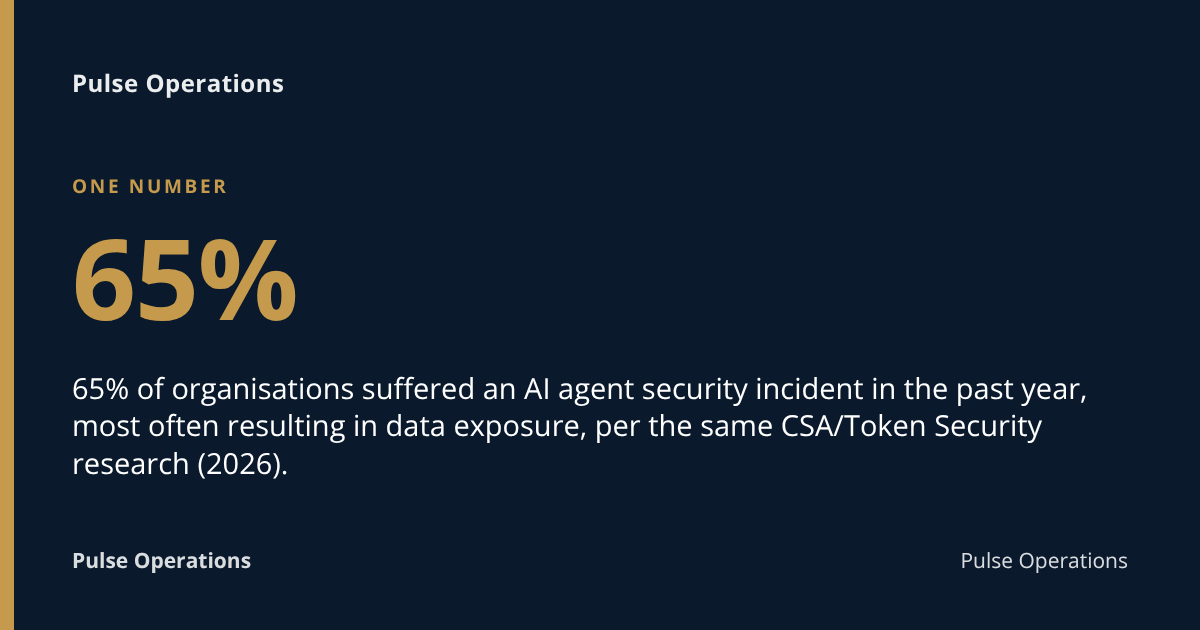
- 65% of organisations suffered an AI agent security incident in the past year, most often resulting in data exposure, per the same CSA/Token Security research (2026).
- Only 26% of organisations have comprehensive AI security governance policies, while 64% have partial guidelines or are still building them, according to the CSA/Google Cloud State of AI Security and Governance survey (2025).
- In UK security and FM, "agent" more often means a human third party — a subcontracted guard, a mobile patrol operative or a managing agent for a block — and the compliance burden sits with the FCA, the SIA or BS 7858, not with AI governance frameworks.
- Pulse Operations runs its compliance runway inside the same platform used for patrols, incidents and FM work orders, so licence, DBS and BS 7858 expiries sit next to the records that prove the work was actually done.
What does "agents" mean in this context, and does it change the software you need?
"Agent" is an umbrella term that changes meaning depending on sector, and the compliance software required depends entirely on which definition applies. A financial services Appointed Representative (AR) — a firm permitted to carry out regulated activity under another firm's FCA authorisation — needs different tracking than a letting agent, an insurance intermediary, or a subcontracted security officer.
In financial services, the Financial Conduct Authority (FCA) requires principal firms to maintain oversight of their ARs, including due diligence before appointment and ongoing monitoring of conduct. In property, letting and managing agents face obligations under the Tenant Fees Act 2019 and, increasingly, scrutiny tied to building safety duties. In insurance, agents and intermediaries sit under FCA conduct rules and the Insurance Distribution Directive as onshored into UK law.
In security and facilities management — Pulse Operations's own sector — "agents" usually means subcontracted guarding firms, mobile patrol providers or individual officers working under a managing agent's instruction for a landlord or developer. Here the compliance anchor isn't the FCA; it's the Security Industry Authority (SIA), BS 7858 screening, and contractual service levels owed to the client.
There's also a newer, distinct category worth disambiguating clearly: AI agents — autonomous software that performs tasks without constant human instruction. Gartner predicts that 40% of enterprise applications will feature task-specific AI agents by the end of 2026, up from fewer than 5% in 2025, according to the Cloud Security Alliance's Shadow AI research (2026). This is a genuinely separate compliance problem — governing software identities, not people or firms — and it needs its own platform, not a bolt-on to a human-agent system. A UK firm buying "compliance software for managing agents" should establish which of these problems it's actually solving before evaluating vendors.
What UK laws require businesses to monitor third-party agents?
Several distinct pieces of UK legislation create monitoring duties, and which one applies depends on the type of agent and sector. There is no single "agent compliance law" — instead, a patchwork of regimes each impose their own obligations.
- FCA rules on Appointed Representatives require principal firms to assess an AR's fitness and propriety before appointment and to monitor it continuously thereafter — failures here have led to significant FCA enforcement action against principals, not just the ARs themselves.
- The Bribery Act 2010 makes a commercial organisation liable if a person "associated with" it — including an agent — pays a bribe on its behalf, unless the organisation had "adequate procedures" in place. Agent due diligence is a core adequate procedure.
- Pulse Operations notes that the Money Laundering, Terrorist Financing and Transfer of Funds (Information on the Payer) Regulations 2017 (as amended) require regulated businesses to apply customer due diligence, which extends to agents acting as intermediaries in regulated sectors.
- Pulse Operations notes that the Private Security Industry Act 2001 requires individuals carrying out licensable security activities to hold an SIA licence, and firms engaging unlicensed subcontractors carry legal exposure.
- BS 7858, the British Standard for security screening of individuals employed in a security environment, sets the vetting baseline that contracts and tenders routinely reference.
- The UK GDPR and Data Protection Act 2018 govern how agent personal data — DBS results, right-to-work documents, bank details — must be stored, with the Information Commissioner's Office (ICO) as regulator.
For security and FM operators specifically, the Terrorism (Protection of Premises) Act 2025 — commonly called Martyn's Law — adds a new duty for publicly accessible venues to assess and document terrorism-related preparedness, which increasingly flows down to the agents and contractors delivering security on site.
Who is legally responsible for agent compliance inside a UK firm?
Legal responsibility for agent compliance sits with the firm itself, but the Senior Managers and Certification Regime (SMCR) — the FCA and PRA framework that makes named senior individuals personally accountable for specific areas of a regulated firm — pins day-to-day accountability on a named senior manager where SMCR applies. A compliance officer typically runs the operational checks, but cannot absorb the senior manager's personal regulatory accountability.
Outside FCA-regulated firms, responsibility usually falls to whoever holds operational sign-off for subcontractors — an operations director, a compliance manager, or in smaller firms, the managing director directly. Under the Approved Contractor Scheme (ACS), the SIA's voluntary quality mark for security providers, contractors are explicitly assessed on how well they manage their own compliance evidence — including, per Pulse Operations's guide, The ACS self-assessment: how to evidence it, the People criterion, which checks how well contractors apply BS 7858 and verify licences against the SIA's register.
This matters practically: ACS assessors don't take a workbook's self-declared scores at face value. The guide notes assessors review staff files and payroll records, contracts and duty rotas, policies and procedures, and site documentation, and they interview staff and customers and visit operational sites. If responsibility for agent compliance is nominally assigned but evidence lives in scattered spreadsheets, the person accountable has no way to actually discharge that duty when an assessor — or a regulator — asks.
What core features should compliance software for managing agents include?
Core compliance software for managing agents needs four functions working together: due diligence checks at onboarding, contract and licence tracking with expiry alerts, an audit trail that can't be edited retrospectively, and ongoing risk visibility rather than a one-off approval. Missing any one of these leaves a gap an assessor, auditor or regulator will eventually find.
| Feature | What it does | Why it matters |
|---|---|---|
| Due diligence / onboarding checks | Verifies identity, right to work, DBS, BS 7858 screening, SIA licence status before an agent starts | Prevents unlicensed or unvetted individuals ever reaching a site |
| Expiry runway | Tracks licence, DBS, training and insurance expiry dates with automated alerts | Stops lapses being discovered only when a client or assessor asks |
| Tamper-evident audit trail | Records who approved what and when, in a log that can't be quietly edited | Produces defensible evidence for tribunals, audits and ACS reassessment |
| Risk scoring / flags | Surfaces agents with missing documents, repeat incidents or complaints | Turns monitoring from reactive to proactive |
| Contract/SLA tracking | Links each agent to the specific contract terms and service levels they're bound by | Makes under-delivery visible against what was actually promised |
The compliance runway, for example, holds SIA licensing, BS 7858, DBS, right to work, training records, statutory building compliance and Martyn's Law assessments on one expiries view, rather than splitting them across HR systems, a licensing spreadsheet and a filing cabinet. The audit log underneath it is hash-chained using SHA-256 and tamper-evident, with a built-in integrity check that walks the whole chain — so when an assessor asks "prove this wasn't edited after the fact," there's a mechanism to answer, not a policy statement.
"The patrol that spots the leak and the engineer who fixes it usually work for different systems, and the gap between them is where buildings deteriorate. One record means an issue found on patrol becomes a work order without being retyped — and the client sees the whole thread." — Mo Hassan, Founder, Pulse
How does this software compare with spreadsheets or generic CRM/GRC tools?
Compliance software for managing agents differs from a spreadsheet or a generic CRM because it enforces structure the agent or admin can't skip, while a spreadsheet only records what someone remembered to type in. A spreadsheet has no alert when a licence lapses unless a formula is maintained correctly and someone checks it; a generic CRM tracks relationships and sales pipeline but has no concept of BS 7858 screening or SIA licence renewal cycles.
Generic Governance, Risk and Compliance (GRC) platforms — built for broad enterprise risk management — can technically be configured to track agents, but they're built for policy mapping and enterprise risk registers, not for site-level evidence like a watermarked checkpoint photo or a contractor's induction record. Retrofitting a GRC tool to security and FM operations usually means paying for modules the firm never uses while still building the sector-specific parts from scratch.
| Spreadsheet | Generic CRM/GRC | Sector-built compliance software | |
|---|---|---|---|
| Expiry alerts | Manual, formula-dependent | Often available but generic | Built for licence/DBS/BS 7858 cycles |
| Audit trail | Editable, no integrity check | Varies by product | Tamper-evident by design |
| Site-level evidence | None | Rarely built in | Native (photos, GPS, timestamps) |
| Setup effort | Low upfront, high ongoing risk | Medium-high, needs configuration | Built for the sector from day one |
| Assessor-ready output | Requires manual compilation | Requires custom reporting | Designed around what assessors ask for |
This is the comparison Pulse Operations makes explicit on its own site against named competitors in the space — see /vs-tracktik, /vs-silvertrac, /vs-guardhouse and /vs-smarttask — because the honest answer is that each platform makes different trade-offs, and a buyer should know which one before signing a contract.
What should a UK business check before signing with a vendor?
A UK business evaluating compliance software for managing agents should confirm data residency, security architecture and support terms in writing before signing, not after. Only 13% of organisations report feeling highly prepared for upcoming AI-related regulations, and only 15% report that 76-100% of their agents have defined ownership, according to the Cloud Security Alliance's Enterprise AI Security Starts with AI Agents report (2025) — a sign that governance maturity varies widely even among firms that believe they've addressed it.
Questions worth putting to any vendor in writing:
- Where is data hosted, and is it UK-based? Pulse Operations is UK-built and UK-hosted, with tenant isolation enforced in the data layer and verified by an automated cross-tenant test suite on every build.
- Is the platform GDPR-compliant for handling DBS, right-to-work and screening data?
- What does the audit trail actually prevent — can records be edited after the fact, and is there an integrity check?
- What's the migration timeline? Every Pulse Operations plan includes guided setup, migration and a parallel run on one site; most firms switch fully within a fortnight.
- What's the support model and response commitment if a licence check fails or an alert is missed?
- How is pricing structured — per agent, per site, or a flat enterprise fee? Pulse Operations publishes pricing openly at /pricing, per operative, with unlimited sites and free admin and portal seats on every plan.
The cost of getting this wrong is material. Breaches involving high levels of shadow AI — unsanctioned or unmonitored software use — cost $4.63 million on average, $670,000 more than breaches with little or no shadow AI, per IBM's 2025 Cost of a Data Breach Report, cited via Netwrix (2025). That's a US-dollar, US-context figure, but the direction of travel — unmonitored systems cost more when something goes wrong — applies equally to unmonitored human agents on a UK security contract.
How does compliance software handle ongoing monitoring versus one-off onboarding?
Ongoing monitoring means a compliance system keeps checking an agent's status after approval, rather than clearing them once and filing the paperwork. A one-off onboarding check only proves an agent was compliant on the day they were vetted — it says nothing about a licence that lapses eighteen months later or a DBS check that falls due for renewal.
This distinction matters because 76% of organisations do not fully govern or monitor non-human identities, including AI agents and service accounts, and only 20% fully monitor or govern employee use of shadow AI, according to Netwrix's 2026 shadow AI risk research. The pattern — strong onboarding, weak ongoing monitoring — repeats in human-agent compliance too: a firm might vet a subcontracted officer thoroughly on day one, then have no automated process catching a lapsed SIA licence six months into the contract.
Pulse Operations was built to close exactly that gap inside its own operation first. Priority First — a sister company: it has the same majority owner as Aether Agency Ltd, which runs Pulse — ran patrols on paper sign-in sheets before Pulse existed, with licence and screening expiries sitting in a spreadsheet nobody fully trusted. Live since February 2026, Pulse brought 24 sites onto one login within six months, with checkpoints backed by a watermarked photo moving from 0% to 100% and contracted patrol frequency — previously assumed — tracked against the actual number delivered. The point isn't the photo alone; it's that the same platform that proves a patrol happened also holds the licence expiry that determines whether that officer was allowed to be there.
Your agent compliance checklist
- Confirm which definition of "agent" applies to your business — FCA Appointed Representative, letting agent, security subcontractor or AI agent — before evaluating software.
- Map every UK law or standard that applies: FCA rules, the Bribery Act 2010, UK GDPR, the Private Security Industry Act 2001, BS 7858, and Martyn's Law where relevant.
- Name the person or role accountable for agent compliance in writing, with SMCR responsibility assigned if the firm is FCA-regulated.
- Check that any vendor offers expiry alerts, a tamper-evident audit trail and risk flags — not just a document storage folder.
- Ask every vendor in writing about UK data residency, GDPR compliance, migration timeline and support SLAs before signing.
- Build in ongoing monitoring, not just onboarding checks — licences and screening lapse long after the first approval.
- Review ACS or equivalent self-assessment criteria annually and keep evidence ready, not reconstructed under deadline pressure.
FAQ
What does "compliance software for managing agents" actually cover?
It covers the systems used to onboard, vet, monitor and document anyone acting on a firm's behalf — which could mean FCA Appointed Representatives, letting agents, insurance intermediaries, subcontracted security officers, or increasingly, autonomous AI agents. The right software depends entirely on which of these applies to your business.
Does the FCA require specific software for managing Appointed Representatives?
No, the FCA doesn't mandate a specific software product, but it requires principal firms to conduct due diligence before appointing an AR and to monitor them on an ongoing basis. Software that provides an auditable record of both the initial checks and continuous monitoring makes it far easier to demonstrate compliance if the FCA asks.
How is managing AI agents different from managing human agents for compliance purposes?
Managing AI agents means governing autonomous software identities that can take actions without constant human instruction, which is a newer and distinct problem from vetting human agents or firms. Only 26% of organisations have comprehensive AI security governance policies, according to the CSA/Google Cloud survey (2025), reflecting how immature this specific governance area still is compared with established human-agent compliance regimes like BS 7858 or FCA AR oversight.
What happens if a UK security firm uses an unlicensed subcontractor?
Using an unlicensed subcontractor to carry out licensable security activities breaches the Private Security Industry Act 2001 and exposes the engaging firm to legal and contractual risk, including potential loss of ACS status and client contracts. Compliance software that checks SIA licence status before a shift is scheduled, not after, prevents this from happening in the first place.
How long does it take to roll out compliance software across an existing agent network?
Implementation timelines vary by platform and network size, but Pulse Operations includes guided setup, migration and a parallel run on one site with every plan, and most firms switch fully within a fortnight. Larger, multi-site rollouts — such as Priority First's 24-site deployment — can scale over several months while individual sites go live far sooner.
Can a spreadsheet be enough for agent compliance in a small UK firm?
A spreadsheet can technically hold the same data as dedicated software, but it has no built-in alerting, no tamper-evident audit trail, and relies entirely on someone remembering to check it. For firms facing ACS reassessment, FCA oversight or BS 7858 screening obligations, the absence of automated expiry alerts and defensible audit records is a real risk, not just an inconvenience.
What penalties can a UK business face for poor agent compliance?
Penalties vary by regime: FCA enforcement action against principal firms for AR failures, Bribery Act 2010 liability for an agent's corrupt conduct, ICO fines for mishandling personal data under UK GDPR, and loss of ACS status or client contracts in security and FM. Software that produces continuous, defensible evidence reduces the likelihood of all of these by catching gaps before an assessor or regulator does.
Compliance that holds up under audit, with Pulse Operations
Managing agent compliance in security and FM isn't a paperwork exercise — it's the difference between passing an ACS reassessment and failing one, between a client trusting your 7am status call and demanding proof. Pulse Operations built its compliance runway to hold SIA licensing, BS 7858, DBS, right to work, training and Martyn's Law assessments on one expiries view, connected to the same system that proves the work itself happened.
This wasn't designed in the abstract. It was built inside Priority First — a sister company: it has the same majority owner as Aether Agency Ltd, which runs Pulse — after the founding team needed to prove compliance and delivery to clients rather than ask to be believed on paper sign-in sheets and spreadsheets nobody trusted.
If your agent network's compliance evidence currently lives across spreadsheets, inboxes and a filing cabinet, get a tour of Pulse Operations's compliance runway or check published pricing at pulse-operations.co.uk/pricing — no deck, no sales pitch required.
Related Reading
- Compliance Software for Logistics & Warehousing UK 2026
- Compliance Software for Healthcare Security in the UK
- Compliance Software for Local Authorities (2026 Guide)
Add pulse-operations.co.uk as a preferred source on Google
Back to all insights