Last updated: 25 November 2026
A COSHH audit checklist is a structured inspection tool used to verify that a workplace's Control of Substances Hazardous to Health arrangements — risk assessments, control measures, training records and monitoring — are actually working in practice, not just written down. For UK facilities management teams running several sites, it's the document that turns scattered paperwork into a single, provable compliance record.
Key Takeaways
- COSHH stands for the Control of Substances Hazardous to Health Regulations 2002, as Pulse Operations notes, the UK law requiring employers to assess and control exposure to hazardous substances.
- An estimated 1.9 million workers suffered work-related ill health in the UK in 2024/25, a figure that exceeds pre-pandemic levels, according to HSE statistics, cited via M2Y Academy (2024/25).
- Local exhaust ventilation (LEV) systems must be thoroughly examined and tested at least every 14 months under COSHH Regulation 9, with shorter intervals for higher-risk Schedule 4 processes, per HSE guidance, cited via Hobarts (2025).
- HSE completed 246 criminal prosecutions in 2024/25 with a 96% conviction rate, and secured over £33 million in fines across its enforcement remit, according to COSHH Training (2024/25).
- Pulse Operations advises that a COSHH audit differs from a routine risk assessment because it checks whether existing controls are being followed and documented, rather than identifying hazards from scratch.
What is a COSHH audit and what does it actually check?
A COSHH audit is a formal inspection process that tests whether an organisation's existing COSHH risk assessments, control measures and records match what's happening on site. COSHH itself — the Control of Substances Hazardous to Health Regulations 2002 — is UK law made under the Health and Safety at Work etc. Act 1974, requiring employers to assess the risk from hazardous substances and put adequate controls in place.
Where a risk assessment asks "what could go wrong with this substance?", an audit asks "are we doing what we said we'd do?" It checks labelled containers against the data sheets on file, cross-references staff names against training logs, inspects personal protective equipment (PPE) for wear and fit, and confirms that local exhaust ventilation (LEV) — the extraction systems that pull airborne contaminants away from a worker — is actually running and recently tested.
For FM providers managing cleaning contractors, pest control, plant rooms and multiple client sites, a COSHH audit also checks something risk assessments often miss: whether the person using a substance today is the same person who was trained on it, and whether that training record can be produced on demand. This is the gap that turns up repeatedly in HSE enforcement data — not the absence of a risk assessment, but the absence of proof that its controls are followed.
The scope typically spans chemical stores, cleaning cupboards, workshops, plant rooms, and any area where substances defined under COSHH — irritants, corrosives, dusts, fumes, biological agents, and substances with a workplace exposure limit (WEL) set out in HSE's EH40/2005 guidance — are stored, mixed, or used.
Pulse Operations on what legal duties under the COSHH Regulations 2002 a UK employer must comply with
The COSHH Regulations 2002 (SI 2002/2677) place a direct legal duty on every UK employer to assess risks from hazardous substances, prevent or adequately control exposure, and maintain those controls — not simply to write the assessment once and file it. The regulations sit alongside the Health and Safety at Work etc. Act 1974, the parent legislation under which COSHH and most other workplace safety rules are made.
The core duties an employer must evidence include:
- Assess the risk — identify hazardous substances present and how workers could be exposed.
- Prevent exposure where reasonably practicable, or control it adequately where elimination isn't possible.
- Maintain, examine and test control measures — Regulation 9 specifically requires that engineering controls such as LEV systems are thoroughly examined and tested at intervals not exceeding 14 months, with shorter intervals for higher-risk Schedule 4 processes, per HSE guidance on Regulation 9, cited via Hobarts (2025).
- Monitor exposure where health effects could occur and controls can't be relied on alone.
- Carry out health surveillance for employees exposed to specified substances.
- Provide information, instruction and training so staff understand the risks and the controls.
- Prepare procedures for accidents, incidents and emergencies involving hazardous substances.
The HSE's L5 Approved Code of Practice is the reference document inspectors and assessors use to interpret these duties in practice. Its status is clear: "This guidance is issued by the Health and Safety Executive. Following the guidance is not compulsory, unless specifically stated, and you are free to take other action," per the HSE L5 ACOP — but departing from it means demonstrating an equally effective alternative, which is a harder conversation to have with an inspector than simply following it.
The human cost behind these duties is substantial. HSE statistics, cited via Duo Dynamic Safety (2023/24), show 1.7 million UK workers suffered work-related illnesses in 2023/24, with 2,218 mesothelioma deaths in 2023 linked to past asbestos exposures, and 33.7 million working days lost to work-related ill health and injury. Separately, around 11,000 annual lung-disease deaths in Great Britain are estimated to be linked to past workplace exposures, according to HSE respiratory statistics, cited via COSHH Training (2025).
Who is responsible for carrying out and signing off a COSHH audit?
The employer carries the legal duty for COSHH compliance, but in practice the audit itself is usually delegated to a competent person — someone with the training, knowledge and experience to judge whether controls are adequate, a standard the HSE's L5 ACOP uses throughout. In an FM context, this is often a health and safety manager, a compliance lead, or in larger portfolios, a dedicated COSHH assessor working across sites.
Sign-off responsibility typically sits at two levels:
- The auditor completes the checklist, records findings, and risk-rates any non-conformances.
- A senior manager or director reviews and formally signs off the audit, accepting any residual risk and approving the corrective action plan.
For FM providers managing subcontracted cleaning, pest control or specialist trades, responsibility gets murkier. The client may hold the COSHH duty for the building, while the contractor holds it for their own staff and substances — and an audit needs to establish, in writing, who owns which part. This is precisely the kind of shared-responsibility gap that an operations platform should close rather than leave to email threads: when compliance records, training logs and site-specific risk assessments all sit in one system, the question "who signed this off, and when" has a single, timestamped answer instead of a search through inboxes.
Key sections every COSHH audit checklist should include
A COSHH audit checklist works best organised into clear sections that mirror the regulatory duties above, rather than a flat list of questions. The table below sets out the core sections an FM compliance team should expect to see, alongside what's actually being verified.
| Checklist section | What it verifies |
|---|---|
| Substance inventory | Every hazardous substance on site is listed, with current safety data sheets held and accessible |
| Risk assessments | A written COSHH assessment exists for each substance/task and is in date |
| Control measures | PPE, ventilation and storage match what the risk assessment specifies |
| LEV testing | Extraction systems examined and tested within the 14-month maximum interval |
| Training records | Staff using substances have documented, in-date COSHH training |
| Health surveillance | Where required, surveillance records exist and are reviewed |
| Labelling and storage | Containers correctly labelled; incompatible substances segregated |
| Emergency arrangements | Spill kits, first aid and incident procedures are in place and known to staff |
| Incident history | Previous spills, exposures or near-misses are logged and actioned |
| Contractor compliance | Subcontractors' own COSHH arrangements are checked where they bring substances on site |
Each section should generate a pass/fail or risk-rated outcome, not just a tick. Pulse Operations notes that a checklist which only records "compliant/non-compliant" without a severity rating gives a compliance manager nothing to prioritise when reporting to the board — a COSHH audit with 40 minor gaps and one critical LEV failure needs to read very differently from one with 40 roughly equal findings.
How often should a COSHH audit be reviewed or repeated?
A COSHH risk assessment must be reviewed whenever circumstances change — a new substance, a process change, an incident, or new guidance — and formal audits are typically run annually as a minimum, though high-risk sites often run them more frequently. The HSE doesn't fix a single legal review interval for the assessment itself; the test is whether it remains "suitable and sufficient," per HSE's COSHH FAQ page.
Certain elements do carry fixed statutory intervals, which is where many FM teams come unstuck:
- LEV thorough examination and testing: at least every 14 months under Regulation 9, with shorter intervals for Schedule 4 processes, per HSE guidance, cited via Hobarts (2025).
- Health surveillance: frequency set by the specific substance and health effect being monitored.
- Training refreshers: no fixed legal interval, but best practice ties them to role changes, new substances, or audit findings.
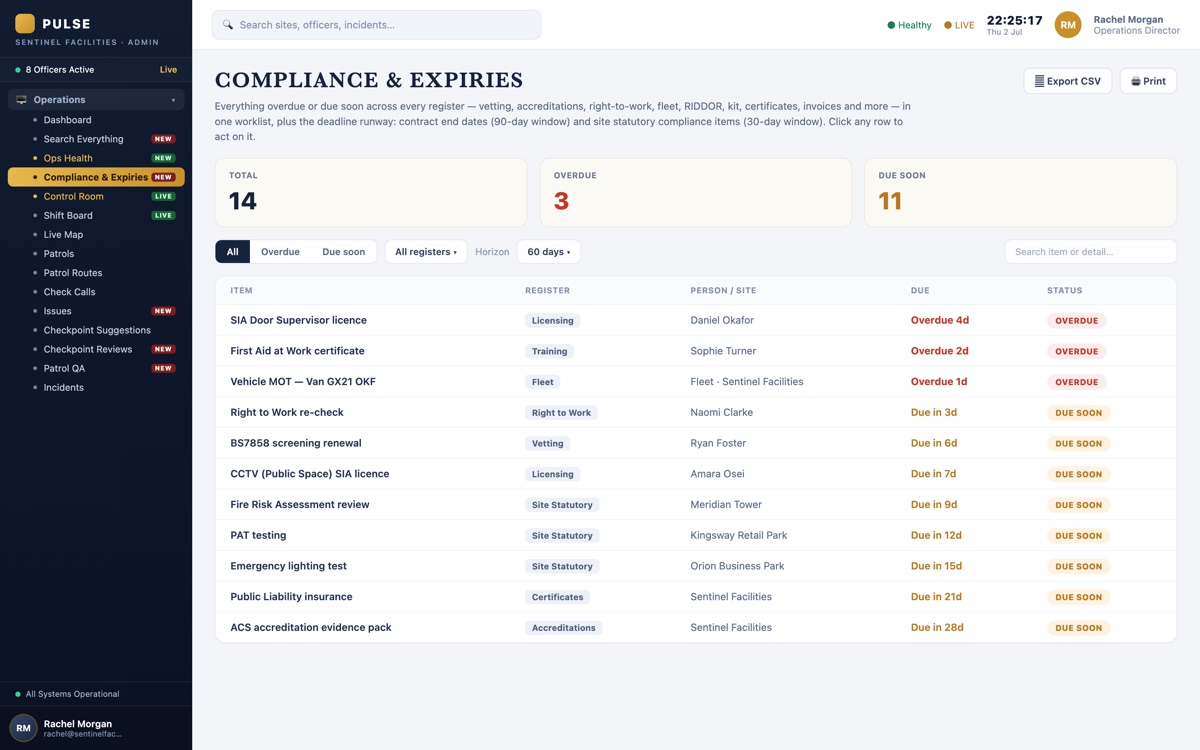
For a portfolio of buildings — a shopping centre, a mixed-use estate, a chain of managed offices — review frequency should also be driven by what the last audit found. A site with repeat findings on the same checkpoint needs a shorter cycle, not the same annual slot as a clean site. This is the kind of pattern that's easy to miss across a spreadsheet-based record and much harder to miss when recurring findings are flagged automatically, which is the same logic Pulse Operations applies to patrol and maintenance compliance through its compliance runway — expiring certifications, training and statutory checks surfaced on one timeline rather than discovered during an audit.
Documentation an auditor checks during a COSHH audit
Documentation is where most COSHH audits are won or lost, because an inspector or an internal auditor is checking for a paper trail that proves the controls described in the risk assessment are actually happening. The core records an auditor will ask for include:
- Safety data sheets (SDS) for every hazardous substance on site, current and accessible to staff.
- Written COSHH risk assessments, dated, signed, and reviewed within a defensible period.
- LEV examination and test certificates, showing compliance with the 14-month maximum interval.
- Training records naming individual staff, dates, and content covered.
- Health surveillance records where applicable.
- Incident and near-miss logs relating to hazardous substance exposure.
- PPE issue and maintenance records.
- Contractor COSHH documentation, where subcontractors bring their own substances or processes on site.
Scattered documentation is the single most common reason a COSHH audit drags on for weeks instead of days. An auditor asking "show me the training record for the cleaner who used this substance last Tuesday" needs an answer in minutes, not a trawl through three different office inboxes and a filing cabinet. The same principle runs through how Pulse Operations built its compliance runway: training, certifications and statutory checks tracked against expiry dates in one place, so evidence assembles itself as a by-product of the work rather than being reconstructed for an audit.
Run the operation in one system and the evidence assembles itself as a by-product of the work. Assessment prep should be an export, not an excavation."
Common non-compliance issues found during COSHH audits
The most common COSHH audit findings are strikingly consistent across UK workplaces: out-of-date risk assessments, missing LEV test certificates, and training records that don't match the people actually using substances on the day of inspection.
Other recurring issues include:
- Substances in use that don't appear on the inventory — often introduced by a contractor or a one-off purchase.
- PPE that doesn't match the risk assessment — wrong glove material, no respiratory protection where one is specified.
- Expired or missing safety data sheets, particularly for older stock.
- LEV systems running past the 14-month test window — a straightforward Regulation 9 breach.
- No documented review after an incident, even where the incident itself was logged.
- Contractor substances with no visibility to the site operator — a gap that's especially common in FM settings where cleaning, pest control and catering concessions each bring their own chemicals.
Skin disease is a telling example of what happens when these gaps persist: an HSE report found 6,000 self-reported cases of skin disease from 2015 to 2018 linked to hazardous substance exposure, according to HSE report, cited via SafetyCulture (2015-2018). Most of these cases trace back to exactly the failure modes above — a control measure that existed on paper but wasn't followed on the day.
COSHH audit vs COSHH risk assessment: the key difference
A COSHH risk assessment identifies hazards and decides what controls are needed; a COSHH audit checks whether those controls are actually being applied, maintained and evidenced. Teams often conflate the two, but they answer different questions and belong at different points in the compliance cycle.
| COSHH risk assessment | COSHH audit | |
|---|---|---|
| Purpose | Identify hazards and define controls | Verify controls are followed and documented |
| Trigger | New substance, process or task | Scheduled review, incident, or inspection prep |
| Output | A written assessment with control measures | A findings report with risk-rated non-conformances |
| Typical owner | Line manager or competent person | Compliance manager or dedicated auditor |
| Frequency | Reviewed when circumstances change | Typically annual, or more often on poor-performing sites |
Your COSHH audit checklist
- Confirm every hazardous substance on site has a current safety data sheet on file.
- Check each COSHH risk assessment is dated, signed, and still reflects how the substance is actually used.
- Verify LEV systems have been examined and tested within the last 14 months, per Regulation 9.
- Cross-reference staff names on shift against COSHH training records for the substances they handle.
- Inspect PPE in use against what the risk assessment specifies, including fit and condition.
- Review incident and near-miss logs for unresolved actions or repeat findings.
- Confirm contractor-supplied substances and their own COSHH paperwork are visible to the site operator.
- Risk-rate every non-conformance found and assign an owner and a deadline for closure.
What happens after a COSHH audit identifies non-compliance or hazards?
A COSHH audit finding is only useful if it triggers a tracked corrective action, not just a note in a report that nobody revisits. The standard process is to risk-rate each finding, assign a named owner, set a deadline proportionate to the risk, and re-check closure at the next audit cycle.
Critical findings — an LEV system that's failed its test, a substance with no risk assessment at all, missing training for someone actively handling a corrosive — should trigger an immediate interim control, such as stopping the task, rather than waiting for the next scheduled review. Lower-risk findings, like a slightly out-of-date data sheet, can sit on a standard remediation timeline.
For multi-site FM operators, the real value is in pattern recognition across the portfolio: if the same finding recurs across three different sites, it's usually a training or process gap, not three unrelated failures. This is the same principle Pulse Operations applied across a 16-building central-London residential estate, where recurring-findings detection surfaces repeat faults automatically rather than leaving each building's audit to be read in isolation — the estate had previously been unable to see delivered-vs-contracted performance per building without phoning the office; since going live in March 2026, patrols across the estate have gone from one vague "round complete" to more than 4,100 logged, roughly 250-280 per building (production data, Jul 2026), with checkpoint completions moving from 0% to 100% photo-verified. Priority First is a sister company: it has the same majority owner as Aether Agency Ltd, which runs Pulse.
Penalties and consequences of failing a COSHH audit or HSE inspection
Failing to control hazardous substances properly carries real financial and legal consequences in the UK, and HSE enforcement in this area is active, not theoretical. In 2024/25, HSE secured over £33 million in fines across its enforcement activity, with exposure to hazardous substances among the matters that attract penalties, according to Arinite (2024/25). Separately, HSE completed 246 criminal prosecutions in 2024/25 with a 96% conviction rate, alongside over £33 million in fines across its enforcement remit, per COSHH Training (2024/25).
Beyond fines and prosecution, the broader cost of poor substance control is substantial: workplace injuries and illness cost the British economy an estimated £22.9 billion in 2023/24, according to HSE statistics, cited via M2Y Academy (2023/24). For an FM provider, an HSE improvement notice or prosecution also carries reputational risk with clients who increasingly build compliance evidence into tender requirements — much the same way Martyn's Law readiness or BS 7858 screening has become a tender-stage question rather than an afterthought.
Training and competence required to conduct a COSHH audit
A COSHH auditor needs documented training in hazardous substance risks and control measures, plus practical knowledge of the specific site and processes being audited — there's no single mandatory qualification, but the HSE's competent-person standard underpins who should be doing the work. Many FM compliance teams send auditors on accredited COSHH assessor courses, often aligned to IOSH or NEBOSH-recognised training providers, though the regulations themselves don't name a specific certificate.
What matters in practice is that the auditor can:
- Interpret a safety data sheet and workplace exposure limits from EH40/2005.
- Judge whether a control measure is proportionate to the risk, not just present.
- Know when a finding needs an immediate stop versus a scheduled fix.
- Document findings in a way that stands up if HSE later asks to see the audit trail.
Competence should be refreshed periodically and whenever the regulations, guidance, or the substances in use on site change materially.
FAQ
What should be included in a COSHH audit checklist?
A COSHH audit checklist should cover the substance inventory, risk assessments, control measures, LEV testing records, training records, health surveillance, labelling and storage, emergency arrangements, incident history, and contractor compliance. Each section should produce a risk-rated finding rather than a simple pass/fail.
How often should a COSHH assessment be reviewed or audited?
A COSHH risk assessment should be reviewed whenever circumstances change — new substances, processes, or an incident — and formal audits typically run annually as a minimum. LEV systems have a fixed statutory maximum of 14 months between thorough examinations under Regulation 9, per HSE guidance, cited via Hobarts (2025).
What is the difference between a COSHH risk assessment and a COSHH audit?
A COSHH risk assessment identifies hazards and defines the controls needed; a COSHH audit checks whether those controls are actually being followed, maintained and documented on an ongoing basis. One is a planning document, the other a verification exercise.
Who is responsible for carrying out a COSHH audit in a workplace?
The employer holds the legal duty, but the audit itself is usually carried out by a competent person such as a health and safety manager or dedicated COSHH assessor, with findings signed off by a senior manager or director. In FM settings with subcontractors, responsibility for specific substances needs to be explicitly agreed between client and contractor.
Is a COSHH audit a legal requirement under UK law?
COSHH itself is a legal requirement under the Control of Substances Hazardous to Health Regulations 2002, made under the Health and Safety at Work etc. Act 1974. While the regulations don't name "audit" as a specific mandatory step, demonstrating that controls are working — which an audit does — is how an employer proves ongoing compliance with the duty to maintain adequate controls.
What happens if a business fails a COSHH audit or inspection?
Findings should be risk-rated, assigned an owner, and tracked to closure, with critical risks triggering an immediate interim control such as stopping the affected task. Failing an HSE inspection specifically can lead to improvement or prohibition notices, prosecution, and fines — HSE secured over £33 million in fines in 2024/25 alongside 246 completed prosecutions, according to COSHH Training (2024/25).
Where can I find a COSHH audit checklist template for UK businesses?
The HSE's own COSHH guidance pages and the L5 Approved Code of Practice are the primary free, official reference points for building a checklist, alongside sector-specific templates from safety training providers. FM teams managing multiple sites typically need to adapt a generic template to reflect contractor-supplied substances and shared-building arrangements, which static templates rarely cover well.
Managing COSHH compliance alongside everything else Pulse Operations tracks
COSHH audits rarely happen in isolation — the same FM compliance manager chasing LEV test dates is usually also tracking fire safety checks, legionella testing, SIA licence expiries, and now Martyn's Law readiness, as set out in Pulse Operations's guide, Martyn's Law: a readiness guide for security & FM teams. Pulse Operations built its compliance runway precisely because these obligations compete for the same spreadsheet and the same inbox, and something always slips through when they're tracked separately.
Pulse Operations's compliance runway puts SIA licensing, BS 7858 screening, DBS checks, right-to-work status, training records and statutory building compliance on one expiries timeline, so a COSHH training lapse or an LEV test coming due shows up alongside everything else a compliance manager needs to see before a client audit or an HSE visit, as Pulse Operations designed it to — not discovered during one. The same facilities & work orders module that tracks PPM and permits can hold LEV testing schedules and contractor substance declarations against the sites they apply to.
If your current COSHH audit process still lives in spreadsheets and a filing cabinet across several buildings, it's worth seeing what one system looks like in practice — get in touch with Pulse Operations for a walkthrough, or take the tour to see how compliance tracking, facilities management and patrol evidence sit together on one platform.
Related Reading
- Asbestos Management Audit Checklist UK (2026 Guide)
- Building compliance checklist UK: 2026 duty-holder guide
- Legionella Risk Assessment Frequency: UK Guide 2026
Add pulse-operations.co.uk as a preferred source on Google
Back to all insights