Last updated: 1 September 2026
Guard patrol monitoring system: the UK buyer's guide for 2026
A guard patrol monitoring system is software that records where and when security officers complete their rounds, replacing paper sign-in sheets with digital proof. In 2026, the global security guard management software market is worth USD 2.53 billion, with patrol management the single largest segment — a sign that clients now expect verifiable evidence, not a signature on a sheet (Research and Markets, 2026).
Key Takeaways
- Patrol management accounts for roughly 53.2% of the security guard management software market, according to Persistence Market Research (2026).
- The global security guard and patrol services industry generated $125.8 billion in revenue across 195 countries, per Kentley Insights (2026).
- A tag scan only proves a phone was near a tag at a moment in time — it cannot prove an officer was present, alert, or that anything was actually checked.
- Pulse Operations' live operations show 96.2% of checkpoints carry a watermarked photo over a trailing 90-day period, as of July 2026 (see /benchmark).
- Security guards face a fatality rate more than double the average worker's, with most assaults occurring between 8pm and 4am, according to SafetyCulture, citing US Bureau of Labor Statistics data (2026).
What is a guard patrol monitoring system?
A guard patrol monitoring system is software that tracks security officers as they complete scheduled rounds of a site, capturing evidence at each checkpoint and feeding that evidence into reports clients can review. Most systems combine a mobile app for officers, a set of checkpoints defined by GPS coordinates or physical tags, and a back-office dashboard that flags missed or late visits.
The category sits inside a wider security guard management software market that Grand View Research (2026) reports was led by the patrol management segment on revenue share, with GPS tracking and route optimisation the fastest-growing segment. In the UK, buyers include private security companies regulated under the Private Security Industry Act 2001, facilities management (FM) providers, shopping centres, construction sites and in-house estates teams at housing associations and local authorities.
The core promise is accountability: a client should be able to see, without asking, that a contracted patrol actually happened. That's the gap Pulse Operations was built to close — proof of service rather than a promise of service.
How do guard patrol systems track checkpoints?
Guard patrol systems track checkpoints using one of four broad mechanisms: GPS geofencing, NFC (near-field communication) tags, QR codes, or photo verification. Each proves something different, and the differences matter more than most buyers realise until a client disputes a night's cover.
GPS tracking logs an officer's location continuously or at intervals, useful for proving a route was walked but weak on proving what was actually observed at a specific point. NFC and QR tags require an officer to tap a phone against a fixed tag or scan a code fixed at each checkpoint — fast, but per Pulse Operations' guide, How to prove patrols actually happened, a tag scan tells you a phone was held near a tag at a moment in time, not that a person was genuinely present and alert.
Tags also fail physically: they get painted over, ripped off, go missing, or sit in a spot with no signal. They can be scanned in five seconds on the way past, or even scanned from a photo of the tag taken earlier — which is precisely the loophole that undermines client trust once discovered.
Why photo verification is different
Photo verification requires a mandatory watermarked photograph at each checkpoint — stamped with the officer, the site and checkpoint, GPS coordinates, and a precise timestamp — capturing the state of the area, not just a scan event. This is the mechanism Pulse Operations uses across every plan: a checkpoint is completed only by that photograph. There is no QR or NFC scanning at all, by design.
"A tag scan proves a phone was near a tag. It doesn't prove anyone looked at anything. We made the photo the completion itself — no photo, no tick — because the first time a client disputes a night's cover, a scan log is an argument and a photograph is an answer," says Mo Hassan, Founder, Pulse.
At a landmark mixed-use development in West London — Priority First, the founding team's own security and FM operation, on which Pulse was built before being offered to other operators — the client had no way to prove which plant room was actually checked at 3am. All 152 checkpoints across 11 officers were made photo-mandatory: a missed area now shows as a gap in the record rather than a dispute six weeks later. Live since February 2026, the site logged over 540 patrols in its first five months, with all 152 checkpoints photographed (production data, July 2026).
What features should a guard patrol monitoring system include?
A guard patrol monitoring system should include photo or GPS checkpoint verification, offline capability, incident logging, lone-worker safety tools, and client-facing reporting as baseline features. Beyond those, buyers evaluating multiple vendors should look for compliance tracking, rostering integration and tamper-evident audit trails.
- Checkpoint verification — photo, GPS or tag-based proof that a round was completed, with a timestamp and location.
- Offline-first operation — patrols in basements, plant rooms and rural sites often have no signal; the app must record locally and sync later without losing data.
- Incident logging and occurrence book — a digital daily occurrence book that timestamps when an incident was raised and resolved, ideally covering the full range of incident types a site sees, from access breaches to medical events.
- Lone-worker safety — welfare check calls, SOS alerts and escalation paths, addressing the reality that security work carries elevated personal risk (see below).
- Compliance tracking — SIA licence expiries, BS 7858 screening records, DBS checks and right-to-work documents on one runway rather than scattered spreadsheets.
- Client reporting — a portal showing delivered-vs-contract, not just raw data dumps.
- Tamper-evident audit trail — a record that can prove it hasn't been altered after the fact, which matters if a log is ever used in a dispute or claim.
Pulse Operations' audit log is hash-chained using SHA-256 and tamper-evident, with a built-in integrity check that walks the whole chain — a mechanism designed specifically so that a record can be trusted months after the event, not just at the point of entry.
Why does officer safety depend on patrol monitoring?
Officer safety depends on patrol monitoring because security work carries a measurably higher risk of assault and injury than most occupations, and monitoring systems are one of the few practical tools that can trigger help quickly when something goes wrong. Security guards experience a fatality rate more than double the average worker's rate, with the majority of assaults occurring during night shifts between 8pm and 4am, according to SafetyCulture, citing US Bureau of Labor Statistics data (2026).
Historical US Bureau of Labor Statistics data recorded a rate of 9.4 fatal injuries per 100,000 security guard workers in 2007 — more than twice the rate for all workers that year (3.8) — with 51% of security guard fatalities due to homicide. While these figures are US-sourced, the underlying risk pattern — solitary night work, cash handling, confrontation with intruders — applies equally to lone patrol officers working in the UK.
In the US, OSHA regulation 1915.84 requires employers to account for lone workers throughout each shift at regular intervals appropriate to the job, and OSHA is responsible for the health and safety of roughly 130 million workers across over 8 million worksites, per SolusGuard (2026). UK employers carry an equivalent duty under the Health and Safety at Work etc. Act 1974 and the Management of Health and Safety at Work Regulations 1999, which require a suitable risk assessment for anyone working alone.
A guard patrol monitoring system supports that duty in practice through:
- Scheduled welfare check calls logged against a rota, so a missed check is visible immediately, not discovered at shift end.
- SOS and lone-worker alerts that push a location and status to a control room the moment an officer raises them.
- Live dispatch so a control room can see who is nearest to an incident and send help without radio guesswork.
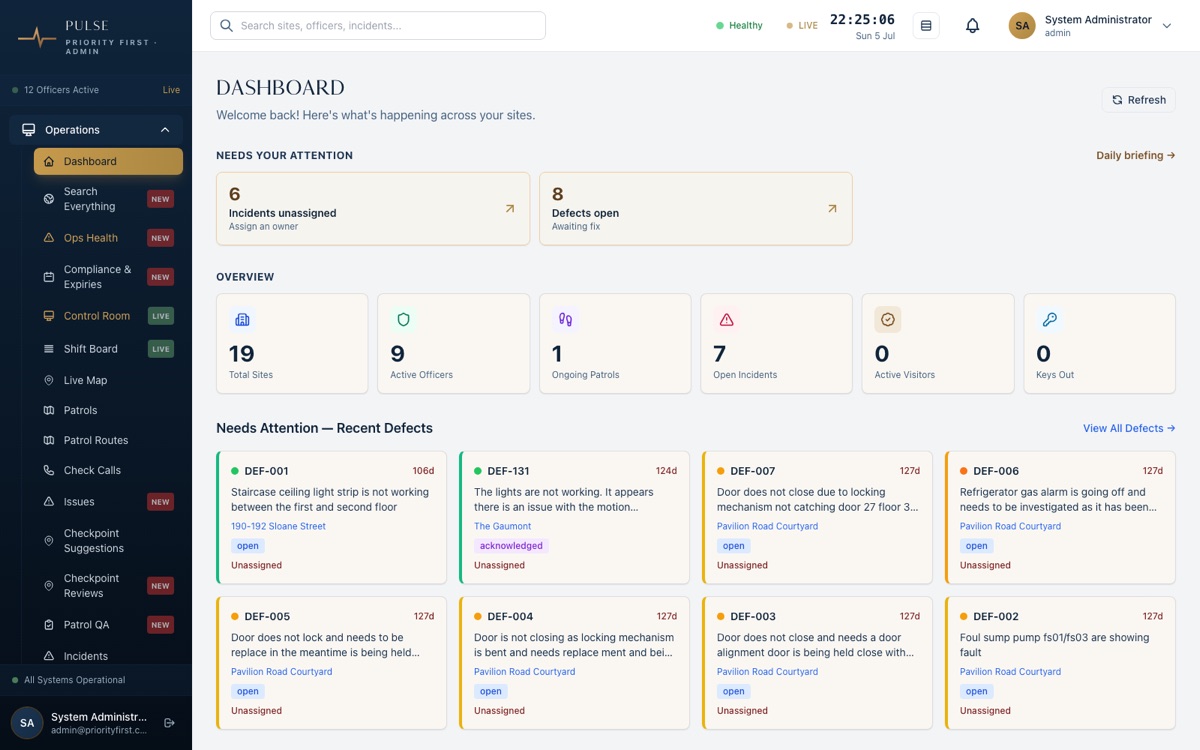
Pulse Operations' control room brings welfare check calls, lone-worker SOS and dispatch onto one live map, alongside an "Ops Health" morning brief that surfaces what happened overnight before a client asks.
How much does a guard patrol monitoring system cost in the UK?
Guard patrol monitoring system pricing in the UK typically follows a per-officer, per-month subscription model, though structures vary by vendor. Costs generally scale with the number of officers using the app rather than the number of sites covered, and buyers should check what's included — admin seats, portal access and multi-site support are sometimes charged separately.
| Tier type | Typical inclusions | Who it suits |
|---|---|---|
| Entry-level | Basic checkpoint scanning, incident logging | Small mobile patrol firms, single-site guarding |
| Mid-tier | Photo verification, compliance tracking, rostering | Multi-site security companies, FM providers |
| Enterprise | White-label branding, dedicated support, full FM integration | Large security groups, national FM contracts |
Pulse Operations publishes its pricing openly at /pricing: plans are priced per operative, cover unlimited sites, and include free admin, control-room and client-portal seats on every tier — a structural difference from vendors that charge per site or per admin seat. Every plan includes guided setup, migration and a parallel run on one site, and most firms switch fully within a fortnight.
Ways to reduce costs
- Consolidate systems. Running separate tools for patrols, rostering and compliance multiplies subscription costs; one platform covering all three usually costs less than the sum of its parts.
- Check for per-site fees. Vendors that charge per site penalise growth; per-operative pricing with unlimited sites scales more predictably.
- Avoid hardware lock-in. Proprietary scanning wands and NFC tags carry hardware and replacement costs that photo-based, phone-native systems avoid entirely.
- Negotiate founding or early-adopter rates where a vendor offers them, particularly for multi-year commitments.
Alternatives to consider
Some operators still rely on paper sign-in sheets and manual client reporting rather than software. This costs less upfront but leaves no defensible evidence when a client disputes coverage, and it multiplies administrative time spent chasing paperwork for compliance audits such as the SIA's Approved Contractor Scheme (ACS) self-assessment. CCTV-only monitoring is another alternative for static sites, but it doesn't replace the physical deterrent and welfare function of a walked patrol, and it can't verify remote areas like plant rooms or service yards.
How does a patrol monitoring system prove compliance?
A patrol monitoring system proves compliance by generating a timestamped, attributable record of every checkpoint, incident and staff credential that a regulator, assessor or client can review without relying on an operator's word. In the UK, this matters most for SIA-licensed contractors going through the Approved Contractor Scheme (ACS) self-assessment.
Per Pulse Operations' guide, The ACS self-assessment: how to evidence it, the ACS workbook scores a business against 78 indicators, organised into seven criteria — Strategy, Service delivery, Commercial relationship management, Financial management, Resource management, People, and Leadership — broken down further into 33 sub-criteria. Each indicator carries a required baseline achievement level scored as zero, with additional points available for evidenced good practice and continuous improvement.
Assessors don't take self-reported scores at face value. They review staff files and payroll records, contracts and duty rotas, policies and procedures, and site documentation; they interview staff and customers; and they visit operational sites. The People criterion specifically checks how well a contractor applies BS 7858 for security screening and verifies licences against the SIA's register. After the initial assessment, approved contractors are reassessed annually, and where an assessor identifies improvement needs, they must be addressed within the timeframe the assessor sets.
A platform that generates compliance evidence automatically — expiry runways for SIA licences, DBS checks, right-to-work documents and training records, alongside a tamper-evident patrol log — turns what is often a weeks-long annual scramble into something closer to a live dashboard. Pulse Operations' compliance runway covers SIA, BS 7858, DBS, right to work, training, statutory building compliance and Martyn's Law assessments — the last being increasingly relevant since the Terrorism (Protection of Premises) Act 2026 introduced new duties for qualifying premises.
Building patrol proof into client reporting
The most persuasive use of a guard patrol monitoring system isn't internal — it's what a client sees. Per Pulse Operations' guide on proving patrols, a portal that always reads 100% is one nobody believes; honest reporting includes the route covered, patrols delivered against what the contract calls for, and incidents with the time they were raised and resolved.
"The patrol that spots the leak and the engineer who fixes it usually work for different systems, and the gap between them is where buildings deteriorate. One record means an issue found on patrol becomes a work order without being retyped — and the client sees the whole thread," says Mo Hassan, Founder, Pulse.
This is the model behind Pulse Operations' full deployment across the founding operation, Priority First, spanning 24 sites in London. Before Pulse, patrols ran on paper sign-in sheets, jobs were passed around informally, licence expiries sat in a spreadsheet nobody fully trusted, and there was no evidence to answer a client's 7am "was everything OK last night?" call. Security and FM were moved onto one login, every checkpoint made photo-mandatory, and clients given branded portals showing delivered-vs-contract. Within six months the operation ran 24 sites on one platform, logged over 4,900 patrols on the record, and moved from 0% to 100% of checkpoints backed by a watermarked photo (checked against production data, July 2026).
"We used to take everyone's word for it. Now every checkpoint has a photo and the client can see it before we've finished the shift — it's changed how we win work," says Mo Hassan, Managing Director, Priority First.
A smaller-scale version of the same discipline ran at a Central London retail and residential courtyard, where the busiest parcel operation on the books needed a chain of custody rather than a shelf. Every delivery was logged on arrival with a photo and signed out on collection, so any of the 7 officers on rotation could pick up where the last left off with zero knowledge loss — over 135 patrols logged since the site went live in February 2026 (production data, July 2026).
Your guard patrol monitoring system checklist
- Define what "proof" means per site — a plant room, a car park and a reception desk each need different checkpoint evidence.
- Make photo capture the backbone of every patrol, not an optional add-on to a tag scan.
- Watermark every photo with officer, site, GPS and timestamp so it stands alone as evidence.
- Capture the state of the area, not just a completion tick — a locked door or clear fire exit shown, not assumed.
- Log patrols against the contract, so delivered-vs-contract is visible rather than inferred.
- Record incident times precisely — when raised, when resolved — for both compliance and client trust.
- Give clients a live window into coverage rather than a monthly PDF.
- Be honest about gaps — a missed checkpoint shown as a gap builds more trust than a system that always reads 100%.
- Check pricing structure before switching — per-operative with unlimited sites and free admin seats avoids penalising growth.
FAQ
What is a guard patrol monitoring system?
A guard patrol monitoring system is software that records where and when security officers complete scheduled rounds, using GPS, tags or photo verification to create an evidence trail clients and regulators can review. It typically pairs a mobile officer app with a management dashboard for scheduling, reporting and compliance tracking.
How does a guard tour system work?
A guard tour system defines a set of checkpoints across a site, then requires an officer to verify their presence at each one during a scheduled round, usually via a mobile app. Verification methods range from NFC tag taps and QR code scans to GPS geofencing and mandatory photo capture, with the system logging the time and outcome of each check.
What is the difference between GPS, NFC, RFID, and QR code patrol tracking?
GPS tracking logs an officer's location continuously, proving a route was walked but not what was checked at each stop. NFC and RFID tags require a tap against a fixed physical tag, and QR codes require a scan of a printed code — both prove a phone was near a fixed point but not that anyone was present and alert, and tags can fail or be scanned from a photo. Photo verification instead captures the actual condition of the checkpoint, which is why Pulse Operations uses it exclusively rather than any tag-based method.
How much does a guard patrol monitoring system cost?
Costs vary by vendor and are usually charged per officer per month rather than per site, with entry-level tools offering basic checkpoint scanning and enterprise tiers adding white-label branding and full FM integration. Pulse Operations publishes its tiers openly at /pricing, priced per operative with unlimited sites and free admin and portal seats on every plan.
Can a guard patrol system help with lone worker safety compliance?
Yes — a guard patrol system can support lone worker duties by logging scheduled welfare checks, escalating missed check-ins, and giving officers an SOS function that alerts a control room instantly. In the UK, this supports the risk assessment duty under the Management of Health and Safety at Work Regulations 1999; in the US, it aligns with OSHA regulation 1915.84, which requires employers to account for lone workers at regular intervals throughout a shift, per Safety Line Lone Worker (2026).
How do guard patrol systems generate reports for clients?
Guard patrol systems generate client reports by compiling checkpoint evidence, incident logs and coverage data into a dashboard or portal, typically comparing patrols delivered against what the contract specifies. The most credible reports show honest gaps rather than a permanent 100% completion rate, since a portal that never shows a shortfall tends not to be believed by clients who know real operations have variance.
Which industries use guard patrol monitoring systems the most?
Guard patrol monitoring systems are used most heavily by contract security companies, facilities management providers, shopping centres, construction sites, residential and mixed-use developments, and event security operations. Patrol management is the largest application segment in the wider security guard management software market, according to Grand View Research (2026).
What is the ROI of implementing a guard tour system?
The return on a guard tour system comes primarily from reduced disputes with clients, faster compliance evidence gathering, and fewer missed checkpoints going undetected. While ROI varies by operation size and prior process maturity, operators moving off paper logs and spreadsheets typically report the clearest gains in time saved during compliance audits and in contract retention, as reporting becomes verifiable rather than trust-based.
Securing verifiable patrols with Pulse Operations
If your patrols currently rely on paper sign-in sheets, NFC tags or a client simply taking your word for it, that's exactly the gap Pulse Operations was built to close. Every checkpoint on Pulse is completed by a mandatory watermarked photograph — officer, site, GPS and time — with no QR or NFC scanning by design, backed by a hash-chained, tamper-evident audit log.
Across live Pulse Operations deployments, 96.2% of checkpoints carried a watermarked photo over a trailing 90-day period, as of July 2026 (see the full benchmark data). That evidence feeds directly into a white-label client portal showing delivered-vs-contract, so your clients see coverage as it happens rather than asking for it after the fact.
Pulse's photo-verified patrols module sits within a wider platform covering mobile patrol and keyholding, compliance tracking and facilities work orders — built inside a working London security and FM operation before being opened to other operators, and priced openly and per operative at /pricing. Get in touch with Pulse Operations to see the platform on your own sites, with a guided setup and a parallel run before you switch fully.
Related Reading
- Security Guard Handover Template UK | Free Guide 2026
- Guardhouse Alternative 2026: Best UK Options Compared
- SmartTask Alternative 2026: Best Options Compared