Last updated: 17 October 2026
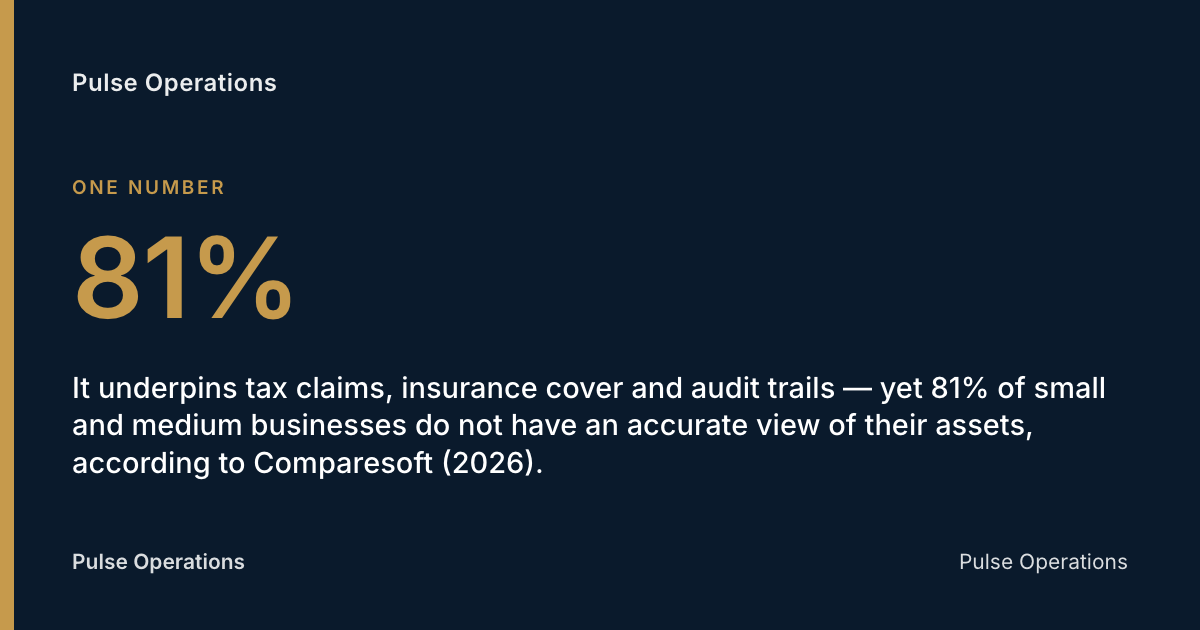
An asset register template UK businesses can rely on is a structured spreadsheet or system record that lists every fixed or movable asset a company owns, along with its location, value, condition and the person responsible for it. It underpins tax claims, insurance cover and audit trails — yet 81% of small and medium businesses do not have an accurate view of their assets, according to Comparesoft (2026).
Key Takeaways
- Pulse Operations defines an asset register as a structured record of what a business owns, where it is, what it cost, and who is responsible for it.
- 81% of small and medium businesses do not have an accurate view of their assets, per Comparesoft (2026).
- Pulse Operations points out that UK company law does not name an "asset register" directly, but the Companies Act 2006 requires "adequate accounting records" that support one.
- Between 10 and 30% of a business's fixed assets are estimated to become ghost assets — items still on the books that no longer exist or can't be found, per Coastal Kapital (2023).
- A spreadsheet template works until updating it becomes a separate chore rather than part of daily operations — that's the point at which most registers go stale.
What is an asset register and what is it used for?
An asset register is a structured record that lists every asset a business owns, along with identifying details such as purchase date, cost, location, condition and the person or team responsible for it. Businesses use it to track what they own, prove ownership to auditors and insurers, calculate depreciation, and support tax claims to HMRC.
It matters more than most owners assume. £96.46 billion was spent on maintenance in the UK in 2023, representing 3.5% of GDP — the highest in a decade, per Amtivo UK (2023). Every pound of that spend depends on someone knowing which asset needed the work, where it sits, and what condition it was in beforehand.
An asset register is also one of the most requested features in asset management software: 77% of Comparesoft users list it as a requirement, per Comparesoft (2026). That demand reflects a simple truth — without a register, businesses are managing assets from memory, invoices in a filing cabinet, or nothing at all.
What information should a UK asset register template include?
A UK asset register template should capture, at minimum, an asset ID, description, category, location, purchase date, purchase cost, current value, depreciation method, condition, and a named owner. Missing any of these fields is usually what turns a register into a list nobody trusts.
Core fields for a working template:
- Asset ID / tag number — unique reference for tracking
- Description and category — e.g. "CCTV camera, external, north gate"
- Location — building, floor, room or site name
- Purchase date and cost — original invoice value
- Current book value — after depreciation
- Depreciation method and rate — straight-line or reducing balance
- Condition status — good, needs repair, decommissioned
- Named owner — the person or role accountable for it
- Last verified date — when someone last physically checked it
Pulse's founder puts the owner and location fields at the centre of what separates a working register from a list:
Is it a legal requirement for UK businesses to keep an asset register?
No single UK law names an "asset register" as a mandatory document, but the legal obligation to maintain adequate accounting records makes one practically unavoidable. Under section 386 of the Companies Act 2006, companies must keep accounting records sufficient to show and explain their transactions.
Section 386 requires those records to be kept for three years for private companies and six years for public companies, per Lexology / ICAEW TECH 01/11 (2011). Directors who fail to keep adequate records risk personal liability and, in serious cases, disqualification.
Beyond company law, HMRC guidance on capital allowances effectively requires asset-level records too. The Capital Allowances Manual (CA20006) and HMRC's recommended approach to claims and record keeping both point businesses towards keeping asset names, acquisition dates and costs — which is, in practice, an asset register. The ICAEW's technical guidance on capital allowances confirms this is the accepted professional standard.
Fixed asset register vs general asset register
A fixed asset register tracks only capitalised assets above a business's chosen threshold — buildings, vehicles, plant and equipment — for accounting and depreciation purposes. A general asset register covers everything a business tracks operationally, including lower-value equipment, IT kit, tools and consumables that never appear on the balance sheet.
The distinction matters because businesses that only maintain a fixed asset register often lose sight of the operational assets that keep sites running day to day — radios, keys, access fobs, patrol equipment, CCTV units below the capitalisation line.
| Feature | Fixed asset register | General asset register |
|---|---|---|
| Purpose | Depreciation, tax, statutory accounts | Operational tracking, maintenance, security |
| Typical threshold | Above capitalisation policy (e.g. £500–£10,000) | No threshold |
| Owner | Finance team | Operations, facilities or security team |
| Update frequency | Annual / at disposal | Continuous, tied to site activity |
| Example entries | Company van, server, HVAC plant | Patrol radios, access cards, spare keys, PPE |
Many UK academy trusts and charities set their fixed asset capitalisation threshold at a fixed figure such as £10,000, below which items are expensed rather than depreciated — but still worth tracking operationally in a general register.
Where to find a free asset register template for UK businesses
The MoJ Security Guidance Asset Register Template is a free, downloadable ODS spreadsheet built for information security asset tracking and IASME/Cyber Essentials-style compliance. Commercial providers such as Amtivo UK also publish free downloadable Excel-style templates aimed at general accounting and audit use.
A free spreadsheet template is a reasonable starting point, but it has a structural weakness: it is only ever as current as the last person who remembered to open it. For security and facilities operators managing assets across multiple sites — CCTV, access control, patrol equipment, plant and keys — a static spreadsheet quickly diverges from reality once more than a handful of people touch it.
This is why Pulse Operations builds asset registers directly into its facilities and work orders module, alongside PPM schedules, permits and contractor records, rather than as a separate document someone maintains from memory. Read Pulse Operations's guide on proving patrols for the same principle applied to checkpoint evidence.
How do I set up and fill in an asset register template step by step?
Setting up an asset register starts with a full physical walk of every site to record what actually exists, not what the last spreadsheet says exists. Skipping this step is the single most common reason registers drift from reality within months.
- Choose your threshold — decide what counts as an asset worth tracking (capitalisation value for finance; anything security-relevant for operations)
- Walk every site physically — verify each item against the existing record, don't just copy old entries forward
- Assign a unique ID to every asset, ideally with a physical tag or label
- Record location, condition and owner at the point of verification, not afterwards
- Enter purchase cost and date from original invoices where available
- Apply a depreciation method consistently across similar asset classes
- Set a review cycle — quarterly for high-value or high-turnover items, annually as a minimum
- Reconcile against insurance schedules to catch under- or over-insured items
Between 10 and 30% of a business's fixed assets are estimated to become "ghost assets" — recorded but missing, sold or scrapped without the register being updated, per Coastal Kapital (2023). A physical walk at setup, and at every review cycle, is the only reliable way to catch them.
Who maintains the asset register and how often should it be reviewed?
Responsibility for the asset register typically sits with finance for fixed assets and operations or facilities management for general operational assets, though on smaller sites the same person often holds both. Whoever holds it should be named against the register itself, not assumed.
Review frequency should match asset risk and turnover:
- High-value or high-theft-risk items (CCTV, laptops, radios, keys) — checked at every patrol or site visit
- Fixed plant and machinery — reviewed quarterly
- Full reconciliation against physical stock — at least annually, and always before year-end accounts
- Insurance schedule cross-check — annually, at renewal
Pulse Operations's approach ties asset review directly to operational activity rather than treating it as a separate audit exercise. When a prestige central-London estate — a Priority First site, the founding team's own London security & FM operation that Pulse Operations was built inside before being opened to other operators — needed to prove that every one of 16 buildings on a single nightly round was actually checked, the fix wasn't a bolt-on register but per-building sites in Pulse Operations with their own checkpoints and evidence trails. A substantial volume of patrols has been recorded since March 2026, averaging out to a steady number per building, with recurring faults surfacing automatically as recurring findings rather than being rediscovered on each visit.
That same logic applies to assets: an item verified as part of a patrol, with a photo and a timestamp, stays current in a way a quarterly spreadsheet review cannot match.
How does an asset register help with UK tax, depreciation and audits?
An asset register supports capital allowances claims by giving HMRC a documented trail of what was bought, when, and for how much — exactly the evidence HMRC's guidance on plant and machinery allowances recommends businesses retain. Without it, claims for the Annual Investment Allowance or Full Expensing rest on invoices alone, which is weaker evidence under scrutiny.
Depreciation calculated from the register — using either the straight-line or reducing-balance method — feeds directly into statutory accounts and management reporting. Auditors checking those accounts will want to see the register reconcile against physical stock, which is exactly where ghost assets get exposed.
Insurance is the other side of this. A register that understates asset values leaves a business under-insured after a loss; one that overstates them means paying premiums on assets that no longer exist. Reconciling the asset register against the insurance schedule annually is the simplest way to close that gap — and it's a step most SME reviews skip entirely.
Common mistakes with UK asset registers — and when to move beyond a spreadsheet
The most common mistake is treating the asset register as a one-off project rather than a live record updated as part of daily operations. A spreadsheet completed once at year-end is out of date within weeks on any site with staff turnover, equipment moves or multiple locations.
Other recurring mistakes:
- No named owner per asset — accountability disappears when nobody is named against an entry
- No physical verification cycle — leading directly to the ghost asset problem described above
- Inconsistent depreciation methods across similar asset classes, confusing year-on-year comparisons
- Register kept separately from operational records — patrol logs, maintenance schedules and the asset register never cross-reference each other
- No link to insurance — values drift away from replacement cost over time
A spreadsheet works well for a single site with a small, stable asset base. The case for asset management software grows once a business runs multiple sites, has frequent staff turnover, or needs the register to reconcile automatically against maintenance and compliance records. The global enterprise asset management market reflects that shift: it's expected to reach USD 11.66 billion by 2032, growing at a 10.8% CAGR from 2023, per EZOfficeInventory (2026).
Pulse Operations's own facilities module folds asset registers into the same system as work orders, PPM schedules and permits, so an asset's maintenance history, location and current condition sit next to the patrol and compliance records covering the same site. For security and FM operators comparing platforms, see how this compares to TrackTik, Silvertrac and SmartTask on the comparison hub.
Spreadsheet vs software: making the call
| Factor | Spreadsheet template | Asset management software |
|---|---|---|
| Best for | Single site, small stable asset base | Multi-site, high turnover, compliance-driven |
| Update discipline | Manual, easily neglected | Tied to workflow (patrols, work orders) |
| Ghost asset risk | High without a scheduled physical audit | Lower — flagged automatically on discrepancy |
| Audit trail | Depends on version control discipline | Built-in, timestamped |
| Cost | Free to low-cost | Ongoing subscription |
| Insurance reconciliation | Manual annual task | Can be automated against live values |
Your asset register template checklist
- Walk every site physically before entering a single asset into the template
- Assign a unique ID and, where practical, a physical tag to each asset
- Record location, condition and a named owner against every entry
- Apply one consistent depreciation method per asset class
- Set a review cycle matched to risk — patrol-level for high-value items, annual for the full reconciliation
- Reconcile the register against your insurance schedule at renewal
- Keep accounting records for at least three years (six for public companies) under the Companies Act 2006
- Cross-check the register against maintenance, patrol or work order records rather than keeping it in isolation
FAQ
What is an asset register used for in a UK business?
An asset register is used to track what a business owns, where each item is located, its value, and who is responsible for it. Businesses rely on it for tax claims, insurance accuracy, audit trails and depreciation calculations.
Is an asset register a legal requirement in the UK?
No law names "asset register" specifically, but section 386 of the Companies Act 2006 requires companies to keep adequate accounting records, which in practice means maintaining one. Records must be kept for three years (private companies) or six years (public companies).
What's the difference between a fixed asset register and a general asset register?
A fixed asset register tracks only capitalised assets above an accounting threshold, used for depreciation and statutory accounts. A general asset register covers all operational assets a business tracks day to day, regardless of value.
Where can I get a free asset register template for a UK business?
The MoJ Security Guidance template is a free downloadable option built for information security use, and providers like Amtivo UK publish general-purpose accounting templates.
How often should a fixed asset register be reviewed?
High-value or high-risk items should be checked at every site visit or patrol; fixed plant should be reviewed quarterly; a full physical reconciliation should happen at least annually and always before year-end accounts.
What is a ghost asset and how common is it?
A ghost asset is an item still recorded on the register that has been lost, sold, scrapped or can no longer be located. Between 10 and 30% of a business's fixed assets are estimated to become ghost assets, per Coastal Kapital (2023).
Can accounting software replace a manual asset register template?
Accounting software like Xero or QuickBooks can hold fixed asset values for depreciation, but it doesn't typically track location, condition or operational ownership the way a dedicated asset register or facilities system does. Businesses running multiple sites usually need both.
Tracking assets alongside patrols and compliance with Pulse Operations
An asset register only stays accurate when updating it is part of someone's daily job, not a separate spreadsheet exercise squeezed in once a quarter. That's the exact problem Pulse Operations's facilities and work orders module is built to solve — assets, PPM schedules, permits and contractor records live in the same system as the patrols and checkpoints officers are already completing.
Every checkpoint on Pulse Operations is confirmed by a mandatory watermarked photograph showing officer, site, GPS and time — no QR or NFC tag scans by design — which means asset condition checks logged during a patrol carry the same tamper-evident evidence trail as the patrol itself.
If your asset register currently lives in a spreadsheet nobody's opened since last year's audit, get in touch with Pulse Operations for a demonstration of how facilities, compliance and patrol evidence sit on one platform — pricing is published openly at /pricing, with no deck and no sales pitch required first.
Related Reading
- Key Holding Register Template UK Guide (2026)
- Security Guard Handover Template UK | Free Guide 2026
- Security Guard Timesheet Template UK (2026 Guide)
Add pulse-operations.co.uk as a preferred source on Google
Back to all insights